If you were ever a child, you know a little bit about the Tasmanian devil (Sarcophilus harrisii) already. He's the critter that spins around in a little tornado and spouts gibberish, right?
Not QUITE like this, but EXCELLENT advertising for Tasmania.
As one might imagine, real Tasmanian devils are not quite like that. Warner Bros. got a few things right, however: The Tasmanian devil is native to Tasmania, and it does have an abnormally large head. It is the top (extant) marsupial carnivore, even though it is primarily a scavenger. Its cries are also creepy as hell:
The Tasmanian devil has a bite to back up its bark. Remember the entry on the dire wolf and how a bigger head generally implies more jaw power? The Tasmanian devil possesses the strongest jaws of any mammal. The Looney Tunes caricature is just barely an exaggeration of how much emphasis the real creature has on its jaws.
It is also endangered. Although Taz has yet to be listed as "critical," the species is becoming rarer and rarer. Dingoes are often cited as making the Tasmanian devil extinct from mainland Australia; remember, placental mammals are not native down there. Others, not wishing to blame everything on dingoes, add that they could not survive the rising temperatures on mainland Australia. They are also preyed upon by red foxes (another introduced canid).
Hell, Tazzies are not even safe on their namesake island; there is a cancer there that gives the devils nasty facial tumors. Being on an island will no doubt lead to a nasty bottleneck, but if cheetahs and humans can survive that, surely these vicious beasts can endure it...right?
Thanks, canids. Thanks a lot.
If the species does wind up going extinct, at least the Tasmanian devil will forever be immortalized as a classic cartoon character. That's pretty cool, even if it does not do justice to the awesomeness of the real animal.
Kangaroos are the most well-known animal in Australia. They hop, they have pouches, and they kickbox. Roos are look like deer-rabbit hybrids that bounce on their hind legs to Westerners; they are generally thought of as happy creatures from the Land Down Under. What's not to love? As The Simpsons put it, "I dare you to look at a kangaroo and not laugh."
They're usually funny.
Oh, and they're also eaten on a regular basis by people in Australia.
They Actually Eat That?!
Behold, the Australian coat of arms. Australia is the only nation that eats an animal present on their national emblem. This practice goes all the way back to the Aborigines; it's not like the Europeans went "hey, let's eat those things." It's more like the Aborigines already knew what little fauna in Australia was not poisonous.
Even this thing can SEVERELY INJURE YOU, white people.
Again, the real question becomes why not eat kangaroos? They are Australia's equivalent of deer. Except for the hopping, kangaroos and deer share a lot of the same machinery - herbivorous teeth, large ears, and so forth. Do you have any objections to eating deer?
Dooo yooouuu?
Furthermore, kangaroo meat is actually quite good for you, especially if it is not farmed. Kangaroo meat is low in fat and very high in CLA (conjugated linoleic acid), one of the best anticarcinogens around. It is also very tender and can be used in many of the same dishes as beef. Good eats, even if some wildlife funds do not like the idea.
Enough of the cute and furry things. Let's do something shiny and insane...just like a Lady Gaga video.
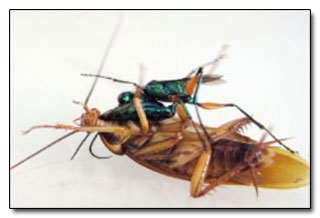
The emerald cockroach wasp, jewel wasp, or Ampula compressa is probably one of the prettiest wasps you will ever see. It lives in South Asia, Africa, and the Pacific Islands, and it is one sick, beautiful bug.
If you were smart, you probably skipped this entry at the mention of "cockroach." Despite being extremely adaptable and going virtually unchanged for eons, humans generally do not like cockroaches in their homes. This wasp's aim in life is to get rid of them in the most sadistic way possible.
Emerald cockroach wasps lay their eggs inside a cockroach's body. This is not unheard of in the insect world; there are a number of wasps that lay their eggs inside another insect or brainwash a caterpillar into guarding their pupae.
This wasp does both. She aims, very specifically, for the ganglion (nerve, roughly equivalent to a spinal cord) that controls the roach's front legs first. Her second sting aims for the brain - again, the specific part of the brain that controls the roach's escape reflex.
This is an act of violence, not love.
Before I go on, think about that for the second. Not only has the wasp disabled the roach's limbs, she has turned off its flight instinct with a very precise injection. A cockroach that cannot skitter away from the light is a very dead bug. The rough equivalent in humans is this:
After brainwashing the roach, the wasp leads the zombie-roach to her burrow. She eats bits off of the roach's antennae and lays one egg in the stunned cockroach. The larva hatches within the roach's body, slowly eating away at its corpse until it pupates. (The wasp larva eats just the right organs so that the roach will remain alive as long as possible.) Then the cycle begins again.
I bet you never thought you would wind up sympathizing with a cockroach, eh?
If you look around the world, you can find some pretty darn weird vampires. Some of the weirdest bloodsuckers come from Malaysia, Burma, Thailand, and other bizarre places with just as bizarre fauna. Seriously, Malaysia has some twisted bloodsuckers that are both WTF and terrifying at the same time.
That said, I could have sworn there was an Asian vampire of some sort based off of this:
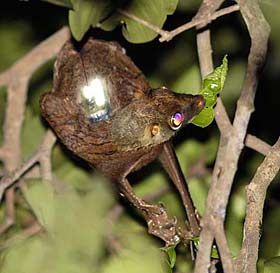
No, that is not a bat or a lemur. The colugo is a category unto itself. There is still debate over whether these things are closer to primates or bats. There are only two species of colugo in the family Cynocephalidae (literally "dog-headed"), and they are both native to Southeast Asia.
Colugos are the most airworthy of all gliding mammals. Not only do they have skin between their hind and forelimbs, but the flap extends all the way to the tip of the tail, and their digits are webbed as well. Such a stretch of skin allows them to glide up to 70 meters (230 feet) with a minimal loss of height. This arrangement does, however, make them clumsy climbers.
They also look sort of like the bastard children of a frog and a squirrel, but let's not go there.
Colugos have a number of other, odder traits. Their babies are born almost like marsupial babies; there is a bunch of crazy stuff about their dentition that makes mammal fanboys go nuts (their incisors have two root canals and a bunch of 'combed' ridges); they have camouflage that puts some moths to shame. The list goes on; no wonder these creatures have a category all their own.
Alas, because colugos are rare, nocturnal creatures, we do not know that much about them. They are threatened by habitat loss. As a creature highly adapted to gliding from tree to tree, if the Asian forests die, so will a valuable piece of evolutionary history.
Alas...I do not have a better place to put something like this. I do not have a "furry blog" in which I jot down all my zoophilic thoughts. (Note that there IS a difference between the two...I just happen to have it really, REALLY bad.) This still needs to be said, as it is relevant to ALL fantasy art. Even if it is fantasy, it has to have some basis in realism or it does not work.
Often, in transformation art, artists will either fuse digits or do something else to which my inner biologist says "no, just NO." Ignoring that this IS fantasy artwork I am talking about here, there are some people who just do not get the anatomy of humans, animals, or both. Below are the most common mistakes on my list of things that piss me off in fantasy art.
1. A paw is a hand. A fin is a hand. A wing is a hand. A hoof is a hand.
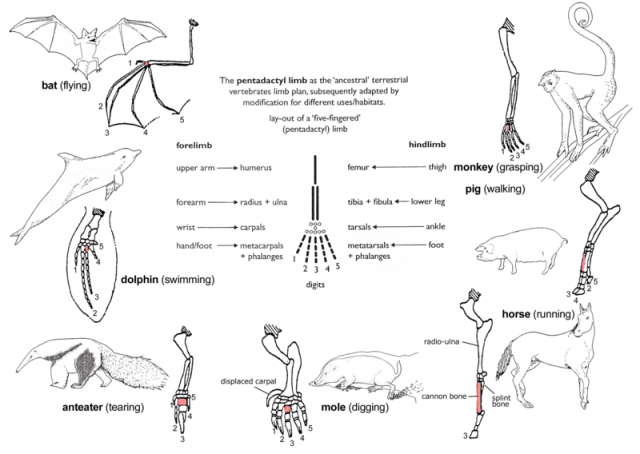
Look at your hand. Now imagine that everything else with skeletal limbs once had the same five digits.
All tetrapods - that is, all things with a bony skeleton and four limbs that are not fish - have a basic set of five possible digits attached to each of their limbs. These are numbered (by scientists, obviously) 1-5, with the thumb being #1.
Breaking this one is somewhat understandable on horse transformations. After all, they only have one thickened digit on every foot. This is the pointer finger on humans, digit #3 or whatever else you would like to call the centermost digit on your hand.
The hoof is still another matter; if you look at the comparison between a simian hand and a horse's leg in the mammals-only image above, you will notice that one bone called the "cannon bone" is significantly longer on horses than it is in primates. This bone is what makes horses and other ungulates able to support themselves as they walk on their fingertips. Some people take shortcuts and not only fuse the whole human hand into one hoof, but also forget that the hand is longer and more slender on horses than on humans.
On artiodactyls - that is, even-toed ungulates such as cows, pigs, sheep, and, when in season, reindeer - there should really be no excuses for digit fusion. Those animals have two hooves (digits three and four) and two vestigial digits for a grand total of four digits on each foot. They are only lacking thumbs (digit 1 on the diagram). Again, the cannon bone is also a LOT longer in these ungulates than in primates. Hoofed animals do not walk on their toes; they walk on their toenails.
This numeric rule is not just true for mammals. It is true for all things that fall under the big "tetrapod" umbrella. Since very few furries have an attraction to invertebrates, this covers the vast majority of furry work. It would do other fantasy artists good to keep this in mind as well. There is a similar issue with hindlimbs, bearing the same anatomy in mind.
2. Snakes are not all tail.
As a reptile fanatic, drakaina fangirl, and general biology nerd, nothing cheeses me off more than leg fusion in a serpentine transformation. (For one thing, fused limbs in humans is nothing short of gross - see my sirenomelia entry for details.)
No. No, no, no. A THOUSAND TIMES NO. Snakes have legs and tails just like lizards do. Here, I'll show you:
Those are vestigial legs on that python. They are attached to a tiny pelvis and everything. The vestigial legs in boids (boas and pythons) mark where the body ends and the tail begins. Snakes have short tails relative to their very, very long bodies.
(The image above is of a colubrid; no spurs, but the rest holds true.)
The remaining spurs are used primarily in mating; they can hurt almost as much as a cat scratch, and some snakes (mostly boids) have excellent control over them. They are usually longer in males than in females, and, in some species, the female lacks these diminished limbs entirely. (For those curious, the rosy boa (Lichanura trivirgata) is one of them, making rosies one of the few snakes that can be accurately sexed visually.)
The evolutionary transition from having legs to losing them was illustrated excellently by Nintendo's new Tsutarja family. Thank you, Nintendo, for doing it right.
3. All scales are the not the same.
Shoooot, where do I begin with this one? Scales are one of the oldest forms of bodily coverings after slime/mucus. They have a million different forms. There is no "one way" to draw scales. It depends on what kind of scales the creature has; fish scales are different from lizard scales are different from pit viper scales. Even then, what fish, what lizard, and what pit viper are we talking about, here?
Scale Sampler. by ~KuroKarasu on deviantART
The image above is only a small sample of the possible scale varieties that creatures could have. One of them is from a mammal. Seriously.
Rules of thumb:
Fish scales -> rounded, fall off individually.
Lizard scales -> beaded, shed in white, flaky pieces.
Boid scales -> rounded with a slight point; dewdrop-shaped. ALL snakes lack eyelids and instead have a clear scale called a brille covering the eye.
Colubrid/Elapid scales -> think elliptical diamonds.
Viper scales -> Heavily keeled; look almost like flat feathers. (If you try this on a cobra, it will look very wrong, very fast; cobras are elapids, not vipers XP)
Then we have dragons, which are a lot more like pangolins than ANY type of lizard. At first, I thought that Ciruelo and Dragonology were crazy for calling dragons mammals. Then the pangolin reminded me that, hey, it could happen.
4. According to artists, anything can have pointy sharp teeth.
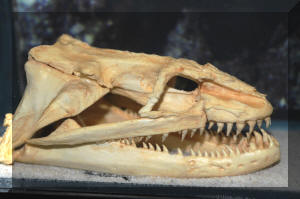
What's wrong with this picture? Stegosaurus was an herbivore, that's what. There is NO reason to draw it with pointy sharp teeth that look more like they belong on a carnivorous monitor lizard. Different types of animals have different types of teeth. To be honest, most generic "carnivore" teeth look like they belong on creatures that eat fish.
Note the homogenous teeth that curl slightly backward. This is a moray eel, BTW.
Other carnivorous animals, mammals in particular, have varied teeth. Pit vipers (NOT elapids like cobras) have long, slender fangs that fold backwards into the mouth. (It's really interesting to see these in action...around professionals, of course.) T-Rex had two different kinds of teeth as well. In terms of mammalian predators, people who draw wolves and lions with nothing but sharp teeth have clearly never owned a petite carnivore.You can look on a cat or dog and prove this one wrong, people.
A gray wolf (Canis lupus) skull.
Part of this error probably stems from the notion that herbivores cannot POSSIBLY be badass. That is false; herbivores HAVE to be badass, or else the world will fall into disarray. They have claws, bulk, horns and sometimes their own teeth to make sure that only the strong predators survive and only the weak herbivores die. Evolution is an arms race, and it is only fair to acknowledge Mother Nature's full arsenal. One swift kick from a gazelle and that lion on the nature channel will never eat again.
Research your creature's dentition. Herbivores usually have flat, grinding teeth. Carnivores have pointed teeth that may or may not also be serrated like a saw's edge. Stop making things like Black Stego; I fail to see how anyone who knows ANYTHING about dinosaurs could possibly take that thing seriously.
5. Form Fits Function.
"Form fits function" is the most basic rule in the book. It can also be phrased as "does it work?" If it does not work, it will not look good. Period.
In short, horns, claws, spikes, etc. do not only have to look good, they have to work and look good. There was this one site that had a bunch of animals that had, for whatever reason, evolved their genitalia on their heads. (I got the feeling that, talented though that artist may have been, they had never gotten laid, but that's off-topic.)
How the hell does that work? Wouldn't getting it on that way be...difficult, to say the least? Oh, and messy. Giving birth so close to the mouth and brain (unless the birthing junk was elsewhere) would suck, too.
The easiest way to see if something works is to look at nature. I saw a complaint that the Dire Horse in Avatar is functionally impossible; its legs could not move well, let alone fast. Given that, on Earth, the fewer toes a creature has on the ground, the faster it is (as a general rule), I can see where having six legs would get cumbersome.
The complaint, BTW.
In summary: If you really like animals, do research on them. Learn how they work before you turn yourself into one. That is why I can giggle a little at people who want to be wolves; in the wild, not only are wolves pack animals, but they're cowards when alone. There is a good chance that you would have to be at the bottom of the pack, not the alpha wolf, and being a lone wolf sucks. Sorry to burst your non-conformist bubble.
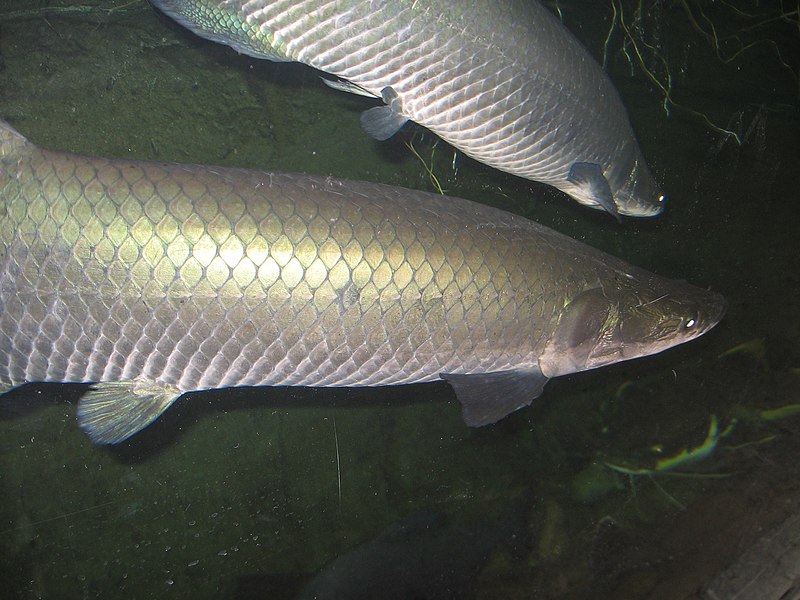
Ever wonder where tales of river monsters come from? You know, besides the whole "a river is, in itself, a destructive force?" Wonder no more. Tales of giant aquatic monsters may very well come from giant fish like this:
That monster of a catch is an arapaima (Arapaima gigas - or, "this fish is BIG"). It is also called a pirarucu or paiche in the Amazon region. One can only assume that there is still another word for "freakin' huge fish."
Keen observers will notice that this fish resembles an arowana in some ways. Yes, they are related. The arapaima, however, is limited to the Amazon River basin and not found in Asia or Africa like other arowanas. The arowana types are so widespread because they first evolved on Gondwana- y'know, before the continents split up.
Which arapaima is the largest ever is up for debate; supposedly, there was an arapaima specimen over 14 feet long. The recorded average is a little over 2 meters (6.6 ft), although specimens up to 8.5 feet have been well-documented. A single one of these fish can produce over 70 kilograms of meat; as you can probably imagine, this has led to the giant fish going commercially extinct...except in Thailand, where they just LOVE breeding giant fish for fun. (No, it is not native there.)
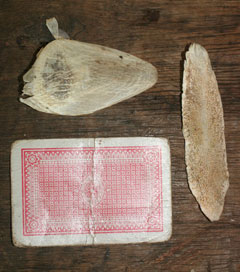
Tongue, scale...and trading card?
The arapaima is not just big, it is weird as well. All osteoglossiformes (including this thing and arowanas) sport bony tongues. These are rough enough to scrape bark, and, presumably, the flesh of smaller river-dwelling munchies. Arapaimas also breathe air (as do bettas - a tidbit I was unaware of when I did that betta entry) via a labyrinth organ.
Arapaimas are well-known in popular culture. If you play any video game that involves fishing, you will probably see this big fellow as a rare catch. Hell, even Street Fighter has a reference to this giant fish. (That's Animal Crossing up there.)
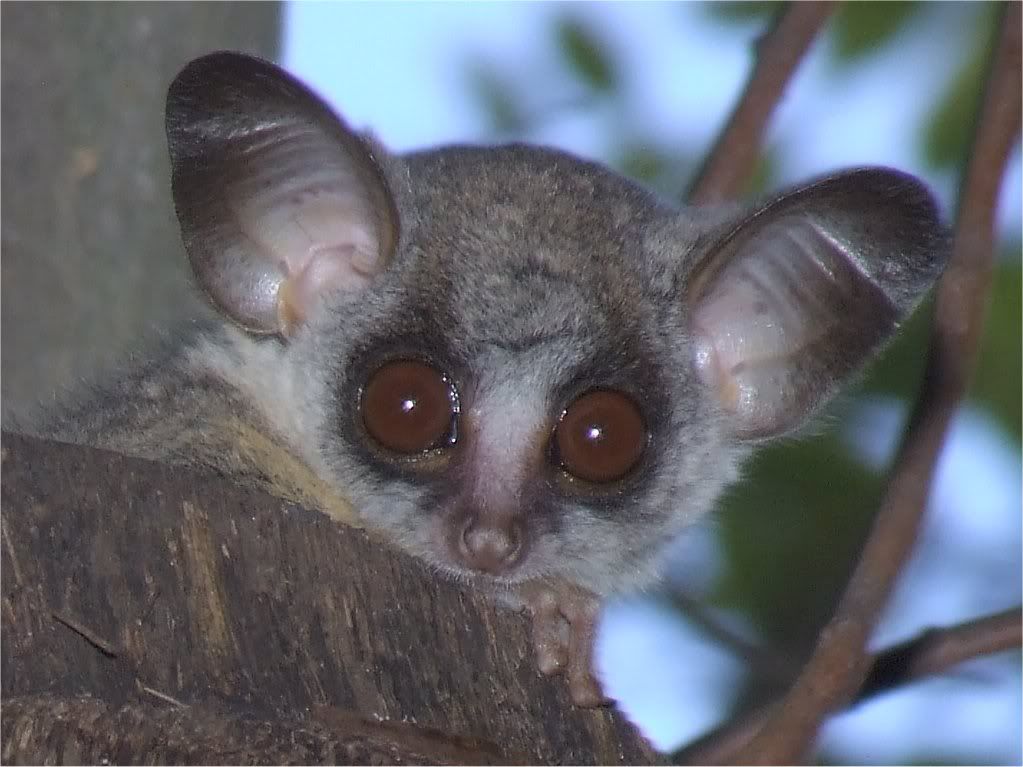
OK, that's cute, but WTH is it? Whatever it is, should I avoid feeding it after midnight?
Actually, galagos (also called bush babies or nagapies ("little night monkeys")) are nocturnal primates of the family Galagidae. They are native to the lower parts of Africa and spend almost all of their time hopping around in the trees at night.
These furry primates have huge eyes, long tails, big ears, and many other traits that make one wonder where Furby and Gremlins got the idea. It would be darn impossible to avoid feeding them after midnight. Don't think they like getting wet, though.
Bush baby is not amused.
Bush babies were probably named for their loud cries in the night and/or cute appearance. They are social, vocal animals with cries that resemble those of human offspring. Alas, I had trouble finding a good soundbyte of this.
These small, furry primates eat bugs, eggs, nuts, and fruits. They also love tree gum, and hop around trees like crazy; despite being small primates (less than a foot from head to tail), they can jump over 20 feet. They give tree kangaroos a run for their money in so many regards.
Bush babies look like large rodents or lemurs, but they are a totally different sort of primate. Like lemurs, they are used in scientific research to see what distinguishes humans from other primates. A project is underway to get a full genome off of a galago and compare it to more hominid primates. Either that, or they really are trying to make gremlins real.
To answer what everyone is thinking: Yes, you can have these as pets, but do you really want one? Monkeys are usually a bad idea because they carry diseases contagious to humans. Galagos have a similar problem. In this case, they may just be cute enough to compensate for any parasites or bugs they might carry.
Your resident lover of weird creatures, foods, etc. Likes going outside and looking for faeries in whatever form they choose to take. Is fascinated by parasites, worms, snakes, and anything with wings.