Monday, February 21, 2011

Creature Feature: Przewalski's Horse.

What? The hell is a horse doing on this blog? We thought this was supposed to be weird, and horses aren't weird! A horse is a horse, of course, of course...or is it?


Ladies and gents, the Przewalski's horse (Equus ferus przewalskii) is the last remaining ancestor of the domestic horse and the only extant wild horse. It lives on the Mongolian steppes and in a Chernobyl radiation field in Russia. Another species, the tarpan, is said to be even closer than Przewalski's horse to the domesticated horse, but it's extinct; people have tried to bring back the tarpan via backbreeding, but this was about as successful as breeding back to aurochs. Talk about beating a dead horse.

To clarify, North American mustangs and Australia Brumbies are not technically wild horses. They are feral horses - that is, domesticated horse populations that escaped and bred. Przewalski's horse is the only known extant wild horse. Another would have been the tarpan, but the last individual of that species died in 1909.

 
Just for reference.

Many times, when a species has become truly domesticated, there is a sudden dip in the population of its wild counterpart(s). The ancient relative of the modern cow, the aurochs, is currently extinct; wolves are either treated as OMG SPESHUL creatures by fans on the internet or hunted by crazy politicians that look like the Baroness from G.I. Joe; nobody really knows where the ferret or chicken came from. Goldfish are the exception rather than the rule; as in Pokemon, carp spawn very well regardless of their domestic midget cousins. Tarpans and Przewalski's horse are both either extinct or highly endangered.


How endangered is it? Due to various factors, such as German occupation during World War II, its population was reduced from "all over Mongolia and China" to "just a few sparse locations and zoos." It was considered extinct in the wild for 30 years. The Asian wild horses around today are from captive-bred projects; see, keeping strange animals isn't all bad!

In Soviet Russia...decide for yourself.


Tomorrow: Speaking of keeping strange animals...there's a chance that I have a strange bacteria-virus. Strange, but awesome!

Sunday, February 20, 2011

Creature Feature: Surinam Toad.

Raise your hand if you know what "lotus boob" is. Keep it up if that simple, Photoshopped image of a lotus seed pod over a lady's teats gives you shivers. If you do not know what the hell I am talking about, there was a lotus pod + boob image combined with a gross story about how parasites laid eggs in a woman's rack a while back. It was quickly found to be fake, but still scarring.

Silly internet. Nature has something much creepier than that.


That's not from a horror flick. It's from an exotic pet convention. People raise Surinam toads (Pipa pipa) at least in part for the strange-as-all-get-out way that the females give birth. Seriously, those guys up there are acting like it's Christmas. They aren't freaked at all; after all, mammalian birth is at least as gross.

Surinam toads are native to South America (hence the name). Even without eggs in their backs, they look strange. They are to frogs and toads what the matamata is to other turtles.

The main reason people are interested in Surinam toads is their weird reproductive habits. While making out (called "amplexus" for frogs), the male and female rise from the floor and begin to loop around while locked. As they turn, the female releases eggs; because of how they loop, the eggs wind up on her back, like this:


Now, hold your Przelawski horses: Don't frogs usually hatch into tadpoles? The ones in the video emerged as...well, not fully-grown frogs, but frogs far more froglike than tadpoles. Those eggs are not just on the mother's back; they're embedded into her skin. So, too, are her babies for most of their lives. When they are fully-developed, they swim through their mother's hollowed skin and are independent from then on.


Hey, be glad that Nintendo did not go all-out with this one. The giant frog from Gen V (dub name not yet confirmed) is covered with giant blue eg- I mean boom box speakers. Well, that's one way to remove how insane this amphibian is; besides having eggs in its back, the male uses clicks to call his mate underwater. The eggs are still freakier.

Tomorrow: What is a Przelawski's horse, anyway?

Saturday, February 19, 2011

Creature Feature: Archerfish.

There is a certain attack in Pokemon called "Water Gun." It's one of those attacks that makes one wonder exactly why it does damage. It's not like a stream of water can hurt anything, right?


String Shot will be used another day.

OK. Maybe a pressurized stream of water can knock wild bugs into a pond, where the marksman can then snap it up. That was one of several fish called archerfish; they are a from the genus Toxotes and are related to perch. Archerfish can be found in the mangrove ecosystems and other freshwater areas in India, Australia, and the Philippines.

This does not look nearly as good as a still image.

Archerfish make human snipers look lame for using weapons. They have a hollow groove in their mouths that they use like the barrel of a gun. Closing their gills pushes pressurized water through this groove; archerfish are usually able to hit prey on the first shot. It takes practice, but the fish figures it out pretty fast. Even if the first shot fails, the fish tries again.

The precision of this water shot is even more amazing when one considers how hard it is to shoot from beneath the water. Ever try to catch a fish swimming beneath the surface of a moving body of water? It's pretty darn hard. Now try catching a tiny little insect from beneath the water with a squirt gun. There are some seriously impressive visual capabilities and physics involved with every shot the archerfish makes.

The archerfish as a textbook physics example.


Archerfish will shoot at anything that glows and/or moves. That may seem a little stupid, but it's still pretty impressive for a fish. They will also leap out of the water and eat bugs that just so happen to be nearby, but that is not nearly as awesome as their built-in squirt guns.

Water Gun: It's super-effective!

Tomorrow: A frog with...WHAT THE HELL? What did this frog do to its back?!

Friday, February 18, 2011

Creature Feature: Lammergeier.

Wow. The title of today's entry sounds like it should be on a Rammstein album. If I told you that this bird fed primarily on the bones (not the meat - the bones) of other animals, it would probably sound like some gothic wet dream (or Greek mythology...but more on that later). It is very real, and just as hardcore as it sounds.


The Lammergeier (AKA "bearded vulture" or Gypaetus barbatus), surprise, surprise, has a decent range in Europe. It also lives in Asia and Africa. Its closest (and only) living relative is the Egyptian vulture, who will get an entry for its very own one day. Both members of this particular order of raptors are sufficiently unique to warrant their own entries, so enough about taxonomy. The main distinguishing trait these two birds share is a strange, elliptical tail visible when the bird is in-flight.

Lammergeiers, like many vultures, circle above dead prey before eating them. They live primarily off of carcasses, but will also eat live tortoises. In both cases, it has a rather bizarre way of getting to the sweet, stem cell-breeding bone marrow that comprises 90% of the bird's diet. Besides swallowing the bones whole, that is.


Both the Egyptian vulture and the bearded vulture like getting into tough prey; the Egyptian vulture uses rocks to crack open hard ostrich eggshells, an impressive instance of avian tool use, and the Lammergeier, when it encounters bones too large to swallow, flies up and drops the bones from above to crack them. It will also do this with live tortoises. Smart bird; compare crows using electric trains to crack open hard-shelled nuts and shellfish.


The Lammergeier's habit of dropping tortoises from the sky may have caused the death of Aeschylus, a Greek playwright. Aeschylus was a tragedian; among his most notable works are the Oresteia (a trilogy containing the Agamemnon, The Libation Bearers, and The Eumenides), The Persians, and Seven Against Thebes. His death is notorious; although it is usually said that an eagle dropped the infamous tortoise upon his head, the Lammergeier does this on a regular basis. There just so happened to be a human in the way at the time. Either that, or the Lammergeier preferred comedies.


Tomorrow: A squirt-gun sniper.


Thursday, February 17, 2011

Creature Feature: Saola.


In the looks department, the saola (Pseudoryx nghetinhensis) is nothing special. It's a fairly bland antelope. Sure, it has some interesting features - short horns, huge scent glands, and an odd skull that make scientists think it a primitive bovid - but not weird enough to make the average Joe go "WOW!" The people in Laos and Vietnam, however, go so far as to consider it a unicorn because of one simple feature: It is that rare.

The last time we heard about something like this was the okapi, an animal so bizarre that it may as well be mythical. There are good records of the okapi in local lore; the Egyptians thought it was strange, and they were the ones obsessed with the afterlife. The okapi was also rare enough to elude scientists until the 1900's. That's rare, but the saola has beaten its record.


 The saola is just plain rare. In 15 years of searching, science has discovered zero saolas in the wild. Its mythical status is well-warranted, seeing as it has been spotted by villagers while avoiding the eye of science for so long. It was not even officially acknowledged as an animal until 1992. Either we fail as humans, or the saola really knows how to hide.

There have been very few instances of a saola ever being in captivity. In August 2010, people in Laos found a wild saola and tried to raise it in captivity, but, like any unicorn, it promptly died. No unicorn would ever tolerate being gawked at and prodded with weird poles. They would commit suicide before that.

Not a happy unicorn. Twonicorn? 
Tomorrow: OK, enough mammals. Time for a bird.

Creature Feature: Entelodonts.

Wild pigs are badass. Look at ancient epics and there will likely be something with a boar. Norse gods frequently use boars as steeds; Odysseus got gored by a boar as a child; hell, ancient Greek warriors wore helmets made of boar tusks, and one of the reasons that the Jews avoid pork might be because the Romans loved using the boar as their mascot.

The kickass wild pig came from an even more kickass relative: the entelodonts. To put its awesomeness into perspective, entelodonts are also called "Hell Pigs" or "Terminator Pigs." Those sound like good names for motorcycle gangs.


Entelodonts have similar dentition to modern pigs, thus suggesting an omnivorous diet. They were primarily carnivorous, eating either fresh or long-dead meat, as well as plant matter if the need arose. (I'm not sure where They were the biggest, baddest creatures on North America, Eurasia, and Asia during the Miocene Period, a little-known era sandwiched between the dinosaurs and the advent of man.

If you think that modern swine are big, think again. The largest entelodont,  Daeodon shoshonensis, was 6.9 ft (2.1 meters) at the shoulder. D.shoshonensis was also 12 feet (3.6 meters) long, i.e. likely bigger than one's car. It had tusks and facial bumps like a warthog, and its jaws could easily crush bone. We do not know whether an entelodont would actually eat you or not, but staring into the mouth of one, we doubt you would care.

YAH!


The larger entelodonts died out, in short, because they ran out of large prey. As time went on, other predators simply became more efficient hunters. The smaller, more scavenge-ready entelodonts lived. The result was the animal that goes into making bacon.


Exactly how close entelodonts were to pigs is still up in the air. Although the obvious evolutionary route judging by the hooves and skull is to swine, some scientists suggest whales and hippos as well. If it walks like a pig and eats like a pig...nah, we won't go there.

Tomorrow:  Chaaarrrlliieee...

Wednesday, February 16, 2011

"They Actually Eat That:" Sausage and Pork Rinds.

Every so often, you will find someone (possibly an Avatar fan) who wishes that we all were living off the land like Native Americans. Prod them enough and you will no doubt receive a speech about how the natives used every part of the buffalo to the point of using the eyes as lollipops. They will also chew you out for eating livestock simply because modern Americans do not do that.

Lies and taffy. We make use of every part of the pig. Not as majestic as the buffalo, but hey, it's still making the most of the animal.


First off, most of the pigs we eat are coming from horrible conditions. They are not happy pigs on a farm like Wilbur in Charlotte's Web. We wish that were the case - really, we do - but the food industry is called an industry for a reason.

In the U.S., there is a practice called factory farming which forces pigs into tiny metal cages. If the Simpsons Movie has taught us anything, it is that pigs, though cute, are also very unsanitary animals. Imagine what it must be like to be in a room with hundreds of sick, pooping pigs with no way out. Worse, imagine what it must be like to give birth in such an environment.


Before I hear "oh, they're just dumb animals that are lower on the food chain," pigs are smarter than dogs. True, they are still ungulates, but they should not be portrayed as "dumb." If you avoid dog meat because dogs are "intelligent," pig meat should be taboo as well. This is a very strange, disturbing double standard in the American mindset.

Enough about how the piggies are caged. They're going to become meat, anyways - and how!


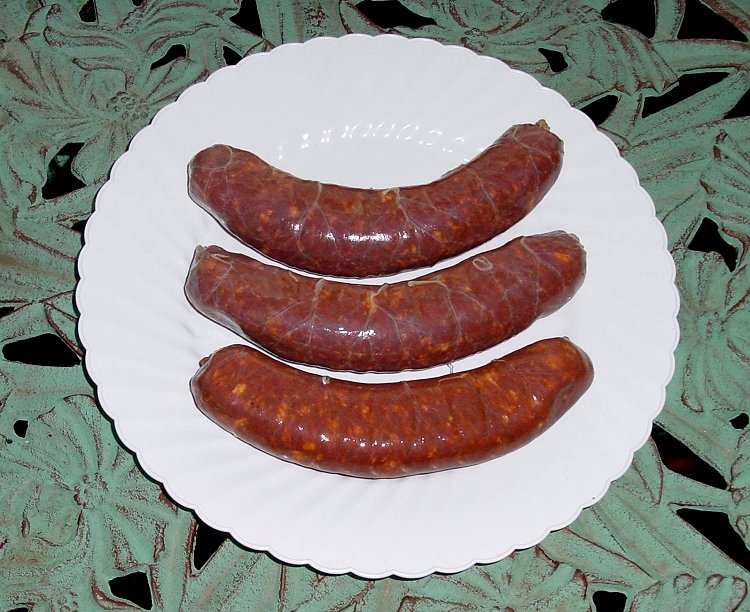
Sausage is our first stop when talking about exactly how well we use pigs. Ham is a fairly common meat wherever there are pigs, but most people do not eat the innards (except for the ancient Greeks, who apparently relished the intestines and livers of their meals). The intestines and other miscellaneous organs that most of us recoil at wind up in sausages of all flavors and varieties.

There are millions of different sorts of sausage, and not all of them are from pigs, but they all boil down to this: Animal organs and other spare, but edible parts wrapped in either genuine intestine or a waxy synthetic casing. Some sausages have blood in them; others have "mystery meat," which is exactly what it sounds like ("we don't know WHAT'S in there, but it came from something"). They usually have a lot of spices and herbs in there to conceal that you are, in fact, eating exactly what most people would not want to eat.


Do you know what's in that? It almost looks like there's a claw on that bun...

This came about as a good way of preserving animal bits that were left on the butcher's floor. Practicality came first; then people decided to try and make sausages tasty. That they could be containing anything is still a little creepy.

So we have a good use for most of the innards of the pig, but what about the outside? Pig skin is no longer good for wearing (it was when they had fur), so people do the next best thing: Eat it.


Pork rinds are, well, pork rinds. They are strips of pig skin fried and puffed like potato chips. They practically are potato chips; they have very little nutritional value and a lot of fat and salt. Pork rinds, also called "cracklings" in the U.S. or "scratchings" in Britain, are often eaten as a snack food. Many varieties of pork rinds have a little bit of flesh and fat still in there after being puffed and deep-fried; therein lies the charm.

This bag is not even trying to conceal the horror.


It's probably a good thing that most people buy the pre-packaged puffed pigskins. The more one thinks about pork rinds, the weirder they sound.


The hooves, snouts, and ears do not go to waste, either. Okinawan, Chinese, and Korean cuisine sport dishes of pig hooves; look at one's local pet store and one will find dried pigs' ears sold as dog toys. See? We use every part of the animal for something; it's just kinda gross, so we do not talk about it much. 

Next week: SPAM deserves an article all to itself.