Tuesday, November 15, 2011

Creature Feature: Numbat.

Say farewell to the nightmare fuel from the deep sea abyss. We have tormented you with enough freaks to fill Davy Jones's locker. It's really about time that we did something cute, fuzzy, and on land. We owe you guys for those sleeping pills, right?

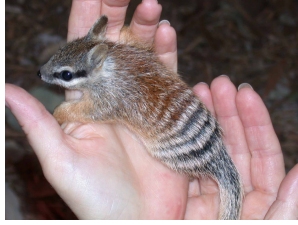
So, to make up for the mind-scarring, have a cute:


Wait. There's a horrible string attached to that cute, isn't there?

The creature above is called a numbat (Myrmecobius fasciatus). Before you all say "that sounds weird," it's native to Australia. At first glance, it looks like one of the less-deadly species in Australia, but remember how crazy Afrotheria got? If the scientists are right, the numbat's closest relative was the Tasmanian Tiger. (At least there's some family resemblance this time!) They are also (erroneously) called banded anteaters and are the only fully diurnal marsupials.

Numbats are one of Australia's least threatening creatures. They are 1-2 feet long, have no intention of eating other mammals, and would make better purse pets than a Chihuahua. Numbats have a fair amount of aerial predators (read: any bird of prey) and are eaten by carpet pythons as well. Just about the only things they are remotely threatening to are termites.
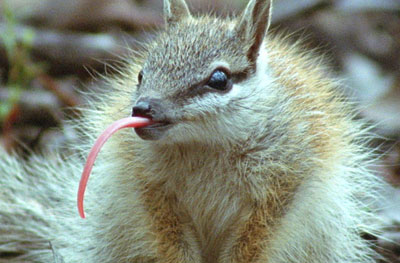
 

May the great Rainbow Serpent help you if you are a termite around a numbat. Numbats eat termites. Just termites. An adult numbat can eat up to 20,000 termites per day. They dig into the earth with those cute little claws, then use their sticky tongues to lap the buggers and gnash them with their teeth. Numbats even have their days scheduled around termites, much like some of us around TV schedules.

Numbats are, however, relatively rare. Unless you happen to have a termite mound in your Australian backyard, you probably will not see them at all. They were fairly abundant until European hunters came down under and unleashed red foxes upon the wild. By the 1970's, there were fewer than 1,000 individuals remaining in the wild. The best areas to see numbats today are in Western Australia.


Endangered species bumpers often cite major mammalian predators as 'warning signs,' but we think numbats deserve to stand out on that list, too. They're a prime example of what happens when non-native species are not kept in check. Maybe, if they ever get off the endangered species list, they will join sugar gliders, Children's pythons, budgerigars, and cockatiels as yet another adorable pet from Australia. You know you'd want one. 

Monday, November 14, 2011

Bio-Art: Cloaca.

Medical science seems to have a solution to every problem under the sun if an organ is defective. Lost a leg? Get a metal one. Arm? Same. Weak heart? We have organ donors for that. Then there are things like this for the digestive system that will likely be available in the near future:


Cloaca is an art piece made by Belgian artist Wim Delvoye. It was unveiled in 2000 at the Museum voor Hedendaagse Kunst in Antwerp, then traveled the world. Another version of Cloaca is located at the Museum of Old and New Art in Hobart, Tasmania. It has also been on display in Dusseldorf, where people "make sacrifices" to it.

Its purpose: It poops.

After eight years of research, Wim Delvoye successfully created a massive installation that replicated the digestive processes in human bodies. It is fed through a translucent mouth. Every acid is there and works on the food just like it would in a stomach. The result is real, foul-smelling, richly colored feces that are darn close to human. Delvoye is always keen to feed Cloaca new things, just to see how the crap will turn out. People gather at Cloaca at 14:30 to see fine food come out as feces and 16:30 to feed it.


The inspiration behind Cloaca was the sheer impracticality of most modern devices. Delvoye set out to create one of the most useless machines ever, knowing full well that making a machine that poops would be a relative waste of his talent. He compared it to a rich guy playing golf: he spends all that time just to get a ball into a hole with very little self-benefit involved.

He also made another point: Cloaca cost millions to make, yet we, as organisms, produce crap on a regular basis. Turds from this machine cost 1,000 USD. Do you realize how expensive your excrement is to make? You do now.

Sunday, November 13, 2011

Week of the Abyss Cont'd.: Walking batfish.


Yes, that is a fish...and it's walking.  Creationists beware: You have found your proof that Darwin was right.

Just when you thought anglerfish could get no weirder, the walking batfish crawls up and says "hello." They are native to nearly all oceans, and can also be found in shallower waters. More on those varieties later.

Fish-people are inevitable.
 

The walking batfish (Family Ogcocephalidae) barely looks like a fish at first glance. Its pectoral fins have been modified to walk on the ocean floor. With limbs so adapted for walking, batfish are poor swimmers. They are also proof that Dagon is, in fact, raising an army in the depths. Shh, keep that one a secret between us.

All species of batfish are predatory. Like other anglerfish, they have a lure (properly called an "esca") at the end of their long noses. Instead of using light like most other species, however, this lure emits a chemical bait. Abyssal hunters tend to be very lazy; all the fish has to do is snap prey up. They usually eat worms, fish, and small crustaceans.

I'm Batfish. And


Several species of New World batfish live in shallower waters. These species are...colorful, to say the least. One could honestly wonder whether the fish above was a poor PhotoShop job. One species, the Louisiana Pancake Batfish, was damaged by the Gulf spill early last year, so please pay it a visit while you still can. People who know about this weird fish have been bemoaning its decline thanks to the spill.

Oh, and by the way: This is one of the few abyssal creatures that one can actually keep as a pet. There are several videos of these fish walking in aquaria and a few care sheets floating around. The requirements for batfish are kind of specific, but we almost guarantee that nobody else on the block will have one.

Saturday, November 12, 2011

Week of the Abyss cont'd.: Comb Jellies.


The video speaks for itself: UFOs are officially underwater. The blinking lights look more fit for a spaceship than a living thing. Yet, we swear to whatever god exists, the video above is footage of a living creature.


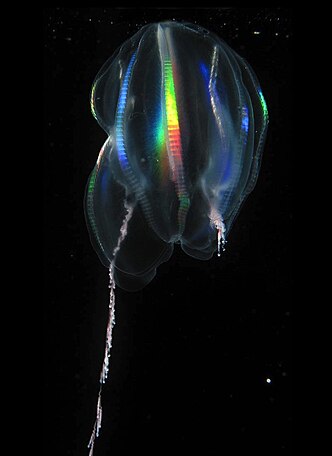
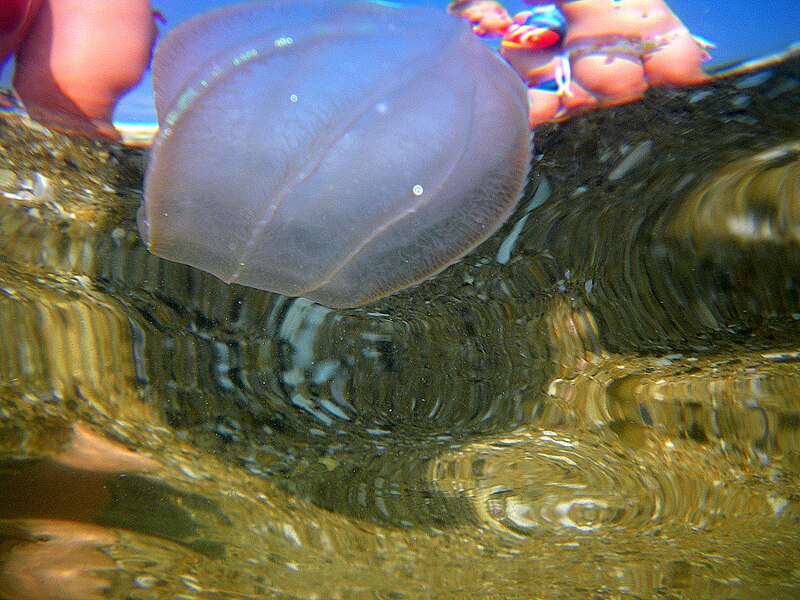
Comb jellies are not even tangentially related to true jellyfish. They have their own phylum, Ctenophora, making this entry one of the biggest 'blanket entries' on this blog. The phylum is somewhere between sponges and cnidarians. They are quite abundant, spanning all marine environments at virtually all depths. That includes the deep, where they are particularly common.

Comb jellies (and their phylum) derive their name from the rows of cilia along their bodies. They are the largest animals that move via cilia (see also: Paramecium). Most modern comb jellies have 8 rows of cilia, allowing them to move like oversized protozoans while sparkling. They do not technically glow in the dark...but you could've fooled us, nature.

Hey, it gets the ladies.
 

All comb jellies are predatory. They will eat roughly anything that fits in their pitcher plant-ish mouth. That includes fish larvae, jellies, other comb jellies, and the ever-popular copepods. The hunting technique varies with the species: some lie in wait, others chase, and still others use tentacles like spider webs. That said, they wreck ecosystems when they are accidentally introduced; the Black Sea got hit with a North Atlantic comb jelly that will likely get its own entry.

Comb jellies one of the oldest animal groups known to man. They have been around since at least the Devonian according to a remarkable fossil record. Some ctenophores were found in the Burgess Shale, which sported many specimens of sea life from the mid-Cambrian Period (505 m.y.a). From these preserved specimens, we know that older comb jellies had more mounted combs than their modern counterparts, and that some of them had very big mouths. There is no say on whether these comb jellies glowed like UFO's or not.


We personally hope they did.

Thursday, November 10, 2011

Week of the Abyss cont'd: Giant Isopods.

There's more to the deep sea abyss than long teeth and pretty lights. Although the great majority of the abyssal fish we've covered so far are relatively small, the abyss is home to some true monsters. There is a concept called "deep sea gigantism" that posits that many deep sea animals are larger than their shallow-water counterparts. Nobody really knows why except in the case of tube worms, which are...special.

For everything else, we must assume that the deep sea abyss exists to make us humans believe that there is a hell, and that it is filled with things like this:


Actually, that's kinda cute. What is it?

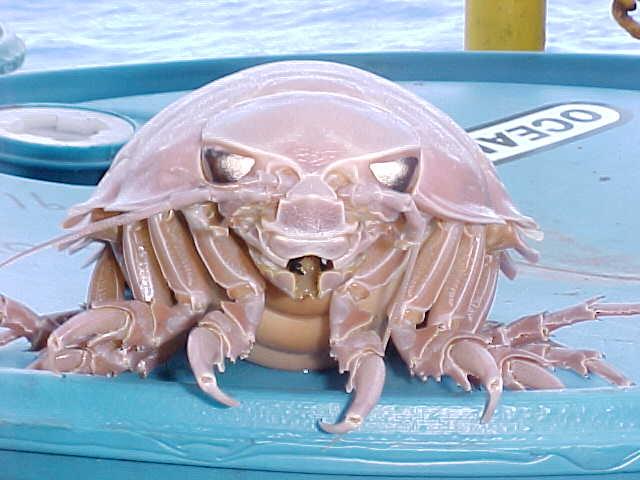
Giant isopods (genus Bathynomus; Bathynomus giganteus is a favorite) are the abyss's version of the roly-poly, woodlouse, or pillbug. They are native to all oceans with very little difference between species. If you took one of those little stunted millipedes (actually crustaceans), then supersized it to a little over a foot in length, you would have a giant isopod. It's an isopod and it's giant.

Giant isopods are vicious scavengers. They prefer meat, but will take what they can get in the depths of the sea. Once they find a good chunk of meat -say, a whale carcass - they will gorge themselves to the point of being rendered immobile. On the surface world, they will still eat anything they can get, including Doritos.


These oversized pillbugs actually do remarkably well on land. This allows them to be easily studied in comparison to other types of abyssal life. We know that the peak mating time for giant isopods is between winter and spring. Most of them are caught in the Americas, and then put in aquaria with relatively few issues. Given that most abyssal things with spinal cords do not last a day in aquaria, this is quite a feat.

The giant isopod holds the unique honor of being the most memetastic of all abyssal life forms. Not only do they have a lot of funny pictures (both PhotoShopped and real), they have a whole CD's worth of songs. Sure, there are only 5 songs, but this is the most random crustacean-related music I've seen since I heard "Triops Has Three Eyes."

This is a thing.

Wednesday, November 9, 2011

"They Actually Eat That:" Chewing Gum.

"Stop chewing gum in class!" It's bad for your teeth, usually contains aspartame, and so on and so forth. It's also a godsend for those of us who have trouble keeping our mouths shut. Whether you love or hate gum-chewers, one must wonder if they truly know what they are eating. After all, there has to be a reason that chewing gum does not digest.


Chewing gum as we know it originated from chicle, the hardened sap from a certain tree (Manikara chicle) native to Mexico and Central America. After being defeated in Texas, Mexican general Santa Anna moved to New York and shared a bit of chicle with his friend Thomas Adams. Thomas Adams tried to use the substance as rubber for toys, masks, and rain boots, but did not experience any success until he chewed some of the leftover substance in his mouth. Chewing gum, as the product would thereafter be called, was officially invented in 1870. Put things in your mouth, kids - it makes you famous!

The problem with chewing gum is that it is essentially food-grade plastic. Take a break, go outside, and walk to 7-Eleven, a gas station, or a drug store. Pick up your favorite brand of chewing gum. Look for one ingredient in English on the label. You are not chewing chicle anymore - it's 90% chemicals, now.

And if you take the blue-red pill, you can have gum from an ACTUAL TREE!


If you think that sounds bad, bubble gum is chewing gum's mutant cousin. Like chewing gum, the invention of bubble gum was a freak accident: A gum maker named Walter E. Diemer noticed one tiny thing wrong with his latest batch of gum - namely that it produced bubbles - and immediately began to market the stuff. A five-pound wad of Diemer's gum sold out in a single afternoon.

I am not sure what to think about the future of gum. Chances are there will be even more chemicals,  more freak accidents, and, maybe, giant radioactive squirrels who accidentally nibbled the wad. The only part of that which sounds fun are the potential Hulk-squirrels. Have fun chewing gum...but remember where it came from!

Tuesday, November 8, 2011

Week of the Abyss cont'd.:Viperfish.

We've said it before and we'll say it again: If you add "fish" onto almost every word in the English dictionary, there is probably a real creature to match. Some of these matches are justified. Others not so much. The viperfish most certainly is, even though it is not venomous in the least. Just...


...what else WOULD you call this?

Viperfish (genus Chauliodus) range from 1-2 feet (30-60 cm) in length and, yes, are fierce predators. They are native to tropical waters. Their lifespan is uncertain, with speculations ranging from 30-40 years in the wild.  Again, this is the week of the abyss continued; viperfish spend the majority of their time in pitch darkness, but venture up to lighter depths occasionally. Both sharks and dolphins have been known to prey upon viperfish.


The most striking thing about this fish are, of course, those disproportionately huge teeth. The bottom teeth on this fish are so big that they curve behind the fish's head. Like many abyssal predators, the viperfish uses a light lure to get little fishies curious before immobilizing prey with its long teeth, meaning that the viperfish does not need to swim far or fast to get a meal.

That is not all the light lure is used for. Unlike anglerfish, viperfish have been shown communicating with each other using their natural lamps. Does this show pack hunting - perhaps even intelligent behavior- within the depths of darkness?  Perhaps their name ought to be changed to "raptorfish" if they show coordinated attacks. There is still much to learn.

Although not as well-received as the anglerfish in popular culture, the viperfish is a fairly popular deepsea fish. Artists absolutely love this thing - after all, what says "fierce" better than a mouth with teeth so big that they barely fit? This is probably the most kickass head tattoo I have ever seen - not that I would EVER do something like that myself.