Thursday, December 15, 2011

"They Actually Eat That:" Seahorse.

"Seahorses rule the world now. Surprised nobody saw it coming."

Seahorses are among the hardest fish to dislike. They're probably the cutest fishes in the sea, what with looking like legless ponies and all. The good connotation of horses carries over to their seaborne counterparts. In China, they're even considered baby dragons. They're also pretty cool in that the male carries babies for a while, making feminists everywhere happy.


Oh, and China eats them.  Seahorses with sticks up their guts can be found all the time in Asian night markets. These night markets are hotbeds of weird food. If it is a thing and was once alive, China has skewered it on a stick. Seahorses are no exception. So much for ruling the world.

Of all things, seahorses are described as tasting like spiced pork rinds. Somebody needs to tell us how this works; yes, that seahorse is probably mostly air, but pork? We were expecting, umm, another fish.  It just goes to show that, with the right seasonings, anything can taste good. Anything. 


By the way, seahorses are also used in traditional medicine. In the seadragon entry, we mentioned that seadragons, close relatives of seahorses, were under threat because they could be used as medicine, of all things. Given what China does with almost every other animal on the planet, seahorses probably have some magical properties, too. I'm not sure whether the seahorse-kebabs are captive-bred or not. Beware of buying anything seahorse-related. There's a good chance you may be picking up something endangered.

This blog needs a tally board. Every time China eats something weird, I will add another mark to the board. After a few months, I am quite sure that the board will be full. 

Tuesday, December 13, 2011

Creature Feature: Vietnamese Mossy Frog.

If there is one thing that I can definitely thank the exotic pet trade for, it is the amazing potential it has to open people up to other species. Even if you personally do not have, say, a Baron's Racer, with exotic pets around we at least know they exist. One could even make the case that breeding for nifty colors in things like ball pythons is more sane than the crazy gene splicing scientists do. Most importantly, however, I would NOT have known that today's creature existed if I had not seen it in Reptiles magazine.


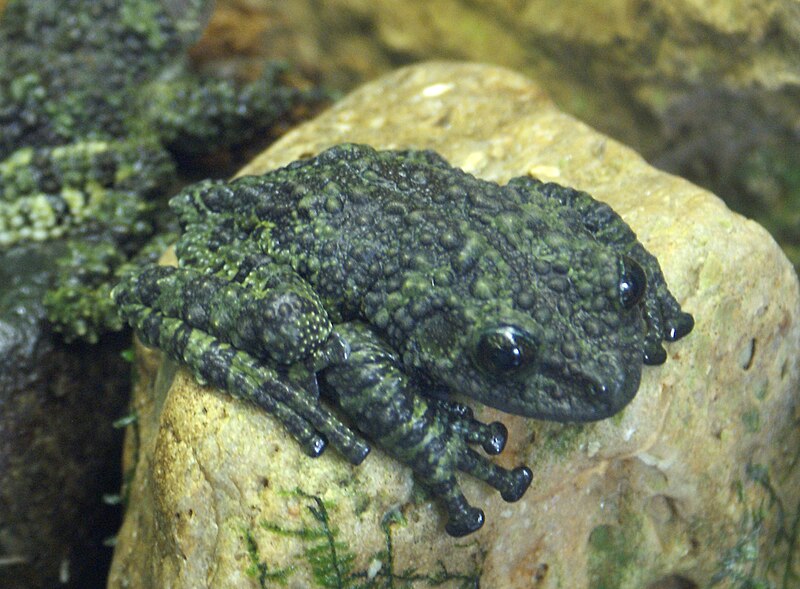
 The Vietnamese Mossy Frog (Theloderma corticale) is native to the wetter climates of Vietnam and China. Its habitat ranges from tropical-subtropical to the Hanoi mountain range. Much of its time is spent in shallow water with only its bug-eyes poking above the surface. It has been described as looking "alien" or like Godzilla. Neither of these descriptions do this frog's amazing mossy camouflage justice.


The camouflage of the mossy tree frog is said to be the best in the whole animal kingdom. (I personally think it has competition in the matamata, the three-toed sloth, and the tawny frogmouth.) It makes seadragon camouflage look like neon lighting. The tubercules on its skin and its coloration both contribute to the image of a lump of moss - nothing to see here! If the frog is sitting perfectly still, it is near-impossible to pick out.

Herpers (people who keep reptiles and amphibians) have several reasons to love this little frog. It can endure a wide range of temperatures and humidity. It eats crickets voraciously. If you make your terrarium right, you can observe this frog's whole life cycle in one cage. Of course, it's also fun to get one of these frogs, name him Waldo, and invite guests over to try and pick him out from his fancy foliage. These frogs like hiding, so they should be a challenge to find.

Like almost all cool frogs, the Vietnamese Mossy Frog is threatened by habitat loss. This makes captive breeding programs not only awesome, but critical to the survival of the species. They are currently protected by the Vietnamese government, so, should you invest in these frogs, be sure that they were captive-bred. In the worst case scenario, we will have another scimitar-horned oryx on our hands.

Monday, December 12, 2011

Bio-Art: The Island of Doctor Moreau (1977)

You knew this day would come. After doing bio-art sections for a few weeks and referencing furries in several entries, reviewing this series was inevitable. All adaptations are based off of an 1896 sci-fi novel by H.G. Wells, the same author who did The Time Machine. Apparently his work has never really been taken seriously, so no matter how profound The Island of Doctor Moreau was, almost everything got lost in the freaky science aspect.

The Island of Doctor Moreau is a legend among the furry fandom. It centers around a castaway (whose name varies from adaptation to adaptation) who winds up on the island of a mad scientist named Dr. Moreau. The good doctor was kicked out of England for his insane vivisection experiments, which have borne fruit on the island. The doctor has created human-animal hybrids thanks to his vivisection research. After severely drugging and repressing their animal instincts, he believes that he can create something closer to the divine than man. This does not work; the manimals break the laws that Moreau gave them, and the island quickly degenerates into chaos. One can see why fans of anthropomorphic animals would have some interest in this story.

So how do you like being a walrus, Homer?
 

There is, however, one big, black sploch on the furries' interpretation of this work: The original hybrids on Moreau's island were going from animal to human and back again, not human to animal like so many tweak. The change was the result of science gone horribly wrong. The book and films get into a lot of the deep, dark issues of scientific progress and general ethics. It's even philosophical at points. The part in the book where the protagonist is worried about humans becoming animals again is cut out in the film versions. The emphasis on furry sex in the 1933 film Island of Lost Souls, however, speaks for itself. We've already degenerated that far, people!

However, as I have not yet read the book version of this behemoth, I was forced to look into the film adaptations instead. After clicking around a bit, it looked like the 1977 version had the fewest deviations from the book.  It was that, a film about hawt panther chick sex, or the 1996 version, which was so bad it got riffed. I hope you all see why I chose the version I did.


The film starts with one Andrew Braddock being shipwrecked. He lands on Moreau's island, which the doctor calls "paradise." Accompanying this doctor is a headhunter named Montgomery and strange-looking servant named M'Ling. Oh, and there's also a hot lady named Maria, who is probably part cat if her pet serval is any indication.

The stranded Braddock realizes very quickly that strange things are going on on the island. Soon enough, Braddock finds the doctor's lab.  While there, he learns of the doctor's vivisection experiments. Not only has Moreau been effectively gene splicing things (in this case a bear) and giving them organs from human beings, but whenever they try to reconnect with their animal selves, the doctor reminds them that they're supposed to be human with a whip. It's a hard scene to watch for anyone who has had any pet ever.

Interestingly enough, the doctor uses the exact same logic that goes into creating scientific chimeras and hybrids today: Think of the benefits for medicine! That's just about the most generic reason in the book for why science does anything. Growing human ears on mice? Glowing bunnies? Just admit it: Humans love playing with nature. It's in our nature to tweak things, even if we shouldn't. The medicine excuse is getting old.

I've seen worse.


Soon, we meet what the furries came to see: Manimals, or, rather, humans with half-decent makeup. Sayer, an ape-man, keeps repeating Moreau's credo as the manimals show more and more bestial traits, killing and walking on all fours. Until he dies at the end of some REALLY intense chaos, his words are along these lines:

"This is human. This is man. This is LAW."

The law includes "no shedding blood," "man shall not kill man," and "no eating flesh." All of these are utopian ideals that man has been striving for for decades. (In regards to "no eating flesh," however, humans need meat, too. Way to go, doctor.) The manimals fail horribly in keeping the laws up. Eventually, they AND Braddock rebel against the doctor. Braddock's punishment is, of course, being turned into an animal.

When Dr. Moreau does try to turn a human into an animal, by the way, his partner Montgomery strongly objects. He objects so vehemently that Moreau shoots him. Also, the transformation is excruciatingly painful for Braddock; I find transformation fascinating, but seeing how much he regressed without showing many major changes was depressing. If this film is the closest to the book, please to be reconsidering your stance on science doing this, furries. I know a good portion of you want to be wolves, but trust me, it's not nearly as fun as you think.

Braddock does manage to escape the island. It's hinted that he and Maria are both returning to their true natures on the way back to civilization. Again, there's no mention of the worry that mankind in London will turn back into animals...


...but I'll save that for next week. ;)

Sunday, December 11, 2011

Creature Feature: Rosy Boa.

Today, I had a little Twitter chat with Brian of Snakebytes.tv. I was wondering why, of all snakes, he had never really covered the Rosy Boa (Lichanura trivirgata) on his show. Things like sand boas, boa constrictors, and Amazon tree boas got the spotlight one week. Yet the rosy boa, one of the most mellow, sweet snakes that I have ever met, has gone all but untouched by one of the most popular snake shows on the internet.


His answer was simple: He never really works with them. That's a damn shame, seeing as rosies are among the easiest snakes in the world to take care of. You don't even need to give them water every day. Don't give them water every day.

Let's back up a little. The Rosy Boa is native to the dry, hot parts of California and Mexico. It is one of two boa species native to the Unites States. It eats rodents and, like most desert boas, is a fairly shy snake. But before I get into how awesome it is to have a Rosy Boa like Eclair, let me make something clear:

"OMG IT'S A BOA! THAT MEANS IT'S GONNA EAT MY KIDS!"

One, you're getting mixed up with pythons. There are no less than three species in the genus Python that grow huge. Not all of them do, but I'll admit that, anacondas not withstanding, boas are a lot smaller in general. Again, aside from anacondas, the red-tail boa is the most common and largest boa  that you will meet.  They get fourteen feet, max. While that may seem pretty long to you, it is not big compared to massive pythons like the twenty-thirty feet of reticulated and Burmese pythons. Boas are also fascinating by default because they bear live young - something that pythons cannot do.

And we boa people LOVE showing it off. Not my pic, BTW.


Two, rosies are really, really docile. They do not resist being handled at all. They are also the slowest snakes in the world, which means that escapees will not get far. They get four feet max and only about as big around as a golf ball. They can swallow mice. That's it.


Albino Rosy Boa II 5-1-08 by ~oOBrieOo on deviantART

They also come in a variety of very appetizing patterns. Seriously. I named my Mexican female Eclair because she looks so strikingly like a dessert. Others have described albino rosies looking like creamsicles. Even the 'mutts,' i.e. rosies of mixed locality, are called "root beers" within the trade.  Just about the only ones that don't look straight out of a frosting tube are the ones that are almost unicolor. All the rest have three stripes that, if bred to look right, can look amazing.

Rosies are awesome beginner snakes. They eat a mouse a week, if that. I was terrified when Eclair did not eat anything for months, but as soon as she got over the normal winter blues, she was fine. They are also easy to breed and come with the bonus of live babies, so they never get egg-bound. The only thing keeping them from being recommended as an ideal starter snake is that they aren't corn snakes or ball pythons.

Saturday, December 10, 2011

Creature Feature: Leafy Seadragon.

Hah. You thought we were out of weird creatures, didn't you? Nope. Nature never runs out of weirdness. That goes double for the ocean, where, in his city at R'yleh, dread Cthulhu waits dreaming. This creature is not that traumatizing, but it will make you scratch your head a little...if you can find it. MWAHAHA!

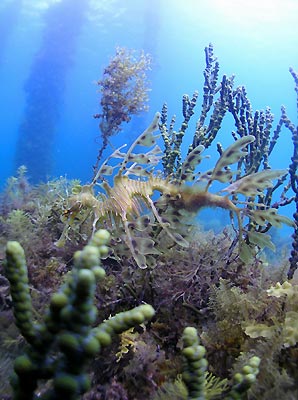
This was the best pic I could find that did NOT point the dragon out for you.


The leafy seadragon (Phycodurus eques) is, as looks would suggest, related to seahorses and pipefish. It eats small crustaceans and plankton, usually while staying perfectly still. It is native only to the waters of Southern Australia, where it has a cult following. They have a leafy festival and the seadragon is their official mascot. The whole state loves leafies!


The leafy seadragon is, of course, best known for its insane camouflage. Those fleshy protrusions make it look a lot like seaweed. The photos online do not do this creature's camouflage justice; much of the time, it is a lot harder to pick one out in a bundle of sea plants than one would think. Mind, the camouflage comes with a hefty price: the 'leaves' serve absolutely no other purpose, making the leafy a slow-moving target when it's not in the plants.

From Animalpicturesarchive.


Everything in nature is out to get leafy seadragons. Collectors and practicioners of traditional medicine covet the leafies. They are very slow swimmers, making the babies easy game. Since the leafy's tail is not flexible in the least, they cannot grab onto anything, and many get washed ashore in storms. Pollution is killing off a lot of the sea plants sea dragons use to hide. In other words, this creature has an existence only slightly more credible than that of the panda.

For those of you wanting a pet dragon, good luck. It's possible to get leafy seadragons, but they are often quite expensive. There have been regulations on capturing leafies for ages. Captive stock must be confirmed before purchasing a leafy. Even then, specimens are fragile; only the Tennessee Aquarium has been able to breed them regularly. Better stick with Pokemon's Kingdra unless you have a good amount of cash to blow and a degree in marine biology. (Yes, I know, Kingdra is more like a seahorse in several aspects.)

Thursday, December 8, 2011

Patented Humans?

To make up for my general sloth this week, I found a rather interesting article concerning the patenting of life. Long story very short, somebody wanted to patent (i.e. claim exclusive rights to) a human-animal hybrid. If this patent had slid, he would have been able to produce said hybrids for his own profit, and would be the only one legally allowed to do so for the next 20 years. Ouch to everyone else.

In the end, the scientist applying for the patent lost the case. The court ruled that the hybrid was "too human to be patentable." However, winning an exclusive patent was not his goal. Instead, his goal was to create a precedent for future human hybrids, which would become inevitable as science progressed.

We already have human chimeras. The government has already allowed a patent on a mouse with a human immune system for medicinal research. "Humanized" animals like this are usually given the OK, but what about non-human things with human brains? How far can we go until something becomes so human that it becomes unpatentable? Hell, human parents might start patenting their kids, just in case they start becoming valuable. They're technically made by people and under the sun.

The article in question brings up some really good points. Science has no ethic; it can and will make human hybrids. If we can patent anything made by man under the sun, including life forms, who's to say that humans will not be patented next? Hell, conspiracy theories are loaded with humans being barcoded. That's actually a very real possibility, what with RFID chips becoming more and more common. Real furries are also slowly becoming more and more plausible. With new advances in science come new meanings of being human.

Just sayin'.

Wednesday, December 7, 2011

"They Actually Eat That:" Arsenic.

As a close runner-up to cyanide, arsenic is one of the most popular poisons in mystery novels. It also has the weird case, like lead, of being makeup at one point. What the hell were those Victorian women thinking? 

We are NOT amused.


Even today, however, this little monster of an element has not left our shelves. 88 samples of juices from various brands had worrisome levels of arsenic in them, maxing at 13.9 ppb for apple juice and 24.7 for grape. 10 ppb is the federal limit. Hey, we already eat cyanide. This is just another drop in the poison bucket.

Just this week, Consumer Reports published a detailed report on how much, how, and why arsenic winds up on grocery shelves. (I am, however, not VC, so I refuse to copy-paste articles.) This is not counting the natural (and surprisingly harmless) arsenic found in ground water found in fish. If you're curious about natural arsenic in your area of the country, check out this map. (Illinois finally beat Wisconsin at something!) This still does not explain how inorganic arsenic has wound up in our juice.

Modern agricultural products use inorganic arsenic. Certain chicken feeds have organic arsenic in them, as do many pesticides. It does not sound like it hurts the birds, but the digestive process turns the organic arsenic in that feed into inorganic arsenic, i.e. the deadly kind. Even if the chickens aren't harmed, we probably will be. The additive was stopped in 2011, but no doubt someone, somewhere, has found a way around FDA regulations. No wonder chicken's been very in lately.


The cows also endorse bad spelling.


Another source of inorganic arsenic is an old preservative used for lumber. Wood treated thus was used in decks and playground equipment until 2003. If that does not sound bad enough, consider that the arsenic from that coating seeped into the ground when the wood was recycled as mulch. This inorganic arsenic has been known to cause at least 3 different kinds of cancer and diabetes, so it should definitely not be in our food.


Any more gaps? Ask China. Yes, even our juice and fruit is made in China. They use arsenical pesticides and have high arsenic content in their water. Arsenic's everywhere unless you grow your own apples, really. Look up a few images of arsenic poisoning for the possible consequences. THAT one I will not do for you.

Besides demanding overdue regulations for arsenic, Consumer Reports also wanted regulations on the lead amounts in juice. Wow, America IS like ancient Rome in so many ways.