Saturday, February 16, 2013

Newsflash: It Is Delicious Data, You Must Taste It.

 Humans are visual creatures. Most of our media are devoted to the sense of sight: posters, video, T.V., and so on. Vision is by far humanity's strongest sense, and easily the one that causes the most impact. Just look at how well preying on vision alone worked for Avatar.

Enter a new device that lets you taste data. Well, not really - you won't be able to taste Domino's latest fat-laden pizza creation, for example. Rather, data is sent in the form of electric tongue tingles as opposed to anything audio or visual. Good chance that tasting data is not too far off if this takes flight, though.

Here's the scoop:

"Gershon Dublon of the Massachusetts Institute of Technology devised a small pad containing electrodes in a 5 × 5 grid. Users put the pad, which Gershon calls Tongueduino, on their tongue. When hooked up to an electronic sensor, the pad converts signals from the sensor into small pulses of electric current across the grid, which the tongue "reads" as a pattern of tingles.

Dublon says the brain quickly adapts to new stimuli on the tongue and integrates them into our senses. For example, if Tongueduino is attached to a sensor that detects Earth's magnetic field, users can learn to use their tongue as a compass. "You might not have to train much," he says. "You could just put this on and start to perceive."

Dublon has been testing Tongueduino on himself for the past year using a range of environmental sensors. He will now try the device out on 12 volunteers.

Blair MacIntyre at the Georgia Institute of Technology in Atlanta says a wireless version of Tongueduino could prove useful in augmented reality applications that deliver information to users inconspicuously, without interfering with their vision or hearing. "There's a need for forms of awareness that aren't socially intrusive," he says. Even Google's much-publicised Project Glass will involve wearing a headset, he points out."

Just gathering data by following the tongue tingles...


I dunno. I think sticking out one's tongue to taste random things is a bit socially-intrusive. On the plus side, it might be neat to taste things in video games. Floor ice cream restores health! 

Friday, February 15, 2013

Creature Feature: Major Mitchell's Cockatoo.

Who wants something more friendly than an entry on eating hearts? You know you do. Something bright and colorful makes winter nice. So, here is a healthy dose of pink:

From Wikipedia.


 Rounding off Valentine's Day is the peachy-pink Major Mitchell's Cockatoo (Lophochroa leadbeateri). It is also called the Leadbeater's Cockatoo, or, simply, "pink cockatoo." It is native to central and western Australia, which is a semi-arid climate.

The above picture has not been altered: Mitchell's cockatoos are really pink, red, white, and yellow. They stand out.  Pink cockatoos are widely considered the most beautiful of all cockatoo species, even by the guy who named them. Sir Major Thomas Mitchell - as in, the guy the bird was named after -  said that, "Few birds more enliven the monotonous hues of the Australian forest than this beautiful species whose pink-coloured wings and flowing crest might have embellished the air of a more voluptuous region". There's no region I can think of where a bright pink parrot wouldn't stand out.

Strangely, these giant pink birds are probably among the most primitive of all cockatoos. It shares a yodeling cry with the corella parrot, which is definitely not a cockatoo. The rounded wing shape is more or less unique to cockatoos, but this bird has the pink plumage and pale bill of other Australian parrots. It's a sort of transition cockatoo.


Anyone who has ever owned a non-Petco parrot will tell you that parrots can be very long-lived. One such parrot happens to be a Mitchell's Cockatoo named Cookie, who is now 79 years old. He is the only surviving member of the zoo's original set of animals from 1934. Unfortunately, Cookie has officially been taken off-display as of June 2012; it's a shame that I couldn't snap a good photo of him for this blog. If there was ever a candidate for a real phoenix, this parrot might be a good base.

No, these beautiful parrots do not make good pets. Parrots - big parrots, not cute little parakeets - are horribly high-maintenance birds, requiring tons of socialization and cleaning. Cockatoos are considered particularly poor pets. Major Mitchell's is not exception, but if you must get one, get a female. Make sure the bird was captive-bred; although not threatened, these birds are on the decline due to habitat fragmentation. Keep the pink cockatoos alive, mate!

Thursday, February 14, 2013

"They Actually Eat That" Special: Hearts.

Oh, it's Valentine's Day! How joyous! Love is in the air, couples are getting it on, and cheesy hearts are plastered everywhere. For those of us who want a more intense Valentine's Day, however, there are dishes of actual hearts waiting to be tried:


Yes, like almost every other organ, humans have found ways of eating hearts. Deer hearts, pork hearts, beef hearts- you name it, someone has taken out its heart and found a way to cook it. It is more or less universal to eat most parts of whatever animals are around, so there are a million ways to cook it.

So, why is there a sort of revulsion when it comes to eating something's heart? For ages, the heart was considered the core of something's being. Now we know that the brain does all that, but the cultural connotation remains.  It is still not a very popular item at grocery stores; check your local butcher instead.

A lot of people attempting to eat heart worry that it will taste like liver. If cooked properly (i.e. slowly) and cleaned thoroughly, the sanguine taste can be all but completely washed out. It's very cheap, mineral-rich meat, and, as stated repeatedly, can be cooked with almost any culinary region in mind. If you find you like heart, don't be afraid to try other organs as well; these are all very cheap cuts and good if you're saving pennies. 

Now, has someone out there eaten a human heart? Yes, but I wouldn't expect to see it on many menus. Cannibalism is frowned upon by many societies, but those that do partake in it may well enjoy heart meat on a symbolic level- absorbing the other person's essence, if you will. Otherwise, never take the phrase "eat your heart out" literally. Enjoy your Valentine's Day!

Tuesday, February 12, 2013

Creature Feature: Mycoplasma laboratorium.

People love reading and writing about artificial life. Predating Frankenstein was the idea of a homunculus - an artificial lifeform made by alchemists. Frankenstein made the concept even more popular. Since then, man-made creatures have been speculated time and time again. They will likely remain a fixture in art and literature for years to come.

Well, guess what? Science fiction is edging ever closer to science fact. Behold the first man-made creature!


In 2010, one Craig Venter announced the first artificial genome ever created. Its name is Mycoplasma laboratorium. Technically, only the genome was 100% synthetic, forming one circular chromosome. The genome has since been transplanted into another cell of the same genus. It is the first man-made life form ever.

That's not entirely correct, however. M. laboratorium is made from reconstructed DNA- that is, it still uses nature's blueprints. It can be more properly said that M. laboratorium is the most synthetic organism to date. It can supposedly reproduce just like a regular, parasitic bacterium, containing all the essential coding for life.

M. laboratorium's basis is a bacterium called M.genitalium. As the name would suggest, it resides in the genital and respiratory tracts of primates, including humans. It has the smallest known genome that can still be called a cell. That, and it must be very easy to acquire, being inside humans and all.

They have also done something which I'm not sure to praise or shun: they have watermarked this bacterium.This sounds similar to Eduardo Kac's messages involving DNA. The actual encoding system remains undisclosed, but the base text is pretty much English. No doubt someone will crack it eventually.

Even with this organism being mostly synthetic, the uproar surrounding the project has been substantial. The Vatican has not condemned this new creature, saying that it is not really new life. Expect more artificial life in the future; the same team that made M.laboratorium has been hired by Exxon Mobil to design algae for diesel fuel. Now if only more creative minds focused on solving the world's problems instead of making video games and movies.

Monday, February 11, 2013

Bio-Art: Lagoglyphs.

A while back, this blog did an entry on a piece called GFP Bunny. For those of you unfamiliar, an artist named Eduardo Kac commissioned a bunny with GFP running through her veins. The rabbit was never allowed to leave the lab, and supposedly died. Kac was mad, starting a "free Alba!" campaign and everything. As per the rest of the art project, the bunny was supposed to integrate with a human household. In protest, Kac made a rather sweet flag with a green bunny on it and put it outside his home. Cute.

This week's entry is not art of the actual rabbit. This is a spin-off that shows just how crazy things got over Alba. Kac, we know you loved your bunny, but a rabbit-based writing system is pushing it.

From Kac's site - more here.


Lagoglyphs are just that - pictograms (I think?) of rabbits printed on silkscreen. Each black drawing is overlayed with a green marking to allude to Alba's GFP-ness.  There are twelve bunnies per sheet, and 12 sheets total, making for a grand count of 144 rabbits. That's a lot of bunnies.

Just to clarify: No, Kac did not create a language based around rabbits. There is no spoken word to accompany these glyphs. There is no cipher to these rabbits. Each rabbit does not equal a phoneme. A writing system is not a language. Kac's a little off for drawing a dozen's dozen of bunnies, but he's not crazy enough to make rabbit-ese.

So, why did Kac do this? It is supposed to "allude to meaning but resist interpretation." Specifically, this piece is the counter to the hubbub generated around Alba. If I'm reading this right, it's basically an attempt to block out the noise- artistically. La la la la, these bunny rants mean nothing!

In a sense, however, Eduardo Kac's dream of having a genetically-engineered organism integrated with a household is slowly becoming a reality. GloFish spring immediately to mind; although not as interactive as a bunny, they're still pets.Glowing rodents are also a thing, and have supposedly been marketed as pets as well. (I saw a site that was supposedly selling glowing mice. It has since ceased to exist.)  How long will it be before Kac is finally reunited with his beloved Alba? Who knows. Just know that it'll happen with the way things are going.

Sunday, February 10, 2013

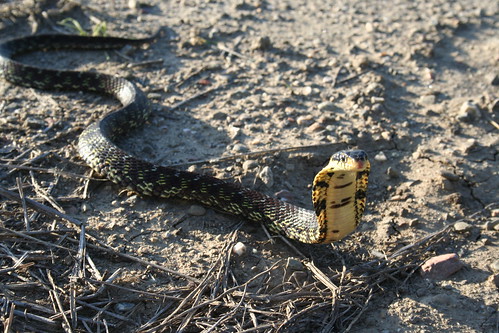
Creature Feature: Chinese False Cobra.

Well!  Today is the first official day of the Chinese Year of the Snake! What better way to celebrate than do kick things off with a Chinese snake, eh?

chinese false cobra 045
(This photograph belongs to its rightful owner. They are very lucky to have such a gorgeous, rare snake!)

This will probably be the first look at a Chinese False Cobra (Pseudoxenodon bambusicola) for many of you. It's native to the cool mountain forests of China. The species is rear-fanged venomous, so handle with care. In the wild, it feeds almost exclusively on frogs. This habit carries over into captivity.

The reasoning behind it being a false cobra is simple: like a cobra, this snake can flatten out a few ribs and raise its head. As Tom Crutchfield, one of the few people who works with these snakes, says, they're "the best monocled cobra mimics. Ever." 

Other than that, this snake is hard to find information on. This is largely because it's all but unheard of in the pet trade. You really have to know someone who's seen one, then done the homework, go to China and pray to Nuwa (China's local snake-bodied deity) that you can snap a pic, or randomly find it in a reptile magazine. Some Indian reptile guides also cover this species. Other than basic field information, very little is known.

These are not beginner's snakes. For starters, yes, they are venomous. There are only a select few people who will breed them, which means either spending a lot of money or getting parasitized wild imports. Finally, they only eat frogs, and nobody has found a way around it. That means no buying mousecicles for Chinese false cobras. Even pros have trouble keeping this shy, fairly docile snake alive. Please try something like a kingsnake or ball python before getting into cobras of any kind!

Just between you and me, I should have done a blue or more black snake for this entry. Happy Year of the Snake- don't worry, snakes guard your money like dragons do their treasure!

Saturday, February 9, 2013

Newsflash: Curiosity Rover Lands On Mars.


Ever wonder if there's life on other planets? Think the conspiracy theorists might be onto something about aliens engineering human beings? Well, depending on what NASA finds out about Mars, you all may have some questions answered, Just today, the Mars rover Curiosity drilled its first sample out of the Gale Crater- an area that may have once been a riverbed. Here's more:
 

"Drilling down 2.5 inches into a patch of sedimentary bedrock, Curiosity collected the rock powder left by the drill and will analyze it using its own laboratory instruments, NASA said in a statement. This is the first time a robot has drilled to collect a Martian sample.

Images of the hole, along with a shallower test hole nearby, can be seen here .

"The most advanced planetary robot ever designed is now a fully operating analytical laboratory on Mars," said John Grunsfeld, NASA associate administrator for the agency's Science Mission Directorate.

Curiosity drilled into a rock called "John Klein," named for a Mars Science Laboratory deputy project manager who died in 2011.

In the next few days, ground controllers will command the rover's arm to process the sample by delivering bits of it to the instruments inside Curiosity.
 
Before the rock powder is analyzed, some will be used to scour traces of material that may have been deposited onto the hardware while the rover was still on Earth, despite thorough cleaning before launch, NASA said.

The drilling and analysis is part of NASA's Mars Science Laboratory Project, which is using the Curiosity rover to figure out whether an area in Mars' Gale Crater ever offered a hospitable environment for life."


Source and images. 

Some of you are probably wondering: Why Mars? There are a number of reasons. It is very similar in size, composition, and distance from the Sun to Earth. All of these provided Earth with adequate sunlight and surface area for the millions of flora and fauna covered on this blog. Most importantly, Mars has ice on its surface, and water is necessary for life. The monster stories came after the fact.

That's what the Rover drilling is about: finding water. If we find water, we find what caused Mars to dry out, or perhaps even micro-organisms. The Gale Crater may It would make us not so alone in the universe, if you will.

Disclaimer: I do not endorse putting aliens in every little thing. The discovery of life on another planet could have big implications for life science as well as science fiction. If Mars once had life, we would be more compelled to save the life on this planet.

So, as cool as Earth is, keep watching the skies. If Curiosity does indeed turn up with Martian water,  bacteria, or some such, you will learn of it here. Then it will only be a matter of time before the aliens take over. Whoops, this isn't a conspiracy site, but we've all seen what even the most innocent invasive species can do.

P.S.- in a twist of "They Actually Eat That," I did something exceptional today and tried rabbit.