Showing posts with label japanese mythology. Show all posts

Wednesday, February 27, 2013

"They Actually Eat That:" Inarizushi.

A lot of people are not adventurous eaters. Just today, I met with someone who had a bad experience with sushi prior to our meeting. He was a bit hesitant to try eel and shied away from sea urchin sushi (which only made me shy due to how pricey it was - see my entry on sea urchin for why). It's not the first time I've met someone shy like that.

Actually, as far as "weird" food goes, sushi is rather tame. This depends on what's in it- for example, fugu is not for the uninitiated. Most "standard" sushi rolls are just fine for people curious. Adventurous eaters will be please by the array of artistic sushi that has been created, even outside of Japan.  For now, let's look at something simple:


This is inari, inali, or inarizushi. Many a sushi place will have it. It is likely the safest sushi for those who do not believe anything with the "sushi" label could possibly be good.

Inarizushi is so named for one, or both, of two reasons. One, Japanese foxes (kitsune) are said to be highly fond of fried tofu. Two, inari are usually cut into triangles like fox ears. Three, Inari is the Japanese god of rice and closely associated with benevolent foxes, who are said to be his messengers. What? Whaddya mean, that was three reasons?

Inari rolls are made of rice wrapped in tofu skin. That's all an inari roll is: rice and tofu. The skin is fried in a sweet sauce, but really, tofu tastes like whatever it's been dipped in. It's a packet of tofu skin with rice stuffed into it. It's nothing nasty like raw fish. If you can handle Chinese food, you can handle inari. It's as safe as sushi gets.

Packaged inarizushi.


So, please don't be too intimidated by my weird food columns. A lot of it tastes just fine, but isn't something that "normal" American people try. Hell, Americans have done things with sushi that the Japanese would likely find disgusting, including putting cream cheese in anything. Try some of it; you might like it. 

Now, back to your regularly-scheduled pterosaurs. 


Sunday, January 29, 2012

Big In Japan: Shirohebi.

Final entry of the week! After sooo many mammals, it's about time we did something at least slightly creepy, no?

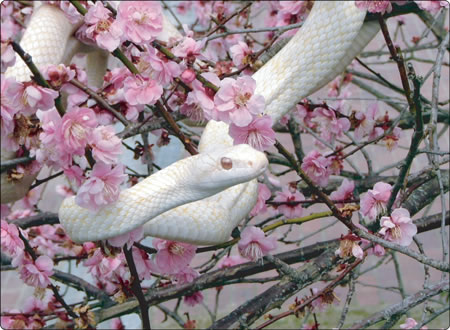
Property of www.shirohebi.com.

...What? Some people I know are terrified of snakes. They will not come anywhere near Eros, my snow corn, who looks like she was pulled off of a Valentine's Day card. Color means absolutely nothing to ophidiophobes. Culture, especially Asian culture, would tend to disagree with such people, especially in regard to white snakes.

Even though snakes are usually vilified, there are two that tend to be exceptions to the rule: cobras and pure white snakes. Cobras have the badass hood (and king cobras eat other snakes for breakfast); white animals in general have this sense of holiness attached to them, in part because white animals rarely last more than two seconds in the wild. White snakes are no exception. China and Japan both love them.

The DVD cover for a box set of a TV series retelling the story of "Madame White Snake" - a Taiwanese folktale that evolved from a horror story to epic spirit romance. Not Japan. Still a kickass white snake.


In Japan, white snakes are considered lucky. They are seen as messengers of the goddess of love and fortune, Benzaiten, who was adapted from the Hindu Sarasvati. Depending on who you ask, Benzaiten either has a dragon (read: magic snake) as her consort or slew him (if you follow the Sarasvati tradition). Regardless, the close affinity between her and various serpents led her to be pictured with a white snake on several occasions. Seeing a white snake is almost as good as catching a leprechaun in Japan...only better, because Iwakuni, a small town near Hiroshima, is chock full of them.

Shirohebi are an albino variation of the Japanese rat snake (Elaphe climacophora). The regular E. climacophora, or aodaisho ("blue general") is one of the most common rat snakes in Japan- sort of like their version of the corn snake. (I have, however, seen it mistranslated as 'garter snake.')  Iwakuni is the only place with 'official' Shirohebi, although one can still buy albino climacs from Kunisir Island. Nobody quite knows why the white population has flourished (there are still a LOT of cats there), but having the misty atmosphere from Lord of the Rings is a good start. I call divine intervention.

So, what is one to do with a town full of white snakes? Make it a tourist trap, of course! I have personally been to Iwakuni, the only place in Japan with a wild albino Elaphe climacophora population, and they love their white snakes. The Shirohebi charm I got there still lives on my phone. Businessmen really do go there to pray to the snakes. They even have Shirohebi parades. Snake-lovers, Benzaiten has heard your wishes.


Shirohebi are nationally protected. Like the Iriomote Cat, they are listed as a national treasure. People are not supposed to take the white snakes out of Iwakuni, but they do anyways. This protected population is shrinking (again). There are still some wild Shirohebi, and captive breeders are doing their best, but please do not take anymore out of Iwakuni. Steal from that little island that's not quite Russia instead.

Go to Russia or face Kanako's wrath. (BTW, anyone know who drew this?)


Thursday, January 6, 2011

Creature Feature: Tanuki.

Anyone who knows anything about Japanese culture knows the nine-tailed fox. If there are monsters in an anime, there will no doubt be a kyuubi no kitsune waiting somewhere to freak out Westerners with its nine tails. Hell, the fox on Naruto would look freaky with just one tail.

Almost as ubiquitous as the nine-tailed fox are strange, raccoon-like creatures holding bottles of sake. They often have large bellies and...err...'golden balls.' The sake can come and go, but what exactly are the critters? They look sort of like raccoons or evil hedgehogs, but obviously are not. (After all, raccoons are only native to North America.)


Whatever it is, we're scared. Seriously, is that an Ewok?

This statue is based off of a real creature. Raccoon-dogs (or tanuki, Nyctereutes procyonoides) are raccoon-like canids native to Japan, China, and that area in general. They are an invasive species in Western Europe. Despite the resemblance to raccoons, tanuki are only distantly related to them. There are five subspecies, with the most valuable one being N.p. viverrinus - the Japanese tanuki.


Tanuki are among the most omnivorous and primitive of canids. They will eat rodents, beached fish, frogs, and other small animals, but will also climb trees in search of berries. They have long intestines for canids - for those unaware of general trends in digestive tracts, carnivores have short guts, herbivores have long guts. These relatively undifferentiated dogs have more guts than Lassie.

The tanuki is (along with the fox and mujina - an animal whose basis is either the tanuki or introduced civet cat) one of the three main shapeshifters in Japanese mythology. It is often seen as a cute, chubby character with wide eyes, a leaf on its that it turns into money or stuff (like Tom Nook from Animal Crossing), a shade, a bottle of sake, and...wait a second, are those...?


No, you are not seeing things...this IS what it looks like.

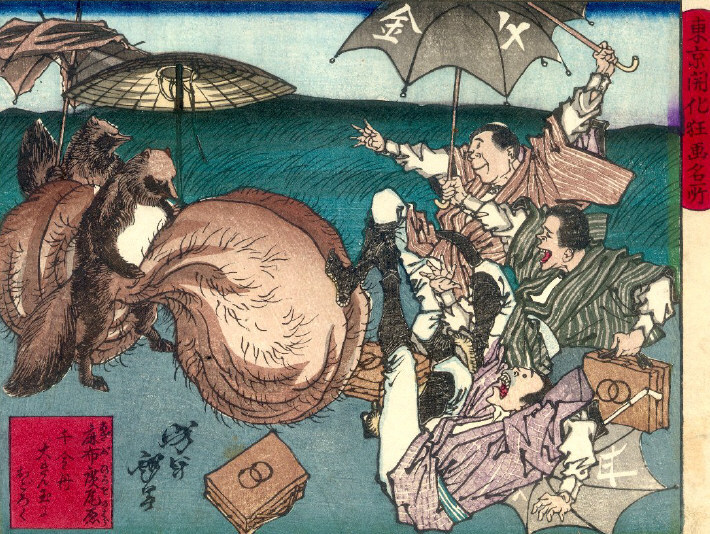
Japan just loves to pick on the real tanuki's exaggerated scrotum in their folklore. There are a number of little sayings about the tanuki's endowments, including a children's song about how its balls swing without wind.


I don't know WHAT'S going on here.

How the mythical tanuki uses these structures is totally Japanese: they can stretch their ball sacs to enormous sizes, play them like drums, and swing them over their backs like bags. These strange functions of their "kintama" plus the use of tanuki pelts in metalwork has made them a symbol of financial prosperity. (Note: Sometimes, the balls are snipped in modern sculptures. The tanuki is instead portrayed drumming on its round belly.)

Tanuki pelts are valued worldwide. Not only are they apparently good for blacksmithing, but the Japanese raccoon-dog has particularly silky fur. The other four subspecies are subpar fur mammals at best.

Like many fur-bearing mammals, trading tanuki for fur led to a population explosion in Europe. While this did lead to a good supply of tanuki fur (and several stores being poked by PETA to do genetic testing on every 'faux fur' thing they've got), tanuki carry 32 species of parasitic worms, 6 types of fleas, several sorts of lice and ticks, and, everybody's favorite mammalian virus, rabies. Eurasia has coped fairly well; unlike dogs (which are apex predators) there are quite a few things that eat tanuki for breakfast.