Showing posts with label mustelidae. Show all posts

Saturday, May 31, 2014

Creature Feature: Zorilla.

You've all heard something like this before: "If it walks like a duck and quacks like a duck, it's a duck." If something has all the makings of something you know, it probably is something you know. That's usually pretty good advice to follow. 

The problem is, nature loves trolling us. There are nonpoisonous snakes that look like poisonous ones, spiders that look almost exactly like flowers, and hell, even butterflies that are really good at looking like dead leaves. 

And then there are furry little animals that look like skunks and stink like skunks, but aren't really skunks: 


This is a zorilla (Ictonyx striatus). It's a polecat (mustelid, similar to a ferret) native to most of Africa. It eats birds, rodents, eggs, lizards, and pretty much any running thing it can sink its pointy little teeth into. They can kill after only nine weeks of being in the world. For those of you who know Spanish, we realize zorillas look almost nothing like "little foxes" and almost everything like skunks. 

Even though it's related to skunks about as much as sea otters are, the zorilla is a really, really good example of convergent evolution. Those black and white stripes warn of the exact same thing a skunk is known for: its stench. A zorilla will turn buttward before firing, so you've got fair warning. The musk is supposedly less pungent than the musk of a skunk; haven't gotten to try this one personally, sorry. Other people claim that its scent can be smelled up to half a mile away, making it the world's smelliest animal. Still, it's not a coincidence that the zorilla looks like a skunk mixed with a Petco ferret; striking markings aren't a good sign. 


(No word on whether these guys make good pets or not, by the way.) 

Zorillas are also very communicative animals. Along with turning their tails towards you before spraying, they will growl and scream before firing. Baby zorillas even have different cries for when mommy is there or not. It doesn't sound as complex as bird song, but still very neat. 

The zorilla may not really be a skunk, but it does a darn good job posing as one. Hell, skunks aren't even in the same area, and the zorilla does the same thing. It's got its work cut out for it. So, umm, even though it's not really a skunk, can't we just call it even and treat it like one, anyways? 

Tuesday, March 8, 2011

Creature Feature: Red Panda.

Now for a million-dollar question (without any money involved): Do you use Mozilla Firefox to surf the 'net?

If so, did you know that Firefox is not based off of a fox at all? Most of us probably know it better as the red panda (Ailurus fulgens). It does indeed look more like a fox than a panda, but whatever you prefer to call it, it is adorable. Cool of Firefox to get us live red panda footage!


The red panda is native to China (like the giant panda) as well as some parts of the Himalayas. It is a small, omnivorous mammal about as large as a house cat. It spends most of the daylight hours sleeping, just like a cat. It cleans itself and climbs just like a cat. Even its generic name, "Ailurus," is a nod to how catlike it is...even though it is closer to raccoons and weasels. It is suspected to be a species isolate; its closest relatives died off 3-4 million years ago. Cutest fossil ever.


The red panda's diet consists largely of bamboo, even if it does eat insects and small mammals as well. It has evolved a "false thumb" like the giant panda to help it hold its food. The similarities end there; it eats bamboo like a panda, but otherwise, red pandas are completely different creatures. Just as cute, though.

Red pandas have a few characteristics all their own. They waddle due to their short front legs, but that same build allows them to climb down trees headfirst. They communicate via a call known as twittering. Yes, you heard that right: The red panda had Twitter long before humans made up the concept. Holy carp, they own the internet!

The little red ball is the internet.


Now, we know what you're thinking: "Can I have one as a pet? PLEEEEASE, mommy?"

Haha. No. Red pandas are vulnerable, sporting less than 10,000 individuals in the wild. If you want one, become an endangered animal breeder. They would make pretty bad pets anyways, even though they thrive in zoos. For the record, raccoons do not make good pets either. We've looked.


Tomorrow: So what CAN you have as a pet? How about a fox as tame as a dog! Also, breast milk.

Monday, February 7, 2011

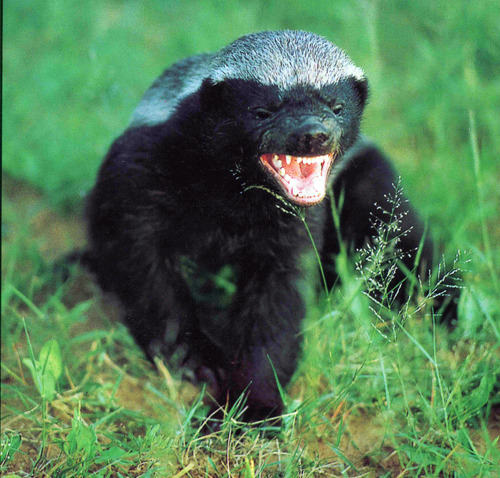
Creature Feature: Honey Badger.

Companies love naming soft drinks after swift, powerful animals, or at least using them as mascots: there's one with a cheetah on the can; I've already said my peace about Red Bull; Venom uses several vipers and elapids instead of flavor names; even Monster has started to use a neat-looking eagle for its imported flavors. There is, however, one animal that they have forgotten:

Cute!


Meet the African Honey Badger, AKA the ratel or Mellivora capensis. Like real badgers, it is a mustelid, and is native to much of Africa, Saudi Arabia, and a good portion of India. Don't let the innocent-sounding name fool you. It is badass 24/7.

For starters, the ratel gets its cutesier other name from a single feeding habit: It breaks into beehives.  It is after honey and the gooey protein sacs called African honey bee larvae that are hidden deep inside the hive. Those claws tear easily through the underground hive, and even with the bees agitated, the ratel's thick hide cannot be stung. Period.


That cute just went out the window.

Being impervious to bee stings is one thing, but these are African bees. These are the bees that make Africanized honey bees (the hybrid between African and European honey bees) super-aggressive. With the ratel around, they really have to be. The ratel probably helped make them as mean as they are today.

Besides being more notorious for messing with bees than Winnie the Pooh, the ratel is a vicious predator.  The ratel will eat just about anything it can catch. Some of the most popular ratel catches are cobras and other venomous snakes (geez, nature film writers love dragon-slaying just as much as storytellers do). This mammal is not 100% immune to snake venom, but...


...two hours after being bitten by a puff adder, that ratel is just fine. It drank a little too much and recovered from its hangover. Time for another round! Mongooses properly eat cobras, too, but they are no match for the ratel; the ratel is practically a thrill-killer of snakes. Guinness called it the most fearless animal alive for a reason.

It gets worse: humans are supposed to be the most dominant species in the world, right? Well, this badger disagrees; spears and other human weapons have just as much trouble penetrating this badger's thick hide as bee stings do. Dogs do not do anything to ratels; their skin is too thick and too loose to be torn off. If a ratel gets into someone's chicken coop, those chickens are screwed. Period.


This thing eats snakes for breakfast. What chance do you have?

If Chuck Norris was an animal, he would totally be a ratel. No questions asked. That is just how invincible this creature is.

Tomorrow: Now I have to do a mushroom, don't I? 

Tuesday, December 14, 2010

Creature Feature: Spotted Skunk.

Skunks have as much uniqueness to them as any other animal. Spanning four genrera, they do not all have the same stripes, which cannot be said of animals such as cheetahs and zebras. There are many different sorts of skunk out there.  Honestly, just because the Looney Tunes say that a skunk can fall in love with a cat that just so happened to be painted with a skunklike stripe does not make it so. The two carnivores are too far apart to ever belong together like Pepe Le Pew so desires.


Mais, qu'est-ce que c'est?

The spotted skunk (genus Spilogale) would like a word with Warner Brothers. The four species of spotted skunks live in much of North America (minus the Great Lakes area -bummer) and some of Central America. They are omnivores, eating anything from berries to small animals. Yes, you can probably have one as a pet; check your local laws.

Unlike 'normal' skunks (y'know, in whatever way an animal that reeks so much can be considered 'normal'), spotted skunks have swirls of white streaked onto their black fur. The spotted skunks are smaller and faster than their striped relatives. They also sport silkier pelts and have been bred for the fur trade for over 100 years.


The spotted skunks should be submitting a letter of outrage to Warner Brothers any time now. Not only do they look considerably more weasel-like than other skunks, they are also frequently misidentified; their pelts used to be sold as "marten pelts," and the skunks themselves can be mistakenly called "civet cats." The two species are unrelated. Civet cats are vivverids and skunks are mustelids, the branch of carnvorids that includes weasels. Get it right, WB; the spotted skunks will leave you alone if you give them a ferret.


Plus, these skunks are far too badass to accept anything less. How many animals have you seen doing handstands lately?