Showing posts with label passeriformes. Show all posts

Friday, January 14, 2011

Creature Feature: Bowerbird.

What really separates man from the animals? Some would say an awesome brain-to-body-ratio and very versatile, articulate digits; others would theorize less physical things like love, imagination, and art.

We could debate about love and imagination in the animal kingdom, but birds definitely invented art first. People likely invented music after hearing bird songs (which have cool tweaks of their own, such as dialects). Some birds, like humans, can see in color; this is best shown in the colorful plumage of parrots and the iridescent plumage of some other birds. There is at least one type of bird that uses modern art to win a mate.


(I've seen worse things called "art.")

Bowerbirds are medium-sized perching birds (passerines) in the family Ptilonorhynicidae. They are native to Australia and New Guinea and are thought to be related to either birds-of-paradise or lyrebirds. Bowerbirds cover twenty species in eight genera, but they all have one thing in common: They're into pop art in a big way.

And I shall call it..."CLOTHESPINS IN STICKS!"


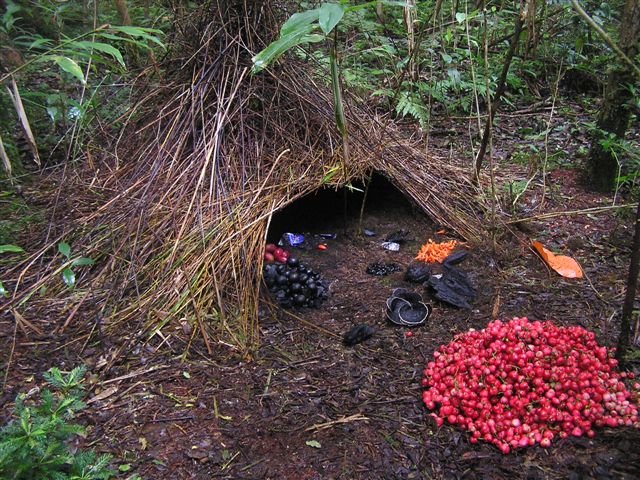
When mating season arrives, the male creates a two-walled structure out of twigs called a "bower." This bower starts simple, but quickly becomes more elaborate as items are added to it. Some keep the two-walled structure and add all sorts of junk; others add berries and make what must be a summer beach house to a songbird.

What sorts of items are stolen for this structure depends on the bowerbird; for example, female Satin Bowerbirds (Ptilonorhynchus violaceus) have evolved to like the color blue. Why? Who knows, but it results in a looot of blue things getting stolen in this video. This guy even opens someone else's car!


The female then chooses the male with the prettiest bower and/or flashiest plumage. Like lyrebirds,  bowerbirds are also excellent mimics, This is like walking into an art gallery, then making out with whomever made the prettiest painting. Naturally, this mating rite attracts more than one female to a single artistic male. Hey, a lot of human women would go with the bird that opened a car.


He also has the most gorgeous eyes I've ever seen on a bird. Look at that PURPLE!

Wouldn't it be great if human artists got that sort of treatment?

Friday, November 19, 2010

Creature Feature: Lyrebird.


"All bird entries are the same, blah blah blah." Yes, many of the bird entries I write simply consist of "the male looks awesome, the female sucks." Although this is also true for this entry, there is a little bit more icing to look forward to on his cake.

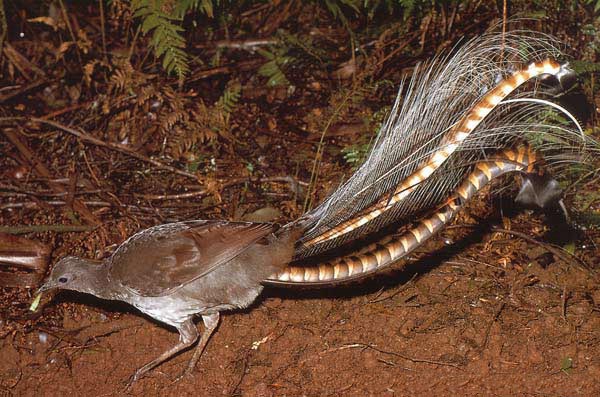
The superb lyrebird (Menura novaehollandiae) looks almost like a smaller, less colorful peacock. It is native to the forests of Australia (no spread to Indonesia this time). Being one of Australia's most recognizable native birds, it (OK, specifically the male) has been featured on money.


As the world's third largest and heaviest songbird, it is about the size and weight of a pheasant. (There is subtle difference between this bird's tail and a peacock's: a peacock's stunning feathers are on his back, supported by tailfeathers.) The male of the species has a pheasant-y tail to match his pheasant-y size:


For those of you who have no clue how the lyrebird got its name, a lyre is a sort of hand-held harp common in ancient Greek art. It resembles this bird's tail very well, but before you start forming conspiracy theories, the Greeks had no idea this Australian bird existed.

This bird is also one of the most amazing mimics I have ever heard:


The bird world has some very good mimics. Rarely are such talents displayed rapid-fire as they are here. The lyrebird copies the most complex sounds he can muster and sings in competition with other lyrebirds. This bird imitates a kookabura, a camera, a siren, and chainsaws just to get his mate.

Hell, y'know what? I'd mate with that bird in a heartbeat; he's just too awesome for anything less.

Friday, July 30, 2010

Creature Feature: Freak Week - Barb Pigeons.


Pigeons have some of the freakiest breeds in the avian world. If you thought the Polish Chicken was freaky, think back to my pigeon article. There was a picture of a Jacobin there - a pigeon breed that looks like its head exploded into a mess of feathers.


KA-POW!

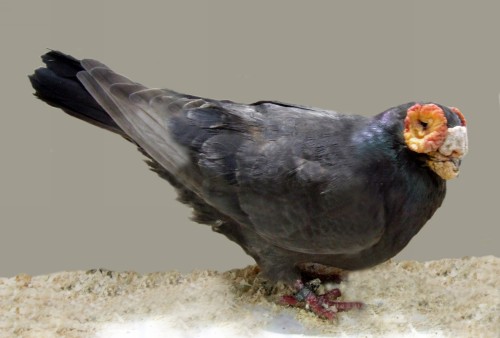
The Jacobin is not the weirdest pigeon in the coop. An even more bizarre breed, the barb, exists. It can only be described as a pigeon who was trying to be a vulture for Halloween and failed. Miserably.


The video does not do those wattles justice.

This...bizarre breed been around for 400 years in Europe. The barb has been featured in the works of Shakespeare and Darwin's Origin of Species. Darwin himself was a pigeon breeder. No doubt that experience impacted one of the most important works of literature ever.

A lot of scientific discoveries are not made by men in sterile white labs. Darwin not only bred pigeons as a hobby, but also went to the Galapagos himself. Gregor Mendel, the father of modern genetics, worked in a monastery growing peas as a hobby. It is one thing to read about evolution, and another to steer it yourself...even if the results seem more odd than beautiful.

Tuesday, June 29, 2010

Creature Feature: Greater Bird of Paradise


It's time for yet another example of sexual dimorphism in birds. As with many of these, the male gets all the love. The male Greater bird-of-paradise sports elaborate feathers that rival the tail plumes of the quetzal. It is native to New Guinea and Indonesia (which is its own reservoir of awesome, I swear).

The Greater bird-of-paradise (Paradisaea apoda) is so called because the first trade skins brought to Europe had their feet removed by the natives. This led European scientists to believe that the bird was a creature from paradise kept aloft by his elaborate display plumes. He supposedly never rested, only landing to Earth to die. (This is almost like an airborne version of an actual creature, the oarfish, but that is for another article.)


The bird-of-paradise's display feathers, instead of being based in the tail, are situated on the bird's flank - that is, beneath its wings. He also has wiry tail feathers that make his display more than just a bunch of yellow fluff.

There are many more interesting birds-of-paradise, but this one is one of the most eye-catching. It is also the species that gave the whole genus its name. One look at those feathers is enough reason to consider it unearthly; use stories and attributes like this for your own designs!

(I'll get bored of pointing out the sexual dimorphism possibilities in birds eventually.)