First off, I apologize for updating this less frequently. The biggest factor, by far, is my own moving away from my old e-mail account, and therefore my Blogger. It's not like my interest in life has been demolished, I've just been lazy about switching accounts. There were also a lot of trips in September!
I've also been thinking about a new type of article. See, this blog started with the intent of being inspiration food. I'm a huge fan of creature designs, to the the point where they tend to overwhelm other parts of my work. I love monsters, especially ones that a) eat people and b) derive from nature. The way I see it, I may as well tell the world more about what I like using examples from both nature and other media. I want to inspire people using everything nature and art has to offer.
In particular, I love animals that use poison! Goodness knows why, but I find it a very interesting, unique bioweapon. It's usually a "big things come in small packages" deal that sometimes even looks cool. Thus, it kinda cheeses me off when people just palette swap a creature and say one color is poisonous without taking in other structural ideas.
So, without further ado…three tips for designing your own toxic beasts!
 |
| If this thing was a Pokemon, I'd catch the hell out of it. And it's invasive, so that would be okay. |
1. Picking Your Poison.
Or, if you prefer, "the nitty-gritty details- how and why?"
I apologize for starting with something so boring. However, it is a rather important part of why certain animals have poison while others do not, and help you, as a designer, gauge how poisonous a creature should be. Aside from the aesthetic of a poisonous thing, why something is poisonous should be the first things you think about.
The truth is, that's how you have to think of poison. A toxin is not a horn or claw. It's not visually appealing in and of itself. Whereas one can easily brush off a horn as, say, a mating display, one cannot do that for poison. Poison has to have a bigger point than that.
So, why does your thing have poison? Is it hunting prey, or just defending itself? While poison's a pretty versatile weapon, this will affect your design. The rule of thumb is that venomous creatures use their poison to hunt, while poisonous creatures use it as a defense. What kind of animal are you making?
Probably the most classic poisonous animal to pick on is the monarch butterfly. The caterpillar of the monarch butterfly eats milkweed, a mildly toxic plant. By doing so, the caterpillar itself becomes bad-tasting, and birds learn to avoid them from that point on. The butterflies are likewise poisonous, and the circle of life continues when they pollinate the poisonous milkweed. A lot of prey animals do this - even the notorious poison dart frogs, which eat toxic beetles to make themselves toxic. Very, very toxic, in fact.
Venomous creatures are another can of worms. A venomous creature is usually a slower predator, often of the ambush variety, that naturally makes its own toxins. It is usually well-camouflaged, sporting a swift strike. This thing is definitely poisoning to kill, meaning that one strike should hurt a lot. Bad taste won't cut it, even if it is still considered toxic. Venomous creatures like our lionfish (from the start of the article) are both predator and prey, thus the vibrant markings.
 |
| Nobody ever suspects...the BUTTERFLY! |
Probably the most classic poisonous animal to pick on is the monarch butterfly. The caterpillar of the monarch butterfly eats milkweed, a mildly toxic plant. By doing so, the caterpillar itself becomes bad-tasting, and birds learn to avoid them from that point on. The butterflies are likewise poisonous, and the circle of life continues when they pollinate the poisonous milkweed. A lot of prey animals do this - even the notorious poison dart frogs, which eat toxic beetles to make themselves toxic. Very, very toxic, in fact.
Venomous creatures are another can of worms. A venomous creature is usually a slower predator, often of the ambush variety, that naturally makes its own toxins. It is usually well-camouflaged, sporting a swift strike. This thing is definitely poisoning to kill, meaning that one strike should hurt a lot. Bad taste won't cut it, even if it is still considered toxic. Venomous creatures like our lionfish (from the start of the article) are both predator and prey, thus the vibrant markings.
Why things do not have poison is just as important as why things do have poison. For example…ever wonder why there are so few poisonous mammals known to science?
Put bluntly: they don't need it. Why invest in poison when you have massive teeth, claws, hooves, or long legs? Mind, there are a few oddball mammals that still have poison, but there's a reason that they are exceptions rather than the rule. For example, a toxic lion would be redundant; one, they aren't prey for anything, two, cats kill with a death-bite to the neck.
Put bluntly: they don't need it. Why invest in poison when you have massive teeth, claws, hooves, or long legs? Mind, there are a few oddball mammals that still have poison, but there's a reason that they are exceptions rather than the rule. For example, a toxic lion would be redundant; one, they aren't prey for anything, two, cats kill with a death-bite to the neck.
Here are a few reasons why something might evolve poison: it's slow; it's small; it doesn't have sharp claws, wings, or horns to defend itself. The vast majority of poisonous mammals are shrews, i.e. small furry things, or shrew-like solenodons; in a remarkable display of sadism for such small creatures, shrews use venom to render prey comatose while they cache it for winter. Solenodons have it because they are the closest mammalian things to reptiles after monotremes, and simply saw no need to evolve out of their toxic fangs.
 |
| Solenodons are weird, by the way. T-Rex would have seen this guy! |
Most mammals have claws, fangs, or massive size that they can use to their advantage. They don't need to slowly weaken things. They don't even need toxic skin to defend themselves. It's the smaller, slower, more vulnerable animals that are more likely to have poison. If you can't cause a lot of damage or run like the wind already, you might just be a good candidate for toxins.
And then, oh, the plethora of toxins out there. There are toxins that paralyze, toxins that cause internal bleeding, toxins that attack muscle, and that's just naming a few. It's not simple to create an antidote for every venom out there, just because of the variety. I could stress again and again that these things tend to be tiny, yet potent, so whichever route you design best be worth it.
And then, oh, the plethora of toxins out there. There are toxins that paralyze, toxins that cause internal bleeding, toxins that attack muscle, and that's just naming a few. It's not simple to create an antidote for every venom out there, just because of the variety. I could stress again and again that these things tend to be tiny, yet potent, so whichever route you design best be worth it.
Of course, when you're making man-eaters, tiny is not an option. Slow is also usually a pretty bad idea, but toxins can still compensate like they do in nature. Monster Hunter has my eternal respect for having several very well-designed poisonous beasts in a number of regards. My personal favorites of MH 3 Ultimate, Lucent Nargacuga and Gigginox, are both venomous, but Gigginox is a real gem. It's slow, blind, breeds more than rabbits, and flings poison lugies at you. Perhaps size aside, it's one of the best-designed toxic creatures ever!
Or you could just go, "here's a thing, here's that thing again, only purple. The purple one is poisonous." Ah, recolors - the bane of my existence in cases like this.
Or you could just go, "here's a thing, here's that thing again, only purple. The purple one is poisonous." Ah, recolors - the bane of my existence in cases like this.
2. It's All in the Delivery.
Here's another bugger concerning poisonous critters: how do you get your poison in?
The evolution of venom in snakes is a long and hole-filled one. We do not know when or how lizards went from having four legs to none, whether it was related to water or earth, or if those lizards were poisonous. We also don't know how certain lizards evolved poison, or if any snakes can truly, 100% be called "nonvenomous." Science is still split on the Komodo dragon, but poison or bacteria, a bite from that thing is deadly.
What we do know, however, is that the poison glands in snakes evolved long before they had the fangs to properly inject the stuff. Duvernoy's gland, the sac that produces venom, is found in seemingly harmless colubrids. There are also snakes dubbed "rear-fanged venomous."
Yes. Let's talk about those for a bit.
 |
| Rattler left, cobra right. |
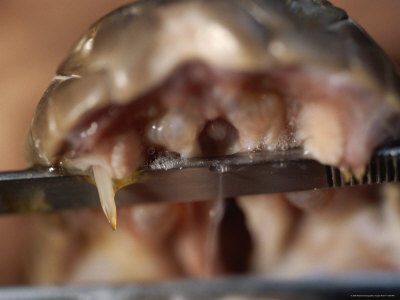
If one looks at the skull of a rattlesnake or cobra, one will notice two very obvious things: one, the skulls have very different styles of fangs, meaning that the images of cobras with massive fangs are really a load of BS; two, despite the differences between the fangs, they are both situated towards the front of the mouth. This only makes sense; after all, where better to put a weapon for injecting poison into prey?
The venom-injecting fang did not start there. Evolution is an awkward mistress who tends to make a ton of mistakes before getting it right. The injection fang was situated towards the eye, closer to the gland, before the efficient venomous snakes we know today. These snakes still have and make poison, but can't get it into a squirming, potentially biting, kicking prey item.
 |
| The boomslang - embarrassingly known better as a Harry Potter potions class ingredient than a snake that can kill you by opening its mouth 180 degrees. |
This says nothing about how lethal the poison is, just that it's harder to get into a nice, warm rodent. Pretty crazy tricks have to be done just to get the point across (ha ha) if the machinery isn't there. The boomslang is one of the more noteworthy rear-fanged venomous snakes out there, but it doesn't have the huge fangs of a rattler, or even the fixed fangs of a cobra at the front of the mouth. It has three fangs for injecting venom, located right beneath Duvernoy's gland. It can almost open its jaws in a straight line in order to deliver its lethal bite; most rear-fanged snakes are not so lucky, and have to chew their venom into their prey to get it in at all.
This is, of course, largely concerning venom. When you're poisoning something to kill it, of course you want the most efficient delivery system possible. If the poison is defensive, however, chances are a predator will be doing half of your work for you - usually touching the skin. Both the pufferfish and poison dart frog varieties have this right, with the pufferfish sporting death needles and dart frogs having a coating so poisonous that merely touching it causes at least a tingle."Your mouth is on my skin- sucks to be you" is very different from sticking fangs into an unsuspecting mouse. Needles, spurs, and toxic coatings are all cool ways to go about it. Delivery isn't as big a problem when the pred's doing your work for you.
Point is, it doesn't matter how nasty your poison is if you can't get it in. It's like putting medicine in a bottle you can't open. In nature, there are no "much stronger people" who will open that bottle for you, so best make sure you can open it yourself.
3. Acid Trip!
Poisonous things can be among the most gorgeous beasts in the animal kingdom! A lot of poisonous (not always venomous) animals are very colorful as a warning, even though most of nature sees in black and white. Poison dart frogs are a classic example of this. Really, this guy blends in exactly nowhere:
 |
| The Frog Formerly Known As Azureus. He was never a Prince. |
Dart frogs aside, nature has another warning method: stripes. There's a trinity of red, yellow, and black that can be found on a lot of poisonous animals, including coral snakes and wasps. One could even add skunks to the "stripy and kind of bad for you" pile. Even to black and white vision, the stripy pattern stands out. The fancy term is "aposematic coloration" for the things that just taste bad.
Then there are the posers.
For every genuinely toxic animal, there is at least one mimic- not usually venomous or poisonous, but darn if they don't dress the part. Coral snakes copy a far less deadly species (they're prey, too, remember?), but kingsnakes and milksnakes are known for mimicking the lethal coral snakes. ("Red next to yellow will kill a fellow, red next to black is a friend of Jack" stops once you cross the southern U.S. border, by the way.) There are several very good bee mimics, including the hummingbird moth. The mimic octopus steals from everybody, making anything else trying to copy a venomous creature a futile cosplay attempt by comparison:
(I'm poisonous! Really! I am ALL AND EVERY POISONOUS YOU WILL EVER KNOOOWWW!)
There is a visual aspect to poison, it just isn't necessarily purple. If anything, poison's colors are red, yellow, and black. RPG's have lied to you!
In conclusion...
...I hate palette swaps. And bad design that doesn't give a flip about how poison works in nature, or how to properly portray it aside from the color purple, but mostly, I don't like how people arbitrarily add poison onto anything without thinking about it. Pokemon and MonHunt have you beat already. There are a ton of creative ways to use poison.
In conclusion...
...I hate palette swaps. And bad design that doesn't give a flip about how poison works in nature, or how to properly portray it aside from the color purple, but mostly, I don't like how people arbitrarily add poison onto anything without thinking about it. Pokemon and MonHunt have you beat already. There are a ton of creative ways to use poison.