Saturday, September 8, 2012

Who Let The Dogs Out: Komondor.

You may have noticed a trend for this week: Small dogs tend to be weird. Versatile as the canid genome may be, abusing it is not without its faults. The weirdest dogs also tend to be from China, but that's beside the point.


As if to prove that not all weird dogs are small, we have the Komondor. This guy looks similar to the Puli, another Hungarian dog with a mop for fur, but is quite a bit larger. The breed has been recognized by the AKC since 1937. Although not quite Chinese, the Komondor's ancestors do hail from Tibet.  It's still cool enough to be one of Hungary's national treasures.

The Komondor's coat consists of white cords that look like albino dreadlocks. This was originally used to prevent bites from wolves that would attack sheep flocks; no matter how cool wolves are, they just can't bite through an organic mop. The moppy coat can only be white in a Komondor, so if you want black or grey, try a Puli. No, they do not come in pastel pink or any other color that would suggest that they can be treated like Crimp n' Curl Cabbage Patch Dogs. Even the Puli would be slightly offended by that; Komondors are even more serious business.

They look more like poodles as puppies. Laugh while you can.


Komondors are guard dogs. They do not even need to be told to guard sheep and cattle. There is a saying that a Komondor might let an intruder into the house, but will never let them out, leaving the helpless soul pinned under the dog's weight (which can be upwards of 80 pounds). They are always wary of strangers. That said, early socialization of these dogs is a must.

Aside from their protective temperament, Komondors have very few health problems compared to every toy breed ever. The main problems are with the eyes, including cataracts and inversion of the eyelid. Bloat is a problem in all large dogs. Due to the heavy coat, parasites are common. That coat also requires a lot of maintenance. Budget accordingly. 

Komondors may look silly to us, but they are not goofballs. The breed has the ability to think independently and has been praised for its strength, valor and courage over the centuries. They are still pretty popular today, especially for shows and livestock hunting. Don't let the haircut fool you; this dog will not back down from wolves.

Thursday, September 6, 2012

Who Let The Dogs Out?: Pugs.

Humans have a very weird definition of "cute." Generally, if it has big eyes, a nearly-flat face, and a short body, it fits this definition. Animators figured this out a long time ago. There are several guides which can tell you, in scientific detail, how to design a cute character. It's really kind of creepy how well they have this pegged.

Thing is, animation rules don't always translate to real life. Case in point, pugs.


Pugs are wrinkled, little dogs who fall under the "toy" header. Generally speaking, they are small, stocky, "squarish" dogs with wrinkly faces and almost no snout. We're pretty sure pugs came from China; they may go back to 551 BCE if Confucius was indeed describing a pug. Some records say that they've been around even longer.They look a lot like the same "lion" that the Pekingese were pointed towards, only not as furry and not as spoiled by a certain empress dowager. No, they were meant to guard Buddhist monasteries.

The pug is usually summarized thus: multum in parvum, or "a lot in a little." They have a lot of personality for a small dog. They are outgoing, playful, and eager to please. They can, however, be rather stubborn as well, and require a healthy amount of exercise. Personality-wise, they are a good match for most people.


So, what's not cute about that? The combination of facial folds and large, bulging eyes creates an uncanny effect. Also, if you look at clips on YouTube, you hear pugs snorting. Indeed, pugs do have respiratory issues; they also have a million eye problems from the shortened skull and overheat really easily. There are also a few pug-exclusive diseases, including necrotizing meningencephslitis - inflammation of the brain and central nervous system. Cute comes at a price.

Pugs are one of those dogs that I, personally, look at and go, "are these really worth it?" These guys are not as notoriously aggressive as Chihuahuas, but they do come with a laundry list of problems. They sounds like good companion dogs...if you can handle the extra care involved. You mileage may vary on cuteness. Still not too bad for a dog made in China.

Wednesday, September 5, 2012

"They Actually Eat That"/Who Let The Dogs Out: Hot Dogs and Dachshunds.

You're probably thinking that this entry is some sort of bad joke. I already did an entry on eating dogs, after all. This was just my corny attempt to fit "They Actually Eat That" in with the theme week. I don't need to make many more bad jokes; dachshund owners do it for me.


For those of you who assumed "wiener dog" could not possibly be the right name for a dog breed, the proper title for sausage-like dogs is "dachshund."  The breed could date all the way back to ancient Egypt, but the first confirmed dachshund was recorded in the 1700's. They are now so closely associated with Germany that the 1972 summer Olympics in Germany created a dachshund mascot.

Waldi, the too-colorful dachshund mascot.


The dachshund's shape is deliberate. It was meant to hunt badgers (with the name meaning "badger hound"). That long, narrow, pointy shape fits perfectly into a badger burrow. The front paws even help for digging! There are also some mini-hot dogs bred to hunt rabbits. The pet dachshunds are usually "tweenies," or wiener dogs somewhere in the middle of the two sizes.

Believe it or not, there actually is a relationship between dachshunds and hot dogs. A German concession seller at the polo grounds in New York first called sausages in a bun "Dachshund sandwiches" sometime in the early 1900's. Supposedly, a New York Post cartoonist could not spell "dachshund," so the name "hot dog" stuck instead. That said, hot dogs themselves are mystery meat coated in bacteria that might make you sick if not cooked and cause cancer if consumed too often, so please avoid them whenever possible.

Also avoid putting them on your dog. Seriously, it looks ashamed.


The strange shape of the dachshund is not without its price. There is a spinal disc malfunction so specific to dachshunds that it's dubbed "Dachshund Paralysis" by most people. Dachshunds are lazy in old age, leading to obesity, diabetes, and all those other nice things doctors warn you about. Demeanor-wise, they are also prone to being brave to the point of recklessness, disobedient, and downright aggressive if not properly amused. E.B. White had quite an experience with his own dachshund, Fred, who "even disobeys me when I instruct him in something he wants to do." Not a beginner's dog by any means.

So, next time you see a furry little sausage at the park, bear the following in mind: 1. Dachshunds  were meant to hunt badgers, easily among the meanest furry mammals on the planet; 2. they are almost synonymous with Germany, a place known for meat, beer, and Rammstein; 3. they are aggressive, assertive little buggers who do not know what it means when you are bigger than them. Have fun sticking them in hot dog buns, now.

Tuesday, September 4, 2012

Who Let the Dogs Out: Pekingese.

Domesticity aside, dogs are usually considered masculine animals. You rarely, if ever, see puppies on birthday cards intended for girls. Dog meat contains a lot of yang (masculine) energy. "Bitch," the term for a female dog, denotes a woman acting like a man. No matter how cute a dog is, it's still masculine.


There are still some dogs that would make people question that perception. Toy dogs with long hair, like the Pekingese above, tend to be seen not as fully feminine, but definitely effeminate in American culture. This is not so in China, where the Pekingese is associated with royalty and, umm, this:


Pekingese dogs are based off of the Chinese perception of a lion (also called a Foo Dog or shishi). Not a real lion - a creature the Chinese made up out of every awesome animal on the planet after hearing stories about lions. China has never had lions, but they heard that whatever a lion was, it was the king of beasts. They also presumably had to get in the car - err, rickshaw - if a lion ever came around. 

The Chinese soon began breeding dogs on their idea of "lion." The "lion" had poofy hair; check. The monkey face, well, they improvised by making the Pekingese's face as flat as possible. (British show standards later outright said, "muzzle must be apparent." Good show!) Other origin stories say that the Pekingese was a cross between a lion and a monkey (or some other small animal). Whatever the case, the Pekingese was treated as a being so sacred that it could chase away demons - and foreigners.

RAWR! >:3


For the longest time, Pekingese could only be owned by members of the Chinese Imperial Palace. In particular, the Empress Dowager Cixi was very fond of Pekingese and kept several in her palace - supposedly, one for every outfit she could manage. For those of you who do not know Chinese history, Cixi was one of the many reasons China hated female rulers; she was basically their Marie Antoinette. As if building a giant jade boat instead of giving her country a decent military was not enough of a slap in the face, she also set the standards for the Pekingese breed. Charming. 

As the Pekingese became even more popular outside of the court and spread to other countries, another disturbing trend came into fashion: "Sleeve Pekingese." Pekingese were bred to be extra-small so that they could fit inside the flowy sleeves of the Chinese nobility. Thus concealed, they could be used for assassinations. Given how bitey a small dog can be, that should not be a surprise. Breeding for these mini-dogs of mini-dogs was eventually outlawed by another Chinese empress; this act alone makes her more palatable than Cixi.

Some dogs were born too late to directly benefit from Empress Tzu Hsi's kindness.


In general, breeding for small size in dogs is not the best idea. Toy dogs in general die from trauma more than anything else. Both the cardiovascular and neurological systems are at high risk. Flexible though the wolf genome may be, it has its limits.

The Pekingese also has some specific health requirements. The fur needs daily combing. The same coat that makes Pekes attractive can also lead to overheating. The flat face comes with its own issues, such as major eye problems and a high risk of respiratory disorders. There is virtually no way to screen for any of these.

You wanna know something really disturbing? Pekingese are one of the oldest breeds of dog. They go back at least 2,000 years. Genetically, they have more in common with wolves than Huskies. That just goes to show you how versatile the canine genome was before we started playing with it...and how easy it was to play with. The question is not, "can we do this?", but "should we?"

Monday, September 3, 2012

Theme Week for September: Who Let The Dogs Out?!


For those of you who have not been following this blog for very long, I am not a dog person. In fact, I think there are some examples of severe insanity among dog owners in particular.  The video above covers just one of my major bitches (pun intended) with dog people. It's like dogs are Jesus or something. There, I said it; props to the random person on Twitter who put my bile for the dog's seeming Mary Sue-ness in our society into one succinct phrase. It's not that I hate dogs, it's that people get insane concerning dogs.

Now, mind, I know a few people with dogs. Some of them are perfectly nice people. My best friend still talks about her deceased dog Bruno just like Foamy described; that's an issue, but I would call it the tip of the iceberg. No, it's these people I have a real problem with:


In recent years, the dog has become a total commodity. We now have a wealth of products assuring you that your dog can color-coordinate with whatever you happen to be wearing: doggy clothes; doggy birthday cakes; doggy nail polish; doggy hair dye. Dog yoga is also apparently a thing ("doga"). I'm fine with giving dogs treats, but this is disturbing when you think about it. It's overanthropomorphizing to an unhealthy degree. Yes, all pet owners do this on some level, but it borders on madness with dogs. As if to add insult to injury, this is especially prevalent on smaller dogs- dogs that already come with problems.

Mind, the early people got really lucky when they managed to domesticate the first wolf. They happened to find an animal that could not only recognize people as alpha, but had quite a few other behaviors in common as well. It also happened that wolves had an extremely versatile genome (bigger than the human genome by a LOT- 23 chromosome pairs in humans versus 39 pairs in dogs) that allowed for a great variety of breeds to flourish over the centuries.

But where did we get off turning wolves into this?


I swear there is a dog beneath all that fur.

There are some dog breeds that just make me go "why?" I've already done an entry on Chihuahuas, the most "why would you do that?" dog in the entire world,  but there are still so many more dog breeds out there that make my mind reel with WTF. Many of them have already been covered. This is just picking up more freakish scraps. Just because we can mess with the canine genome doesn't mean we should.

Sunday, September 2, 2012

Creature Feature: Caracal.

The average human psyche has exactly two images in mind in regards to felines: big cats, like lions and tigers, and domestic cats. The small- and mid-sized wildcats are often overlooked. That's a shame, because a lot of them are really neat.


Enter the caracal, one of the most striking of the little cats. If you took a lynx and exaggerated its ears and tail, you would get something that looks like a caracal. Caracals are native to much of Africa and the Middle East, and the name derives from a Turkish word meaning "black ear." Although it looks related to lynxes, it is closer, genetically-speaking, to the African Golden Cat and the tabby cat down the street.

The ears are the most noticeable part of the caracal. They have long tufts that make lynxes jealous. Although nobody knows the exact purpose of those tufts,we have several theories as to why they exist. On lynxes, the ear tufts function almost like radio antennae, helping the cat to hear. They might also help break up the outline of the caracal's head.


There's more to caracals than just the ears. Their paws have stiff hairs that probably allow them to walk on the sand, sort of like snowshoes. The caracal is also known for snatching birds in mid-flight - sometimes many birds at once! They also get most of their water from their prey, and domesticate surprisingly well.

Caracals have been in human company since ancient times. India and Iran both have a good history with these cats. The Persians were fond of using them to hunt pigeons. They can kill up to ten pigeons in one hunt! Yes, these cats have been exotic pets for a very long time, and remain pretty popular today.


Keen observers probably noticed a while back that caracals look a looot like house cats; yes, the two can make babies.The Moscow Zoo tried it, and caracal-cat hybrids can be found in captivity as well. "Caracats" have many of the same traits Savannah cats do - larger size (12-14 inches at the shoulder, 25-30 pounds) and fertility issues in the males. (For those curious, yes, servals and caracals can breed, too.) They usually use Abyssinians as a domestic base. F2 (second generation) caracats still have the attractive ears of their wild relatives and make better pets than F1 hybrids. Above is a caracat kitten for your squeeing pleasure.

That said, this month's Theme Week is going to be a doozy. I'm a cat person,  darnit!

Saturday, September 1, 2012

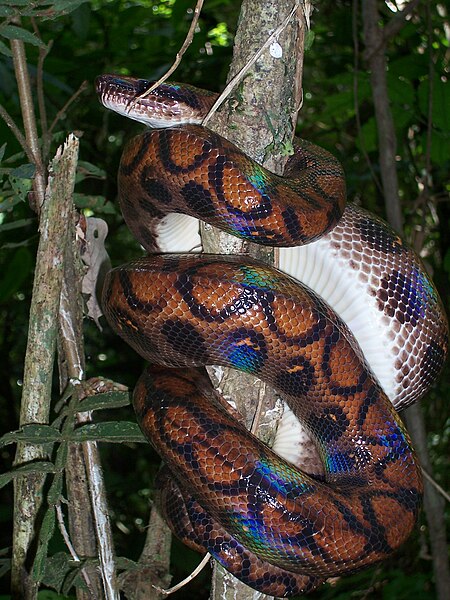
Creature Feature: Rainbow Boa.

Although some people might recoil at the mere thought of snakes, rainbows are one of the more positive things that they tend to be associated with. China and Australia both make mention of a "rainbow serpent" of some sort - in the case of China, it even has two heads! Considering that some snakes are iridescent, this should come as no surprise. It's still awesome when science and lore agree on something,  so here goes.


The rainbow boa (Epicrates cenchria) is a real snake- and what a piece of eye candy! They are native to Central and South America. Like all boas, they have live babies.Rainbow boas eat anything small and warm-blooded that they can sink their teeth into.

The rainbow boa is named for, you guessed it, its multicolored luster. Rainbow boas are highly iridescent, unlike some snakes that only yield a flash of color once in a while. A flash of cyan looks quite striking against the red and black patterning, too. Your mileage may vary on whether this or the sunbeam snake has more shine. Some people have hailed the rainbow boa as the most beautiful snake in the world, but it has serious competition for that title.


This shininess has made rainbow boas highly desirable snakes in the pet trade. A lot of specimens have been taken from the wild, decreasing the amount of rodent-eaters in the ecosystem.  Luckily, the upside of this is the abundance of rainbow boas bred in captivity.  I would still ask where any given rainbow boa came from; if the answer is "from Brazil," don't buy it! Boas are good for the ecology down there. There's no need to take them from the wild anymore.

Rainbow boas are not a beginner's snake. Beautiful though they may be, they do get around 6-7 feet in length. All of them require extra humidity unless you happen to live in a rainforest already. .I wouldn't call them a good 'first' snake; the guys at my local reptile place were honest when they warned me that Brazilian rainbow boas were fragile. Those that keep them well, however, will be rewarded with a real light show in their terrarium. These are snakes for looking at more than handling.