Thursday, February 7, 2013

Creature Feature: Irritator.

You are not misreading that header. It is not Pokemon Week again. There really is something with the simple name of "Irritator." Let us show you.

I'll show YOU irritating - try being DEAD for a couple million years! - from Wiki.


This is a dinosaur named Irritator challengeri. It was found in Brazil in 1996. Like other spinosaurids, it was either carnivorous or piscivorous - there's still a fair amount of debate on that regarding spinosaurids in general. It lived in the early Cretaceous, which means it did not quite coincide with Tyrannosaurus and a great amount of the most popular dinosaurs.

Before you mention that this sounds like Latin done by a moron who was trying to sound smart, no, it was made by scientists after racking their brains trying to figure out what exactly this thing was. It was first classified as a raptor for some very questionable reasons, including that the snout had been lengthened just to make the specimen more impressive. It might even be the same thing as Angaturama, another spinosaurid found in the same time and place. Irritating indeed.


Despite being named by scientists, Irritator was not discovered by scientists. They named it, but they were not the ones to dig the skull up. The skull - the only part we have - was found through the illegal fossil trade. As mentioned above, it was doctored to look more impressive, making scientists ball up paper in frustration. The good news? It's still the most complete spinosaurid skull today.


Now for what you really came to see: Irritator in the flesh. Contrary to its mildly-annoying name, Irritator was a beast. Imagine a crocodile walking on two legs. Now imagine that it weighs 2-3 tons and is 8 meters long from head to tip of the tail. Imagine that it had a neat-looking fin and could all but breathe underwater with its nostrils located towards the top and back of the jaw. That was Irritator, AKA "Jaws meets Jurassic Park."

Irritator has not had much love in popular culture. To its credit, however, the "Dinosaurs Alive!" attraction at King's Island starts with Irritator. It's hard to imagine a Vivosaur more trollicious than Dimorph in Fossil Fighters, but if Irritator ever made the cut, I'm sure he would live up to his name. Don't expect to see him as a Jurassic Park threat, though...at least, not with a name like that.

Wednesday, February 6, 2013

"They Actually Eat That:" Escolar.

If you ever pick up a sushi menu, you will see some strange stuff. There are things like sea urchin and eel alongside common salmon, tuna, and shrimp. Then there are simply odd uses for regular fish, like taking their eggs.

But "escolar?" That sounds like it might be English. What is it, anyways?


Escolar (Lepidocybium flavobrunneum) is found in deep, tropical waters around the world. It is related to oilfish. It is often mislabeled, leading to caveat emptor around anything labelled "butterfish." In fact, it can be mislabelled as almost any other fish on the planet. It is possibly the most dangerous fish on the market.  Oh my. 

 Escolar has a serious consequences if eaten in excess. The technical term for it is keriorrhea. In English, that means you get nasty bowel movements and urinate yellow oil. Escolar do not metabolize oil as well as some, so we get stuck excreting it instead. For the record, the safe amount is 6 ounces.

The good news: it can taste really good. As a fattier fish, it tastes very rich. It has been described as having a laxative effect. Despite the side-effects, escolar remains popular due to the taste and other effects.  In other words, it's the illegal drug of the fish trade.

The irony? Escolar is banned in Japan and Italy. The Japanese government considers escolar toxic, and these are the people who eat fugu.If a roll has escolar on it, it sure as hell isn't traditional. It's tricky; escolar is often mislabelled as white tuna, Atlantic cod, or other fishy things. It is usually either illegal or issued a fact sheet...except in the United States. Even Hong Kong has limits on it, and they make low-quality stuff on a regular basis. Enjoy illegal sushi!


Tuesday, February 5, 2013

Creature Feature: Apple Snail.

I apologize in advance for the video I am about to show you:


Yes, snails can actually be interesting to watch. I had the pleasure of seeing one of these up close and active. These are apple snails (family Ampullaridae), and they are among the most popular freshwater aquarium snails in the trade. The 6 genera in the family can be found in the freshwater areas of South America, Europe, Africa, Asia, and the lower parts of North America.  They are also marketed as "mystery snails," which is a complete marketing gimmick. These snails are far from a mystery, but still quite cool. We'll focus on Pomacea for now; other apple snails are fascinating in their own rights.

Apple snails are among the few truly amphibious snails. They have both primitive lungs and gills.  The mantle - the part of the body that yields a shell - is actually divided between the two types of respiration. Thankfully, most apple snails can stay aquatic; only if food runs out in the water will they move onto land. They have survived for over 50 million years for a reason.

The shell even looks apple-y.


That said, if you intend to breed apple snails, it is not as easy as it is with some other snails. Unlike most snails, apple snails have sexes - they aren't hermaphrodites. Each species of apple snail has its own egg-laying style and preferences, so adjust accordingly. We wish there was a cute Valentine's Day pic with snails, but these guys and girls sound difficult to sex properly.  If taken care of, some snails can get shells up to 6 inches in diameter.

Apple snails have mixed effects when introduced to non-native ecologies. In Taiwan, apple snails were marketed as a protein source, but fell flat on their not-faces and escaped into the wild after being unprofitable. The population then exploded; remember, these are versatile, adaptable creatures. Before they were bred in captivity, many apple snails were actually unwelcome hitchhikers in aquaria. Times change.

 Other people deliberately introduce apple snails (but not Pomacea) to out-compete and even eat more harmful snails that are vectors for parasites - some deadly, some just annoying. They are even eaten in Mexico. Mystery snails no more; apple snails are here to stay, but we make no promises about keeping the doctor away.

Monday, February 4, 2013

Bio-Art: Explaining the Uncanny Valley.

 3-D animation and robotics are getting more advanced every day. As technology advances, the line between human and inhuman will become blurred. Nerds foretell the robot apocalypse for a reason. Just look at some of the robots Japan has:


Enter the uncanny valley. As robots and animation become more advanced, you will be seeing this word more and more. It's worth knowing what it's all about.


First of all, just what is this valley that is so uncanny? The word "uncanny valley" comes from a strange dip on a graph. The graph basically says that as robots get more and more human, the viewers of those robots should come to sympathize with them - except they don't. There's a certain point on the graph where viewers start to feel revulsion towards the robot. That point - that sudden dip into "that freaks me out" - is the uncanny valley. The term was coined by Japanese robotic expert Masahiro Mori, who had definitely experienced its effects firsthand.

The uncanny valley is totally natural. The current theory about the uncanny valley is that it stems from a human instinct to avoid mating with the sick. These slightly-abnormal elements tip us off that the "person" we are looking at may not be all right. It's just that: uncanny.

Spoiler: Emily here is CGI.


The uncanny valley does not just apply to robots. Next time you see a zombie flick and feel like someone in the main cast is going to go nomming brains, you know what sense is tipping you off. It's that "this person is not acting normal" feeling and is perfectly natural. Pay attention: If it isn't a robot apocalypse, it'll be a zombie apocalypse, so keep your Uncanny Goggles (TM)  on.

Although not a proven scientific idea and very hard to define, the uncanny valley is taken very seriously by filmmakers and, in particular, animators. Back before Toy Story, Pixar made a short called Tin Toy. YouTube it if you like. The baby in the film is so realistic that it's creepy (if babies don't creep you out already). The Polar Express has also been accused of hitting the valley. Nonetheless, the powers that be will strive on to make the robots as human as possible. Except...y'know...thinging.


Sunday, February 3, 2013

Megafauna Week: Baluchitherium.

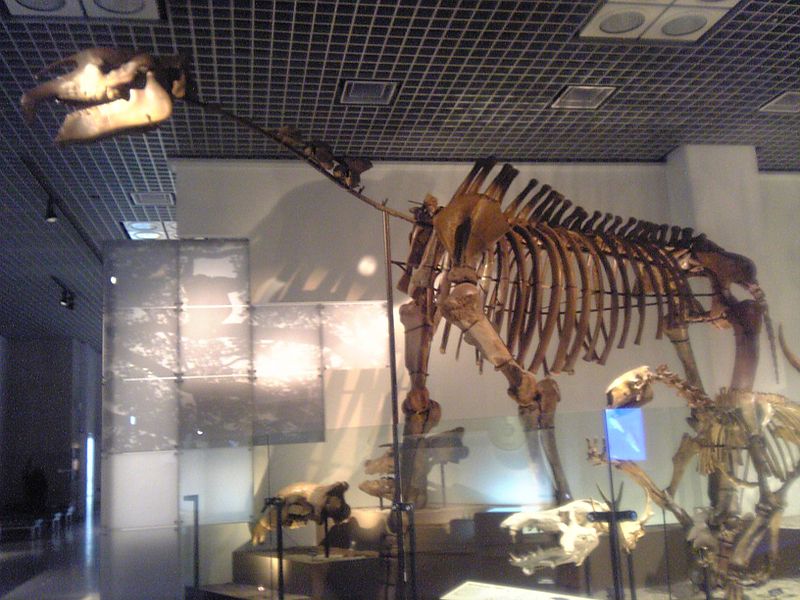
This is it. This is the big one. No, really, I've ended this week with one of the biggest mammals of all time. Anyone who knows their paleos probably saw the grand finale coming from a mile away. For those of you who have no idea what Baluchitherium is, however, feast your eyes:


The behemoth above is a titan among titans. It is one of perhaps a few different indricotheres, or "holy CARP that is a big mammal." Just like with the Elasmotherium, indricotheres were related to rhinoceroses. We're pretty sure this one was a browser, making this gigantic beast the unofficial bastard child of a rhinoceros and a giraffe. Its name comes from the first specimen being discovered in Baluchistan, Pakistan. It lived during the Oligocene epoch- 34-23 million years ago. It probably inspired a great deal of monsters if any survived alongside humans.

The first thing that one will notice when researching indricotheres is that the classification is very, very hazy. The species are distinguished by subtle skeletal differences. Paleontologists debate whether this is sexual dimorphism, maturity, or indeed different species from the same genus. Thus the same creature (more or less) has different names, including Baluchitherium, Paraceratherium, and Indricotherium. It's hard to identify distinct species when they can't make babies anymore. We think they're all the same genus.

Baluchitherium was the largest land mammal known. It averaged 5 meters (16 feet) at the shoulder and 8 meters (~26 feet) from nose to rear. The image above showed exactly how small a human was relative to this beast. No matter how many measurements I give, it will not do this creature justice. Just...look at this thing:

From Wiki, and apparently taken at the Tokyo Natural History Museum. Japan really does have giant monsters.


As the largest land mammal ever, Baluchitherium has made quite a dent in popular culture. It has been featured on prehistoric nature shows, sure, but the influence extends beyond that. This behemoth was the inspiration for the AT-AT Walkers in Star Wars, and it shows. The Digimon "SkullBaluchimon" is unfortunately a misnomer; it just barely looks like Baluchitherium, although its backstory as being made of counterfeit fossils justifies the dissimilarity. Does this mean we would be any less scared to encounter a Baluchitherium, much less a digital skeleton of one, in a dark alley? Of course we'd still be scared shitless! This is the biggest mammal in Earth's history, dead or alive.

It'll haunt you in your nightmares, too.


Saturday, February 2, 2013

Newsflash: Tapeworm Eggs Found In Prehistoric Sharks.

Although it's easy to focus on giant mammals for an entire week, here's a small reprieve: parasites have been around even longer. (Actually, I couldn't find too many newsworthy things related to ancient mammals.) Tapeworms have been found in the body of a shark from the Permian, a time when mammal-like reptiles were a thing. That was before the dinosaurs, in case you aren't up to snuff with your periods of Earth's history.

The tapeworm cysts were found in the gut of  a 270-million-year-old fossil shark. Given the presence of Brazilian journals, we can safely assume that it was found somewhere in South America.

"Remains of such parasites in vertebrates from this era are rare- of 500 samples examined, only one revealed the tapeworm eggs. This particular discovery helps establish a timeline for the evolution of present-day parasitic tapeworms that occur in foods like pork, fish and beef.

The fossilized eggs were found in a cluster very similar to those laid by modern tapeworms. Some of them are un-hatched and one contains what appears to be a developing larva. According to the study, "This discovery shows that the fossil record of vertebrate intestinal parasites is much older than was previously known and occurred at least 270-300 million years ago."

The fossil described in this study is from Middle-Late Permian times, a period followed by the largest mass extinction known, when nearly 90% of marine species and 70% of terrestrial species died out."- source.

It's kind of humbling to know that tapeworms have lived so long. If you know absolutely nothing about parasites, you know that some parasites have super-specific life cycles. Tapeworms have survived so long precisely because they are simple. Humans can get fish tapeworms, pork tapeworms, beef tapeworms...you name it. The tapeworm is not picky, which explains its amazing endurance over eons.Versatility tends to win out in the long run.

Parasite fanaticism over. Back to your regularly-scheduled mammals. Speaking of, happy Groundhog Day!

Friday, February 1, 2013

Megafauna Week: Elasmotherium.

Ah, unicorns.  What would be cooler than meeting a unicorn? Wouldn't it be awesome if unicorns were, y'know, real? Then that unicorns VS zombies book would actually have some merit, and bronies would not be up in our faces anymore.

The good news: Macro Polo saw one. Here's what he wrote:

They have wild elephants and plenty of unicorns, which are scarcely smaller than elephants. They have the hair of a buffalo and feet like an elephant’s. They have a single large black horn in the middle of the forehead . . . They are very ugly brutes to look at. They are not at all such as we describe them when we relate that they let themselves be captured by virgins, but clean contrary to our notions.

It has long since been decided that Marco Polo was describing a rhinoceros, not a pretty white unicorn found on some chick's binder. Still, fossil evidence suggests that the traveler may have been onto something:

Chaaarrrlliiiiieee!


If the narwhal and oryx were not inspiration for the unicorn, one might suggest fossil evidence of the Elasmotherium, a relative of the rhinoceros. It lived from the Pliocene to the Pleistocene, and may have been around as recently as 50,000 years ago - old enough for a few people to have seen it and drawn it in caves. They spanned much of Asia and into Europe.

The most outstanding trait of this giant herbivore was the single horn on its face. Although "unicorn" or "monoceros" may refer to almost anything with one horn, only Elasmotherium has the horn placed right where the modern notion of "unicorn" has it - on the forehead. It was characterized as being capable of galloping based on having longer legs than most rhinoceros-like animals. We think it ate grass like a horse, too. Even with narwhals and oryx around, the Elasmotherium strikes one as a very likely basis for unicorns indeed.

Cave drawing from France.


So just how big was the real unicorn? Think 15-16 feet from head to tail. A basketball player could barely reach the top of its shoulder. It weighed 3-4 tons. Although far from the petite, slender creature depicted everywhere nowadays, Elasmotherium was still pretty amazing as far as unicorns go. Sorry, Twilight Sparkle was completely made up.

Cheer up, fantasy fans. Unicorns were once real. Sure, they weren't the prancing ponies we know today, but they were still around. The best part is, you'll never see a Christian arguing that unicorns never existed; they're in the Bible.