Showing posts with label parasites. Show all posts

Tuesday, March 12, 2013

Creature Feature: Cymothoa exigua.

This blog keeps saying that horror movies need more biodiversity. There are too many shark, crocodile, and snake movies out there. The world is full of untouched terrors that would make great movies, but simply aren't as "classic" as giant, scary predators.

Well, we had no clue this one had a horror flick until it was found in a video store:


After looking at some reviews, The Bay may actually turn out to be a good one. It's been called "eco-terror" and has enough basis in reality to warrant a bio-art entry. The biggest flaw I've seen in reviews are the "found footage" effects. The basis for that movie is equally terrifying:


Source.


You, dear reader, are probably in denial of what you are actually seeing. That is indeed a small crustacean inside the mouth of a fish. In fact, that crustacean is so deeply embedded into the fish's mouth that it has actually replaced the fish's tongue.

The real name of this Saw-tier horror is Cymothoa exigua. It primarily parasitizes snapper species found in Costa Rica, but the range of hosts may be expanding. It is also known as the "tongue-eating louse" for obvious reasons. The louse first extracts out of the fish's tongue, effectively numbing it, then sits its lousy rear right where the old tongue was, attaching itself to the membranes thereon. The isopod then becomes little more than a tongue with eyes: its limbs atrophy, it becomes a little more swollen, and so forth. The fish can use the new critter just like a regular tongue, and the isopod gets delicious mucous and other non-horror-flick munchies and a ride. This is the only known instance of a parasite replacing an entire organ - so far.

Hey fish, wanna free tongue piercing? Some stupid fish say "yes."


Here's another fascinating thing: only the females eat the fish's tongue. The males have to live in the gills, which is also probably not pleasant for the fish. They are technically born males, with only the largest of the bunch swimming off and becoming little more than a tongue with eyes. The new tongue-lice have to find a host fast. Nobody ever said life as a tongue was easy.

Remember that pic where the giant isopods wanted our Doritos? Yeah. Apparently, if this continues onto land, they will get their Doritos...by replacing our tongues. Then they'll have alllll the salty snack foods that giant deep-sea crustaceans crave. We wish more horror flicks could get that creative.  Have a nice night!

Saturday, February 2, 2013

Newsflash: Tapeworm Eggs Found In Prehistoric Sharks.

Although it's easy to focus on giant mammals for an entire week, here's a small reprieve: parasites have been around even longer. (Actually, I couldn't find too many newsworthy things related to ancient mammals.) Tapeworms have been found in the body of a shark from the Permian, a time when mammal-like reptiles were a thing. That was before the dinosaurs, in case you aren't up to snuff with your periods of Earth's history.

The tapeworm cysts were found in the gut of  a 270-million-year-old fossil shark. Given the presence of Brazilian journals, we can safely assume that it was found somewhere in South America.

"Remains of such parasites in vertebrates from this era are rare- of 500 samples examined, only one revealed the tapeworm eggs. This particular discovery helps establish a timeline for the evolution of present-day parasitic tapeworms that occur in foods like pork, fish and beef.

The fossilized eggs were found in a cluster very similar to those laid by modern tapeworms. Some of them are un-hatched and one contains what appears to be a developing larva. According to the study, "This discovery shows that the fossil record of vertebrate intestinal parasites is much older than was previously known and occurred at least 270-300 million years ago."

The fossil described in this study is from Middle-Late Permian times, a period followed by the largest mass extinction known, when nearly 90% of marine species and 70% of terrestrial species died out."- source.

It's kind of humbling to know that tapeworms have lived so long. If you know absolutely nothing about parasites, you know that some parasites have super-specific life cycles. Tapeworms have survived so long precisely because they are simple. Humans can get fish tapeworms, pork tapeworms, beef tapeworms...you name it. The tapeworm is not picky, which explains its amazing endurance over eons.Versatility tends to win out in the long run.

Parasite fanaticism over. Back to your regularly-scheduled mammals. Speaking of, happy Groundhog Day!

Saturday, September 15, 2012

Creature Feature: Bed Bugs.

"Good night. Sleep tight. Don't let the bed bugs bite!"

Hahaha. As I've been finding out recently, easier said than done. We have bedbugs or something else. I want to say that it's some sort of mite, but for now, let's look at bed bugs. (I will make another entry on mites if need be.) There is more to them than meets the eye.


The term "bed bug" usually refers to Cimex lectularius, the common bed bug that feeds on human blood. It can, however, refer to any member of the genus Cimex or even the whole family Cimicidae. Bed bugs are found everywhere and have been feeding on humans for millennia. Don't feel too bad about finding them in your house - you're just a few generations behind.

The bed bug has to be one of the most durable little insects ever. They do not really care how hot or cold things are; too cold and they just hibernate. Bed bugs do not care whether your house is clean or dirty. All they want is your blood and a place to hide and reproduce in. That's really all they need: Food, shelter, and sex.

Oh wow. Yes, let's talk about bedbug reproduction for a moment. It's...special.

Pic by Rickard Ignell.


All bed bugs mate through something called "traumatic insemination." While taking that literally might just translate as "rape" to most people, it is a very special kind of rape in scientific circles. Some animals do not have openings for a penis to go into, so the male inserts himself wherever he pleases into the female's flesh (and thus blood). That is how bedbugs get knocked up: by having the male pierce the female's exoskeleton with his hard-on. Face it: Even the kinkiest people wouldn't find that kind of penetration sexy.

So, how do you know if you have bed bugs in your house? Well, seeing one or getting repeated blisters for no good reason are fairly sound signs. Dead bed bugs apparently smell like raspberries, so if you aren't a fan of raspberries and randomly smell them, that's a pretty good hint, too. Get an exterminator; they might even bring a bed bug-sniffing dog along. Bed bug attacks have been on rise rise, so have the number handy. Just remember that the females get a really raw deal.

Wednesday, July 11, 2012

"They Actually Eat That:" Worms.

Eating worms is usually a gag in American culture. There will always be that one kid who ate earthworms on the playground. There's even a dessert using gummy worms and Oreo crumbs to platy with the novelty of eating worms.

But could eating worms seriously be good for you?


According to scientists (including an old teacher of mine), sure! Worms of all types come into contact with bacteria that support a healthy immune system. Actually, the act of putting all kinds of foreign objects in one's mouth helps build a healthy immune system - especially during childhood. That kid who ate worms was onto something.

Our  industrialized society has the curse of being too clean for its own good. Children are told not to put things in their mouths, whether it be dog crap or something they left on the floor. This prevents them from getting exposure to foreign things -bacteria and the like- to which they can build an immunity.  Furthermore, the use of too many soaps and disinfectants creates antibiotic-resistant strains of bacteria. There is such a thing as too clean, and it's a lot more widespread than lutefisk.


Aside from eating regular worms to prevent immune problems later in life, eating other worms has its own benefits. Hookworm therapy is becoming a huge thing. Don't worry, species that regularly infect inhuman animals are used. Again, this works because industrialized society is too clean for its own good. Not saying go back a century, but don't try to sterilize your world, either.

How does it work? A protein called IgE can be held responsible for many autoimmune diseases, including allergies,  arthritis, and even a few cancers. The same protein is responsible for handling parasites. By introducing a harmless parasite into the body, these immune proteins have a target to attack. One man went all the way to Thailand just to get some worm eggs. It saved him from a premature death via a malfunction in another protein. Overall, it might not be bad to be infected.

So, go ahead. The earthworms aren't going to hurt you. Grab a few and try some.

Friday, May 25, 2012

Creature Feature: FLEAS.

Hooo boy. For those of you with cats and dogs out there, flea season has started in the northern hemisphere. Expect to see a lot more scratching than usual. Be prepared for vet visits and flea sprays/soaps. You've been warned.


That said, fleas (order Siphonoptera) are fascinating as creatures. Because of their prevalence on birds and mammals, there have been extensive studies done on fleas. They are found virtually everywhere, so there is no shortage of specimens. Roughly 2000 species have been identified, each of which has its favorite host. Yes, humans can have fleas, too. The ones that infest pets are in the genus Ctenocephalides.

As most of us who have furry friends have no doubt noticed, fleas are fast. They can jump up to 18cm vertically and 33cm horizontally - that's 1200-2200 times their own body length. They are slender, too, making them very aerodynamic. No matter how much of a nuisance they are, that's pretty impressive, especially for an insect.

Along with being fast, fleas are very hard to kill. They have evolved super tough, bristly exoskeletons. Remember, this is an animal designed to hang on while being scratched by an angry dog or cat. Even human fingertips can't squish these guys. The best ways to kill fleas are tape, wax, and somehow managing to catch the flea in your fingernails. Oh, and of course, flea removal products (which even then require killing at two stages in the life cycle). Did we mention that fleas can reproduce asexually? No? Now you know.


Fleas feed exclusively on blood. They seek warm-blooded animals like birds and mammals, like most hematophages prefer. Even as larvae, they eat the sanguine feces of the adult fleas, making one wonder how this vicious cycle got started. With over 2000 species, each one can pick on a very specific host. Cat fleas are different from dog fleas are different from human fleas, so no, your dog's fleas won't get to you.

It is usually very easy to tell whether your pet has fleas or not. They start scratching like crazy to the point where they may lose patches of hair. Basically, if your cat or dog starts acting abnormal and scratches a lot, fleas are probably to blame. In the worst-case scenarios, they may develop anemia. Still, if flea-crippling products do not suffice, please take your pet to the vet. It could be allergies or mange if it isn't fleas.


Of course, fleas are fairly popular in movies and TV...mostly as nuisances. They are often imagined as having little, anthropomorphized populations on dogs or cats. Some, like P.T. Flea from A Bug's Life  or The Flea from Los Luchadores, have more important roles than chewing on a dog's rear. Like it or not, fleas do impact human life quite a bit, and they're probably here to stay.

Thursday, May 17, 2012

Creature Feature: Loa loa.

Part of the reason these entries have been so very delayed has been my fairly sudden, but completely foreseeable, interest in the Shin Megami Tensei franchise. That series has a whole compendium's worth of monsters from around the world, including the loa, a spirit from African folklore and voodoo rituals.


No, not all loa look like that. After a quick glance, loa are a lot like Greek daimones or angels - spirits between humans and God. I have yet to see a description of a loa resembling a bad goth tattoo attempting to be edgy, but if such a loa does exist, it would explain why Loa loa is the scientific name of the African eye worm.

Infinitely more terrifying than a skull-snake. Thank stanford.edu.


Yes, that is exactly what it looks like: A worm in a person's eye. Loa loa is a parasitic roundworm spread through horsefly bites. It is mostly found in Africa and India; please bring bug spray if you ever go to either of those places.The best way to avoid Loa loa is to avoid the bites, obviously.


Loa loa is spread entirely via fly bites. Specifically, they love using horseflies and deerflies (which are a type of horsefly) as vectors. Deerflies are vampiric like mosquitoes, yet suffer only a fraction of the hate. An infected fly bites a human, the larvae develop in the human, and another fly gets the same stage inside it. Then that fly infects another human. We're just the daycare center for those little worms while they breed. Even without the eye thing, that's a little bit nasty.

Because in your eye and blood is a LOT creepier than through your skull.


The presence of a Loa loa traveling through the eye is usually one of the first signs that somebody is infected. Otherwise, the most they feel is joint pain, called Calabar swellings, when the little larvae get stuck in one place. There are also some subtle disturbances in the lymphatic system and lungs in intense infestations. Like most parasites, Loa loa tend to be subtle. Until, of course, the worm appears in somebody's eyeball.

If symptoms persist, the host may die, but most of us are sensible enough to see a doctor for a freakin' worm in the eye. Really, that moment is not a good time to be a belonephobe. The worms can be surgically removed and/or slowly killed by diethylcarbamazine or Ivermectin. That doesn't mean that being infested with worms will not make one suspect voodoo afoot.

Monday, January 23, 2012

Bio-Spot: The Meguro Parasite Museum.

Hello, Monday! Monday is Bio-Art day, but this Monday also starts "Big In Japan Week." That means every single entry will relate to something from Japan. This entry is no exception. (I decided to change it from "bio-art" to "bio-spot" for this one simply because not everyone would consider gift shop trinkets and a folded giant tapeworm artwork.)

As Bogleech rightfully pointed out, Japan is more fascinated with life than any other nation I've been to. Both the adults and kids were excited to see "Lion-san" at the Ueno Zoo. Apparently, they have a stronger science curriculum as well, covering all sorts of life forms that schools in the U.S. will not touch. They also possess the world's only known parasite museum. 


 Meguro is a suburb of Tokyo that has spectacular cherry blossoms every year, but the Meguro Parasitological Museum by itself attracts attention. It was established entirely by doctor Satoru Kamegai in 1953. Since then, it has been grossing out Westerners while proving one of Japan's most popular date spots. Only in Japan would they consider posing near a giant (8.8 meter) tapeworm an idea for a good date.


The museum is divided into two floors. The first has maps showing where certain parasites come from, as well as a general overview of parasites. The second sports all sorts of parasite specimens, showing their various life cycles and, sometimes, fully-preserved hosts. Somewhere, there is also a cafeteria with sushi. We do not think they deliberately put anything in there to go along with the theme, but after seeing the sorts of things that live in fish, it may be better not to eat the sushi. No offense meant.

So, where does the 'art' come into this? Parasites are extremely hard to take care of in a laboratory setting. That means that many specimens have to be mounted, which Japan happens to be good at. That tapeworm is more impressive folded like that than it would be in a jar, right? Plus, hey, they made a tapeworm T-shirt and sealed actual parasites into plastic. Stop making me want to go back to Japan, Meguro.

As the official site says: "Try to think about parasites without a feeling of fear, and take the time to learn about their wondrous and resourceful way of life." Good advice!

Tuesday, January 3, 2012

Creature Feature: Ribeiroia


Wait. Frog Week is done. Why is there another frog up here? Can't we look at the Indus River Dolphin or someth-


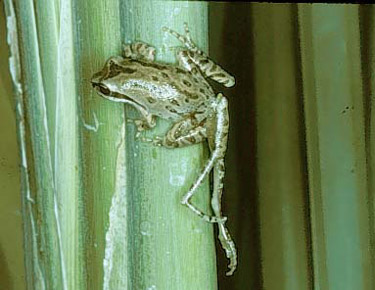
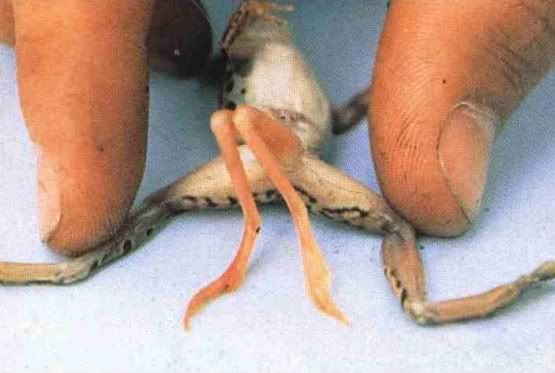
Oh, snap. Those extra limbs are freaky. These are the frogs that were made into malformed skeletons for MALAMP. As the bit for that project said, these multi-limbed frogs are mostly found in North America - i.e. many of our backyards. They are getting more and more numerous every year, so we should probably learn about what causes them.

Prior to the discovery of a parasite in the frogs, people assumed that the freakish limb deformations were mankind's fault. We were thinking that these freaks were the result of nuclear waste, mercury, or some other sort of pollution-related mutagen.  Today, we still haven't quite ruled pollution out, but we have changed our prime suspect to this:


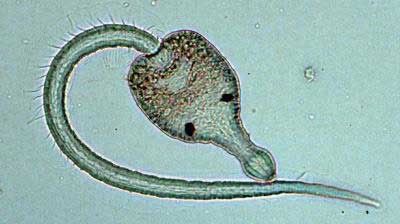
Without bringing toxic waste into the picture, multi-limbed frogs are typically caused by a parasite called Ribeiroia. There are three species- one in North America (R. ondontrae), one in Guatamala and the Caribbean (R. marini), and one in Africa. All of the above are parasitic flatworms that infest frogs to further their life cycles. They are usually found in freshwater ponds and wetlands (you know, places where there are frogs).

Like many parasites, the life cycle of these little flatworm is surprisingly complex. Ribeiroia starts out in the gut of an aquatic snail, then reproduces asexually into flagellated juveniles. These little not-sperm then find a tadpole and encyst themselves into what would be the tadpole's legs. It is suspected that this is done because frogs thus deformed are more likely to be eaten by birds (who will then complete the cycle by depositing the parasite's eggs). The alternative explanation? There is no God.


Monday, August 22, 2011

Bio-Art/Myth Week: Shiki.

Permit me to nerd out for more than a minute. Yes, Kuro is an anime fan, and yes, some anime qualifies as bio-art in the simple definition that it combines life sciences with art.


Such is the case with Shiki, a novel written by Fuyumi Ono and manga-fied by Ryuu Fujisaki. Semi-long story short, Sotoba, a rural town in Middle of Nowhere, Japan, suddenly gets an epidemic of summer colds caused by vampire bites. The local doctor soon figures out that the strange cases of anemia going around the village are not a 'natural' occurrence. Shit hits the fan and scatters in EVERY direction. That trope "Anyone Can Die?" We mean it here.

Hoo boy, are there a lot of ways to dissect Shiki (pun not intended). I've looked at it as a Japanese take on a normally Western creature; I've looked at it as an encounter between two sentient races (as expected, it does not end well); I've watched it several times just to take (horribly detailed) notes on this particular type of vampire; hell, there's even a way to look at it as a massive, supernatural analogy for the music industry. This will focus on the science, but no doubt some other things will slip through as well.

Pictured: SCIENCE!


The scientific facets of Shiki hit the reader/viewer hard from day one. Although most vampire stories have an occult doctor (a staple of the genre since Carmilla - a lesbian vampire story which predates Dracula), Toshio Ozaki goes above and beyond by giving us extremely descriptive details of exactly what these vampires are doing. Two different types of anemia and the term "hematocrit" come up within the first two episodes. One of the vampires tries to excuse her nocturnal behavior by passing it off as a form of lupus. Daaang.

Is having pitch-black eyes part of your skin condition, too? All right then!


Just about the only thing dubious about the research that went into this series is Toshio's repeated diagnosis of "bug bites;" vampire bites look a loooot more like pit viper bites, and Japan's most common snake is the hemotoxic mamushi. No reason not to TRY the antivenin, which is supposedly so common that police boxes have it. Nobody tries to make a vaccine throughout the series, either. A few of the reactions were off, but the research was solid.

That was all just background for the only vampires I have ever seen work. Ever.

Left: Anime screenshots. Right: Actual Plasmodium falciparum.


Shiki are caused by a parasite that looks and acts a lot like Plasmodium falciparum - the organism responsible for 90% of all fatal malaria cases. The main differences are the tweaked incubation period (4 in the living body and 4 in the corpse - still a total of 8 before it really takes over) and that P. shiki has flipped the mosquito the bird. Wow, mosquitoes, even malaria hates you now.

"Fuck off!"- sincerely, Plasmodium.
 

There are a number of reasons why something might evolve away from using a mosquito as a vector. Bats eat you, dragonflies eat you, and all it takes is one good bug net to keep you out. There is also some sort of weird internal clock that times things such that the Plasmodia all burst out of the red blood cells at the exact time of night the human body's fever is at its highest and pray that the scheduled mosquito has not been eaten by a bat. Otherwise, it cannot continue its life cycle properly. Screw that.

The (fictional) Plasmodium shiki has taken the mosquito out of the equation by using a human corpse as a vector instead. This would logically have started with a mind-numbed corpse (either resurrected by slowly rewiring circuitry or numbed a la datura) only capable of biting other humans as a means of furthering the parasite's reproductive cycle. Over time, the species would have been selected to keep the memories and personality of its host. Easy food is easy.


Almost everything strange about vampires can be explained by the behavior of a Plasmodium parasite. Plasmodia are blood-borne; the resulting organism has a modified, thinner integument that burns easily in sunlight; the weakness to stakes is, well...almost anything would die by being staked or beheaded. That internal timer was set to shut off as soon as the sun rises, then reactivate when the sun sets.

There are a number of things that are still a touch hard to explain. For example, no extant mammal has retractable injecting teeth. The parasite either recalls ancient genes (atavism- it happens) or constructs the fangs itself via differentiation. Also, we don't know how the parasite does this, but it has activated infrared vision in human corpses (which makes sense; mosquitoes and vampire bats both use infrared to detect warm-blooded prey). There are still a few fantastic elements, but they can be figured out well enough to make solid bio-art/hard fantasy.

Teeth BEHIND the corpse's.


As an anime series in particular, Shiki's pacing is horrible. Do not be fooled by the Shounen Jump label; the additions to the series that make it, ah, shounen-friendly are noticeable. There are some cultural things that the average person will miss, but are fun Easter eggs for those with eyes to see. I'd be lying if I said I didn't thoroughly enjoy Shiki. Swear my parasite nerdiness and Chizuru's rack are not the only reasons.

I'm onto your blood-perfume, Gaga.


Now, if you all will excuse me, I have a tin hat to put on. Google is watching me sleep.

Monday, March 14, 2011

Creature Feature: Malaria.

Malaria is one of those diseases that one only hears about in third world, tropical countries (but used to be more widespread). Most people only know that it is spread by mosquitoes and that it really, really sucks to get because there is no real cure. This is the tropical disease that single-handedly renders nations poor and incapable of economic recovery. It's that bad.

Actually, this is kinda cute.


Oh, and it's a critter. Not a virus, not a bacterium, a single-celled critter commonly called a protist. More accurately, any disease caused by a microscopic organism called a Plasmodium can be called "malaria." There are several Plasmodium species that can infect humans including P. falciparum, P. malariae, P. ovale, P. vivax, and P. knowlesi. P. falciparum is the one that most people are worried about, although any one of the above will at least ruin your year.

While most parasites try to make their presence as innocuous as possible, malaria does not even try. It can incubate for up to a year without any noticeable symptoms, but after that, its presence becomes known very quickly. This is not a friendly parasite; it makes a tapeworm look like a good neighbor.

 
Yeah. Kinda like this in comparison to malaria.

The symptoms of malaria vary slightly from species to species. Common indicators are fever, chills, and headaches. If left untreated, the spleen may also swell (do you know where your spleen is?), and, eventually, the parasites can cross the blood-brain barrier, causing coma and death. Since some  parasites use the liver as part of their life cycle, thorough tests for malaria require both blood and liver examinations.

Malaria starts its life in the gut of an Anopheles mosquito. The mosquito bites an infected human, sucking immature plasmodia into her gut. They mature slightly into sporozoites and travel to her saliva. Then, she is ready to bite and start the cycle again. We realize that one mosquito may well look like the next to most of you, but please be on the lookout for this one:


Once inside a human, the sporozoites (the wormy things from earlier) rupture, releasing countless merozoites. These swiftly infect red blood cells and reproduce asexually within them. P. falciparum goes for the liver before heading towards the blood; when the infected liver cells burst, the malaria then goes for the erythrocytes. In short, these are protozoans that reproduce like a virus.

This might actually make a bitchin' roller coaster.
 

Over time, there have been a number of "cures" for malaria. The first was quinine, a substance originally found in the cichona tree in the Peruvian Andes. Several other drugs, including fakes common in Asia, have since been developed, but Plasmodium protists gain drug resistance just like bacteria and viruses do. They evolved with us and will continue to evolve with us.

We're fucked.


Tomorrow: It looks like a kingsnake, but it swims!

Friday, January 7, 2011

Creature Feature: Cordyceps.

Have you ever wondered how certain health foods got their starts? Whose smart idea was it to climb an insanely high tree to pick the first acai berries? Granted, these things take balls, warranting a high price tag, but some other health foods make one wonder who had the idea.


Fungi of the genus Cordyceps is are among those things. The YouTube search listing for Cordyceps has both "killer fungus" videos like the one up there and "Cordyceps is a superfood" videos. It is darn near impossible to imagine someone looking at the insect below and saying, "hey, let's eat that!"


Superfood?

Cordyceps fungus is exactly what David Attenborough says it is: An endoparasitic fungus that uses insects as its host. (These can include cicadas, thus explaining where the idea for the Pokemon Paras came from.) There are over 400 species of Cordyceps, but the most well-known of these is Cordyceps sinensis - also known as the caterpillar fungus. Surprise, surprise; it's part of Chinese medicine.


Different species of Cordyceps use different insects as hosts. Some, like the ant shown in the video, are brainwashed before the fungus feeds off of their corpse. Climbing a branch like that goes against every instinct the ant has - oh, and it looks like it's on drugs, too.


Duuuude. It's, like, a mushroom cloud!

Cordyceps is one of the many parasites that influences the behavior of its host; yes, there are more parasites that use brainwashing techniques far more effective than any psychologist's prescription. They try their darnedest to make babies, and if our brains are in the way of that, they'll screw that ball of neurons and glia good. This makes us pretty darn sure that Lady Gaga is a legitimate artist and not an alien spreading space Cordyceps around the world. Given the rather...extreme claims about Cordyceps, however, we would not be surprised either way. (Remember: A lot of human habits VERY CLOSELY PARALLEL INSECT BEHAVIORS.)

I've had chocolate Cordyceps. They aren't that great.


Before 1993,  the Western world was scarcely aware that this bizarre mushroom even existed. It was brought to the world's attention after three Chinese athletes broke five world records at the Olympics in Beijing, China. After it was revealed that the athletes had been doing 'shrooms, not steroids, the value of Cordyceps increased by 200% over the course of ten years. Research on Cordyceps has since shown that it may be able to cure diabetes, serve as an antidepressant, and even prevent organs from being affected by radiation.

Or maybe that's what the Cordyceps fungi want us to think.

Wednesday, December 1, 2010

Creature Feature: Twisted-Wing Parasites.

There are a million parasitic bugs in the world. They are fascinating, mortifying creatures that make us not want to live a bug's life. For many cases of parasitism, we can sympathize; after all, humans can have worms inside them, too. Other parasites can be, well...twisted.


The handsome fellow up there is from a family of insects known as Strepsipterans. If one just happened to encounter an insect like that, one would probably think that it was just some sort of fly. Strepsipterans are, however, very, very different from flies...as well as most other insects.

Strepsipteran parasites all start life as highly mobile larvae. The grubs have little legs (triungulate) to help them better seek out a host, usually a wasp or bee in North American species. They enter in through a host's foot, abdomen, or eggs, and then proceed to lead horribly sexually-segregated lives that would make any feminist scream bloody murder.

Don't worry about how aerodynamic this creature is. The males only live for 5 hours anyways. 


The family name "Strepsiptera" means "twisted wing," and no name could be more apt to describe the adult males of the species. Strepsipteran males have hind wings like giant fans; when at rest, they are twisted over the male's back, hence the name.


Although the wings are pretty darn weird, more people are interested in the male's hairy, blackberry-esque eyeballs. Most insects have multifaceted compound eyes, but the eyes on these parasites are composed of dozens of individually-functional eyes. This has only been seen in trilobites; no other extant animal has eyes like these twisted males.

Body Part #23 - The Strepsipteran female.


The females, although less mind-bogglingly bizarre, are still strange in their own right. Females never leave their hosts; they remain without wings or legs in between the plates of their host's exoskeleton. They have only their faces sticking out of the host's plated armor, so the male has to pierce her neck with his penis. Don't look so disgusted; quite a few insects (including bed bugs) do this. It does, however, look a lot like inter-species sex gone horribly, horribly wrong.

The closest relatives of these trippy parasites are still up for debate. They were originally thought to be related to some families of parasitic beetle (which will get their own entries some time), but Diptera (common, two-winged flies) and Lepidoptera (butterflies and moths) have come up as well. This family is a puzzle, even with genetic research helping to piece it together. Chalk it up with Hallucigenia as "we don't know what this is."

Friday, November 12, 2010

The Human Freak: Elephantiasis.

Warning: The following entry contains a link to some manparts. Shut up. You can see them on Wikipedia, too. 

Up until now, we have covered diseases and disorders that, for the most part, you cannot get. You either have them or you don't from the day that you are born. If you don't already have increased aging or fused legs, good for you. You can induce hypertrichosis if you like, but that's your call, not mine.

This is unlike everything else that I have covered so far in that it can happen to anyone. It is not genetic. It is not induced by drugs. All you have to do is get bitten by the wrong mosquito to end up like this:


The Taiwanese woman above is currently dealing with elephantiasis. It is so named because, yes, the end result resembles an elephant's foot.

If you're a guy, this disease will also swell your scrotum in a way that a sketchy drug you ordered online might. Yeah, your junk is going to be ENORMOUS, but it will also be filled with worms. NOT IN THAT WAY, I mean actual worms.

Picture linked here is NSFW. If you don't like male genitals, don't look.

The scientific community is honestly more interested in what this disease does to a man's junk than what it does to anybody's leg. That's sad.

Most forms of elephantiasis are caused by roundworms of various species (Wuchereria bancrofti, Brugia malayi, and B. timori), to name a few. These live in pretty much every tropical-subtropical region in the known world (i.e. you are bound to find ONE of them in the area if you ever want a tropical getaway). The larvae travel by mosquito. Their destination is the human lymphatic system.

It is not entirely certain whether the swelling in the legs and genitals is caused by the worms themselves or by the human immune system's response to the worms. Whatever the case, the bulging is like a beacon to mosquitos that says "bite me." They take a few larvae out of one host and stick them in another while sucking some blood in the process. (If you think this sounds like the botfly, it sort of is, but the botfly is at least motile on its own in one stage of life.)


There is no cure, but damn if people are not trying with this one. They have put out antibiotics, an anti-worm drug called albendazole (which looks like something from Taco Bell, but is a potent vermicide), and started mapping the genome of one of the worms in an attempt to cure this. You hear a lot of talk about cancer, arthritis, etc., but although a million scientists are working on those, I have not seen such a fervent movement towards completely wiping out a pathogen since smallpox. These people not just trying to treat the symptoms - they want the worms dead, dead, dead.


Kill on - oh, wait, we can only see these things under a microscope.

Or you could, y'know, eradicate the people harboring the worms in those parts. They are a vital part of the creature's life cycle. The mosquitoes FAR outnumber the humans and will keep reproducing even if humans are not around, but the worm needs humans to work. You want to stop elephantiasis? Stop humans. (Yes, I realize how callous that sounds.)

Wednesday, September 22, 2010

Creature Feature: Screw-worms.

(Warning: This entry is NOT for the faint of heart PERIOD. If you are squeamish, BACK OFF RIGHT NOW. Some of the pics I saw for this one made ME a little sick and I like to think that I have a strong stomach. Nature is not always pretty.)

So it's a zombie apocalypse. People are dying and un-dying left and right. You've got at least one gun and have barricaded yourself in the nearest Wal-Mart, although given the types of people who shop there, you wonder if maybe you were not better off with the zombies.


Braaains...and low, low prices on cheap craaap...

Then you remember that, wait a sec, there are a million things designed to feed off of dead tissue. Maggots come to mind (as vomit might to your throat). Whether they can feed off of undead tissue or not is another matter entirely. Regardless, there is another type of maggot that feeds on living tissue, so if you happen to be in Mexico-Central America when the apocalypse hits, you're safe either way. (There is another, almost entirely unrelated version of this one in other tropical parts of the world, so you're probably cool there, too.)


I am not zooming up on this pic. No, no, no.

Wait. Wait. I just said that there was a maggot that fed off of living tissue. How the hell is that safe and where's a can of bug spray?!

The New World screw-worm fly (Cochliomyia hominivorax - nice species name!) lays its eggs in a mammal's bleeding wound. Yes, it could lay eggs in yours - like I said in the Toxoplasma entry, humans are just another mammal to nature. Try to kill the babies and the little worms will screw themselves deeper into one's flesh (hence the name - but the scientific name is so cool). (For those of you who do not understand Latin, the word "homo, hominis" means human and "vorax" is a cooler way of saying "eater.")


(I actually could not find a good video with these guys; they seem to have all been removed for obvious reasons.)

A brief reminder of why flies lay their eggs on dead animals: The maggots are born on their food so that they can start eating immediately. That means that whatever the screw-worms are laid on is going to find itself with a much bigger wound than before.

Quickly.

Like most small animals and insects, screw-worm flies breed often and have a lot of offspring in one sitting. The larvae pupate after anywhere from 3-7 days after hatching. After another week or so, the adult flies are ready to mate - and how! Females are promiscuous, mating with as many males as possible while they can. Each clutch contains up to 400 eggs, which can hatch into flesh-eating larvae in 12 hours. Their whole life cycle lasts 31 days max, during which the female can lay at least 2,800 eggs.


To be fair, adult New World screw-worm flies are HUGE and easily distinguishable from other flies. Oh, wait, that's still not fair.

Opening up a wound naturally leads to infection and even more screw-worms. Creatures infected by screw-worms usually die within a week or two due to infection, severe tissue damage, or any other combination of icky factors. (Zombies usually have infected wounds already, so they're prime targets for future punishment from these little nibblers.)

While you may be thinking, "Eww, I hope this doesn't happen while I'm eating a taco," the main concern with these guys is the damage that they do to livestock. Yeah, you're on the list, too, but the primary reasons behind the screw-worm's notoriety are economic. (To give you an idea of how drastic a blow this could be, a screw-worm infestation could easily cost cattle farms in Australia 500 million (Australian?) dollars in losses.) You are awfully close to a cow and people are more worried about the cow, a creature that oh, by the way, is responsible for global warming and removal of precious rain forest. I like cows just as much as the next person, but really? This might be a warning sign.


This is from Brazil, but makes the point pretty well.

Some of you will probably be relieved to hear that the screw-worm has been officially eradicated in the U.S. and several South American countries. Beware; everything in an ecological system has a niche. Who knows? Perhaps screw-worms are nature's answer to the impending zombie apocalypse. (Or maybe she's just trying to say, "Get the fuck out of the tropics, ranchers!")


Nah, screw-worms were totally made to be zombie deterrent. Or Wal-Mart shopper deterrent, take your pick.

Monday, September 20, 2010

Creature Feature: Toxoplasma gondii.

If you have kept up with my dA page as well as this blog, you have probably noticed me watching a lot of Higurashi no Naku Koro Ni, an anime series based off of a phenomenally successful Japanese visual novel. One of the recurring themes later on in the series is a document that gets constantly debunked with the argument that no parasite could ever control a human mind.

My response to that: BAHAHAHA! That's a good one; I think I snorted pomegranate juice out of my nose. Joke's on you, suited motherfuckers! There are tons of parasites that do just that!
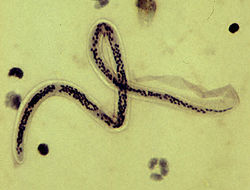
Ahem. Seriously, though? Your body has tons of parasites in it at this very moment. You are a warm-blooded mammal in proximity to many other warm-blooded mammals on a daily basis; that is paradise for any number of little critters. What on earth makes you less viable than a dog or cat as a host? For Ai's sake, there are two types of lice unique to humans - human head lice and human pubic lice. If complex invertebrates can evolve so specifically, imagine how many microbes have evolved just to feed on us.

Scary, isn't it?


Probably the most notorious brainwashing parasite is Toxoplasma gondii. Nature treats humanity like it's nothing special; T. gondii is really a cat parasite that just so happens to work for humans as well as several other animals.


It is as Ceiling Cat wishes.

T. gondii's life cycle starts out like something out of science fiction: First, the parasite infects a rat that has presumably had contact with cat feces. Then, in an amazing display of brainwashing, T. gondii removes the rat's fear of felines so completely that the rat is actually attracted to the scent of cat urine.


Suddenly, this makes sense.

As one may have expected, this leads to the rat getting eaten. The parasites then spend the rest of their lives in the cat's guts, mating and breeding there with few ill effects on the cat, until...


Toxy spreads like a YouTube meme: Through poop.

After being literally shat out of a cat's system, the cycle begins anew. Whenever a creature - including a human - comes into contact with cat crap, they risk acquiring the parasite.

Usually, it stays harmless; sure, the person may suddenly develop an affinity for cats, but otherwise it's nothing to worry about. It only kicks in when a human's immune system is weakened by pregnancy, AIDS or, well, any other method; then it becomes a potentially lethal infection called toxoplasmosis.


Pictured: A mild case of toxoplasmosis.

Toxoplasmosis attacks the glial cells in the brain. For those of us who are not neuroscientists, the glial cells help hold your neurons together and transmit a few signals of their own. They make up a very large percentage of the human brain - that's where that "you only use 10% of your brain" BS came from. The resulting infection thus has symptoms that resemble (and can be treated with medicine for) schizophrenia.

Schizophrenia is not MPD. As per Wikipedia, the typical symptoms of schizophrenia are "A person diagnosed with schizophrenia may experience hallucinations (most commonly hearing voices), delusions (often bizarre or persecutory in nature), and disorganized thinking and speech." It's a lot more than the name ("split mind") lets on.


Severe toxoplasmosis at its finest.

But that's rare, right? Y'know, it probably only occurs in Africa or some other non-developed areas of the world...right? Right?!

No. Half of the human population on the whole entire planet is infected with Toxoplasmosa. Crap!

Want more details? Click here.

By the way, if you think dogs are a safer option, they have their own set of bugs for you to deal with. You aren't safe anywhere.


Don't worry, Mittens. We can't stay mad at you.