Showing posts with label arthropods. Show all posts

Friday, January 11, 2013

Creature Feature: Trilobites- K. brutoni.

Of all things this blog has covered, trilobites have not been among them. We've done Anomalocaris, triops, and various other prehistoric shelled things, but never the classic trilobite. So, for the sake of a trilobite finally having its day in the sun, here:

Cambrian (early) trilobite.


For starters: what is a trilobite, anyways? Trilobites were a huge group of extinct arthropods. They came about before the Cambrian Explosion and lasted until the Permian Extimction (252.28 Ma). They took over the world, or at least the seas, during much of their time on earth; if a landmass was underwater up to the Permian, it'll have trilobites somewhere. We are still not sure whether these bizarre creatures were more closely related to crustaceans or arachnids. This is after finding millions of trilobite specimens. Just treat them as their own thing, for now.

Trilobites are by no means rare. There were millions of them in the prehistoric seas. They had four distinct orders and several hundred genera. It is possible to tell where a fossil formation is from just by looking at the trilobites. They came in all sorts of shapes and sizes, so they were able to fit a million different niches. Now, they're so common in fossil collections that rock shops sometimes sell them for cheap. By fossil standards, anyways.

The kicker is that there were so many different trilobites that I would feel guilty compressing them all into one entry. That said, I picked what I thought was the most...shocking...out of the trilobite species: Koneprusia brutoni. 

This is the TOP of the trilobite. (Credit: Wikimedia.)


K. brutoni was one of the most elaborately-decorated trilobites in existence. It lived during the Devonian in what is now Morocco. Its genus was a member of the order Lichida, which is notorious for spiny trilobites. These spines may have evolved to coincide with the advent of jawed fishes, but nobody really knows. Alas, despite its awesome looks, information on K. brutoni is very, very sparse.


This trilobite just looks badass. You could slap this thing on a heavy metal album cover and it would sell for the sheer WTF. It's one of those trilobites that has spines all over and generally looks like something from Alien. Regrettably, there have been no horror movies about giant trilobites...fund it. We need to break the alien/zombie fad going on.

From here. The price is exceptional for this excellent specimen.


So, what happened to all the trilobites, including K. brutoni? They slowly lost their ecological niches as time went on. Some people think that the last remnants might be horseshoe crabs and certain types of abyssal shrimp. Now trilobites are remembered as the generic "prehistoric bug...." and Kabutops, who remembers that trilobites were once badass.

I'll make YOU extinct!

Saturday, December 15, 2012

Newsflash: Gold-Mining Termites.

If you walk down a street or turn on the radio, there is a good chance you will hear/see at least one  advertisement offering "cash for gold." The idea is basically selling your jewelry and antiques to get money.

The thing is, gold is actually useful. Aside from being decorative and having a loooong history as a status symbol, gold is used in computers. It's a better conductor than copper. Functional and fashionable? How wouldn't that lead to money?

Looking for a way to get some easy gold? Well, it turns out that ants and termites are natural treasure hunters. Here's the scoop from National Geographic:

"New experiments in West Australia reveal that termites "mine" and stockpile the precious metal while they're collecting subterranean material for their nests.

For the study, entomologist Aaron Stewart, with Australia's Commonwealth Scientific and Industrial Research Organisation, and colleagues took samples from several termite nests and compared the nest material to nearby soil samples from varying depths.

By using a mass spectrometer—an instrument that measures molecules' chemical makeup—they discovered that the termite nests were richer in gold than termite nests farther away from the metal, Stewart said in an email. (Also see "Battling Termites? Just Add Sugar.")

"That social insect colonies can selectively accumulate metals from their environment has been known for some time," Robert Matthews, a professor emeritus of entomology at the University of Georgia, noted by email.

"Some have even suggested that ant and termite nests could be analyzed productively when searching for potential mining sites for precious metals" such as gold, he said.

Those are Stewart's thoughts exactly. Gold deposits are usually hidden a few meters below the surface, making them tough for people to locate. But insects could essentially act as indicators of this buried treasure, said Stewart, whose study appeared recently in the journal Geochemistry: Exploration, Environment, Analysis.

"Drilling is expensive. If termites can help narrow down the area that needs to be drilled, then exploration companies could save a lot of money."

~National Geographic. Source and more here.

The question is why the termites are hoarding gold. Zinc, as the article later details,  helps keep insect armor tough. Gold would seem to be far less useful to them, but who knows? Maybe the termites really regulate their mounds via supercomputers, or perhaps they just like shiny things despite being almost blind. So much like us!

By the way, don't sell your gold objects. Ever since the U.S. ditched the gold standard, the dollar has been backed up by faith. Faith in the government...riiiiight.

Saturday, September 15, 2012

Creature Feature: Bed Bugs.

"Good night. Sleep tight. Don't let the bed bugs bite!"

Hahaha. As I've been finding out recently, easier said than done. We have bedbugs or something else. I want to say that it's some sort of mite, but for now, let's look at bed bugs. (I will make another entry on mites if need be.) There is more to them than meets the eye.


The term "bed bug" usually refers to Cimex lectularius, the common bed bug that feeds on human blood. It can, however, refer to any member of the genus Cimex or even the whole family Cimicidae. Bed bugs are found everywhere and have been feeding on humans for millennia. Don't feel too bad about finding them in your house - you're just a few generations behind.

The bed bug has to be one of the most durable little insects ever. They do not really care how hot or cold things are; too cold and they just hibernate. Bed bugs do not care whether your house is clean or dirty. All they want is your blood and a place to hide and reproduce in. That's really all they need: Food, shelter, and sex.

Oh wow. Yes, let's talk about bedbug reproduction for a moment. It's...special.

Pic by Rickard Ignell.


All bed bugs mate through something called "traumatic insemination." While taking that literally might just translate as "rape" to most people, it is a very special kind of rape in scientific circles. Some animals do not have openings for a penis to go into, so the male inserts himself wherever he pleases into the female's flesh (and thus blood). That is how bedbugs get knocked up: by having the male pierce the female's exoskeleton with his hard-on. Face it: Even the kinkiest people wouldn't find that kind of penetration sexy.

So, how do you know if you have bed bugs in your house? Well, seeing one or getting repeated blisters for no good reason are fairly sound signs. Dead bed bugs apparently smell like raspberries, so if you aren't a fan of raspberries and randomly smell them, that's a pretty good hint, too. Get an exterminator; they might even bring a bed bug-sniffing dog along. Bed bug attacks have been on rise rise, so have the number handy. Just remember that the females get a really raw deal.

Sunday, April 29, 2012

Let's Go Spelunking: Cave Shrimp + Crayfish

(Apologies: I went to take a nap and wound up sleeping longer than intended. Come hither, Hell Week...)

Remember when I mentioned that cave creatures had a strange aesthetic to them? Well, to be more specific, creatures that spend their lives exclusively in caves tend to have a few features in common.  These include pale skin, poor or absent eyesight, reduced size, and enhanced senses of hearing, touch, and smell. In human terms, 3/4 isn't bad, nerds.

Lincoln approves of cave shrimp?


Enter the Kentucky and Alabama cave shrimp (Palaemonias). They are both native to the Southwestern U.S. as their names imply. Yes, apparently the South has a lot of neat cave life. They eat anything that washes into the sediments underground. (FYI: Since several kinds of shrimp do in fact eat dirt like this, they are probably not the healthiest seafood in the world.) As the picture above demonstrates, they are smaller than a penny.

Cave shrimp are a prime example of what happens to 'normal' animals once they adapt to cave life. These shrimp are not just blind - they're completely eyeless. They're pure white with translucent skin. If they ever left the safety of the caves, they would die in a heartbeat. Even as they are, they have predators in other cave creatures such as salamanders, raccoons, and equally-blind cave crayfish (a case of the blind eating the blind).


Yes, crayfish live in the caves, too. There are several species (Cambarus pecki in Alabama; Procambarus elsewhere), several of which live in Florida and all of which are endangered. They look a lot like cave shrimp, only bigger, nastier, and with pincers. Like the shrimp, their skin is so light you can see through it - who needs melanin when you live in depths in which nothing can see? It's amazing; we could have saved so much mess in biology if some smart soul had bred translucent crayfish for us to study.

Both species of cave shrimp and all cave crayfish are endangered. The main cause for this classification is poisoned groundwater. As we've said before, freshwater ecosystems are fragile. So are species that are highly adapted to one environment. Cave shrimp will probably not be around much longer, so enjoy them while you can.

Sunday, October 30, 2011

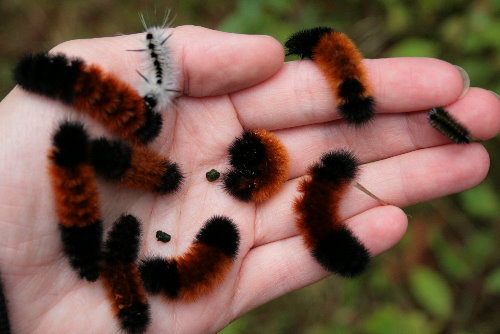
Creature Feature: Woolly Bears.


Oh! Look at that. It's a piece of somebody's Halloween costume that got left out in the woods. And...it's...moving?!

That moving chenille stem is actually a caterpillar of the Isabella tiger moth (Pyrrharctia isabella). Tiger moths are found all over the world, as are their animate pipecleaner larvae. Their fuzzy larvae, called banded woolly bears, are usually out in fall, which is somewhat rare for caterpillars. They are America's most recognizable caterpillar, enough so that Ohio gave them a festival.

Like all caterpillars, woolly bears eat vegetation. They can eat any and all kinds of vegetation. They may ingest certain plants to prevent flies from laying eggs in them, but these things are not monarch larvae. They will not hurt you if you pick them up - if anything, they will play dead, acting even more like a craft project leftover than they were before.


Woolly bears hatch during the fall. Just like real bears, they have evolved to hibernate during winter: their skin contains natural antifreeze that prevents the little caterpillar from dying. Come springtime, they wake up and eat any plants they can find while they are abundant. They become moths and mate during the summer.

Much like how groundhogs have Groundhog Day, the woolly bear has a weather-related superstition. Depending on the measurement of the red band, there may be more or less severe winter for the year. (It makes more sense to do this in Fall than in February - sorry, groundhog.) If the red-brown band on a woolly bear is thick, the winter will be mild. If not, well...happy Halloween.


From Flickr.

Sunday, October 9, 2011

Creature Feature: Deathstalker.

If you were shocked by the title, you are probably expecting something epic. Without looking the creature up, you probably think that it has skulls, a scythe, or, better yet, flaming skulls and a scythe. The name is that appealing to fans of "darker and edgier." Hell, why isn't this creature blessed with its own heavy metal band, yet?

It already has a B-movie.


Thing is, most venomous animals don't roll that way. Often, the deadliest things are tiny, inconspicuous, and sometimes even cute. The same goes for the deathstalker - you will NEVER see it coming.

From Wikipedia. :)
 

That's the deathstalker (Leiurus quinquestriatus), the deadliest scorpion in the world. It is native to Israel, Pakistan, Egypt, and other blisteringly-hot, politically-intense areas in that range.  Like most scorpions, it feeds on insects. Watch out for your shoes if you wander into its range.

The deathstalker has the most potent venom of any scorpion. One sting from it contains no less than 5 different neurotoxins. The sting is extremely painful and should be treated as a medical emergency. Antivenin availability varies from place to place, with French and German pharmaceutical companies making it regularly, but NO support from the USFDA. Even with a name like "deathstalker," the sting is only usually fatal to the immune-challenged.

Of course, people want this bugger for more than just antivenin. Along with those neurotoxins, valuable chemical agents dwell in the deathstalker's tail. Chlorotoxin, a peptide, has been shown to help tame brain tumors. A few other chemicals might regulate insulin, making this little scorpion a lifesaver to diabetics.

Source:Offbeatpets.com


This does not mean you should keep this scorpion as a pet. Deathstalkers are by no means a beginner's scorpion, but are often sold to anyone willing to pay anyways. Some smart, yet ruthless person figured out that people interested in arachnids miiight just want something called a "deathstalker," regardless of how dangerous it actually was.

Sunday, October 2, 2011

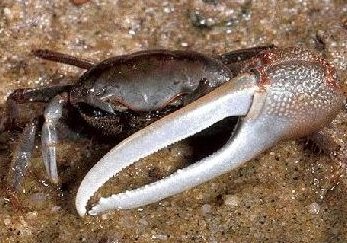
Creature Feature: Fiddler Crabs.

Look around at most crablike monsters. There will be a good chance that one claw is larger than the other. As in, possibly bigger than the crab's entire body. Since these are monsters we are talking about, they may even come with electric spikes or blades in between the two parts of the claw.

This is a particularly worrisome one.

Surely such a disproportionate crab can't be real. Just imagine a crab like that. It would lose balance all the time...right?


The hundreds of fiddler crabs (genus Uca) exist to prove you wrong. No matter how off-balance they may look, the male fiddler crabs do not tip over on a regular basis thanks to their massive claws. The smaller claw is used almost solely for bringing food (algae and bits of dead flesh) into the crab's mouth. The group is successful enough to inhabit the marshes, beaches, and mangrove swamps of the East Pacific, West Atlantic and Indo-Pacific.

Male fiddler crabs are all endowed with giant claws on one side or the other. They are so named because the smaller of the two claws sometimes looks like it is 'fiddling' the larger claw. Really, the smaller claw is just used for eating, making the fiddler crab one of the few animals that can eat and fight at the same time.


Besides engaging in combat with those massive claws, fiddler crabs are one of the few crustaceans out there with a sophisticated communication system. The crabs will often wave to each other with their large claws. Variations are made depending on visual distance. This is particularly true of courtship displays, which sacrifice feeding time and must be seen as soon as possible. This form of communication is almost like crab semaphore when studied closely. Maybe those PETA folk were onto something; that's pretty smart for a crustacean!

Mind, this doesn't mean that other crabs are ill-suited as monsters. I'm stunned that a certain other crab lacks more monsters, to be honest. More on that when the Week of the Abyss starts up, just in time for Halloween!


Thursday, July 7, 2011

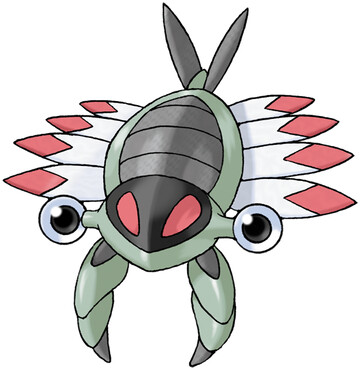
Creature Feature: Anomalocaris.

As you may have noticed, the authoress of these entries has a strange sense of cute. Planaria? Cute. Baby ball pythons? Cute (and velvety). Malaria vampires? Cute.

This thing? Cuuuuute!
Quick, someone scribble a heart in Paint above its head!

No doubt some of you are probably screaming and/or going "AAAAAHH, WHAT THE HELL IS THAT?" The authoress thinks it's one of the cutest things ever.

In all seriousness, the shrimplike creature above has been extinct for a loooong time. Its name is Anomalocaris, and it was all over the world's Cambrian oceans. At three feet long from head to tail fin, it was the largest predator to evolve at that point.


This puts king crab legs to shame...and it's not a leg.

We did not know exactly what Anomalocaris was for the longest time. It started when we found those two long feelers and thought that they were prehistoric jumbo shrimp. Then they found an independent ring-mouth and called that an ancient, toothy jellyfish. The body was also discovered near the mouth, but deemed a sea sponge. It was not until 1985 that someone put all the pieces together into the weird-cute shrimpy creature we know today.


Anomalocaris ate the ever-popular trilobites. Exactly how they ate trilobites is unclear. One would guess that simple biting would do it (and dents on some trilobite shells agree), but certain scientists say that the mouthparts of Anomalocaris could not break the trilobites' shells. The appendages in front of the mouth are thought to have helped crack open the little buggers instead. The actual mouth of Anomalocaris looks more suited to eating soft-bodied creatures like jellyfish.

Nomnomnom.


The lobe-fins on Anomalocaris allowed it to move swiftly through the water. They may look awkward, but they are actually quite hydrodynamic, moving the whole creature along like a very shrimpy stingray or flatfish.

See? CUTE.


What? Stingrays can be cute...

Thursday, March 17, 2011

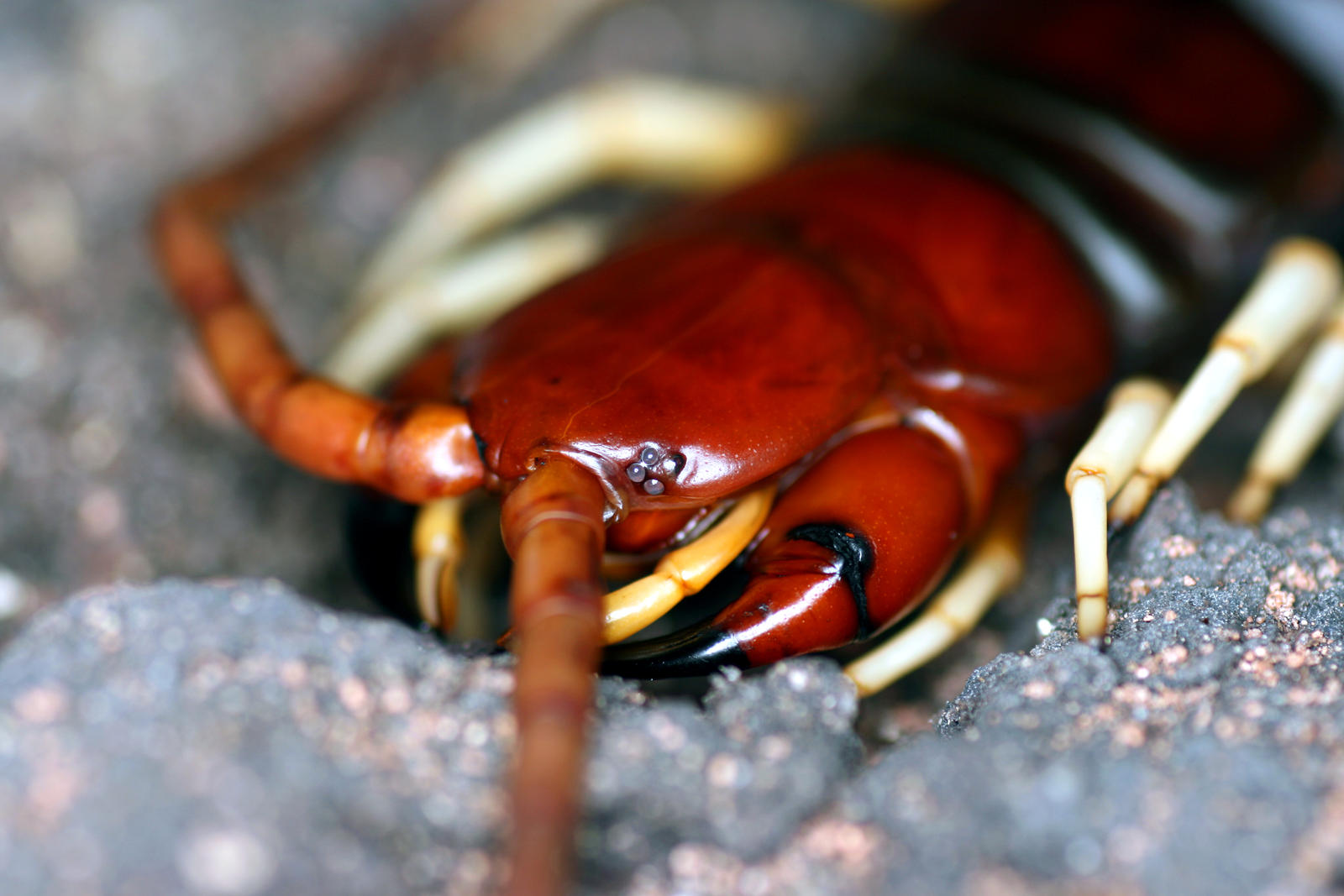
Creature Feature: Scolopendra gigantea.

Centipedes are one of those bugs that freak non-entomologists right the fuck out. Most people kill them on sight, knowing full well that they are poisonous or just because they're centipedes. They are not overgrown pillbugs like millipedes (at first glance); one look and you know that a centipede is nasty. Out of all the designs in Pokemon Gen V, NOBODY would expect a giant centipede to be popular.


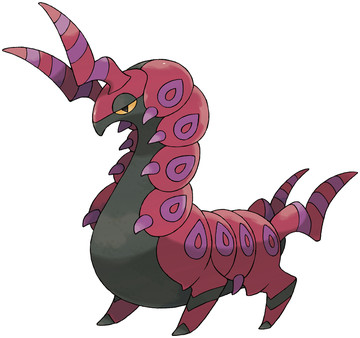
For whatever reason, Scolipede, a deer-centipede hybrid, has stolen the hearts of people who do not ordinarily like bugs. It has a design reminding us that Poison can actually be a pretty cool type, has awesome stats, and goshdarnit, myriapods deserved something better-looking than Drapion. If only more Pokemon players knew that real Scolopendra gigantea were just as popular with arthropod fans.


Scolopendra gigantea is exactly what it sounds like: A giant centipede. It can grow up to 12 inches (30 cms) long.  S. gigantea is native to South America (specifically Peru and other northwestern countries) and Jamaica, Trinidad, and Hispaniola. If the next Pirates movie features giant centipedes, you know why.

All centipedes are carnivorous, but S. gigantea exists to remind us that centipedes were once giant land terrors. It is one of the rare centipedes that eats vertebrates at every meal. Frogs, lizards, birds, rodents, and even three distinct species of bat are all on the menu.


S. gigantea does, of course, have a potent venom cocktail designed to work on things with spinal cords. Those pincer-like claws, officially called forcipules, deliver a mix of numbing chemicals (including serotonin, histamine, and acetycholine), proteases, and a cardiodepressant. Victims feel chills, fever, and weakness after being bitten. Not fatal, but still sucks.


People who keep giant centipedes as pets have got some serious balls. Feedings can be pretty darn intense; as with falcons and snakes, one likely needs to handle dead rodent carcasses. Even a single drop of venom on one's skin can cause a reaction, so wear protection when handling one. A giant centipede is still of the better venomous animals to keep as a pet.

Now, if you will excuse us, we have a killer Scolipede to train.


Tomorrow: By the way, what's Remoraid based off of?

Thursday, January 27, 2011

Creature Feature: Sydney Funnel-web Spider.

Remember when we said that Australia had too much extant badass for a scorpion that shoots salad dressing out of its rear? That is because everything in Australia is equipped with something that can put a man in the hospital without difficulty. Even when we brought puppies over, they evolved to have an appetite for human babies. When the ecology is enough to turn a domesticated dog into a baby-killer in a relatively short span of time, you know something is hardcore about that place.

Everything in Australia is trying to kill you. Every. Living. Thing. The 'average' creepy-crawlies over there are no exception.


Look up any "world's deadliest spiders" list and the Sydney funnel-web spider  (Atrax robustus) will definitely be on it- probably at the top. The name says a lot: It's native to the area around Sydney, one of Australia's biggest cities, although it has gotten as far as England (likely thanks to imported goods). The spider lives in a special silk-lined burrow, thus "funnel web."

Sydney funnel-webs are medium-large spiders and look almost like Halloween decorations: Large, black, huge fangs, and would look darn scary dangling from a piece of twine. There are no special markings to tell you "don't touch this spider." All one has to know is that it, like everything else in Australia, is out for your blood.


Those giant fangs are not just for show. Unlike most arthropod pincers, they are designed to pierce. To use them, the funnel-web spider rears up, then strikes repeatedly at whatever is threatening it, injecting a lot of venom.

The male funnel-web's venom, atracotoxin, is a powerful neurotoxin that fucks with the sodium gates in the nervous system. It specifically attacks motor neurons, causing the twitch mentioned in the video. The spider gains no benefit from attacking humans except a killer reputation; this venom was originally intended to harm insect prey in the same way.

Seek medical attention immediately if bitten. Symptoms include tingling around the mouth, muscle spasms, excessive salivation, and, eventually, respiratory failure. A single bite can kill in 15 minutes, but if an antivenin is administered, it is not even a threat. They have gotten good at curing that deadly bite down under.


The good news is, once you know what a funnel-web looks like, they are easy to pick out and hit with a newspaper (or avoid). The bad news? They're everywhere around Sydney and Canberra. The males will wander during the warmer months of the year to find a mate. Their attraction to water often leads them to swimming pools; they can survive being drowned, and will bite if taken out of the pool by hand. One site said that the female sucks a little bit of the male's brain out during mating, which would make him a real-life zombie spider. Way to go, Australia: You've found a way to make the undead.


Tomorrow: It's a dinosaur! It's a bear! It's...neither of the above, but it has HUGE teeth!