Showing posts with label arachnids. Show all posts

Tuesday, May 21, 2013

Creature Feature: Spitting Spider.

There seem to be a lot of misconceptions about spiders. For instance, most spiders are not dangerous, and are not malicious arachnids aiming to wipe out humanity. Another, less-crippling misconception is that spiders spit their silk. No- it comes out the other end.


There are, however, a few exceptions to this rule. There is a group of spiders called spitting spiders.  The family of spitting spiders, Scytodes, do just that: spit silk. Oh, and the silk's coated in venom, too. Screw webs - this spider manages to snag prey and envenomate it all at once. The family is found worldwide. At least Spider-Man only shot gunk.

Spitting spiders have silk glands at their head. These are right next to the venom glands, thus allowing for poisonous string. The silk then shoots out of the fangs and onto whatever the spider sees as dinner. Suddenly, Twilight's venom fangs don't seem so implausible.

These spiders are also evil masterminds at what they do. They plot out the trajectory of their spit. Then, like the world's sickest icing, they drizzle the venomous filament over their target by zig-zagging. This lets the spider take down prey much larger than itself, including other spiders!


(Another one caught a brown recluse- one of the few spiders I'll kill on sight. Praise it. PRAAAAIIISE IIIIT!)

Spitting spiders are also surprisingly social. Families will dine on one corpse, live in the same web (which is not used to catch flies), and overall have a fun time together. Some even look after their little spiderlings. On the flipside, however, these spiders are also cannibalistic.

Saturday, April 20, 2013

Creature Feature: Myrmarachnids.

Not many people like spiders. The awesome lady with the spider jewelry last night was more an exception to the rule than anything. They are, however, fascinating creatures that really deserve more entries on this blog.


Look out, here comes the Spider-Ant! Actually, it's an ant-mimicking jumping spider (Myrmarachne formicaria), but close enough. It's native to Africa, with relatives in many places.

In all seriousness, though, there are a number of jumping spiders who have ants as alter-egos. They span at least two genera, and are native to most tropical parts of the world. A few live in temperate regions. Yes, they eat insects, like most other spiders. Despite awesome mimicry, this is not cannibalism. There are an amazing amount of these spiders. Cue mass-entry guilt.

For those of you who know nothing about arthropod anatomy, here's a little primer. Insects have three body segments and six legs. Spiders have two body segments and eight legs, plus two pedipalps. A number of tricks are used to pull off that visual trickery, including raising the forelegs like antennae and making the pedipalps look eerily close to an ant's head. It's a darn good job.


Why the spiders do this is something of a mystery. Always suspecting the worst of a venomous creature, scientists first thought that spider-ants were infiltrating anthills by going in undercover. This turned out not to be the case for many, but not all, ant-mimics. Unbeknownst to most humans, ants taste bad, and can also sting with formic acid. Not a bad thing to disguise oneself as.

Of course, this won't protect them from humans who hate ants, too...and there are quite a lot of those. You fooled nobody with A Bug's Life, Disney - ants are crafty little buggers who wind up in my bathroom every spring. Yeah, disguising yourself as an ant won't work well all the time.

Monday, April 16, 2012

Bio-Art: Insect jewelry?!

Among the things one can get at ReptileFest, a few trinkets will always be related to insects and other arthropods. There was the framed cicada I showed you yesterday, but also jewelry with scorpions,  beetles, and other such things imprisoned in lucite for better viewing.

Yes, you read that right: Jewelry with real dead scorpions in it.


This is an especially stunning scorpion pendant from eBay seller china_custom_5000. People can get very creative with sticking insects into clear plastic. This one almost looks like it's trapped in amber, and that setting is just to die for.  Of course, given that the Chinese sellers of such things love advertising that they're from Tibet, I'd think twice. Still a very nice piece of jewelry. I also like the ones that glow in the dark. 

Scorpions not your thing? How about beetle bracelets, then? The seller there is where I got my own rose chafer bracelet from; now I wish I'd gotten the chafer bracelet linked above! (Glow in the dark things make Kuro very happy). A lot of their things seem like Chinese repacks (you'll notice a lot of bug jewelry sellers located in China/Hong Kong), but they're cheaper, ship from the U.S., and have tons of cool packaging. Check 'em out at www.realcoolbug.com if you're not into eBay. They do good work!

Now for one of my personal insectoid covet items on eBay: a glow-in-the-dark cicada computer mouse. There's also a clear one, but again, the glowy one is fine for sampling. A lot of these things come in multiple colors, so if you have an outfit that a scorpion would look great on, by all means get one that matches. Hell, my chafer bracelet has alligator pleather on it; this stuff can work.

Along with being eaten, making insects into accessories seems to be the new 'in' thing. There also used to be green rose chafer clocks, but I can't find them anymore. If you want to invest in these, the sellers in China adore wholesalers, and will gladly sell you dozens for roughly 40 bucks. Have fun!

Tuesday, February 28, 2012

Creature Feature:...Gold Skulltula?

Confession: I am taking my sweet, sweet time with Legend of Zelda: Ocarina of Time for the 3DS. Almost to the end of the Shadow Temple, which is...I want to say the second to last. Then there will be mini-quests to do, simply because the game is set in a world almost as awesome as ours.

Just as a reminder, here's a real, live Gold Skulltula:


Kidding. The Gold Skulltulas in Zelda were clearly based off of Argiope savignyi. They can be found from Mexico to Bolivia. They are not necessarily gold; the golden female above was one of several color variations.  For those curious about the generic name, "Savigny" happened to be the last name of Marie Jules Cesar Savigny, the first person to describe the genus Argiope. He was a guy, by the way.

For those of you who do not know spiders, they can be classified in terms of how they weave their webs. Argiope spiders are particularly creative orb-weavers. A. savignyi can weave a number of patterns into its orb web. Among them are a cross-shape and disc-shape. Sometimes, these designs are combined into a super-pattern. The resulting web, regardless of pattern, is very sturdy...which results in one of the few things this spider is known for:


Yes, that is a bat in that spiderweb. Yes, the spider is being a vampire and slowly sucking out its inner juices. Gold Skulltul- I mean A. savignyi is one of the few invertebrate predators of bats. Specifically, they feed on the proboscis bat (Rhynchonycteris naso) - a strange critter in and of itself. These aren't even unhealthy bats - just unlucky bats who don't see the Argiope's web. They are successfully entangled within two hours. Again, pick your favorite; some wouldn't be rooting for the spider or the bat in this instance.

As a friendly reminder: Wild A. savignyi do not grant you magical items every time you kill ten of them. Do not carry a hookshot around in preparation. If you happen to think you have a hookshot at your belt, by the way, please see a therapist or look for "Zelda Addicts Anonymous."

Thursday, October 20, 2011

Creature Feature: Goliath Birdeater.

We at the blog should be scaring you all silly during the month of October. Then again, we should be trying to do that all the time, making this month not very special at all. That means we have to try extra hard for the rest of the month, so expect every spell ingredient in the book to get its own blog page.

Yesterday was a newt. Today...


...is a MASSIVE spider.

The Goliath birdeater (Theraposa blondi) is the second largest spider in the world. It has a legspan of up to a foot. It is native to the Amazon rainforest, which is a good place to avoid if you are easily intimidated. There are enough deadly animals there to fill a whole week's worth of entries. This spider is not among them.

The Goliath birdeater does not eat birds at every meal. Most of its diet consists of invertebrates. The name comes from a Victorian report of this spider eating a hummingbird - in other words, small bird, big spider. Due to its size, Goliath can consume a number of vertebrates, including birds, lizards, bats, and venomous snakes. Depending on your specific set of phobias, a spider that eats snakes may be more or less terrifying than one that does not.


Luckily, this super-spider is not harmful to humans. Its bite is only as bad as a wasp sting. Worry more about the hairs it sheds in defense; those will irritate your skin. Again, this is not nearly as badas one would expect from such a large spider.

Arachnophobes, you got off easy. We've already covered most of the nasty Australian stuff for you.

Sunday, October 9, 2011

Creature Feature: Deathstalker.

If you were shocked by the title, you are probably expecting something epic. Without looking the creature up, you probably think that it has skulls, a scythe, or, better yet, flaming skulls and a scythe. The name is that appealing to fans of "darker and edgier." Hell, why isn't this creature blessed with its own heavy metal band, yet?

It already has a B-movie.


Thing is, most venomous animals don't roll that way. Often, the deadliest things are tiny, inconspicuous, and sometimes even cute. The same goes for the deathstalker - you will NEVER see it coming.

From Wikipedia. :)
 

That's the deathstalker (Leiurus quinquestriatus), the deadliest scorpion in the world. It is native to Israel, Pakistan, Egypt, and other blisteringly-hot, politically-intense areas in that range.  Like most scorpions, it feeds on insects. Watch out for your shoes if you wander into its range.

The deathstalker has the most potent venom of any scorpion. One sting from it contains no less than 5 different neurotoxins. The sting is extremely painful and should be treated as a medical emergency. Antivenin availability varies from place to place, with French and German pharmaceutical companies making it regularly, but NO support from the USFDA. Even with a name like "deathstalker," the sting is only usually fatal to the immune-challenged.

Of course, people want this bugger for more than just antivenin. Along with those neurotoxins, valuable chemical agents dwell in the deathstalker's tail. Chlorotoxin, a peptide, has been shown to help tame brain tumors. A few other chemicals might regulate insulin, making this little scorpion a lifesaver to diabetics.

Source:Offbeatpets.com


This does not mean you should keep this scorpion as a pet. Deathstalkers are by no means a beginner's scorpion, but are often sold to anyone willing to pay anyways. Some smart, yet ruthless person figured out that people interested in arachnids miiight just want something called a "deathstalker," regardless of how dangerous it actually was.

Thursday, September 1, 2011

Creature Feature: Happy Face Spider.

The authoress has not had a good week. After an anxiety attack on the first day of classes and a frantic schedule readjustment, she is completely fried from senior burnout. Also, this blog was targeted for copyright infringement, which is a whole different headache.

So here's a spider with a smiley face on its rear.


Source.

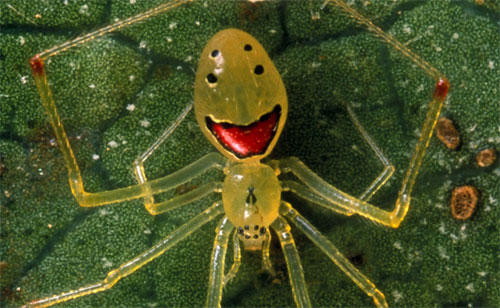
No, that is not a bad Photoshop.  This may be the last time we get to say that, but that goofy face above is totally natural. Theridion grallator, AKA the "happy-face spider," is native to many of the Hawaiian islands. Yes, it is always that happy. (You would probably be happy too, if you lived on Hawaii.)

Nobody knows why this spider's rear looks like a smiley balloon. It's not intimidating enough to scare off predators, which the spider has very few of anyways. We doubt even arachnophobes are scared of this brightly-colored little guy. The types of inheritance vary from island to island, if the smiley is there at all. This is one of the few markings that seems to serve no purpose whatsoever...

...except further evidence that Mother Nature has a trollicious sense of humor.

Wednesday, August 17, 2011

"They Actually Eat That:" Scorpions.

After watching one too many videos detailing what goes on in factory farms, we're all about other, locally-farmed sources of protein. Rabbit and horse have both escaped being factory-farmed, for example. So has dog, but that's going out of fashion. Most people do not dare venture into land invertebrate territory, despite crickets being perfectly good whole food. For the extra-daring nature lover/factory farm hater, there is a special diet option: SCORPIONS!


Source: The Herald.

The truth is, many other places have been eating scorpions for quite a long time. China is the number one nation known for eating scorpions, for example. Besides claiming the world record for eating things that would never go over well in America (scorpions are really just another drop in the bucket), the Chinese see eating scorpions as a testament to one's courage and manliness. Plus, mongooses eat them, and who wouldn't want to be compared to a mongoose?


Recently, scorpions have actually caught on in America as well. Not only have they appeared in things like Hotlix and Chinatowns, but there are whole festivals for arthropod cuisine in Richmond, Virginia. Time magazine latched onto one creative soul turning frozen scorpions into Italian cuisine.

Source: Time Magazine.


Scorpions: Naturally-grown, kick ass, mongoose approved. They're EXTREEEEME!

Sunday, July 24, 2011

Creature Feature: Harvestmen/Daddy Longlegs.

Sometimes, people ask me about my pets. Along with my two cats, two birds, betta fish, and ten snakes, I sometimes add the colony of cellar spiders living in my basement. Most of the time, I don't get to the spiders- people are too stunned by my snake collection to really get there. They've always been interesting creatures to me, if only because they were one of the few weird things I always had access to in my basement.


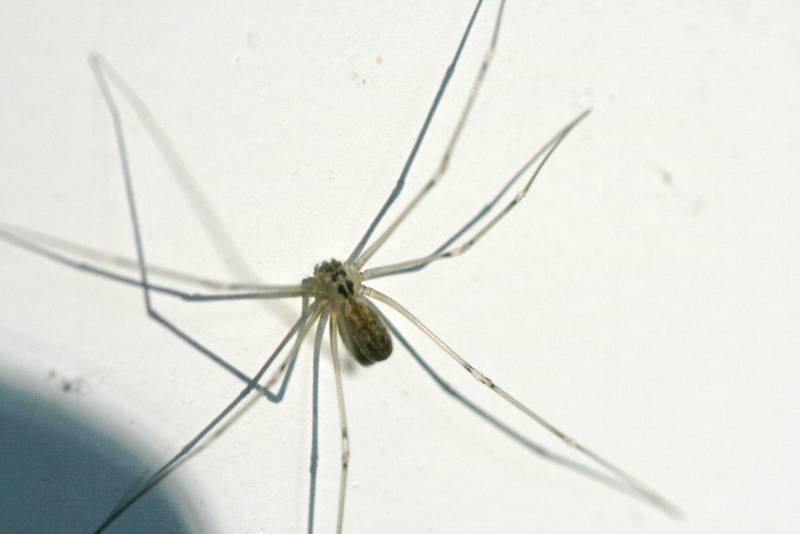
No, that is not a daddy long legs. That is a cellar spider (Pholcus phalangioides). Cellar spiders are perfectly normal spiders with bulging abdomens, many eyes, and two distinct body segments.They shake in their webs when threatened and would probably make an interesting entry all by themselves.

THIS is a daddy long legs:


Daddy long legs, or harvestmen, are about as close to spiders as scorpions are. The 5,000-odd species comprise their own order, Opiliones. They have been around and virtually unchanged since the Devonian, a time period when fish were just beginning to get on land. As expected with something that has lived so long, these arachnids can be found virtually everywhere. There are even a few cave-dwelling species that would be excellent to cover in a troglobite week.

True daddy longlegs possess several anatomical differences from spiders. The two body segments of a harvestman are nigh-indistinguishable from each other. The legs are exceptionally long in most species. Harvestmen have only two eyes, not eight. Just about the only thing they have in common with spiders is their eight legs.


They even eat different things from spiders. While spiders eat bugs and occasionally birds, harvestmen can eat insects, plants, fecal matter, and any dead animals lying around. Exactly what they can eat depends on the suborder in question. Harvestmen have the most versatile diets of any arachnid group, even though they are relatively unarmed.

Harvestmen are harmless. Really. Despite being omnivores or scavengers, their chelicerae (very short fangs) cannot pierce human skin easily, let alone inject venom. They have no venom glands whatsoever. They do not even have silk like spiders. Don't listen to the BS about daddy longlegs being the most venomous creatures on the planet; even the copies are harmless.

Sunday, July 17, 2011

Cool Video: Amazing Bugs.


Afraid of insects? Don't be! These bugs are beautiful, bizarre, and would make great jewelry! Just thought it was worth blogging. ^_^

Wednesday, February 23, 2011

Creature Feature: Brown Recluse Spider.

After reading all of my blog posts, you are probably thinking that there is no creature that I will not obsessively love for a day. Just like everyone else, however, I have one creature that I simply do not like. That creature is the brown recluse spider (Loxosceles reclusa).


No, I am not an arachnophobe. I have nothing against spiders. My usual instinct is to take whatever spider I find and move it out of harm's way. I just do not like this particular spider, even though it lives in my neighborhood.

Brown recluse spiders are native to the midwestern U.S. down to the Gulf of Mexico. It is identified primarily by the fiddle-shaped mark on its back. It is also a fairly large spider, so it is easy to see this little deathbringer coming. Their favorite hiding places are in the basements and drawers of suburban households.

So, why don't I like it? Put simply, this:


One bite from a brown recluse causes necrosis. Some people feel nothing at first, but the area will become inflamed within a few hours. The pain slowly gets worse until the flesh and other soft tissues are rotted through. If that was not bad enough, the wound is also open to infection. Ouch.

Of course, it's the human's fault if the spider bites. The name says it all: These are shy spiders. Humans just made several perfect environments for these spiders to live in. Many spider bites are also misdiagnosed; Staphylococcus aureus can cause similar symptoms if it infects the bite. As a reminder, those are the same bacteria that have become resistant to antibiotics. Even if the spider is not initially responsible for necrosis, its bite is nasty.


It's even sadder when a llama gets bitten.

The recluse's bite is just about the only cool thing about it. There are no markings or similar that say, "hey, I'm a dangerous spider that may melt your skin off." I am not about to systematically eradicate these guys, but if one crosses my path, expect it to be hit with a newspaper.

Tomorrow: Oh SHIT that fish attacked my naughty bits!

Wednesday, February 2, 2011

"They Actually Eat That:" Mealworms, Crickets, Scorpions...


Yes, I just ate real larvae covered in cheese powder. Yes, they really did taste just like chicken with some cheese sprinkled on. You are not a hardcore reptile keeper until you have eaten lizard food. Period.

Mealworms are most commonly known for being fish bait and reptile food. They are the larvae of the darkling beetle Tenebrio molitor, which has one of the most villainous names of any insect. Seriously, tell me that you can't see a Rowling fan's evil wizard character being named after the beetle that mealworms become when they grow up. Awesome name is awesome; it's a shame their main goal in life is to be food for something else.

Clearly an evil mastermind.


Larvets, Cricket Lickits, and other reptile food for people are made and marketed by Hotlix. This California-based company specializes in what China has been doing for centuries: Turning bugs into snack food.

Made in California, NOT China.


Hooo boy, does Hotlix have a variety of treats if you've ever wanted to try a scorpion or other arthropod.  They take chocolate-covered ants to new heights, have 'amber' candy with real bugs inside, and if you can feed it to your lizard, they have stuck it in a lollipop. OK, no dead mice; you'll have to go back in time to ancient Rome to get those. Or Korea, but that's next week's endeavor.

If bugs are not your thing (they all taste like chicken, and I don't like chicken), Hotlix has a few other nature-related treats. Their non-insect offerings range from rather innocent things like aquarium candy to eye-popping eyeball lollipops. These guys also make exclusively-labeled products for traveling exhibits and such, so next time I'm at the Field, I might get more interesting insectoid edibles.


Thursday, January 27, 2011

Creature Feature: Sydney Funnel-web Spider.

Remember when we said that Australia had too much extant badass for a scorpion that shoots salad dressing out of its rear? That is because everything in Australia is equipped with something that can put a man in the hospital without difficulty. Even when we brought puppies over, they evolved to have an appetite for human babies. When the ecology is enough to turn a domesticated dog into a baby-killer in a relatively short span of time, you know something is hardcore about that place.

Everything in Australia is trying to kill you. Every. Living. Thing. The 'average' creepy-crawlies over there are no exception.


Look up any "world's deadliest spiders" list and the Sydney funnel-web spider  (Atrax robustus) will definitely be on it- probably at the top. The name says a lot: It's native to the area around Sydney, one of Australia's biggest cities, although it has gotten as far as England (likely thanks to imported goods). The spider lives in a special silk-lined burrow, thus "funnel web."

Sydney funnel-webs are medium-large spiders and look almost like Halloween decorations: Large, black, huge fangs, and would look darn scary dangling from a piece of twine. There are no special markings to tell you "don't touch this spider." All one has to know is that it, like everything else in Australia, is out for your blood.


Those giant fangs are not just for show. Unlike most arthropod pincers, they are designed to pierce. To use them, the funnel-web spider rears up, then strikes repeatedly at whatever is threatening it, injecting a lot of venom.

The male funnel-web's venom, atracotoxin, is a powerful neurotoxin that fucks with the sodium gates in the nervous system. It specifically attacks motor neurons, causing the twitch mentioned in the video. The spider gains no benefit from attacking humans except a killer reputation; this venom was originally intended to harm insect prey in the same way.

Seek medical attention immediately if bitten. Symptoms include tingling around the mouth, muscle spasms, excessive salivation, and, eventually, respiratory failure. A single bite can kill in 15 minutes, but if an antivenin is administered, it is not even a threat. They have gotten good at curing that deadly bite down under.


The good news is, once you know what a funnel-web looks like, they are easy to pick out and hit with a newspaper (or avoid). The bad news? They're everywhere around Sydney and Canberra. The males will wander during the warmer months of the year to find a mate. Their attraction to water often leads them to swimming pools; they can survive being drowned, and will bite if taken out of the pool by hand. One site said that the female sucks a little bit of the male's brain out during mating, which would make him a real-life zombie spider. Way to go, Australia: You've found a way to make the undead.


Tomorrow: It's a dinosaur! It's a bear! It's...neither of the above, but it has HUGE teeth!

Wednesday, January 26, 2011

"They Actually Eat That:" Scorpions.

We cannot top pica. Period. The only thing that can top a disorder that makes people stuff everything in their mouths are the people who can digest everything. Those individuals are few and far between, but they might make it onto this blog if we ever do an "X-Men Week." Professor Xavier has a human goat somewhere in his school, right?


For now, back to China. Sure, it's not as intense as snake venom medicine, but eating scorpions is still pretty darn weird:


Oh, China. If we ever need any more weird food ideas, we know where to turn. 

Eating scorpions is about as popular as eating/drinking venomous snakes for the exact same reasons: It takes balls to eat something with deadly venom and doing so makes one some sort of insane sex god. Hell, scorpions are often added to snake wine, in itself a knockout aphrodisiac.


If you drink this stuff and LIVE, you deserve to get laid.

This one is actually not restricted to China. People in Thailand and Afghanistan also eat scorpions. In North Africa, they are often used in folk medicine. If you really, really want to try scorpions without learning Chinese, eHow has a handy guide on how to catch your own edible, venomous arachnid. It is still not recommended.

Creature Feature: Vinegarroon.

So, how do you like your scorpions? Live? Fried? Boiled? With a little bit of salad dressing?


Thank you, Japan, for proving that you can literally find "anything VS anything" on YouTube.

Actually, if you like your bugs with a little bit of tang, nature has several all ready and waiting for you. Arachnophobes stay away; the whip scorpions of the order Thelyphonida, more commonly known as vinegarroons, look like a cross between a spider and a scorpion. They are carnivorous and native to every dry tropical environ except those in Africa (though they have been introduced there) and Australia, which has too much badass for this arachnid to handle.


The vinegarroon is strange even by arachnid standards. Like scorpions, it has ten appendages: Eight legs and two pedipalps that have evolved into pincer-tipped appendages. It only uses six of its eight legs for walking; the remaining two have become sensory organs akin to antennae on insects. If limbs becoming antennae and mouthparts becoming limbs were not weird enough, vinegarroons also have that tail.

The whiplike tail on the vinegarroon does not have the same venom as the more menacing tails of true scorpions. Special glands near the vinegarroon's rear secrete acetic acid, the same chemical that gives vinegar its smell and flavor, and octanoic acid, a compound found in the milk of several mammals (including goats). When the vinegarroon feels threatened, it aims its tail towards the attacker's eyes, squirting this delicious sounding concoction into a place where the predator cannot enjoy it. The resulting spray smells like vinegar (hence the name "vinegarroon").

This thing should taste like a Greek salad.


 To be perfectly honest, we are not sure whether anyone has tried eating vinegarroons or not. Seeing as they come with their own marinade, one would think that somebody, somewhere, would have tried eating this weird-ass arachnid. This looks to be one of the few arachnids that never get eaten, even if they are kept as pets by Linkin Park fanboys. (Watch. We'll be proven wrong within the hour.)

Thought this was terrifying? Have an actual spider tomorrow. SPIIIDDEEEERS! 

Saturday, July 24, 2010

Creature Feature: Jyorou-gumo (Nephila clavata)


Every culture has its own version of the succubus: A sexy, sultry she-devil who lures men into her bed, then either drains their energy or eats them afterward. In Europe, she has the typical, goatlike demonic traits when in her true form; the Greek lamia evolved into a seductive snake-woman; foxes in Korea, Japan, and China have long been known to use lovers for their own evil ends.


Oh, come on. You have to help this fox take over the world.

Japan has as big a thing for man-eating, seductive female monsters as Greece and Rome did (count the Greek monsters with racks. Hurry!). Besides kitsune (foxes), the yuki-onna ("snow woman"), hone-onna ("bone woman"), and several other female youkai prey on the libido of human men. The spider-lady jyorou-gumo (also written as 'jorogumo,' 'joro spider,' or 女郎蜘蛛) is one of the few seductive creatures with a basis in fact. (Fun fact: When the word is written in katakana, it is always referring to the arachnid.)


"I told you that she's hot as Hell..." The screencap is from CLAMP's xxxHOLiC, and the lyrics are from Lady GaGa's "Monster." It will become relevant very soon. (Plus, I'd hit that.)

Although many youkai come from real animals, there may be a particular reason that this spider wound up as a seductress. Like the black widow, the female jyorou-gumo is more brightly colored and several times larger than the male. After mating, the jyorou-gumo may try to eat him - the smaller the male, the more likely he is to escape.


The pretty one is the lady, this time.

The "prostitute spider" is just as notorious in Japan as the black widow is in the West, possibly for the same habit of sexual cannibalism. It is nonetheless viewed favorably; N. clavata is a gorgeous spider, and its golden thread is strong enough to make socks and bulletproof vests. Seriously.

Japan has another, vaguer youkai called the tsuchigumo ("ground spider") with a slightly different web to spin. Like jyorou-gumo, she is frequently portrayed as an attractive spider demoness, but her name is derived from a tribe of cave-dwelling dwarves in the Japanese Alps. She is not even consistently female; many stories feature male tsuchigumo. Other times it is simply a giant spider. This creature shares its name with the ground spider (Atypus karschi). The ground spider is not as beautiful as N. clavata, but I am sure that a spider fanatic can tell me how interesting it is. ;)

More on youkai: The Obakemono Project.

(YAY, my first spider article!)