Showing posts with label hawaii. Show all posts

Wednesday, June 19, 2013

"They Actually Eat That:" Hibiscus.

 Every so often, a new 'superfood' suddenly floods the market. Usually, it's something only a small amount of people have heard of, comes with a fancy Greco-Roman science word attached, and has a long history of being medicinal from the ancient past. Recently, the buzzword has become "antioxidants," and acai and pomegranates are leading the way in that regard. Here's what is slowly becoming the next "superfood:"


This flower should look familiar to a lot of you. It's a type of flower called hibiscus, and is probably the most marketable superfood yet. Yeah, that flower on tacky Hawaiian shirts? That's hibiscus. Hibiscus iced tea is becoming more and more popular, popping up in Starbucks, Argo Tea, and Panera. It has "from Asia" and "might have antioxidants" going for it already.

But is it actually edible?

First off, the nectar and tea are usually pretty safe. Hibiscus has been used as a tea for centuries in Asia and Nile Valley Africa. The tea has been believed to cure everything from high blood pressure to cancer.  I've had hibiscus tea and nectar plenty of times with no adverse reactions. The only confirmed medicinal effect of hibiscus is as a diuretic, but people are looking into antioxidants.

The diuretic effect is particularly noticeable if animals eat it. I've heard varying reports, but the general consensus is that hibiscus plants are toxic to cats, dogs, and horses. It probably isn't the end of the world after one little bite, but just to be safe, hibiscus is on the list of "plants that are not pet-friendly." If your pet starts acting odd after eating hibiscus, call poison control.


As for actually eating hibiscus, there are dos and don'ts. Some hibiscus varieties are not edible, period. Others, like Hibiscus sabdariffa, can be eaten in salads and stir-fries like red spinach (which is its own thing). Most restaurant chains and such will not be using the poisonous varieties of hibiscus, so please enjoy the summer's latest iced tea craze. Just don't use it to cure cancer or give it to your dog, OK?

Sunday, January 20, 2013

Creature Feature: Picture-Wing Flies.

Flies are really taken for granted. Sure, they land on our food, but it's only because we leave it out for them. Without flies, the world would be covered in dog poop. In more than one sense, they're garbage men for the entire planet - it's a dirty job, but someone's gotta do it.

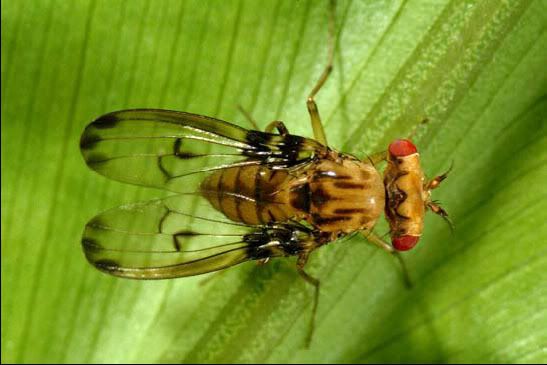
But did you know that flies can also be gorgeous? As in, comparable to birds-of-paradise?


That is one of several (111) species of picture-wing fly found only on Hawaii. They are closely related to the common fruit flies around the world, and are so named for the patterns that the males have in their lacy wings. Several of these fly species are endangered or threatened, which are in turn important to equally-endangered plant species on the island. Yes, these flies are nectar-drinkers and pollinators- just like hummingbird, butterflies, and fuzzy-wuzzy bumblebees. They're sounding cuter already.

Compared to the 1000-something species of fruit flies in existence, 111 species is not a lot, nor should it be a surprise. It only takes two fruit flies for there to suddenly be millions on an island. If the Center for Biological Diversity is correct, those 111 picture-wing species came to Hawaii only 5 million years ago from one egg-bearing female- even more stunning than if a male had been present. They reproduce faster than rodents.

Fruit flies also have simply amazing genetic potential. That's why they're so horribly popular in genetic studies: they breed like crazy and have a million mutations to play with.  Lek courtship is unusual in insects, and is far more common in birds, which have more potential for elaborate courting rites...or so we thought.


When the rapid breeding rate and genetic potential of the fruit fly is brought to an island, the flies flourish. What were once ravenous pests suddenly become nectar-drinking, dancing insects with beautiful wings. Even humans do not change that radically in such a short amount of time. These must be Beelzebub's personal entertainers, if I must make a reference to Lord of the Flies. Flies may annoy us on the mainland, but they aren't all bad.

Tuesday, October 16, 2012

Creature Feature: Alala (Hawaiian Crow.)

Picking up where my rant on the strangely positive silver lining of the exotic pet trade left off, a nice video on YouTube just added another member to the list of "extinct in the wild, but has a breeding captive population." Surprise, surprise, it's...a crow?!


Yes, the Hawaiian Crow (Corvus hawaiiensis), AKA the 'Alalā, is one of the most endangered animals in the entire world. Like most crows, these are omnivores with a preference for eggs and insects. They are usually heard making a bizarre caw mixed with a meow, but that weird call is being heard a lot less lately. The crow is sometimes treated as a deified ancestor; that has not kept it from going nearly extinct.

All of the Hawaiian Crows in Hawaii today have been captive-bred. Even then, 21 of the 27 CB crows died almost as soon as they were returned to the wild. They're so rare that they're extinct in the wild except for the sparse captives that have been released. Those are at risk of being food for Hawaiian hawks, so really, the population's still under considerable threat. Yes, these are still versatile, resourceful, intelligent crows we're talking about.


Source.


The strange thing? Nobody knows exactly why this crow has gone completely extinct in the wild. Feral pigs, rats, and mongoose have all been cited as culprits. Microscopic nemeses include avian malaria, fowlpox, and Toxoplasma gondii, AKA the protist that causes crazy cat ladies.The Hawaiian hawk also eats these birds, but that's a natural predator.

As people who are not on islands, we tend to take crows for granted.  They really are valuable scavengers. Even disease-bags can be hit with nasty parasites, eaten, and have their habitat destroyed. Don't take any animal we have for granted. You never know what might affect them.

Monday, February 13, 2012

Bio-Art: Hawaiian Gyotaku.

What would you do if you caught a creature from the deep, dark abyss? Recoiling in horror would probably be your first reaction. After that, chances are you would either toss it back or take it to a local aquarium to see how it got to the surface. Whatever your response happens to be, we're pretty sure "getting it inked and putting it on a T-shirt" was not on your list of priorities.


In December of last year, one Travis Toyama was casually fishing in one of Hawaii's many tide pools when he prepared to receive the weirdest bite he would ever get. No, it was not from a bearsharktopus. He had caught a slender-horned armored gurnard, an eel-like fish that looks bizarre as all get-out. (There are prettier gurnards out there.)

Instead of tossing the fish back or making it into sushi (Hawaii has SPAM sushi- I put nothing past them), Travis made a surprisingly well-thought move and took his catch to a gyotaku - a fish house.  The internationally-renowned artist had the gurnard inked and put on a T-shirt.

That's not all he did, though. The inked fish was also preserved on a canvas, which Travis intends to hang in his room. He also wants to get the fish to a taxidermist so that he can have a mount of it. That is one hardcore fisher. May he win at whatever championships fishing has.

His reasoning? He wanted to remember it long after its spiny remains decayed. Damn.

Whatever's in the water in Hawaii, I want some. That is one competent kid. He should try out for being a Chinese sage; if all kids thought at his level, they would actually be tolerable.

Thursday, January 19, 2012

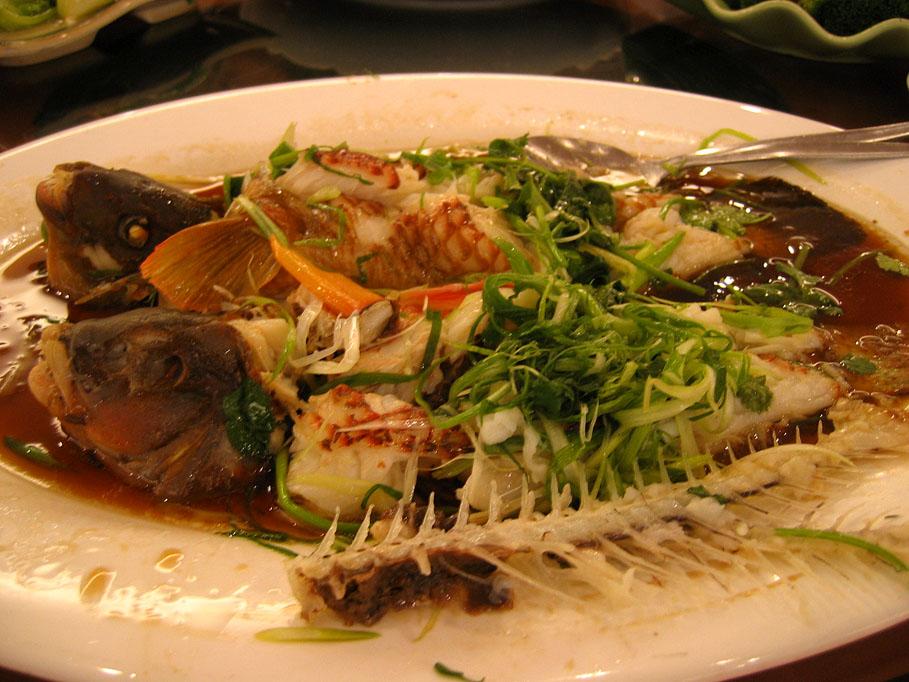
"They Actually Eat That:" Parrot Fish.


This parrot fish is no more. It has ceased to be. It has expired and gone to be someone's dinner. It's a stiff, bereft of life. THIS is an ex-parrot fish!

Yes, they actually eat parrot fish. China and Korea will eat almost anything; small surprise to find parrot fish in a few other countries in East Asia, e.g. the Philippines and Malaysia. It has spread to markets in the United States, including some places in San Diego and Chicago. That people eat parrot fish is hardly surprising, but still enough to make people who appreciate how colorful and awesome parrot fish are a little bit teary.

One can probably guess that parrot fish is particularly popular on islands. According to National Geographic, parrot fish is considered a delicacy in Polynesia. Filipino food may also use parrot fish. Hawaii just loves them, and they can catch them locally, too!


Certain Chinese (and likely Korean) restaurants may also cook parrot fish for you. It is likely an obscure item along the lines of zombie jellyfish, however, so not many places will have it. Still, if you seek this colorful fish, try Asian markets. It probably helps if you know someone who already speaks Chinese or Korean.

As for what it tastes like? Parrot fish has been described as white, delicate, and very chewy. Until I actually find some parrot fish for myself, I will not be able to confirm or deny whether or not it constitutes a delicacy.  I may be taking a trip to a Korean grocery store, soon, but if you have personally ever eaten parrot fish, let us know!

Saturday, November 19, 2011

Creature Feature: Wholphin.

Sometimes, we just have to wonder what science has done. We make freaks almost solely because we can. Even if we say we are making mice glow green to cure Parkinson's, c'mon. Scientists just want to make stuff glow in the dark, just like paleontologists get a kick out of posing dinosaur skeletons in battle postures.

Well, this freak is not quite the result of science. All we had to do for this one was put two animals in the same tank; the freakish offspring was an accident. The following is the result of two different species of toothed whales loving each other very, very much:


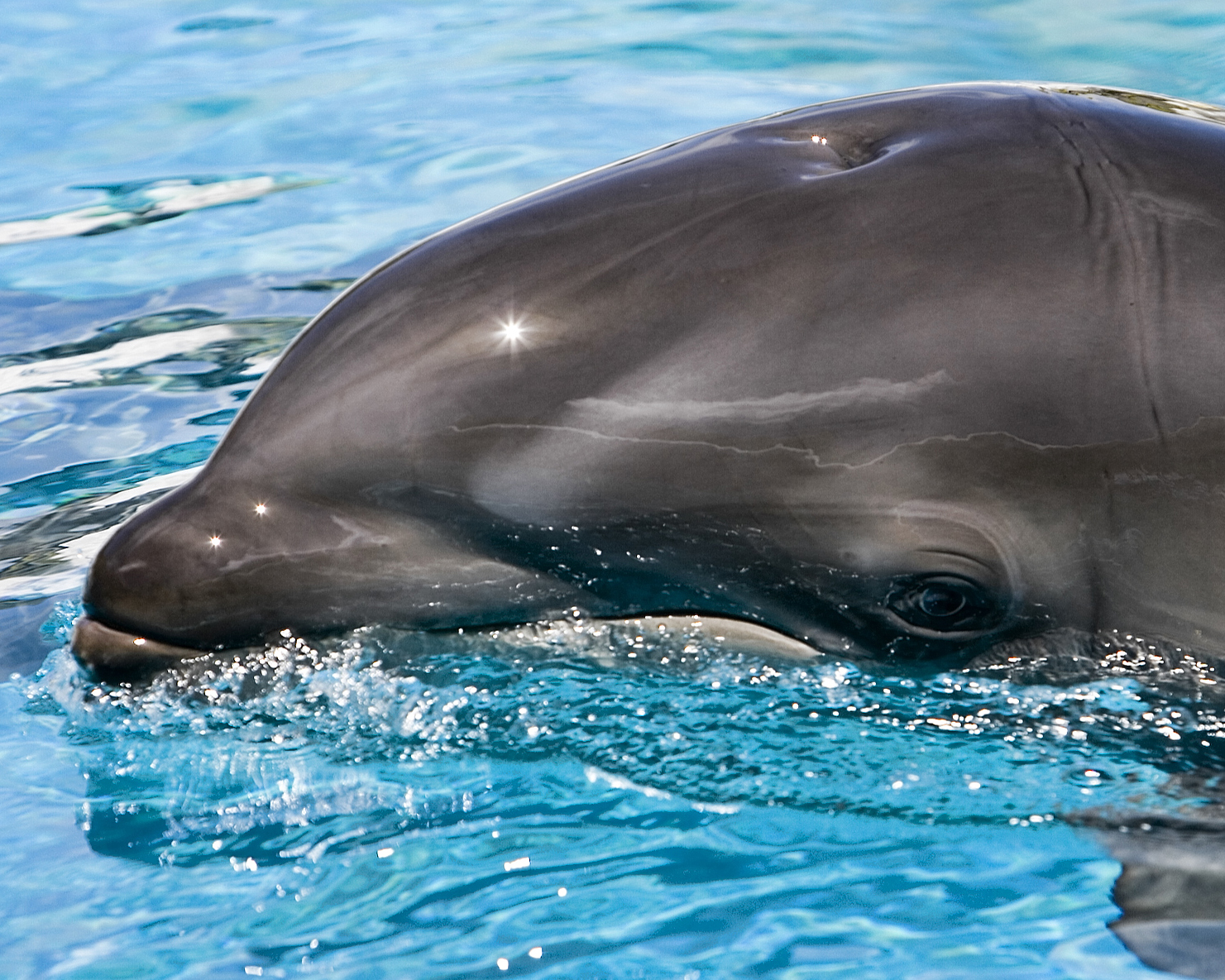
This Uncanny Valley-ish creature is called a "wholphin" (or "wolphin").  It is the hybrid of a bottlenose dolphin (Turisops truncatus) and a lesser known cetacean called a false killer whale (Pseudorca crassidens). Although there have been some reports of wild wholphins, they have only been confirmed to occur in captivity.

At first glance, you might not see what is wrong with the dolphin in that video. Unlike ligers, where the public is very well aware of both hybrid species, not many people know about false killer whales. All you, the readers, really need to know is that they eat other marine mammals like orca whales and are a lot bigger than regular dolphins. To give you an idea of how different the two species are, here they are, side by side, in Enoshima, Japan:

Perhaps, in Japan, another wholphin will be born. I fear for its life.


A lot of the rules that can be applied to ligers can be applied to wholphins as well. Wholphins, like ligers, are bigger than their parents. They grow faster and have been described (by eyewitnesses) as "giant dolphins." They have teeth smack dab between those of dolphins and false killer whales: dolphins have 88, FKW's have 44, and wholphins have 66. Like many hybrids, they have fertility issues; the first wholphin did not have a stable calf until 2004, when she yielded a baby with a bottlenose sire. The young wholphin reached the size of a year-old bottlenose within a few months.

From Pinhole's flickr. :)
 

Unfortunately - or fortunately, depending on where you stand on hybrids - there are currently only two wholphins in existence. They are both at Sea Life Park, Hawaii, which is one of the last places you would expect an exotic animal hybridization to take place. Keikaimalu, the original female, still performs at Sea Life Park. Hey, at least she's in Hawaii.

The question now is this: When will scientists really get cracking and make a wolf-dolphin hybrid? Or a gryphon? Hey, if we're going to make abominations, we may as well make awesome ones. Whatever you believe about hybrids, so long, and thanks for all the fish!


Thursday, September 1, 2011

Creature Feature: Happy Face Spider.

The authoress has not had a good week. After an anxiety attack on the first day of classes and a frantic schedule readjustment, she is completely fried from senior burnout. Also, this blog was targeted for copyright infringement, which is a whole different headache.

So here's a spider with a smiley face on its rear.


Source.

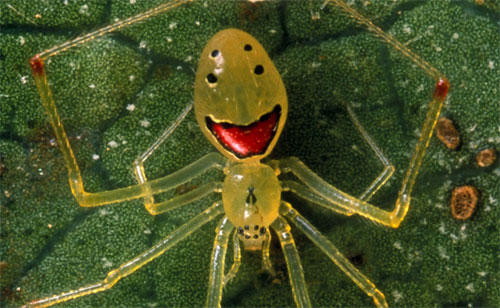
No, that is not a bad Photoshop.  This may be the last time we get to say that, but that goofy face above is totally natural. Theridion grallator, AKA the "happy-face spider," is native to many of the Hawaiian islands. Yes, it is always that happy. (You would probably be happy too, if you lived on Hawaii.)

Nobody knows why this spider's rear looks like a smiley balloon. It's not intimidating enough to scare off predators, which the spider has very few of anyways. We doubt even arachnophobes are scared of this brightly-colored little guy. The types of inheritance vary from island to island, if the smiley is there at all. This is one of the few markings that seems to serve no purpose whatsoever...

...except further evidence that Mother Nature has a trollicious sense of humor.

Saturday, August 28, 2010

Creature Feature: Reef triggerfish...


...AKA Humuhumunukunukuāpuaa. That's one of the longest words in the Hawaiian language, right there. I'll stick with "reef triggerfish," (or Rhinecanthus rectangulus) thanks. It is also called the rectangular or wedge-tail triggerfish for obvious reasons.


OK, maybe not as rectangular as the name implies.


The Hawaiian name of the reef triggerfish means "triggerfish with a snout like a pig." That is exactly what it is. The reef trigger is, first of all, a triggerfish - that is, it belongs to a group of fish related to sunfish and pufferfish. (The pufferfish has been adequately covered in the entry on fugu; the ocean sunfish deserves a bit more love.) All of these fish, true to the title 'tetradontiformes,' have four teeth ready to deliver a nasty bite at any time.


Pictured: PAIN.

Triggerfish in particular are known for a 'lock in' defensive tactic. All triggerfish, including humminahummina up there, can wedge themselves into tight spaces and stay there thanks to an erect second spine. Many of them are also aggressive little fuckers and can change color depending on their moods. Their toxicity ranges from "nasty" to "delicious."

So, for this fish, what's in a name? According to Hawaiian lore, every land animal has a counterpart in the ocean. This is not an uncommon way of thinking; check out sea lions and sea cows, for example. Given that the hakunamatata actually grunts like a pig when predators approach and has a porky physique, we really cannot blame the Hawaiians for calling it such. They can also shoot water from their mouths in order to rummage up more edibles, but bar the fixation on food, that is not very porcine.


What a wonderful phrase...

Seriously, though? I think Hawaii picked this fish as their State Fish just to screw with our heads. Humuhumunukunukuapuaaa~