Showing posts with label worms. Show all posts

Wednesday, July 11, 2012

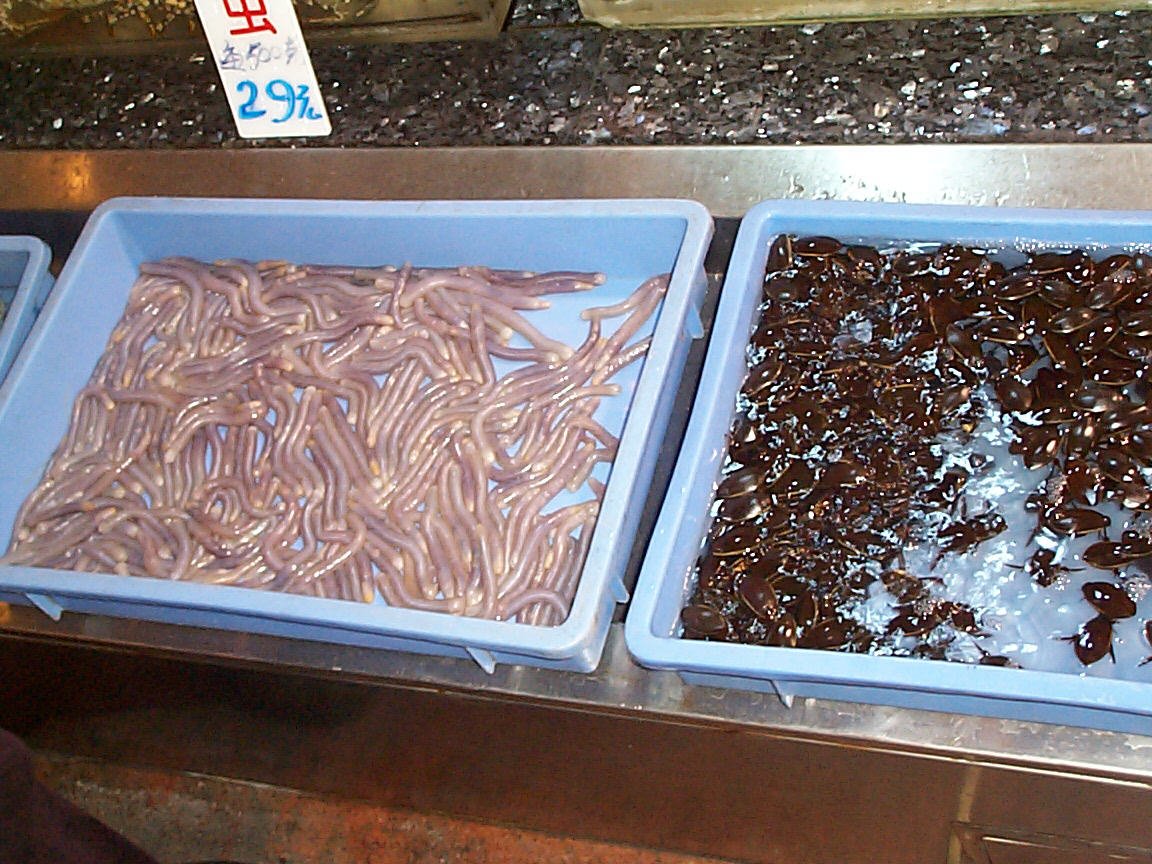
"They Actually Eat That:" Worms.

Eating worms is usually a gag in American culture. There will always be that one kid who ate earthworms on the playground. There's even a dessert using gummy worms and Oreo crumbs to platy with the novelty of eating worms.

But could eating worms seriously be good for you?


According to scientists (including an old teacher of mine), sure! Worms of all types come into contact with bacteria that support a healthy immune system. Actually, the act of putting all kinds of foreign objects in one's mouth helps build a healthy immune system - especially during childhood. That kid who ate worms was onto something.

Our  industrialized society has the curse of being too clean for its own good. Children are told not to put things in their mouths, whether it be dog crap or something they left on the floor. This prevents them from getting exposure to foreign things -bacteria and the like- to which they can build an immunity.  Furthermore, the use of too many soaps and disinfectants creates antibiotic-resistant strains of bacteria. There is such a thing as too clean, and it's a lot more widespread than lutefisk.


Aside from eating regular worms to prevent immune problems later in life, eating other worms has its own benefits. Hookworm therapy is becoming a huge thing. Don't worry, species that regularly infect inhuman animals are used. Again, this works because industrialized society is too clean for its own good. Not saying go back a century, but don't try to sterilize your world, either.

How does it work? A protein called IgE can be held responsible for many autoimmune diseases, including allergies,  arthritis, and even a few cancers. The same protein is responsible for handling parasites. By introducing a harmless parasite into the body, these immune proteins have a target to attack. One man went all the way to Thailand just to get some worm eggs. It saved him from a premature death via a malfunction in another protein. Overall, it might not be bad to be infected.

So, go ahead. The earthworms aren't going to hurt you. Grab a few and try some.

Sunday, November 6, 2011

Week of the Abyss: Giant Tube Worms.

If fish and eels were not freaky enough, nature really gets crazy with worms in the sea. Even without diving into the abyss, while we're more or less stuck with earthworms and leeches on land, annelids have Christmas Tree Worms and the rather unflattering pig-butt worm among their more interesting members in the ocean.

Things get even weirder in the abyss, where the harmless earthworm becomes a species whose sole purpose in life is bad hentai potential:


Permanently stuck around the geothermal vents ("black smokers") of the deep sea, these giant tube worms (Riftia pachyptila) are some of the largest annelids in existence. They can get 2.4 meters (7 feet ten inches) in length. Those tentacles can be pulled into the worms' white sheaths when danger approaches, not that they have many predators.

The tentacles on these worms are red for a reason: like our blood, they contain hemoglobin. The red tentacles have complex hemoglobins circulating in them, which allows them to circulate oxygen in a highly sulfuric environment. They are not poisoned by the hydrogen sulfide in their environment- instead, they benefit from taking in a substance that would kill any other animal.

Hell's lipstick.


If the tentacles coming out of their tubes were not creepy enough, imagine a 7-foot-long creature that lives solely on symbiotic bacteria. The bacteria in these worms is designed to convert hydrogen sulfide and carbon dioxide - basically, the stuff that Hell is made of - into usable material for the worm. These giant worms do not eat and have no gut. The millions of bacteria inside them do all the work. They're almost more like fungi than animals.

Hope you enjoyed the absolute nightmare fuel found in the deep, deep sea! Since weeks have been stunted, expect a bonus abyssal critter or two next week as well. :)

Wednesday, October 26, 2011

"They Actually Eat That:" Worms.

The potential entries for eating bugs will never end. Humans will eat anything, and land-bound invertebrates are actually an awesome source of protein. What better time to open another can of worms than the Wednesday before Halloween?

Thanks, China. And dangerousintersection.org.
 

Every child in America has heard about "that one kid who ate worms." Somewhere, on the playground, there was a child who ate worms. This probably cemented his future as a freak in the carnival. Most of us stuck with gummi worms and just joked about eating worms from that point on.

Like many invertebrates, however, earthworms have become fashionable as an alternative meat source in the States and Canada. Most of global warming is caused by livestock, not gasoline! If backyards are any indication, worms are easier to farm than cattle or swine, and nature treats them as whole foods already. There's no reason why humans, the one animal that eats ANYTHING, cannot do the same.

Great way to break the ice at parties! (internetchef.com.)


As per a site specializing in annelid cuisine:

"Earthworms have received considerable attention in the press recently as an excellent and potentially economical source of human food. From all accounts, they are a nutritious addition to human diets. Besides being high in protein, they are entirely edible, with no bone or gristle to throw away, and their subtle, earthy flavour lends itself well to all sorts of delightful dishes."

Come to think of it, the absence of hard parts does give worms an edge over shellfish. Slimy yet satisfying? It sure sounds like it!  The site linked above even has a few tips for acquiring and cooking one's own worm cuisine, should you feel so inclined to have a unique appetizer for your Halloween party.

Why go for the gummis this Halloween? Real worms are better for one's health!

Saturday, October 1, 2011

Creature Feature: Land Planarians.

As you all (hopefully) well know, the authoress of this blog finds planaria to be among the cutest creatures in existence. Some people are freaked out by simple earthworms, but what's there not to like about cross-eyed flatworm? Heck, they even look like they're smiling if you catch them on a good day. Even without that luck, they are eternally cross-eyed, which is pretty amusing itself.

ETERNAL DERP.


Then there are land planarians. Yes, flatworms can go on land. Did you think you were safe just by avoiding the water?

Land planarians (family Geoplanidae) are a lot less cute than their water-bound counterparts. They look a lot more like nudibranchs that made it onto land. These worms come in trippy colors and are definitely predatory, eating any invertebrates smaller than themselves. They cannot live outside of rainforest regions. When they do have the right environ, they do well enough to cause problems to native invertebrate fauna.

TRIPPY! Credit is on the pic. :3
 

The way these land-bound planarians hunt is quite ingenious: Many invertebrates leave a slimy trail in their wakes as they squish along. As soon as night falls, the planaria come out and follow the chemical trails to find slugs, snails, and their favorite foods, earthworms. They are also cannibalistic, showing that even flatworms can be quite vicious!

Land planarians are so successful in the right environment that they have been used to curb invasive snail species in Hawaii and the Pacific Isles. On the flipside, they also threaten any native snails. Somehow, land planarians have caused issues in the British Isles - how they survive there, we do not know.

From Whatsthatbug.com. Go there.


Unfortunately, not many people are looking into these exotic worms. Despite their flashy colors and ecological significance, land planarians remain one of the least studied invertebrate groups in existence. This must be fixed.

Monday, July 11, 2011

Creature Feature: Nemertean Worms.

There is something to be said for the phrase "learn something new every day." Even I, in all my wormly knowledge, did not know about these:


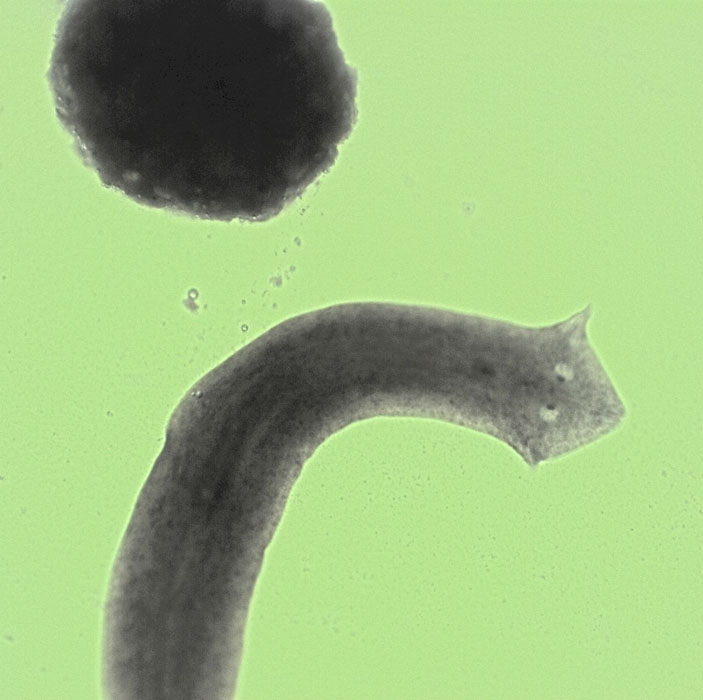
They are called nemertean worms, and are a whole phylum of carnivorous worm awesomeness. I only had the faintest knowledge of their existence (i.e. "huh, nice worm, wonder what it is?") before finally getting their name on a BBC broadcast in Best Buy. They fascinated me, moving swiftly towards the seal corpse alongside starfish and various other eager feeders. The last time I had seen worms like that was in a 'pseudo-pond' in micro-bio!

Nemertean worms are very diverse. Worms like the seal-eaters above can be found in both fresh and salt water with one lucky species found on land in Java. They can range anywhere from a few millimeters long to 100+ feet, making these worms the longest animals alive.

Nemerteans have interesting anatomy. They have probosces that may or may not be armed with a sheath with which they probe their prey. These worms are thus classified based on whether their probosces are 'armed' with solid piercing materials or not. The ones with sharp points on their probosces can also be toxic. Said toxin is under examination as a possible means of memory enhancement.


As with many worms, nemerteans have amazing regenerative capabilities. Cut off a piece of one of the larger ones and it becomes a whole new worm. They can also reproduce sexually (with or without hermaphroditism). Even the most durable vertebrate looks fragile as glass by comparison to these guys.


It feels like a single entry does not do these worms justice. They are so cool, but I only just learned about them. It's hard to sandwich the awesomeness of ribbony, velvety carnivorous worms into an entry like I would with a single species.

Wednesday, July 6, 2011

Creature Feature: Medicinal Leech.

Ever look back at old medicine and wonder what people were thinking? They would poke at organs to try and make you healthy. They thought that eating certain foods had some strange impact on temperament lost to modern society. Hell, they even thought that leeches were good if somebody had too much blood.


Wait. They still are.

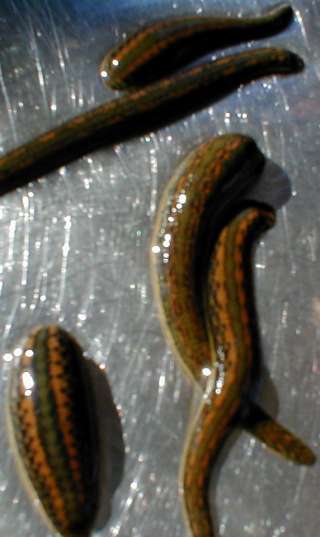
The standard medicinal leech (Hirudo medicinalis) can be found all around Europe and in Kazakhstan (Borat territory). Although several other species of leeches can be used, this one is understandably the most common. All are annelid worms that suck blood better than Edward Cullen. In the wild, however, H. medicinalis is protected and even considered a Vulnerable species by CITES. Best get your leeches from a licensed dealer, now.

The bite from a leech is almost painless. The worm makes a y-shaped incision with its tripartite jaw, then attaches to its host with its suckers. The leech stays attached for only as long as it takes to fill its gullet with blood, which may be five to ten times the leech's weight. They can live up to a year between feeding, putting Burmese pythons to shame.

Still pretty to me.


Way back when, leeches were used to balance out the four humors of the body: blood, yellow bile, black bile, and phlegm. If you think this sounds gross, it was. There were various methods to balance these four out, including giving wine to people who were coughing up phlegm and, of course, putting leeches on a person considered 'sanguine.' That means 'too extroverted' or 'had a fever' in today's terms. (For the record, I seem to be very Mel-San according to Wikipedia.)


Nowadays, leeches are still used to remove excess blood. They also secrete an anticoagulant (Hirudin) like all hematophagous creatures do, which makes them handy for removing clotted blood. They can also re-stimulate circulation when it comes to reattaching body parts that require a lot of blood, such as eyelids, fingers, and ears. Think about that next time you want plastic surgery.

Monday, January 31, 2011

Creature Feature: Giant Blue Earthworm.


What? You thought we were making stuff up? That really is a giant blue earthworm, and it really does release glow-in-the-dark mucus. Its more official name is not "tentacle rape in Australia," but the more worksafe "Giant Gippsland Earthworm (Megascolides australis)." It is one of the few things in Australia that does not want to suck your intestines out...as far as we know. It's big enough to possibly do that.

How giant is giant? Nobody is really sure, but reports range from 2-3 meters in length for adult specimens. The largest ever was supposedly 4 meters (around 13 feet). They can be found in the colorful clay soils of Gippsland, Australia. That land is protected to keep these rare worms alive; as of right now, they are the only Australian worm classified as "vulnerable."


You thought the deepsea was unknown? We don't even know how these strange worms reproduce. Like David Attenborough up there said, we have their egg cocoons and can hear them squishing underground, but know very little about them otherwise.


In retrospect, that might be a good thing.  I don't want to know why this scientist named hers 'Bitey.'

Tomorrow: After this and the yeti crab, you deserve a cute. A cute that can smash your face with its butt!


Saturday, January 8, 2011

Creature Feature: Pig-Butt Worm.

This blog covers some pretty weird stuff: trippy colors, shiny bugs, and mind-controlling fungus, to name a few. Frustration upon frustration in the span of a few hours is enough to make me hit you all with one of the weirdest things yet: A pigbutt worm.


No, seriously; even the Latin (Chaetopterus pugaporcinus) thinks that this annelid worm resembles a pig's hindquarters. Another not so flattering name for it is "flying buttocks," which sounds like something out of a Monty Python sketch. There is no flattering name for a worm that resembles an ass.

 Yes, that is a worm. The two middle segments are inflated such that the worm resembles a hazelnut-sized behind. They live just below the oxygen minimum zone in the ocean, which explains why scuba divers and marine biologists were not having underwater gigglefits until recently.

Unfortunately, the entry has to end here. This worm was only discovered recently (2007) by experts at the Monterey Bay Aquarium. Said experts suspect that it might even be some weird larval form of some...actually, let's not think about what the adult stage of a floating behind would be. Most worms of this genus have adult forms that live in parchment-like tubes on the ocean floor. A disembodied rear end cannot become anything worse than that...right?

Monday, November 29, 2010

Creature Feature: Sea Mouse.

After reading the title, you're probably picturing an adorable little mouse in scuba gear. Just to get the image out of your head and onto the screen, here's underwater Mickey:


The Illuminati are even underwater now. 

Now that's that's over with: 


Squeak!

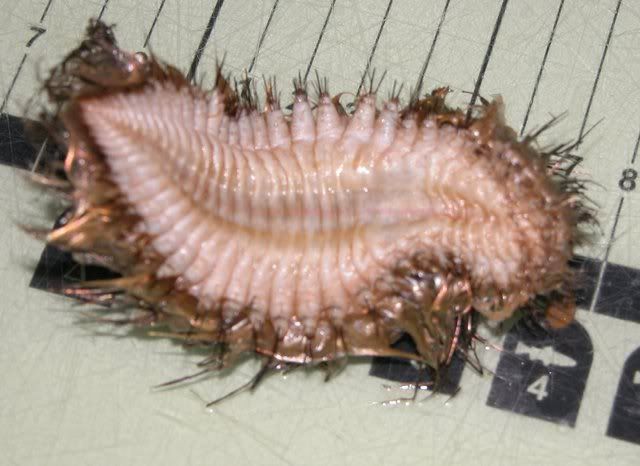
The real sea mouse (Aphrodita aculeata) is not a mouse at all. It is instead a fuzzy, polychaete worm that lives on the ocean floor (up to 1000 meter depths). Sea mice are related to those funny little Christmas tree worms that inspired the plants in Avatar; a lot of polychaetes are spectacular to look at, either shining or glowing in the dark. 


The sea mouse's body (up to 20cm in length) is covered with iridescent setae (i.e. hairs) that shine red or green depending on the angle of light. This is perfectly fair game for polychaete worms; many have spectacular gills, glow in the dark, or do other things that make humans jealous.

If you think the sea mouse looks like something strangely familiar or cleverly picked out that the sea mouse's generic name looks a lot like "Aphrodite," the Greek goddess of love, you get a cookie. Yes, that name is a reference to the worm's resemblance to human female genitalia when seen from below.


So, wait...this creature is a giant, sparkling pube? Why hasn't Japan turned it into a Pokemon yet?