Showing posts with label platyhelminthes. Show all posts

Tuesday, January 3, 2012

Creature Feature: Ribeiroia


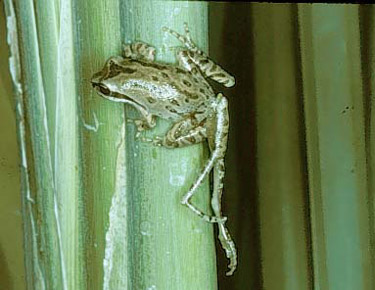
Wait. Frog Week is done. Why is there another frog up here? Can't we look at the Indus River Dolphin or someth-
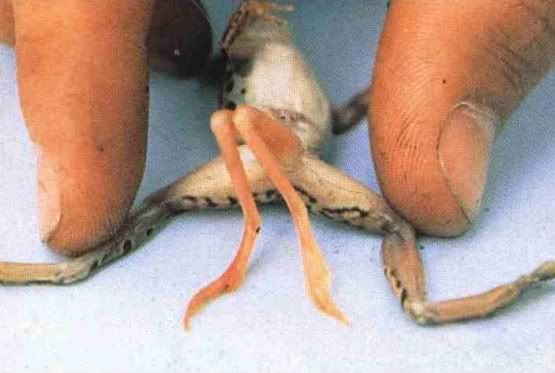
 

Oh, snap. Those extra limbs are freaky. These are the frogs that were made into malformed skeletons for MALAMP. As the bit for that project said, these multi-limbed frogs are mostly found in North America - i.e. many of our backyards. They are getting more and more numerous every year, so we should probably learn about what causes them.

Prior to the discovery of a parasite in the frogs, people assumed that the freakish limb deformations were mankind's fault. We were thinking that these freaks were the result of nuclear waste, mercury, or some other sort of pollution-related mutagen.  Today, we still haven't quite ruled pollution out, but we have changed our prime suspect to this:
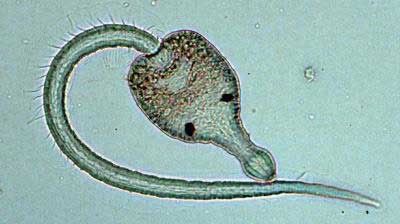


Without bringing toxic waste into the picture, multi-limbed frogs are typically caused by a parasite called Ribeiroia. There are three species- one in North America (R. ondontrae), one in Guatamala and the Caribbean (R. marini), and one in Africa. All of the above are parasitic flatworms that infest frogs to further their life cycles. They are usually found in freshwater ponds and wetlands (you know, places where there are frogs).

Like many parasites, the life cycle of these little flatworm is surprisingly complex. Ribeiroia starts out in the gut of an aquatic snail, then reproduces asexually into flagellated juveniles. These little not-sperm then find a tadpole and encyst themselves into what would be the tadpole's legs. It is suspected that this is done because frogs thus deformed are more likely to be eaten by birds (who will then complete the cycle by depositing the parasite's eggs). The alternative explanation? There is no God.

Saturday, October 1, 2011

Creature Feature: Land Planarians.

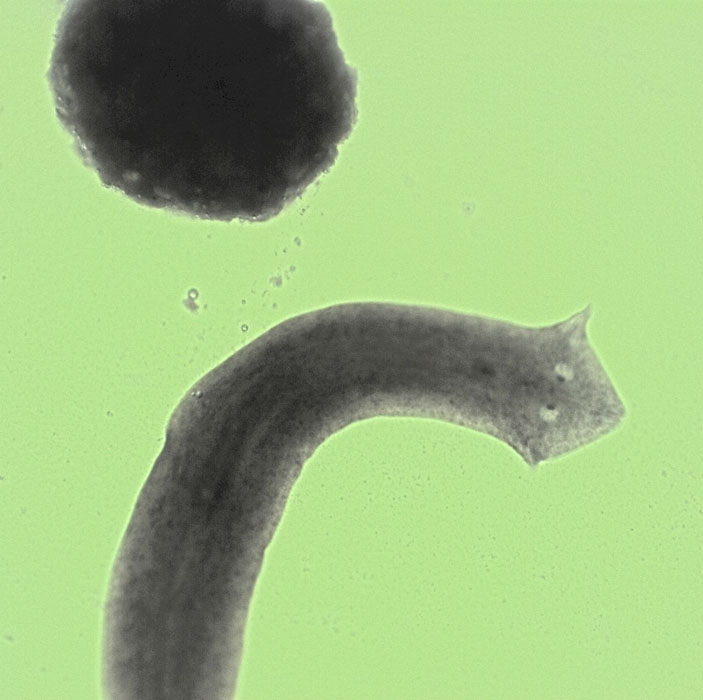
As you all (hopefully) well know, the authoress of this blog finds planaria to be among the cutest creatures in existence. Some people are freaked out by simple earthworms, but what's there not to like about cross-eyed flatworm? Heck, they even look like they're smiling if you catch them on a good day. Even without that luck, they are eternally cross-eyed, which is pretty amusing itself.

ETERNAL DERP.


Then there are land planarians. Yes, flatworms can go on land. Did you think you were safe just by avoiding the water?

Land planarians (family Geoplanidae) are a lot less cute than their water-bound counterparts. They look a lot more like nudibranchs that made it onto land. These worms come in trippy colors and are definitely predatory, eating any invertebrates smaller than themselves. They cannot live outside of rainforest regions. When they do have the right environ, they do well enough to cause problems to native invertebrate fauna.

TRIPPY! Credit is on the pic. :3
 

The way these land-bound planarians hunt is quite ingenious: Many invertebrates leave a slimy trail in their wakes as they squish along. As soon as night falls, the planaria come out and follow the chemical trails to find slugs, snails, and their favorite foods, earthworms. They are also cannibalistic, showing that even flatworms can be quite vicious!

Land planarians are so successful in the right environment that they have been used to curb invasive snail species in Hawaii and the Pacific Isles. On the flipside, they also threaten any native snails. Somehow, land planarians have caused issues in the British Isles - how they survive there, we do not know.

From Whatsthatbug.com. Go there.


Unfortunately, not many people are looking into these exotic worms. Despite their flashy colors and ecological significance, land planarians remain one of the least studied invertebrate groups in existence. This must be fixed.

Tuesday, June 22, 2010

Creature Feature: Tapeworms.


Behold the tapeworm, a MARVEL of nature! YT would not let me link this, so you will have to click the text. (For the lulz, note the Shakira interview and "America's Got Talent" alongside flesh-eating parasites.)

Yes, I went from the elegant quetzal to a creature that most people would in horror from. You know how I get with worms; they fascinate me!

Tapeworms (Class Cestoda) are no exception to my love of worms. Remember, parasites have to thrive inside another organism; they have to live through acids and our own immune systems in order to survive. If anything, living in such harsh conditions should be seen with more admiration than mere predation.


All hail the tapeworm. These can grow anywhere from 40-100 feet in length. Long worm is loooong.

The first things that most people notice about tapeworms are the flat segments that make up its 'body' called "proglottids." These, almost like those little sea salps in a chain, can reproduce independently, making some biologists believe that a single tapeworm should be treated as a colony of proglottids rather than a single organism. They can reach chains of up to 100 feet long.

Gravid proglottids usually come out in a host's feces, and lay eggs intended for a different host. Beef, fish, and pork can all contain juvenile tapeworms (cysts) just waiting to get in your gut and start the process all over again.

The head of the worm, called the scolex, is rarely seen. It has suckers and a hooklike 'mouth' that latch it onto the intestinal wall. It also looks like something straight out of an Alien movie:


Just as an example of how specialized parasites like this can be, let us look at the beef tapeworm (Taenia saginata). As the name implies, the beef tapeworm spends much of its life in a cow's body, but falls onto pastures via human feces. Once the resistant eggs from a proglottid are ingested by a cow, the larvae spread all around the cow's body from there. The cycle repeats itself unless the meat is either frozen or heated to temperatures that the cysts cannot handle.


Creepy? Perhaps, but also admirable in its own right. Few species accommodate so well to the introduction of domesticated animals. There is even one for puppies, animals hailed as man's best friend. These little guys have found a way to not only infect said animals, but also to make humans part of their wormy complete breakfasts. Hosts usually show no outward symptoms, but some cases result in severe weight loss, decreased appetite, nausea, and dizziness. You may also wind up with bad case of diarrhea, making this Japanese video essential:


Since at least the Victorian era, tapeworms in particular were advertised as a weight loss supplement. Given that many parasitic infections result in a change in appetite and weight loss, it may have worked.


There are, however, several better parasites for your health; hookworms in particular have been known to reduce allergy symptoms. That's a worm for another day.


This, however, has no excuse. It looks even more like a tapeworm with wings in the video games.

Tuesday, May 18, 2010

Creature Feature: Planarians


Some people may twitch at the sight of nightcrawlers, but planaria are a whole
different can of worms. These guys are just adorable! Most biology classes cover the various freshwater planarian species at some point; there are also a few land-based planaria. They are not as enchanting as yesterday's damselfly, but are still unbelievable in their own right.

For starters, they look adorably cartoonish. Even though they eat via a tube on their stomachs, they swim like little otters, and have some of the most ridiculous-looking (and primitive) eyespots in the animal world. They do not have focused, complex vision like we do; being cross-eyed is not a problem for these little guys. Their 'eyes' are just photosensitive.

To their credit, they look smarter than Bibarel.


They even "smile!" How cute is that? :3

Of course, planarians are not popular biology lab rats because of how goshdarn cute they are. Besides being one of the first critters to sport cephalization ('head-ness') and bilateral symmetry, they have insane regeneration capabilities.


As this extremely fucked-up Japanese cartoon (based off of an equally-FUBAR cartoon with a pink rabbit) demonstrates, cutting a planarian up will cause a whole new individual to be born. Yes, planaria lead the life of Rin from Mnemosyne; people cut them up like genuine sadists only to have them regenerate. This ability also leads to multi-headed planaria like these:


You know that debate about stem cells? These guys are like stem cell mania. The whole deal with stem cells is that they can become any part of an organism. One cut of these guys creates an entirely new worm. Holy fuck. Take that, vertebrates!

Of course, this regeneration is nothing compared to the immortal jellyfish...but that's a post for another day. ^_~