Sunday, February 24, 2013

Wild Fest 2013 Coverage!

Today was the 2013 Wild Fest! I had no idea how to get there or how big it would be. It turned out to be relatively easy to find and a small exhibit that fit into a Sunday afternoon nicely. A lot of wildlife centers in IL were present. So, without further ado...pictures!


SOAR (Save Our American Raptors) had a booth at the show. FYI, "raptors" here means "Birds of prey" - let's not go Jurassic Park here. They had a lot of owls, a peregrine falcon (the fastest animal in the world) and a bald eagle. While we were not allowed to touch the raptors, they were still awesome to see. How often do you get up-close and personal with a bald eagle, after all?


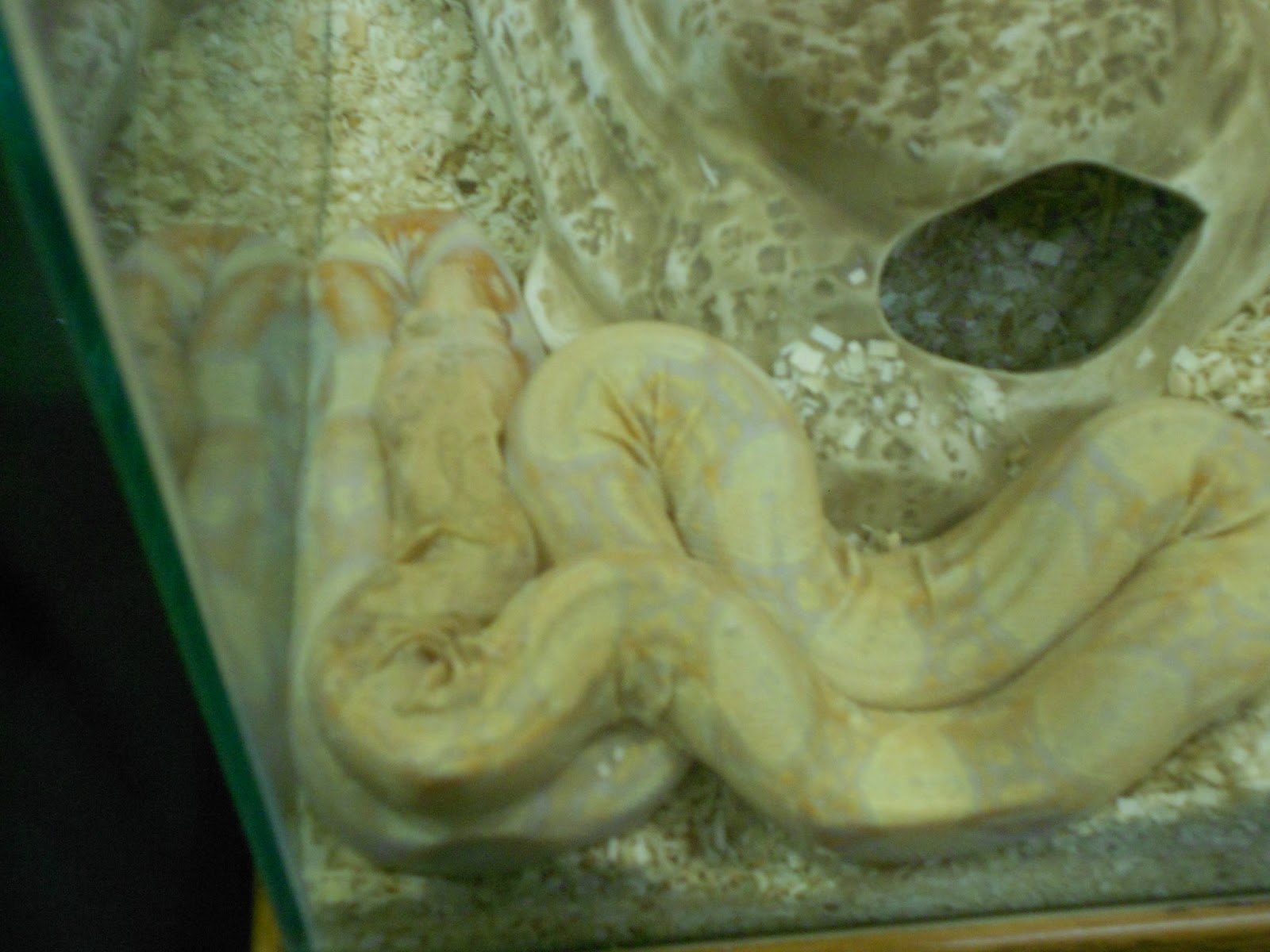
Animals for Awareness had a lot. Parrots, hedgehogs, and an albino male boa were pretty much par for the course. What I did not expect was the kinkajou - a smallish Central and South American mammal related to raccoons. She was very active, so unfortunately, my pictures sucked. Fret not; I will call them about volunteering opportunities.


Incredible Bats was just that: A bunch of awesome fruit bats that people could see right in front of them. Both species (Egyptian and Straw-Colored) were from Africa, which is usually not praised fro its fruit bats. Alas, bats are nocturnal, and these guys were not very interested in the fruit we offered them.


Jim Nesci is something of a legend among reptile people. He uses exotic reptiles for a lot of educational shows and appears regularly at ReptileFest and NARBC. We just missed his big display involving an albino Burmese python. BUBBA was there, too; check out the little girl getting a ride on an alligator's back!


Finally, Big Run Wolf Ranch made it to this awesome exhibition. Neither Shanoa nor Zeus wanted to show up; instead of the standard gray wolf, we got to see Canuck (sp?), a British Columbian wolf. These wolves are actually the ranch owner's favorite, sparting dark coats, brilliant yellow-green eyes, and a white mark on the chest. It's a shame I couldn't figure out how to get my camera to shoot right. Kirby II was there as well.

This was a pretty awesome event, if small. With only so much space to work with and so much time, it's pretty easy to see everything in an hour. Stick around for a show; you won't regret it.

Saturday, February 23, 2013

Newsflash: Manipulation of Monarch Butterflies.

It's almost March. That means Spring will be coming soon. This also means that several other animals, such as monarch butterflies, will soon be flourishing in our lawns. 


For those of you who know nothing about monarch butterflies aside from what they look like, you are missing out. Monarchs migrate from the cooler parts of North America down to Mexico as soon as winter hits. They give birth there, then die. The new monarchs that result then fly their way back up north when things get warmer. They are the only insects that migrate 2,500 miles a year. One of the classic butterflies happens to be one of the most impressive in several regards.

One mechanism has been found to play a tole in this intense migration: monarch butterflies have an uncanny genetic instinct to migrate to the exact same spot every year. The monarchs mate, then die, leaving their offspring to navigate the exact same path. That's 2,500 miles, all wrapped into genes like the world's finest GPS. Beat that, Google Maps.

Now, scientists have found what makes these butterflies tick. Here's the deal:

"Until now, researchers didn’t know what triggered the trek north. They suspected environmental factors such as temperature or changing day length could cue the monarchs. To find out, Reppert’s team studied southward-migrating monarchs captured in the eastern United States. The scientists housed one group of migrants in an incubator for 24 days and turned down the temperature to 4° Celsius during dark “night” periods and 11° C during light “day” periods — the average temperatures in the wintertime butterfly roosts. The team exposed a second group of butterflies to the same temperatures while also simulating the subtle increase in daylight that monarchs see over the winter while in Mexico.

Then the researchers took the two groups outside and tethered them one by one inside a flight simulator — a white plastic barrel that gauges flight bearings. In both experimental groups, the lab-wintered butterflies flew north. In fact, Reppert says, “the data were identical.”
Also, southern-migrating monarchs that had been captured in Texas and kept in the lab under fall conditions — with no pulse of nightly cold temperature — continued to head south when hooked up to the flight simulator.

“It’s astounding,” says ecologist Karen Oberhauser of the University of Minnesota, who supplied captured butterflies to Reppert’s team. She’s convinced that just 24 days of cold temperature is enough to switch butterflies’ flight direction from south to north. But she’s also curious about the effects of day length alone.

Reppert says the direction trigger might be modified by changes in day length, but “clearly coldness is the main factor.” Next, his team hopes to figure out exactly how the monarchs sense temperature."


Source + more here. 

This is neat stuff.A lot of people don't really think about seasonal cycles in wild animals. We're kinda used to animals, including humans, mating all the time. In reality, animal mating cycles are fine-tuned such that mommy only gives birth when there is an abundance of food available. Humans and domestic animals usually don't have to worry about that.

More importantly, however, this revelation on the impact of temperature may mean that the monarch is in trouble. If global climate change messes with their migration patterns, the species could die out. Enjoy the magnificent butterflies while we have them; if these findings are any indication, we might not have them around much longer.

Thursday, February 21, 2013

Creature Feature: Longhorn Cowfish.

The idea of "you can slap any word onto 'fish' and it's probably a thing" makes for a rather funny game. Triggerfish are subtle; there is a trigger there, but it's not obvious unless you're looking for it. Surgeonfish? Yeah, I don't get it, either, but I wouldn't trust it with open-heart operations either way. Squirrelfish do not look like squirrels - period. Then there are cowfish...

Source.


...yeah, that one works pretty well, actually.

Cowfish are members of the boxfish family, which are closely related to pufferfish. Yes, like fugu, these fish are poisonous. They are native to tropical waters; many of them can be found in the Indo-Pacific. They eat crustaceans, like fish and crabs, as well as plants like algae. The longhorn cowfish ( Lactoria cornuta) is the most popular.

Cowfish are best known for, well, looking like cows. They have boxy bodies and long horns coming out of their heads. Like cows, they are also tanks; the scales on this fish's body are fused into a tough shell. They are slow swimmers and grunt when captured. We'll cut the fish some slack because a mooing fish would be just crazy, and they look enough like cows without sounding like pigs. Moo.


Cowfish have another defense aside from looking like cows: if irritated, they excrete a nasty poison. It is called ostracitoxin and cannot be broken down as it is not a protein. It is hell-bent on destroying other fish, and is hemolytic to boot. It kills sharks. Even other boxfish are not immune to one PO'd cow. The meat is also poisonous. No cowfish steaks for you!

Good gods, cowfish are popular in captivity. They are available at Petco if the online search results are any indication.  This does not mean they are beginner fish - it means that you need to read directions. Cowfish are generally peaceful, easy-going fish that take their time and do not like stress from having a lot of tankmates.  Failing to acclimate them properly may result in poisoning your whole tank. Popular, but still not for beginners, so if you're a newbie, don't get a cow, man.

Wednesday, February 20, 2013

"They Actually Eat That:" Pigs in China.

Today's entry is one of our more 'different' food features. Instead of looking at downright weird food, this entry will focus on China's new version of "normal" food. The Chinese love meat, for sure. That includes relatively mundane meat, like pork...which they are crazy about.


Yes, despite being a nation of "we'll eat anything," China is particularly fond of pork. There are a whole slew of reasons for this, including pigs serving as garbage disposals in traditional households. There is one angle that is particularly pertinent to this column: meat is a triumph over China's other weird food.

This blog covers a lot of weird foods. One of the main reasons people eat weird foods is because it's traditional. The case holds for China, the nation of "everything we can land chopsticks on," as well. Eating many foods is good for humans, but there are cultural stigmas and the like that make certain foods taboo, or, otherwise, convey status.

That is exactly the situation with pork in China: it's a status thing. The Chinese see eating meat as a triumph over poverty. Thus meat, particularly pork, is seeing an amazing rise in popularity. This also correlates with the increasing amount of money in China's collective pocket. While eating anything may attract tourists, China loves pork so much that half of the world's swine live there. More and more people are eating them every day.

This increased demand for pork has led to severe environmental damage. As any of us who have seen The Simpsons Movie know, pigs are among the most environmentally-unfriendly farm animals in existence. Respiratory infections and awful smells follow in the wake of a pig farm. Oh, and yes, overdosing pigs on antibiotics leads to antibiotic resistant bacteria ("superbugs") in the pigs' feces.


Tuesday, February 19, 2013

Creature Feature: Spiny Leaf Insect.

There is a rather bizarre game that I like to play in the shower at my local health club. For whatever reason, there are a strange number of small flies in the women's locker room - usually one or two to a stall. (I haven't said anything; they've been there for as long as I can remember, and I'd presume the various renovations they've done would have fixed something.) My goal, as soon as I hit the shower, is to go fly-hunting. I show no mercy; rather, the night is not complete without swatting one fly on the marble. After all, I'm only selecting out the flies who aren't fast or clever enough to camouflage themselves, right?


That said, some insects, like this spiny leaf insect (Extatosoma tiaratum), have stunning camouflage. It is so good at camouflage that it is also called "Macleay's Spectre." This insect is native to Australia and possibly New Guinea. It is related to walking sticks despite looking a fair amount like a mantis, and is not a true leaf insect at all.

One word can sum up the spiny leaf insect: Impressive. It's large, for a bug, able to stretch across a grown man's fingers. Both sexes will occasionally curl their long abdomens like scorpion tails when threatened, creating a sort of mantid-scorpion look. Again, that camouflage is a real treat; it even has thorns. 


There are a number of interesting things about spiny leaf insect reproduction. For example, the males can fly, and only the females have that godly camouflage. The females, after getting knocked up, flick their eggs out of their bodies and onto the forest floor. These eggs hatch better in cooler temperatures, - under 25 degrees Celsius. Also, the girls are parthenogenic- that is, they can produce other female progeny without a male.

Know what's awesome? These unique insects make excellent pets. They can be found in schools and laboratories as test animals, and are very good for the first-time insect fancier. They are vegetarians, and can feed on any number of plants. Find a care sheet on them if you're interested; I'm sure they're around. It would be hard to find a better pet or display insect, if that's up your unique alley. Look closely at that tree branch- it might be a bug.

Monday, February 18, 2013

Bio-Art: Away from the Flock (Divided).

There is a phrase called "starving artist." To make a lot of money, artists have to keep doing controversial things. When the controversial becomes expected, however, is it still controversial? Apparently so. After all, people with way too much time and money on their hands pay millions for art like this:

Pic from trash.nonoo.hu.


Damien Hirst has done it again: he has dunked an animal in formaldehyde and called it art. "Away From the Flock (Divided)" features a bisected lamb split between two tanks. One of Hirst's other works, "Mother and Child (Divided)", has a similar theme. Nonetheless, the split sheep remains a trademark of Damien Hirst's style. It was sold at a Christie's auction for 3.3 million dollars, but was expected to hit 3.8. That's a lot of preserved mutton.

Just to be clear, I am aware that there is some skill present in this piece and others like it. It can't be easy to bisect a lamb that neatly. It also can't be easy to put both halves in formaldehyde without spilling lamb entrails everywhere. These, I will admit, qualify as art. Whether it is worth millions and worth replacing (even preserved animals don't last forever) is another issue entirely.

Hirst's logic for splitting a lamb in two and dunking both halves in formaldehyde? It's a statement about God.  There are a tons of lines calling humans God's little sheep, which becomes more disturbing the more you think about it. If you want to extend the metaphor, the split sheep could represent a religious schism. It really is just a matter of perspective. One man's bisected lamb is another man's religious statement.

But can Hirst keep up the shock value? If the difference between the projected price and the actual price is any indication, the demand has gone down for Hirst's work.Eventually, putting dead animals in glass and calling it art is not going to work anymore. Yes, it's cool to have a style, but shock pieces get old after a while. Animal in a tank? We've seen that before. Next?

Creature Feature:

Ever think about how huge an honor it must be to name a dinosaur? The result is then recorded for generations to come- at least, until somebody finds that it belongs to an existing species and needs to be merged. Oh well.


Michael Crichton received the honor of being named after a dinosaur in 2002 when an ankylosaur was dug up in China. The ankylosaur was named Crichtonsaurus bohlini; a second species in the genus was found in 2007. Crichtonsaurus was around during the Late Cretaceous- the last period before the KT event, which wiped out the vast majority of dinos. On the plus side, at least it got to hang with T-Rex, Triceratops, and a bunch of other popular dinos we all know and love.

Don't know who Crichton is? Of course you do. He's the guy who wrote Jurassic Park! Without him, many of us would not be into dinosaurs. Many of us would also not own pet reptiles; Jurassic Park made owning lizards, particularly the frilled dragon, very fashionable. The world would not be the same place without Crichton. He deserves a dinosaur.

Crichtonsaurus was technically a nodosaur, not an ankylosaur. The general idea is still the same: an armored, herbivorous mass of scale and plates. Many ankylosaurs also had a club on their tails which could be used like a mace. They're neat creatures, and this blog needs more of them. It's still far from what one would expect if they heard that the author of Jurassic Park got his own dinosaur.

We want something that'll look cool on a logo, darnit!


Really, though? It doesn't matter if this dinosaur was a clunky, herbivorous tank instead of a massive predator like T-Rex. If anyone deserved a dinosaur named after them, it was the author of Jurassic Park. Without him, the world would be a very different place.