Tuesday, February 15, 2011

Creature Feature: Vampire Moths.

"I'd come back as a butterfly."

"Why?"

"Because nobody ever suspects the butterfly. Mwahahaha!" - Bart Simpson.

Indeed, who would suspect a butterfly of doing anything sinister? Moths are slightly more suspicious and annoying, but still nothing to worry about unless you have a precious wool sweater. All of Lepidoptera seems pretty innocent; even the moth with a skull on its back is harmless. They are hardly frightening creatures.

Oh, wait. Except that moth.


Moths of the genus Calyptra have a sinister secret hiding beneath that demure, brown coloration: Their proboscises have evolved to become sharp enough to pierce mammalian flesh. While pulsating their bifurcated mouth parts into a mammal's (that means your) body, they slowly suck up some vital fluid. (By the way, the case is opposite with these moths and mosquitoes; the males bite.) Expect the bite to hurt for 2-3 hours after the moth has left. They are not disease vectors like mosquitoes, so you will definitely live to say that you got bitten by a vampire moth.


Nobody is sure exactly how these moths became dusty, fluttering nosferatu, but the current theory is that related moths first evolved those strange mouth parts to suck fruits juice out of fruit. Sucking human blood is just an extension of that talent. Umm, wow, science; does this mean that we should all start fearing vegans?


Yes. No good can come of an image like this.

Oh, and by the way, Calyptra moths are native to southeast Asia, Japan, China, the Urals, and southern Europe...or they were. They have now spread as far as Finland; a few have also been spotted in Sweden, a little further West. If this keeps up, they will get to America and have terrible literature written about them within the next few decades.

At least they don't sparkle.


Tomorrow: The parts of the pig that you never thought would have a use DO have a use; also, see how awesome pigs used to be!

Monday, February 14, 2011

Creature Feature: Kissing Gourami.

Happy Valentine's Day, everyone! Go out and buy some chocolate, cards, and a Kama Sutra. Oh, and don't forget those adorable kissing fish!


 Kissing gouramis appear in nearly every Valentine's Day montage ever. The green kissing gouramis are from Thailand; the pink ones, Java. In a nutshell, they are omnivorous fish (do NOT put a gourami in with smaller fish) that kiss.


"Aww, how cute! Those fish are kissing!"

Kissing in gouramis does not mean the same thing as it does in humans, much like smiling in chimpanzees is a hint that one might get one's hand bitten off. The puckered lips in kissing gouramis are tipped with teeth; a kiss is not nearly as friendly in these fish as it is in humans!

Kissing can be seen as a form of sparring between fish. There is nothing cute about it and no way to guarantee that you are getting a male and female couple. Although there is no "kiss of death," being kissed too much may cause the mucus coat on other fish to deteriorate, leaving them open to infections. Ouch.

Pucker up! Hey, it's a tradition to kiss the first fish one catches, anyways.


Speaking of, no matter how adorable these fish may seem, do not impulse buy them. Much like Burmese pythons and green iguanas, kissing gouramis start small, but will quickly outgrow their tank if the owner is not aware of how big they get (anywhere from 20-30cm/7.87-11.81 inches). They are a lot harder to take care of than goldfish because they are omnivores; give the new 'couple' a gourmet meal to work with, including both lettuce and live food. Leaving algae on the side of the tank must be like parsley garnish to them. Bon appetit, fishies!


Tomorrow: BEWARE THE VAMPIRE MOTH!

Sunday, February 13, 2011

Creature Feature: Cookiecutter Shark.

And now for something completely different: A shark that makes perfectly circular wounds with its teeth.


These cuts were made by a shark. Not a lamprey. Not a crazy sea worm from some B-horror movie. A shark, as in, related to Jaws. It lives in only a few little spots in the ocean, but those spots are riddled with hole-pocked animals.

This shark has binocular vision, just like Prasina vine snakes and humans.


The cookiecutter shark (Isistius brasiliensis) is one of the smaller shark species referred to as 'dogfish.' These are not the same sharks as the menacing Tiger and Great White species; they are a lot smaller (14-15 inches at most), which honestly makes them creepier when looked at head-on. The cookiecutter shark is particularly uncanny in this regard - it has binocular vision and a mouth straight off of an alien monster.


The  cookiecutter's crazy, suction-like mouth almost looks like it does not belong on a shark. It nonetheless fits the cookiecutter's semi-parasitic life style; cookiecutter sharks swim around taking bites out of whatever they happen to encounter. These chunks are usually 2 inches (5 cm) in diameter and 2.8 inches (7 cm) deep. They can appear on anything - fish, other sharks, whales, dolphins, undersea cables, submarines, human bodies, anything. The U.S. Navy was once forced to retreat because the sharks had caused their submarines to leak. Our finest, everyone!

Besides the strange cutting pattern, the cookiecutter shark also has a number of other weird things about it. It undergoes a migration from miles beneath the sea (literally the "twilight zone") to the surface every day. Oblivious porpoises and other predators may mistake the school of sharks for much smaller, tastier fish thanks to some of the best countershading on the planet.


The cookiecutter shark may look rather drab on top, but it possesses photophores on its underside that make it glow in the dark (a feat so amazing that creationists are all over a creature CLEARLY from the damper reaches of Hell). Its underside glows bright green except for one strange, collar-like ring around its neck (thus a scientific name derived from "Isis," the Egyptian goddess of light). Glowing in the dark is pretty cool, but the collar baffles scientists; the current theory is that it serves as a lure,  making this the first recorded instance of reverse-bioluminescence as a hunting mechanism. Trippy.

Tomorrow: Happy Valentine's Day! Those kissing fish are not as lovey-dovey as one may think.

Saturday, February 12, 2011

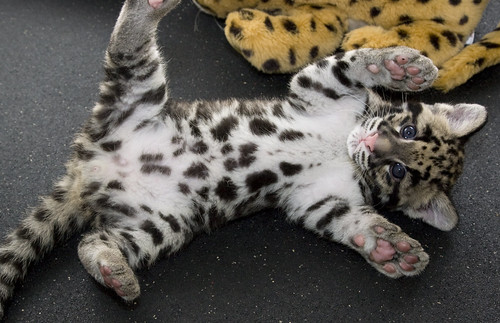
Creature Feature: Clouded Leopard.

Said it before and will say it again: "Middle felids" need more love. To most people, there are only small, domestic cats and giant wildcats like lions and tigers. What do you think happened to all the cats in between, guys? Did they disappear thanks to some natural phenomenon that did not play to one extreme or the other?

No. People just do not think that mid-sized cats can be awesome. Here's a Clouded Leopard (Neofelis nebulosa) to prove them wrong:


Clouded leopards live in Southeast Asia, from the Himalayas to China to Indonesia. They, like all cats, are carnivores; clouded leopards may be big and bad enough to take down large mammals. Its exact diet is largely speculation due to the clouded leopard's very small wild population size. It is estimated that there are no more than 1,000 adult cats in one area. Deforestation is not helping.

 In many ways, the Clouded Leopard is the mid-sized cat.When scientists first saw this cat's skeleton, they could not tell whether they were looking at a large or small felid. They do not purr like small cats, but can meow, hiss, growl, and make a number of other noises. This was all learned from captive specimens.


(Turn off the Thai music if you must.)

Clouded Leopards have several other strange things about them that neither big nor small cats have in spades. They have the largest canine teeth (proportionately) of any felid; picture a tiger's teeth on a little kitty like that and one wonders if it will eventually evolve into a stealthy, arboreal Smilodon.


Show me your teeth!

As if saber-teeth were not enough, clouded leopards are the best climbers of the feline world. Their ankles rotate so that the animal can climb upside-down on tree braches and down tree trunks headfirst like a squirrel. That long tail helps it balance. All of these adaptations put together lead researchers to believe that the Clouded Leopard, besides hunting arboreal prey, might be able to drop down upon unsuspecting ungulates. Again, nobody's sure.


If you want to support conservation of the clouded leopard and other big cats, take a snap of your own cat. Send it and five dollars to National Geographic's Little Kitties for Big Cats fundraiser and your furry friend may become cat of the week. Share the love! 

Tomorrow: Jaws just got a whole new meaning.

Friday, February 11, 2011

Creature Feature: Cuban False Chameleon.

1You have probably heard the old saying, "If it walks like a duck, quacks like a duck, and swims like a duck, it's a duck." Generally, if one animal behaves and looks a lot like another animal, the two animals are probably the same species.

Again, if only nature made things that easy.


This alien-looking lizard is called a Cuban False Chameleon (Chamaeleois genus; also Anolis barbatus, "bearded anole"). It is found only in Cuba and resembles a cross between a chameleon, an iguana, and a space monster. It is so obscure that Wikipedia does not even have a page on it.


The Cuban False Chameleon walks like a real chameleon and has bulgy eyes like a real chameleon, but is not a true chameleon. It, like the "chameleons" common in Florida, is an anole - a type of lizard related to iguanas. It cannot change color like those little anoles, and overall behaves much more like an iguana when it is not swaying like a twig.

Cuban False Chameleons are lazy. If you own a CFC, it will spend most of its time on a branch, staying as still as the wood itself. These lizards are not very active; their sluggish nature plus excellent camouflage means that predators will have a hard time picking one out. It also means that they are fairly easy to take care of, even though they are rather large for anoles.


Wood, lizard, or lizard made of wood? 

Good luck finding a CFC if you want one as a pet. They can get rather pricey; after looking around a little, one can expect to pay upwards of 300 USD for one lizard. In the wild, they eat snails, insects, frogs, and young birds; they can eat insects specially sold for lizards in captivity. Cool lizard; decide for yourself whether it is worth 3 paychecks for yourself.


Tomorrow: Yet another overlooked felid!


Thursday, February 10, 2011

Creature Feature: Box Jellyfish/Sea Wasp.

It stuns me that there has never been a horror flick about jellyfish. Their body structures are alien to humans, they have vicious stinging tentacles, and they either look somewhere between creepy and elegant or are darn near invisible in the ocean. As icing on the cake, many of them glow in the dark. Sounds like monster movie material to me.

Haha. If only nature cranked out a gargantuan, man-eating jellyfish for us to play with! The deadliest jellyfish in the world is nigh-invisible, and some of its relatives are tiny.


Chironex fleckeri, also called the sea wasp, is cited as the most lethal jellyfish in existence. Its tentacles contain enough venom to kill 60 adult humans; like everything else in Australia, it is out to kill you, and does a damn good job of it. A few others in the genus have nasty venom as well.


Box jellyfish in general are sophisticated cnidarians. As their name indicates, their bells are distinctly cuboid as opposed to being round and frilly like the bells on most jellies. They have a nervous system more complex than that of many jellyfish, and, despite lacking a central nervous system, eyes. These eyes pick up not only dark and light, but also color; box jellyfish were found to have a particular aversion to the color red, so red safety nets are common on Australian beaches. They may also 'sleep' at night, but nobody is sure about that.

When box jellyfish, namely the sea wasp and another, smaller cousin called the Irukandji, hit the beaches, humans are usually warned via large, friendly signs. Rightfully so; these jellies are very hard to see, and with cnidocyte-covered tentacles up to three meters long, few people dare swim. Those that do step into the water risk their lives.


Also a good warning against tentacle rape. Just sayin'.

A sting from a box jelly's tentacle can kill a person in up to three minutes. Of all things, the best immediate remedy is acetic acid - the same stuff that makes vinegar smell. This will not cure the deadly sting, but can keep a person alive until an antivenin is administered. Y'know, if they can get it in before those 3 minutes. Even then, whatever the jellyfish touched will never be the same again.


Tomorrow: It's an iguana! It's a chameleon! It's...WTF is it?

Wednesday, February 9, 2011

Creature Feature: Gambian Pouched Rat.


3...2...1...

AWWWWW! <3

Flower up there is not a fancy rat. She is a Gambian Pouched Rat, also known as a Gambian Giant Rat (Cricetomys gambianus). Despite being only tangentially related to rats (they're both rodents - that's all!), they resemble giant regular rats at first glance. By "giant," we mean approximately a meter from head to tail.


What really sets these African rodents apart from other rats, however, is their cheeks; like hamsters and chipmunks, pouched rats have cheek pouches. Regular rats do not. The pouched rats are actually from a uniquely African branch of mousy rodents, and can make great exotic pets.

Yeeeaaah...that is where the problems come in.

If you have followed this blog long enough, you know the stance on exotic pets: As long as you can handle them, cool. As with giant pythons, however, a few animal conservation groups got cheesed by the giant rats. That's not fair; they're being trained to sniff out land mines in Africa.

Plus, they like bananas.


To be fair, these rats have one thing against them that the giant pythons did not: Monkeypox. As with the Black Plague, giant pouched rats were blamed for an outbreak of monkeypox in the U.S. in 2008. They have also invaded Florida - geez, guys, can't you just ban the exotic pet trade there? Yes, yes, Floridians love their giant snakes and rats as much as anyone else, but all of these invasions are in one area. Have some sense.