Showing posts with label cephalopods. Show all posts

Saturday, January 12, 2013

Newsflash: Neat Footage of a Giant Squid.

In case you haven't seen it already, here's footage of a giant squid that surfaced (ha-ha) some 3-odd days ago: 


This footage was caught in a collaborative effort between Discovery Channel and the NHK, a major Japanese television network. It took over 100 tries to get that video. The two used "ultra-sensitive camera systems with light invisible to squid, bio luminescent lures and secret squid attractants" to get the squid close to their very special camera. Congrats on succeeding!

The unique thing about this footage is that it shows a giant squid in its natural habitat. Prior, we had only found dead specimens. Giant squid live in the abyssal depths of the sea, so they are very hard to catch on film. We knew they existed simply because those carcasses had to come from something. This is the first time we've seen one alive. It's a treat.

The video, combined with a few other dead specimens, has revealed some terrifying things about this sought-after sea monster. For example, it has "eight arms and "two very, very long tentacles which it uses to grasp its prey." Its limbs have suckers lined with sharp teeth." (That article is wrong about Scylla, BTW; the popularization of Scylla as a tentacled monster strays very far from the original woman with dog heads extending from her waist.) This is sounding more and more like nightmare fuel.

So, so far, seamen have been right about sea serpents and giant cephalopods. If a real mermaid (not a dugong) comes up, I'm going to start wanting a swig of their rum. Monsters are real, guys. Oh, and if Cthulhu awakens, causing mass-insanity? Don't say this blog didn't warn you.


Saturday, December 22, 2012

Newsflash: Mass Squid Beaching - A Sign of the End!

OK, I've been bad. It would be downright cruel to you all if I didn't do something relating to the apocalypse. December 21st, 2012 has come and gone, but nothing happened on that day. Some weird stuff happened before that day, but, with the exception of it being Friday (and therefore awesome by default), nothing happened.

Were there still signs of the end times? Sure. North Korea launched a "satellite" up into space. There were two mass shootings on the opposite sides of the country (no offense meant). Oh, and this, which happened on December 11th, 2012:


"Hundreds of squid intentionally stranded themselves on the shores of California and scientists only have guesses as to why. The Santa Cruz coastline is littered with squid carcasses. Sure, but what does the Bible say about this? Check the Book of Revelations...Nothing!?... Seriously!?...Ok... Check the Mayan Calendar...What, that doesn't say anything about this either?!...Fine, ask a Stanford professor...Oh. They say there's nothing to worry about? Probably just normal. Cool. That's great."

~Source.

I knew it was going to be Cthulhu. Even when people were ranting about the Four Horsemen and Judgement Day, global warming, and massive spiritual revelations, the most realistic answer turned out to be that Cthulhu is waking up from his millennia-long nap at the bottom of the ocean. Enjoy your sanity while it lasts, because it won't be around much longer.

Don't know who Cthulhu is (or why I bring him up around weird cephalopods)? You will...after looking him up on Wikipedia. 

Saturday, December 8, 2012

Mollusc Week: Japanese Flying Squid.

You knewJapan was going to make it on here. Somehow, somewhere, the oceans around Japan, AKA the Weirdness Archipelago, would turn up a mollusc so weird that this blog would have to cover it. Remember, the Japanese culture eats everything it possibly can from the sea; weird is on the menu. One could not expect, however, that Japan would be weird enough to yield baby eldritch overlords.


Baby Cthulhu, AKA the Japanese/Pacific Flying Squid (Todarodes pacificus), is exactly what it says on the label: A squid native to the Pacific Ocean around Japan down to Vietnam that, of all things, flies. All squid are predatory, so if you happen to see one of these hovering above you, your brains may not be safe. Squid have never been known to eat human organs, but there's always a first time. 

Now, like many "flying" animals, flying squid do not actually fly. The extended fins on their mantles are not capable of powered flight. They can glide up to 50 meters to avoid predators; while not impressive compared to arboreal creatures, that's still pretty far for whatever was trying to eat the squid. They also glide looking backwards, a feat that mammals and fish have only thought of in their wildest dreams. Wildest, stoned dreams.

They are, however, jet-powered gliders. The squid gets in the air via the same mechanic that it shoots out ink: jet propulsion. These squid simply get the eff out of the area instead of shooting ink. While this squid may not actually be able to fly, it's closer than most gliding animals simply by having a built-in engine. Rocky the flying squirrel doesn't count.

Worry not. These are small squid that are easily confused for flying fish. They only fly to escape...as far as we know. The cephalopod apocalypse is not near, but if we see bigger squid flying? Godzilla might be necessary. Also, get all the sushi chefs on this, pronto.

Tuesday, December 4, 2012

Mollusc Week: Giant Octopus + Octopus Wonders.

In the interests of givig xhitons and their squishy brethren their due, this blog proudly presents Mollusc Week! Yes, molluscs are weird, wonderful creatures that inhabit most types of water. They have soft bodies and have shells, not exoskeletons: (Fun fact: If you get a whole squid at a restaurant near a port, they might leave the small, iridescent, internal shell in for you.) Of course, not all of them have apparent shells, like today's number:


The Giant Pacific Octopus (Enteroctopus dofleini) is exactly what it says on the can: a big octopus found in the Pacific Ocean. These particular octopuses prefer temperate waters. Like all octopuses, it is carnivorous, using a sharp beak to snatch and tear fish. The main distinguishing trait of these octopuses is their odd skin, which looks almost like leaves.

So, how giant is giant? The legs on a giant octopus can get 30 feet (9.1 meters) across. They could easily tentacle rape somebody with their arms (which is the correct term), but are by no means the krakens that people love marketing. They are, however, still impressive enough to be among the most filmed octopuses in the world. They never reach the massive sizes of giant squids...as far as we know.

More importantly, however, octopuses (in general)  are the magicians of the sea creature world. They can disappear into the background, escape from almost any prison that isn't entirely enclosed, and, of course, use the classic ink vanishing act. They can also solve mazes and open jars. A lot of octopus feats are better witnessed than described; how does that amazing brain fit through a tiny hole?!


Probably not a giant. Still impressive.

The only limit to an octopus's awesomeness is how big its beak is. In general, they are intelligent creatures who manage to do things that we thought only vertebrates could do. Yeah, chimps suddenly look really boring by comparison, don't they?

By the way, in case you were curious, octopuses make horrible pets. They are very sensitive to their environments, making them strongly affected by climate change and pollution. Also, they are escape artists. Please leave them either in the ocean or to real aquarium experts. 

Tuesday, November 1, 2011

Creature Feature: Dumbo Octopus.

The deepsea abyss is full of things that you thought only existed in nightmares. There are things with diminished eyes, huge jaws, tentacles, and other traits that make one wonder if R'lyeh was really Atlantis at some point. Maybe H.P. Lovecraft was right about evil gods living at the bottom of the ocean.


For example, this is baby Cthulhu. Or, if you prefer, the Dumbo octopus (genus Grimpoteuthis). Dumbo octopuses live in the abyssal depths of 3-4,000 meters, feeding on worms, bivalves, copepods, and, presumably, human souls. The largest of the Dumbo octopuses are 1.8 meters in length (almost 6 feet) but most of these cephalopods are smaller.

The Dumbo octopus gets its name from the cute earlike flaps on its head. They make it look somewhat like Disney's classic flying elephant as it swims through the water. It also has another method of crawling along the bottom in which it flattens itself into a pancake, which is just as adorable. This other style gives it the name "flapjack octopus."


As creatures of the abyss, they do not need the sophisticated camouflage seen in other octopus species. Instead, they employ light tricks similar to those of the vampire squid. They can do anything from making their skin glow to making it completely clear. When you live in a place with so little light, color does not matter nearly as much. They also have no suckers, simply because they do not need them.

Alas, Dumbo octopuses are rare. Some researchers have even called them the rarest of all cephalopods. As abyssal sea creatures and octopuses, they also fare poorly in captivity. They would probably make adorable pets if only we could keep them! Good thing this mini-Cthulhu is one of the least terrifying creatures this week.

Saturday, March 12, 2011

Creature Feature: Mimic Octopus.

Nature is full of awesome mimicry. We've already covered the pseudo-poisonous coloration of the king snake family. Viceroy butterflies are a good example of a non-toxic creature mimicking one with a bad taste. Mimicking a toxic/bad tasting species while being harmless yourself is called Batesian mimicry and is found throughout nature.


This octopus does that and then some.

Discovered in 1998, the mimic octopus (Thaumoctopus mimicus) lives exclusively in the prey-rich areas of Indonesia and Sulawesi. It is considered the single most intelligent invertebrate in existence. Is it a manifestation of Cthulhu's almighty tentacles? Maybe.


In his city at R'lyeh, dread Cthulhu waits dreaming. Do not disturb.

All octopuses are carnivores, but they have predators, too. They are the masters of camouflage. Octopuses do not just change the colors of their skin, they change the texture as well. Push comes to shove, a lot of them have ink and can regenerate tentacles if one gets torn off. Octopuses have plenty of tricks up their sleeves simply by virtue of being Cthulhu's minions octopuses.

The mimic octopus makes other octopuses look like amateurs. It has excellent camouflage powers, copying other species of sea life in every way except genetics.

AWESOME chart from webecoist.com; feel free to open it in another window for a better look.


A number of factors affect what form the mimic octopus chooses to take. Depending on where it is located in the water, it can copy the shape and movements of a flounder (which is not like the friendly fish from The Little Mermaid at all) or the venomous lionfish with its flashy fins spread wide. Granted, the lionfish is not its most impressive imitation; for something without a spinal cord, it still does a damn good job.


If attacked, the mimic octopus may even imitate the aggressor's natural predator.  For example, a lot of things fear black and white sea snakes. They have good reason to; sea kraits are the third most venomous snake in the world and have menacing bands to look the part.  In a flash, the octopus can look like one of the most venomous creatures in the world. This is not just a color change; as you can see in the video, it makes its tentacles mimic the behavior of a snake as well.

These examples are just the tip of the iceberg; the mimic octopus has been known to copy up to 15 different species with surprising accuracy. Somewhere, viceroys are jealous. No wonder it wasn't acknowledged by science until recently - it does a fine job of keeping its true identity under wraps.

Tomorrow: Speaking of, flounders are pretty weird fish in and of themselves!


Wednesday, March 2, 2011

"They Actually Eat That:" Squid.

Cephalopods, the family including octopuses, squid, and cuttlefish, are among the sea's weirdest residents. Despite not having spinal cords, they are strange, wonderful creatures. Octopuses can morph into any shape, walk on land, and predict soccer match outcomes with surprising accuracy. Cuttlefish are like living mood rings. Squid, well...


Everybody eats squid. Go figure, Japan eats the most at 700,000 tons.

"Calamari" is the general term for squid as food. It is derived from the Italian "calamaro", which just means "squid." Greek and several other languages use similar words. Calamari as most restaurants in the U.S. serve it is deep-fried and served with dips; think of them as fleshy onion rings. Other garnishes, sauces, and cheeses may be used depending on where you go. One Spanish calamari recipe even uses the squid's own ink as part of the sauce!


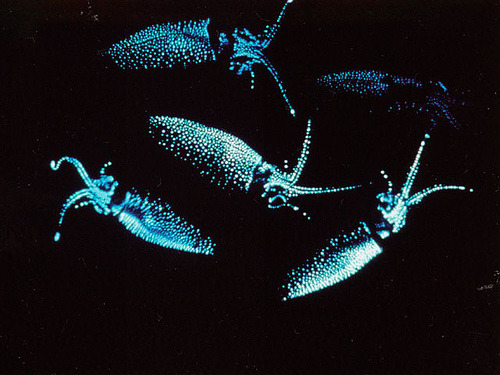
Japan, China, and other places in the East not only eat squid, but have picked up the idea and ran with it. Sushi with squid on or in it is called "ika" (again, just another word for "squid"). Squid can also be served alive (ikuzukuri), or at least very, very fresh. Korea and Japan have a particular taste for the only type of squid that can see color - and it glows in the dark!


Dude, that's trippy...let's eat it!

Eating tiny, glowing squid is just the tip of the iceberg. Japan puts squid on their pizza and squid ink in their soft serve ice cream. Anyone who has seen the movie Host knows that dried squid are sold as snack food in Korea, China, Japan and Taiwan. The West has pork rinds, the East has squid hung out to dry.


No wonder Cthulhu's always in such a bad mood. We're eating his babies. 

Next week: Breast milk. We swear that Qwaser has nothing to do with it.

Tuesday, December 7, 2010

Creature Feature: Colossal Squid.


OH MY GOD A COLOSSAL SQUID! It's a squid and it's colossal!

The Colossal Squid (Mesonychoteuthis hamiltoni) is one of the rarest cephalopods known. It lives in a nice, wide ring around Antarctica, which leads it to sometimes being called the "Antarctic Squid." This creature and the giant squids of the genus Architeuthis are probably what inspired tales of sea monsters like the Norse kraken.


The Greeks had other sea monsters  and a million crazy little islands to pick on.

The term "kraken" should ring a few bells if you have seen any crappy CGI flick at all.  It has become a generic modern term for "that giant-ass cephalopod," regardless of whether or not it should really be part of that particular mythological canon. Sometimes, all we see of a kraken are those giant tentacles wrapping around a ship.

Both the giant squids and Colossal Squid owe their massive size to abyssal gigantism. Because the deep-sea abyss is a high-pressure, isolated region, some creatures have evolved to massive sizes. The exact reasons for this phenomenon are unknown, but some theories include pressure resistance, scarcity or abundance of energy, delayed sexual maturity and/or slower metabolisms. Whatever the reason, the deep-sea abyss has yielded many creatures far bigger than their shallow water counterparts, including sperm whales, spider crabs, and of course giant squids.


Or you can blame Cthulhu, take your pick.

That said, how colossal is "colossal" according to science?


The most complete Colossal Squid is 14 meters long and weighs half a ton. In relative terms, that is at longer than a school bus. In squid terms, the giant squid still gives it a run for its money at 13 meters. "Colossal" is still a better name than "that squid only slightly bigger than the giant squid, but still large enough to make us wet ourselves," so let's forgive science on this one.

Wednesday, November 17, 2010

"They Actually Eat That:" Ikizukuri.

I like sushi. As such, I respect that sushi is supposed to be as fresh as possible, eaten cold, and so on and so forth. Sure, you risk mercury poisoning and tapeworms, but it is not bad in terms of cold, fresh food.

There should, however, be some limits on how fresh seafood should be:


Yes, you just saw a fish twitching with its flesh made into sashimi.

They Actually Eat That?! 

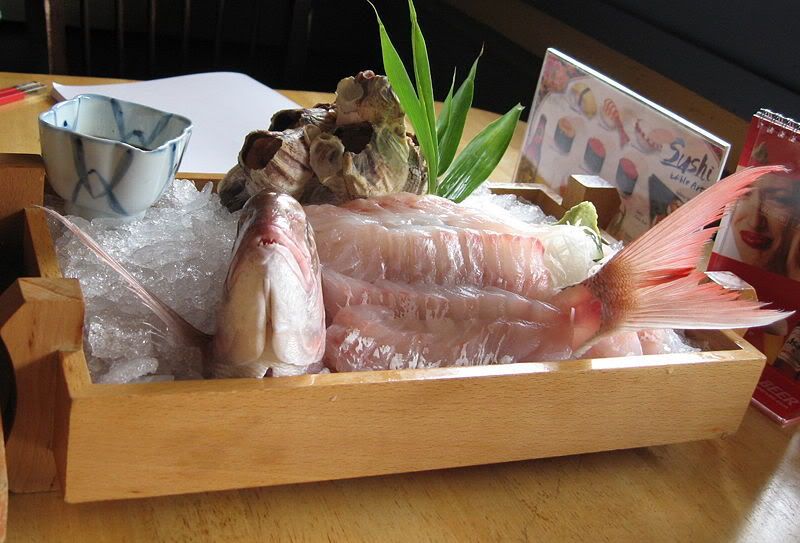
Yes. That fish was prepared in a traditional Japanese cooking style called ikizukuri (生き作り)- literally, "made/done alive."

It starts out somewhat like a good lobster dish in the West: A customer selects a live fish (or squid, whatever) from a tank, which is then cut up like...that on the spot.  (Wikipedia mentioned something about the fish swimming around in the tank with its flesh cut like that in between courses, but given the next paragraph, I'm taking it with a grain of salt.)


Exactly how alive the fish is when it gets to the table is up for debate. Some sources say that the fish is reacting in the exact same way that a chicken with its head cut off does - that is, it is twitching because of a massive chemical flood that occurs after successfully dying. Others swear that the fish is still breathing. No matter how you slice it (...I'm sorry, I did not even MEAN that one), it is a fresh dish. A very fresh, sadistic dish.


Although not as hot a topic as dog is in Korea, ikizukuri is controversial in Japan. Like in Greek drama, some people over there prefer their fish to be killed off-screen. Good choice.

Friday, August 13, 2010

Creature Feature: Vampire Squid from Hell.


Monsters lurk in the deepest, darkest depths of the oceans. Life flourishes in the places that sunlight never touches; the abyss is a brutal, glorious light show with more wondrous life forms than any movie. IA IA CTHULHU F'TAGN!

That includes vampires...or at least the weird-as-fuck vampire squid.

Even the Latin name admits that this thing looks hellish. Vampyroteuthis infernalis literally means "vampire squid from hell," making it have one of the coolest scientific names in the world. With its little winglike ear flaps, red (or black) body and batlike cloak, it totally fits.


Vampire squid are technically neither squid nor octopuses. They are a living fossil of a cephalopod that has gone virtually unchanged over the eons. No other extant species has nearly sucker-less tentacles, eyelids that cover a translucent blue eye or sensory filaments that almost resemble dragon whiskers.


They have awesome eyes, too.

The vampire squid is small - only about a foot long, at best. It has numerous tricks up its sleeve to avoid being eaten, the most well-known of which is its 'pumpkin' mode:


The spikes are harmless. Swear.

Like many creatures that live down that deep, Dracula here is also bioluminescent. It has small spots that can serve as glowing 'eyes' that shrink in the depths, giving the impression that the squid is getting away. Another glowing defense it has is, I kid you not, shooting out sparkle snot worthy of being called Edward Cullen body glitter.

Perhaps H.P. Lovecraft was onto something: In the deepsea abysses, Cthulhu waits dreaming.


2012...Think about it.

Friday, June 18, 2010

Creature Feature: Cephalopod Acid Part 2: Blanket Octopus


Just when you thought the blue-ringed octopus was the trippiest thing in the sea, along comes this pretty lady. Along with many other cephalopods, the whole genus Tremoctopus was born when Mother Nature had some spiked punch. There are four species in that genus; the most well-known is T. violaceus. Geez, even the name sounds like something from a drug trip.

One of the first things that one immediately notices upon meeting a female blanket octopus is her namesake train. Blanket octopuses do not use ink to defend themselves; instead, they unfurl an amazingly long, beautiful cape that can be fractured easily and regenerated. As an added bonus, they also steal man o' war tentacles. Tentacle porn, much?

Unlike peacocks, grackles, birds of paradise, deer, and most other sexually-dimorphic animals with elaborate displays, the female blanket octopus is larger and more splendid. The male is significantly smaller - he is only 2.4 centimeters VS a 2 meter plus female. He drifts along waiting to get laid, which, in this case, means cutting off a sperm-filled tentacle for his massive honey. This dimorphism allows the male to mature faster and the female to give birth to as many healthy offspring as possible. Macrophilia is alive and well in nature, guys. (As if anacondas were not enough of a hint.)

Tuesday, June 1, 2010

Creature Feature: Cephalopod Acid Part 1 - Blue Ringed Octopus.


Cephalopods - the family containing squids, octopi, cuttlefish, and nautili - are some of the trippiest members of the animal kingdom. They squirt ink, glow in the dark, and have some of the best mimicry ever seen in nature. It's as if that whole class of animals had taken a dose of LSD in the Late Cambrian and kept doing it for a few hundred million years.

The blue-ringed octopus (genus Hapalochlaena) also went to the drug-fueled evolutionary rave party. Like many cephalopods, it has has amazing camouflage capabilities. It can blend in perfectly with its habitat (the tide pools of the Pacific Ocean, including those around Australia) by quickly changing the color of its stretchy skin. It is a small octopus that only feeds on crabs and other crustaceans, but size does not matter in this case. If threatened, it becomes a bright, aesthetically-pleasing creature with bright blue rings.


Lady GaGa's next outfit design. *SHOT.*
It is, of course, poisonous.

The little octopus warns you with its blue-spotted, gold-yellow body. Any predators stupid enough to attack something with spots like that are doomed. The poison this octopus uses does not just cripple - it kills. It kills ANYTHING.

Remember that poison from the fugu fish, tetrodotoxin? Yeah. This octopus uses that poison. There was a reason I did not detail its effects last time; I was saving them for this entry.

First off, unlike being poked by a puffer fish's spines, the bite of this octopus barely hurts. You probably do not even know that you have been bitten until your lungs stop working, which happens within minutes of a bite. Your body is totally paralyzed, leaving you unable to signal for help as the venom slowly kills you. It doesn't matter whether you are a crab or just an asinine human. It will still ****ing kill you.


MWAHAHAHA! Come into the void!

You are aware of every minute of it. This poison does not knock you out. Instead, it lets you contemplate the dumbass mistake you made of touching the acid octopus as your body slowly shuts down. After all, it wasn't out to get you.

If you DO manage to get medical help, and survive the first 24 hours of poisoning, you are probably in the clear. If you were alone when you got the bite, you're probably fucked. Sorry.

Do not enrage the Great Old Ones, for they have powers of psychedelic EVIL! IA IA CTHULHU FHTAGN!


...D'AWWW.