Showing posts with label crustaeceans. Show all posts

Sunday, April 29, 2012

Let's Go Spelunking: Cave Shrimp + Crayfish

(Apologies: I went to take a nap and wound up sleeping longer than intended. Come hither, Hell Week...)

Remember when I mentioned that cave creatures had a strange aesthetic to them? Well, to be more specific, creatures that spend their lives exclusively in caves tend to have a few features in common.  These include pale skin, poor or absent eyesight, reduced size, and enhanced senses of hearing, touch, and smell. In human terms, 3/4 isn't bad, nerds.

Lincoln approves of cave shrimp?


Enter the Kentucky and Alabama cave shrimp (Palaemonias). They are both native to the Southwestern U.S. as their names imply. Yes, apparently the South has a lot of neat cave life. They eat anything that washes into the sediments underground. (FYI: Since several kinds of shrimp do in fact eat dirt like this, they are probably not the healthiest seafood in the world.) As the picture above demonstrates, they are smaller than a penny.

Cave shrimp are a prime example of what happens to 'normal' animals once they adapt to cave life. These shrimp are not just blind - they're completely eyeless. They're pure white with translucent skin. If they ever left the safety of the caves, they would die in a heartbeat. Even as they are, they have predators in other cave creatures such as salamanders, raccoons, and equally-blind cave crayfish (a case of the blind eating the blind).


Yes, crayfish live in the caves, too. There are several species (Cambarus pecki in Alabama; Procambarus elsewhere), several of which live in Florida and all of which are endangered. They look a lot like cave shrimp, only bigger, nastier, and with pincers. Like the shrimp, their skin is so light you can see through it - who needs melanin when you live in depths in which nothing can see? It's amazing; we could have saved so much mess in biology if some smart soul had bred translucent crayfish for us to study.

Both species of cave shrimp and all cave crayfish are endangered. The main cause for this classification is poisoned groundwater. As we've said before, freshwater ecosystems are fragile. So are species that are highly adapted to one environment. Cave shrimp will probably not be around much longer, so enjoy them while you can.

Sunday, October 2, 2011

Creature Feature: Fiddler Crabs.

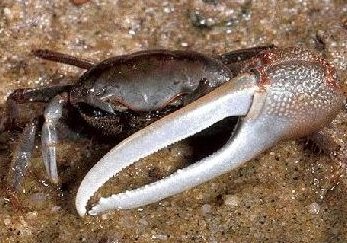
Look around at most crablike monsters. There will be a good chance that one claw is larger than the other. As in, possibly bigger than the crab's entire body. Since these are monsters we are talking about, they may even come with electric spikes or blades in between the two parts of the claw.

This is a particularly worrisome one.

Surely such a disproportionate crab can't be real. Just imagine a crab like that. It would lose balance all the time...right?


The hundreds of fiddler crabs (genus Uca) exist to prove you wrong. No matter how off-balance they may look, the male fiddler crabs do not tip over on a regular basis thanks to their massive claws. The smaller claw is used almost solely for bringing food (algae and bits of dead flesh) into the crab's mouth. The group is successful enough to inhabit the marshes, beaches, and mangrove swamps of the East Pacific, West Atlantic and Indo-Pacific.

Male fiddler crabs are all endowed with giant claws on one side or the other. They are so named because the smaller of the two claws sometimes looks like it is 'fiddling' the larger claw. Really, the smaller claw is just used for eating, making the fiddler crab one of the few animals that can eat and fight at the same time.


Besides engaging in combat with those massive claws, fiddler crabs are one of the few crustaceans out there with a sophisticated communication system. The crabs will often wave to each other with their large claws. Variations are made depending on visual distance. This is particularly true of courtship displays, which sacrifice feeding time and must be seen as soon as possible. This form of communication is almost like crab semaphore when studied closely. Maybe those PETA folk were onto something; that's pretty smart for a crustacean!

Mind, this doesn't mean that other crabs are ill-suited as monsters. I'm stunned that a certain other crab lacks more monsters, to be honest. More on that when the Week of the Abyss starts up, just in time for Halloween!


Sunday, September 4, 2011

Creature Feature: Triops.

At some point in your life, you have probably heard of Sea Monkeys. Sea Monkeys are a hybridized, selectively-bred form of brine shrimp that does not remotely resemble the race of freakish anthros on the packaging:

At least they ADMIT to wanting world domination.


For those of us that want to breed something a little bit more intense than Sea Monkeys, there are a number of other types of shrimp that go into diapause - that is, they do not hatch until the water conditions are juuust right. This, for example, is a more Lovecraftian version of Sea Monkeys.


Triops shrimps - also called long-tailed or tadpole shrimps - are not the same sort of shrimp that you see at cocktail parties. They instead resemble mutant trilobites that somehow survived through the Carboniferous into the modern day. Triops shrimp have literally gone unchanged for 300 million years, and, even though we keep them in fish tanks today, they are probably laughing at us from behind the glass for being stupid whippersnappers. They can be found everywhere except the coldest regions of the world.

Eldritch horror in a box.
 

The same process that makes triops oh-so-marketable is also its key to success in the wild. The natural habitat of triops is temporary ponds. They can only live that sort of life by making their eggs go into diapause every time the puddles dry up. In this state, they can survive extreme temperatures up to 98 degrees Celsius (ALMOST boiling water- think about that) for 16 hours. All they have to do is wait for it to rain until they can grow, quickly breed, and die after the water leaves.

The name "Triops" literally means "three eyes." Yes, they do indeed have three eyes. Nowhere says this better than the perfectly silly song by They Might Be Giants, complete with some cool videos of Triops in action.


Triops are easily available online from www.triops.com. They originated from a doctor's stock. He was studying their amazing diapause abilities. In theory, they could stop aging and possibly lead to the Fountain of Youth. Also, y'know, dealing with Cthulhu's underlings is a lot safer than messing with any cnidarians that actually do have eternal youth. We would rather deal with shrimp that definitely die than hydras and jellyfish when it comes to looking young and pretty all the time. Yep, that makes a lot of sense.

When Homo sapiens sapiens goes extinct, the Triops will still be here. Y'know, if the world has not become a swimming pool by then.  Even then, they will probably be only a diapause away from world domination.

Monday, August 8, 2011

Bio-Art: Fragment.

Yet another result of Borders binging, Fragment had my eye for a while. Every time I passed it in the bookstore, I would stop by and take a look. I was all "huh, sounds cool," then I would put the book back. With its price slashed from 25-something to six bucks, I had no excuse not to buy it.

I now have more confidence that I can become a published writer.


First off, the cover slip, good review, and inner flap information are misleading. Despite the scales and raptorish-claw, there are no dinosaurs involved in this story. Period. It is similar to Jurassic Park primarily in its use of data to supplement something that could happen, but JP reigns supreme when it comes to reviving ancient creatures.

Fragment does not revive ancient creatures in the same way Jurassic Park did. Instead, it answers the question, "What would happen if an island existed, untouched by other landmasses, for billions of years?" The answer, according to author Warren Fahy, is "Australia on crack with crustaceans." Seriously, I should scan you all the concept sketches for his new species.

Humans come to the island of lost species via a sponsored reality TV show. They hear a S.O.S. signal from an abandoned boat and decide, hey, what better setting for an epic series? This plan is thwarted when over half the crew is killed by the island's vicious inhabitants. Later, it turns out that not every creature on this rock is blood and guts incarnate, so three of the initial crew members have to preserve at least one benevolent species. Easier said than done. 

Therein lies the real charm of Fragment for any biologist or creature designer: The island Fahy creates is in complete isolation from most forms of vertebrate life. Everything on said island is derived from a creature I have already talked about on this blog: the mantis shrimp.

In case your nightmares were lacking in rainbows.
 

Mantis shrimp are badasses. They see more colors than humans. They can break aquarium glass. They have very pretty colors. Who's to say that some remote island doesn't have weirdass relatives of mantis shrimp? That sounds like a recipe for success right there. We're amazed that these Cthulhu-Xanadu hellspawn have not taken over the world yet.

The island ecology that Fahy made based on these crustaceans branching off was anything but fragile. Numerous animals, including hawks, pit vipers, and mongooses, were tested against his mantis shrimp-based ecology. Even though science says things with exoskeletons cannot get that big (I'd have to check his explanation for myself), mantis shrimp relatives are so awesome they beat vertebrates in minutes. He definitely put effort into making a dog-eat-dog-and-everything-else ecology work. MMOs and Avatar could take a few hints from this guy.

I just wish Fahy's writing had been awesome enough to back up the story's creative setting. He starts a lot of sentences with conjunctions, which sounds awkward in English (but not in other languages). Many of the paragraphs are two sentences and not very detailed. The headers jump around so much that it's a little dizzying. Although the creatures the author designed merit awesome CGI, the book has doomed itself with its format. Instead of getting a full-length movie, it will likely get shunted into a made-for-TV-movie, a TV series, or a movie that feels made for TV.

Don't get me wrong. I enjoyed the killer land-dwelling arthropods for all they were worth.  Jurassic Park still outshines it in every regard. Would I recommend it? Well, it was worth 6 bucks.

Monday, March 7, 2011

Creature Feature: Mantis Shrimp.

Remember how, in the blacklight entry, we said that birds could see UV light? And hey, don't vipers and pythons see heat via infrared? It would be the most awesome thing in the world to see all that and more, would it not?

Well, there is one animal that can do that. No, it's not a bird. It's not a snake. It's not a mammal that exceeds humanity in every regard. It is a crustacean called a mantis shrimp, and is a real badass for having the most complex eyes in the animal kingdom. It is also a reminder that the sea can be a scary, wonderful place and that, in his city at R'lyeh,  Cthulhu waits dreaming.


Mantis shrimp: When H.P. Lovecraft pops LSD. 

Just to clarify, mantis shrimp are not shrimp.  They are an entirely different type of crustacean called a stomatopod. They exist in all of the world's oceans as well as in dreams after smoking too much weed. Appropriately, they have been called creepy names such as "sea locusts," "prawn killers," and, recently, "thumb-splitters." Mantis shrimp have been known to break aquarium glass on occasion. They are compared to a predatory insect for a very good reason

But it's so beautiful...


As the iridescent shells of some of these 'shrimp' might indicate, mantis shrimp can see color.  Yes, they appreciate reds, greens and blues like humans, birds, insects and...well, not many other things can see color on land. Bear in mind that birds and insects kick our collective ass when it comes to color vision. 

So do mantis shrimp. They win at color vision. Period. Name a type of light and these guys can see it. UV? Yes. Infrared? Mm-hmm. Radio waves? 3D movies? Oh hell yes, this crazy crustacean can see those without the aid of silly glasses. Name a wavelength of light and this creature can see it. The result is, well...


This cube and then some. 


Nobody really knows why these crustaceans evolved such sophisticated vision. In more colorful species, it allows them to see each other better; in other species, it may help them determine what phase the moon is currently in or help spot shining predators like the barracuda. Whatever the cause, it sure makes us feel silly for being one of the only mammals with RGB vision. 


We get back at them by turning them into sushi. 


Tomorrow: Just what IS a firefox, anyways? If you answered "Vulpix," you're wrong.

Sunday, January 30, 2011

Creature Feature: Yeti Crab.

Every year, more and more new species are found. Some of these are in unexpected places, like those frogs recently discovered in the Himalayas; others are in places that mankind simply has not poked around in, yet. The deepsea abyss is one of those places.

In our narrow-minded perception, life cannot exist without sunlight. Plants need sunlight, and plants feed everything else; therefore, all life needs sunlight. It makes sense to us on the surface world, therefore we make the sun a god and all that jazz. There's no way that anything else could be the case...right?

WRONG!

It turns out there there is a whole ecosystem that gets along just fine without any hint of sunlight. New organisms are discovered every time we take another look down there. The yeti crab (Kiwa hirsuta) is one of the more recent ones.


The yeti crab was discovered in the South Pacific by Monterey Bay Aquarium specialists in 2005. Seen via submarine (the pressure down there kills humans), this crustacean was found along the Pacific-Antarctic ridge near geothermal vents. In surface world terms, this is a couple thousand miles away from Easter Island. The discovery was officially announced on March 7th, 2006. 

Yeti crabs get their name from the furry setae on their legs and pincers. The fuzz contains bacteria that may help detoxify the water around geothermal vents. It is assumed that this crab is carnivorous, perhaps feeding on other geothermal-friendly bacteria, but more likely eating bigger prey.


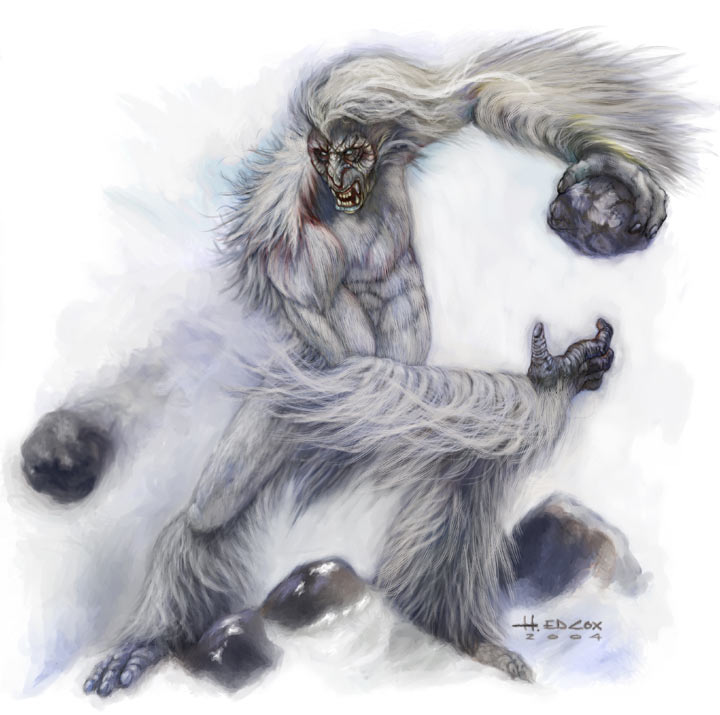
Just like a real yeti!

Other than that, nobody really knows much about this fuzzy crab; it has only been known to science for a little over four years. Sheldon knows that they will be around for a long, long time to come, so we'll have plenty of chances to learn more. Our surface world seems pretty insignificant now, doesn't it?


Tomorrow: Giant blue earthworms? That sounds like a bad porno.