If you are a regular biology student, your first encounter with the microbial world will probably be with a slipper-shaped fellow called a Paramecium. It looks vaguely like an elliptical blob with strange hairs along its sides. They are rather bland as far as protists go, but simple and familiar enough to create a solid basis.
Nonetheless, it makes sense as an intro to protists. K? K.
Paramecia are found in fresh water all over the world with a few species found in the ocean. They are also frequently found in biology labs, often slowed down so that the students can observe them better. They eat yeast, bacteria and algae. Some have symbiotic algae in them already. They can reproduce sexually or asexually, which helps explain why they're so popular.
A single-celled organism like a paramecium needs to do all the things that any other animal needs to do: move, eat, reproduce, defecate, the works. All cells need to get energy. Paramecia have mouths, organelles (mini-organs), gullets, two nuclei, and a special pump that makes sure that they do not shrivel up or explode via osmosis. Oh, and yes, they do poop. Everybody poops.
Paramecia move by fluttering tiny little hairs called cilia. They move the opposite of whatever direction the hairs are folded - that is, backwards-folding hairs move the paramecium forwards, and forward-folding hairs move the microbe backwards. If you think this sounds topsy-turvy, paramecia really do turn as they move.
Since paramecia are the main protists used in science, quite a few experiments have been done with them. One of the most impressive I have seen is the fishing rod made by Joe Davis, who can also hear the different sounds of microbes. Using a bunch of high-tech gizmos, one can fish for paramecia beneath a microscope. The fishing hook he designed fits perfectly into the oral groove of a paramecium. It really does tug when you've got a big one!
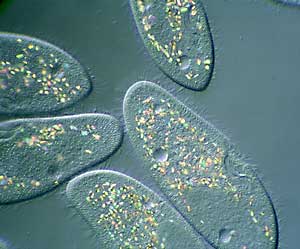 |
| They aren't THIS colorful. Usually. |
Nonetheless, it makes sense as an intro to protists. K? K.
Paramecia are found in fresh water all over the world with a few species found in the ocean. They are also frequently found in biology labs, often slowed down so that the students can observe them better. They eat yeast, bacteria and algae. Some have symbiotic algae in them already. They can reproduce sexually or asexually, which helps explain why they're so popular.
 |
| Cover your eyes, children. |
A single-celled organism like a paramecium needs to do all the things that any other animal needs to do: move, eat, reproduce, defecate, the works. All cells need to get energy. Paramecia have mouths, organelles (mini-organs), gullets, two nuclei, and a special pump that makes sure that they do not shrivel up or explode via osmosis. Oh, and yes, they do poop. Everybody poops.
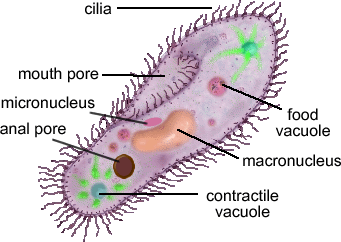 |
| Guess what the anal pore does? |
Paramecia move by fluttering tiny little hairs called cilia. They move the opposite of whatever direction the hairs are folded - that is, backwards-folding hairs move the paramecium forwards, and forward-folding hairs move the microbe backwards. If you think this sounds topsy-turvy, paramecia really do turn as they move.
Since paramecia are the main protists used in science, quite a few experiments have been done with them. One of the most impressive I have seen is the fishing rod made by Joe Davis, who can also hear the different sounds of microbes. Using a bunch of high-tech gizmos, one can fish for paramecia beneath a microscope. The fishing hook he designed fits perfectly into the oral groove of a paramecium. It really does tug when you've got a big one!