Thursday, July 12, 2012

Creature Feature: Giant Eland.

Nature shows focus too much on big preds, blah blah blah. Seriously, film crews have to spend hours getting those successful hunts on film.  More often than not, the herbivore survives. Predators kill off the weak, very young, or sick. That way both species stay healthy as a whole.


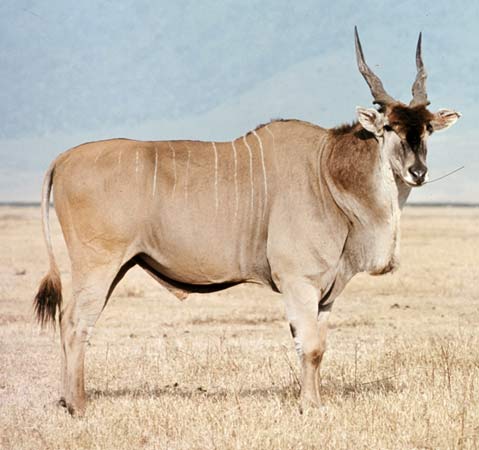
With that in mind, there are some herbivores that are pretty impressive to look at, even without a lion chasing them. The giant eland (Taurotragus derbianus) is one of them. It is native to central and western Africa. Like most antelope, it's an herbivore. What, did you think it had the potential to eat you, too?

The giant eland is impressive on a number of levels. It's fast, capable of reaching speeds of up to 43 mph. A height of almost 6 feet at the shoulder makes it the largest antelope in the world. The babies grow fast. Also, those horns look pretty darn awesome. (Luckily, they're also pretty docile.)

Badass, even when chillin'.


Both sexes of eland have twisting, V-shaped horns. The bulls lock them during courtship, as might be expected. They are also useful for knocking down branches. You will never forget those horns after seeing them once Many antelope have nice headgear, but the eland has to be at least in the top 5 when it comes to having awesome horns.

Despite being listed as "least concern," the giant eland is increasingly threatened by human hunting. This is just not for a very impressive trophy head; the meat of the eland is also packed with nutrition. The milk of an eland also contains twice the protein and three times the content of regular cow milk. They also require a lot less water than cattle. Luckily, there have been quite a few instances of domestic giant elands, so they should be around no matter how desperate Africa gets. Then again...behold the fate of the aurochs:


Shoot.
Wednesday, July 11, 2012

"They Actually Eat That:" Worms.

Eating worms is usually a gag in American culture. There will always be that one kid who ate earthworms on the playground. There's even a dessert using gummy worms and Oreo crumbs to platy with the novelty of eating worms.

But could eating worms seriously be good for you?


According to scientists (including an old teacher of mine), sure! Worms of all types come into contact with bacteria that support a healthy immune system. Actually, the act of putting all kinds of foreign objects in one's mouth helps build a healthy immune system - especially during childhood. That kid who ate worms was onto something.

Our  industrialized society has the curse of being too clean for its own good. Children are told not to put things in their mouths, whether it be dog crap or something they left on the floor. This prevents them from getting exposure to foreign things -bacteria and the like- to which they can build an immunity.  Furthermore, the use of too many soaps and disinfectants creates antibiotic-resistant strains of bacteria. There is such a thing as too clean, and it's a lot more widespread than lutefisk.


Aside from eating regular worms to prevent immune problems later in life, eating other worms has its own benefits. Hookworm therapy is becoming a huge thing. Don't worry, species that regularly infect inhuman animals are used. Again, this works because industrialized society is too clean for its own good. Not saying go back a century, but don't try to sterilize your world, either.

How does it work? A protein called IgE can be held responsible for many autoimmune diseases, including allergies,  arthritis, and even a few cancers. The same protein is responsible for handling parasites. By introducing a harmless parasite into the body, these immune proteins have a target to attack. One man went all the way to Thailand just to get some worm eggs. It saved him from a premature death via a malfunction in another protein. Overall, it might not be bad to be infected.

So, go ahead. The earthworms aren't going to hurt you. Grab a few and try some.

Tuesday, July 10, 2012

Creature Feature: Macrotrema/Swamp Eels.

A lot of people will probably see me as crazy, immature, or both for secretly liking Yu-Gi-Oh! The game is a broken mess of OTK's and shiny cards that are way too hard to get, ZeXal scares me proper, and yet cool monsters are cool enough to keep me intrigued. Admittedly, now it's become a game of humans and dragons, but it used to have an amazing amount of monster variety. This one in particular got me thinking:


OK, I get the point that it's a fish, but what's a "macrotrema," anyways? YGO tends to pick on weird fish, but this one was so weird that I had to look it up. After I looked it up, I kept the card for a bit as a sort of "well, that was interesting" trophy.

It turns out there are several things with "macrotrema" in their names. Given that the card was called "big eel" in the Japanese game, however, I'm inclined to believe that the creators were going off of the Macrotrema eels native to Asia. There is only one species, Macrotrema caligans, but since it is horribly hard to find information on (seriously, most of the hits for "Macrotrema" are of the trading card), this entry will also cover some other members of Synbranchidae. They are also called "mud eels" and "swamp eels," hinting that it would be darn near impossible to find a real deep-sea Macrotrema. As the name "mud eel" would imply, this weird pink fish lives in the muddy beds of estuaries in Asia. The whole family Synbranchidae has members in Mexico, South America, Africa, and in Asia from India to China, making the Ganges River slightly creepier than it already was.

Not a Macrotrema. Still a swamp eel and probably close enough.


Swamp eels resemble worms with spinal cords more than any type of fish. They're pink, live in mud, and barely have fins as adults. As with most cave-dwelling animals, the eyes are small; when you live in mud, sight is not a big issue. They're even proper hermaphrodites, starting their lives as ladies and becoming male after four years. (For the record, a whole group of creatures, tunicates, does the same thing.)  In other words, they're weird even by eel standards, and eels are already darn weird.

Nobody is really sure how far swamp eels go back in the fossil record, but they probably resemble some of the first air-breathing fish that gave rise to amphibians. Although they start life with skin that takes in oxygen (sound familiar?) and fins, both of these features regress as the fish matures.  The throat of a swamp eel is adapted into a primitive, but efficient lung. Like mudskippers, swamp eels can even slither around on land if the soil is wet enough.

Since this entry wound up bleeding into Wednesday, I may as well say it: yes, this eel is edible. China, one of the few places infamous for eating anything,  uses swamp eels in stir-fries with garlic and soy sauce. Given its distribution, it is probably enjoyed in other parts of the world as well.

I'm not sure what to think about most peoples' knowledge of swamp eels coming from a single trading card. Konami didn't have accuracy in mind, but, to be honest, they made these not-lungfish look cooler than their real-life counterparts. The real Macrotrema and swamp eels in general are pretty neat animals, too.

Monday, July 9, 2012

Bio-Art: The Holy Virgin Mary.

Remember that cow pat paperweight from a previous bio-art review? Yeaaah, after thinking about it, there were several people who would like that. Scat fetishists aside, there are fascinating things about animal feces.  Some artists even use dung as an artistic medium.

Yeah. Y'know what? I'm sure you can see where this is going. After that paragraph and a quick glance at the title, you have to realize that this is leading nowhere good fast. Brace yourself for the black virgin Mary plastered with elephant dung and naughty bits.


This, umm...art piece...was made by one Chris Ofili. Ofili is a Nigerian artist born in Manchester, England. He had a Catholic education and went to two art colleges. Along with elephant dung, he has plastered pornographic images upon the sacred virgin. It's properly called The Holy Virgin Mary and was on display in a gallery called Sensation until it entered a private collection. It is now on display again in the Museum of New and Old Art in Hobart, Tasmania.

Elephant dung is a recurring medium in Ofili's works. It's not quite splattered; many times, Ofili uses the dung almost like paint or to create a certain texture. Sometimes the dung is even holding the painting up.  It's not like the guy isn't being creative when he uses it in his work. That is at least creative. Elephant dung itself is a versatile material that has been used to make paper; no shit.

One of Mr. Ellie Poo's notebooks, made using the fiber from elephant dung.


For the record, the Black Mary is definitely a thing when she is not covered in elephant dung, too. She is particularly popular in African cultures and among feminists. African Christians like her for obvious reasons; feminists believe that the Black Madonna has a mystique and power that white Mary does not. Some also trace her to pre-Christian cults like the several revolving around Cybele, a Greek earth goddess who had a chariot of lions at her disposal. Kickass.

Regardless of your stance on Black Mary, the virgin Mary is one of the most sacred images in the Catholic church. Here she is with elephant dung and genitalia scattered about. Surely there must be some profoud meaning behind mixing the sacred and profane like that, right?

Umm...nope. Not unless you consider trolling the First Amendment hard in any way philosophical. 

Unfortunately, this piece was made for all the wrong reasons. I would like to say that this has some deep, far-reaching message - I really would - but the sole purpose of this mess's existence is to push the boundaries of free speech.  This thing was shown at a gallery called Sensation- a title which begs both "WTF for the sake of WTF" and "ASK ME WHAT IT MEANS! ASK ME WHAT IT MEANS!" Is that all it takes to be art? I'm not questioning Ofili's choice of medium, artistic talent, or anything else. The sole purpose of this piece is to push the system to its very limits. I'm wondering if that's really art or not. At least it's making me think.


Sunday, July 8, 2012

Creature Feature: African House Snakes.

After being pissed off at a certain statement, I decided that this blog needed to show off more cute scaly things. I just heard today that a ball python was in the news; snakes are getting a worse and worse rap every day. Time to fix that.


"House snake" can refer to any snake in the genus Lamprophis - literally "shiny snake." Unlike the extremely diverse python family, house snakes are all mid-size snakes (a little smaller than a corn snake - another common snake in captivity) native to most of sub-Saharan Africa. They eat rodents and other small land animals.

There is a lot of confusion over who's in what species; house snakes are poorly-researched, leaving much of the work to be done by captive breeders. Even the captive breeding results vary when it comes to hatching hybridized babies. To make matters even stickier, they are frequently mislabeled in the trade; almost everything is Lamprophis fulginosus. Thus, as much as I hate doing this, the whole genus will be covered in one entry.

The aurora house snake is a bit harder to find than other species.


Species classification aside, house snakes have a lot in common. House snakes are not venomous. They come in a lot of colors, often sporting iridescence. They only get around five feet long, if that. A million things eat them. Just about the only thing remotely terrifying about these guys are their slit pupils, which most hobbyists find cool.

African house snakes are the definition of cartoon snake: Green or brown, random markings, slit pupils, and otherwise a generic colubrid.  They're just cute like that, even as adults. I realize some people are ophidiophobes by default, but for those of us with the potential to like snakes, house snakes are as charming as they come.

And the albinos look awesome.


I'm honestly surprised that house snakes aren't more popular in the pet trade. They don't get too big, come in several color patterns and morphs (including albino), and are a great first snake. They can take a high temp range. No extra lighting required; they can breed with normal day sh normal light cycling. Everybody has corns and ball pythons; not many people have house snakes.  The only issue is that some hatchlings need their first few meals lizard-scented. The species thing is another problem entirely; let the pros deal with that one. 

Saturday, July 7, 2012

Bio-Art Mini-Post: Thoughts on The Amazing Spider-Man.

(To put things in perspective for how tired a single visit with my brother's family can make me: I tried COFFEE and DDR MUSIC was out like a light.) 

What? A bio-art entry on Saturday instead of Monday? Preposterous!

Thing is, I wanted to get this down while it was fresh. I saw The Amazing Spider-Man today and wanted to jot down my thoughts before they floated away. Rather than waiting 'til Monday, I figured, hey, this movie is actually wicked relevant to right now. It deserves its own entry ASAP.


So, let's get to it. I won't reintroduce the Spider-Man story since almost everybody knows it. Average guy Peter Parker is bitten by special spider, saves NY on a regular basis, yadda yadda.  What this new movie introduced, however, was a ton of neat science-related stuff that was meant to bring the setting up to date...but does it?

One of the big themes in The Amazing Spider-Man is cross-species genetics.  Both the 'radioactive' spider that bit Peter Parker and the Lizard resulted from genetic engineering. I will say that I actually like this change with the spider; saying that it was genetically spliced was a lot more plausible than anything radioactive. (Seriously, if it was, cancer would have been involved at some stage in the game.) Genetic engineering is obviously a favorite of sci-fi writers for creating really cool genetic freaks and filling in plotholes ("it's genetically-engineered, we can do whatever we want!").

Because I know people will ask,  no, geneticists do not work with spiffy holo-screens like they do at Oscorp. They have to test things over and over again on many, many little lab rats before even attempting human testing. Genes are also usually injected at the embryonic stage as opposed to during life. That one of the three-legged mice actually took a gene warp during life was a miracle in itself.

That said, some of the things related to cross-species genetics in the movie are outdated. "Fact or fiction?" Cross-species genetics is fact now, guys. It's been fact for a very long time. Transgenic foods stock our grocery shelves. GloFish are available at Petco. Ruppy exists, meaning that transgenic humans are getting closer and closer to existence. Designer babies are a thing. For a movie that uses Google and smartphones, it's stuck in the past. This could have been a really powerful statement about all the things that could go wrong with gene splicing, but we've come too far to go back to questioning whether things are fact or fiction. The line gets blurrier every day.

Then there's the Lizard himself. Let's get a few things straight with the Lizard: He was an amalgam of several different lizards (the creators keep citing "Komodo dragon," but they also say amphibians have scales and I know Komodos can't climb walls), the specimen shown in the splicing was some sort of agamid (likely an attempted green anole?), probably should have been using axolotl or planaria instead of lizards (they're far superior in terms of regenerative capabilities),  and despite being a herpetologist in canon, at least one thing he said was blatantly incorrect. This last point worries me the most: 

"Reptiles are usually the top predators in their ecosystem." 

Umm, no. That is blatantly not true, Mr. Herpetologist. I want to say roughly one-third of all reptile species are apex predators - that is, they have no natural predators as adults. The actual amount of reptilian apex predators is probably more like 1/4th, if not less, and then largely restricted to warmer climates. That is definitely not the majority of reptiles. I want to say this statement is so wrong that it just plain goes against common sense, but since common sense is not so common, here's a shining example of what I mean:


Take a good, long look at the flag of Mexico, sometime. It's a pretty darn well-known fact that eagles and other birds of prey eat snakes to the point where it is a staple in mythology around the world. Mongooses and honey badgers eat cobras, the most popular, intimidating snake in the world, on a regular basis. Apex predators they are not. The statement about most reptiles being superpreds is wrong on so many levels.

Do your research. This could have been a well-said reply about how reptiles dominated the Earth for a good long time, and still manage to be pretty effective today, relying on a combination of stealth, trickery, and power to survive. See? That's an epic answer to the same question. There was literally no reason to get this wrong, especially since the very adaptation that The Lizard was using to regrow limbs was a defense against predators. Why would a top-tier creature need to cut off its own tail and regenerate it?

The roadrunner says "meep meep" to your logic, movie.


What worries me about this is, of course, the implications in relation to the Burmese python problem. There is currently a turf war between two apex predator reptiles that is making all reptiles in captivity look really bad. If, suddenly, millions of people see all reptiles as dangerous, the results could be disastrous for the pet trade. I like to think that people have more common sense than that, - something, somewhere has to eat leopard geckos with how tiny and cute they are - but have learned not to get my hopes up. Someone wrote that line with the flag of Mexico against them. I would almost forgive them if it was meant to sound delusional. Almost.


Overall: Go see it (in 3-D!) as a solid introduction to Spidey, but don't expect super-accurate information. This is Spider-man's 50th anniversary, and it kinda shows. Still a good movie, but the inaccuracies and dated information jarred me.

Thursday, July 5, 2012

Creature Feature: Giant Cloud Rat.

If reading about insular gigantism scared you, worry not. Not every giant animal on an island  is going to eat you. Here, let us show you:

From biolib.cz. Cutest pic I could find.


OK, bad example. I know some people are terrified of rats. Still, the giant cloud rat - and cloud rats in general- are at least as fascinating as Darwin's finches. They're all native to the Philippines, just like giant crocodiles. The main difference is that, unlike crocs, giant cloud rats would make great plushies.

All cloud rats are leaf-eating, nocturnal rodents that spend most of their time in trees.  There are a total of six species of cloud rats that are in turn divided into two genera. The "giant" ones in question are the North and South Luzon cloud rats, both of the genus Phloeomys. Again, aren't they cute? No? Fine, rat-haters.

Also very cute!


The giant cloud rat is the largest type of cloud rat in the Philippine forests. It is also the largest species of rat in the entire world. We're talking a 7-pound rat with teeth an inch long. That's a rat that would give a cat a run for its money. Being so big also makes it good meat, of course, and Filipinos have indeed been known to eat them. (Rodents are whole food. Really.)

Despite being unique species, not much study has been done on cloud rats. The only reason I even know about them is because one scientist at the Field Museum is studying these weird insular rats. Only three zoos have any kind of cloud rat in their collections, so even that's not a good bet if you want to gawk at a live giant rat.

Want a giant cloud rat as a plush- I mean pet? They're rare, but in the exotic pet trade nonetheless. A few of them are reliable breeders, so you should be seeing more captive-bred specimens soon.  They are marketed as the replacement for the Gambian Pouched Rat, which, while also large, is less cuddly.  Cuteness and legislation are together on this one, plus the giant cloud rat actually needs to be researched.