Friday, November 19, 2010

Creature Feature: Lyrebird.


"All bird entries are the same, blah blah blah." Yes, many of the bird entries I write simply consist of "the male looks awesome, the female sucks." Although this is also true for this entry, there is a little bit more icing to look forward to on his cake.

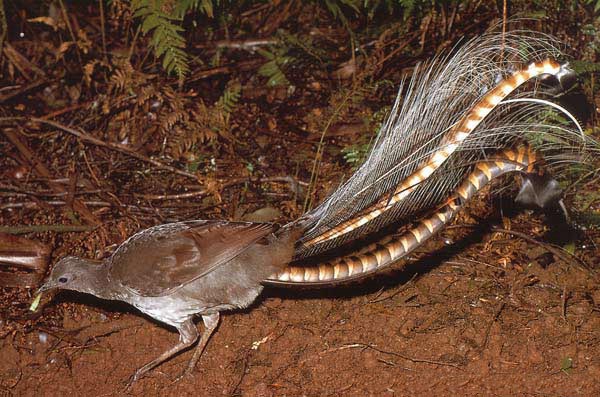
The superb lyrebird (Menura novaehollandiae) looks almost like a smaller, less colorful peacock. It is native to the forests of Australia (no spread to Indonesia this time). Being one of Australia's most recognizable native birds, it (OK, specifically the male) has been featured on money.


As the world's third largest and heaviest songbird, it is about the size and weight of a pheasant. (There is subtle difference between this bird's tail and a peacock's: a peacock's stunning feathers are on his back, supported by tailfeathers.) The male of the species has a pheasant-y tail to match his pheasant-y size:


For those of you who have no clue how the lyrebird got its name, a lyre is a sort of hand-held harp common in ancient Greek art. It resembles this bird's tail very well, but before you start forming conspiracy theories, the Greeks had no idea this Australian bird existed.

This bird is also one of the most amazing mimics I have ever heard:


The bird world has some very good mimics. Rarely are such talents displayed rapid-fire as they are here. The lyrebird copies the most complex sounds he can muster and sings in competition with other lyrebirds. This bird imitates a kookabura, a camera, a siren, and chainsaws just to get his mate.

Hell, y'know what? I'd mate with that bird in a heartbeat; he's just too awesome for anything less.

Thursday, November 18, 2010

Creature Feature: Flying Frogs.

Speaking of things that should not fly but do...


Flying frogs (family Rhacophoridae) glide (again, not fly) using the webbing in between their REALLY long toes.They live in the more tropical regions of Asia, including China, Laos and Vietnam. (Why is everything I like from Asia? I swear, I didn't know that was where flying frogs came from!)  The earliest reports of flying frogs came from Alfred Russell Wallace, who got the largest species (Rhacophorus nigropalmatus) named in his honor.


Wallace's flying frog exhibits several traits that make it aerodynamic: its limbs are a LOT longer than those of the average frog; its body is narrow; finally, get a load of those winglike feet!

Wallace's flying frog is not only the largest flying frog, but the most photogenic; the markings on its webbed toes look almost like something off of a dart frog's body. Before you all bitch that there is probably an adaptive drawback that keeps the frog from moving, each of its long toes is also tipped with a suction cup. It can climb just fine and escape from tree snakes via the awesome gliding flaps.


(They also have cool eyes.)


As the video said, there are also extreme kamikaze frogs that jump for their lives when faced with a tree snake. These can be found all over the world; Old World flying frogs like Wallace's are different from the New World treefrogs in that they DO have those amazingly huge flaps for gliding. The ones in the New World are more like the second frog shown in that video.


Don't worry! You'll get there, someday! Keep flying, froggies! :D

Wednesday, November 17, 2010

Creature Feature: Momonga.

If you have ever heard the above word before, you have no doubt borne witness to it in some form of Japanese monster culture. Yu-Gi-Oh! has a few Momonga cards and Pokemon just got another electric squirrel in Generation V:


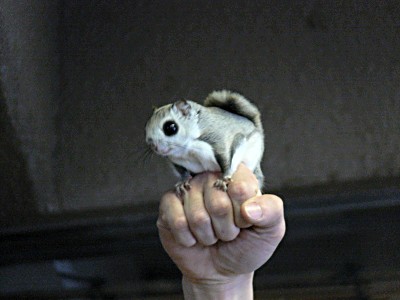
Japan has several species of flying squirrel. They can all be referred to as "momonga," but the 'true' momonga is the Japanese dwarf flying squirrel (Pteromys momonga). I'll let that sink in before I post the pic. Dwarf. Squirrel. That flies.

Brace yourselves:


How did nature make something so goshdarn cute? You might be able to blame insular dwarfism; sometimes, when creatures evolve on islands, they get substantially smaller than their mainland counterparts. Japan also has another giant momonga, which may be the opposite case (insular gigantism). In the end, it really does not matter: They are adorable.


Momongas, as well as other flying squirrels, do not actually fly. They have a flap of skin called a patagium in between their forelimbs and hindlimbs. "Parachuting squirrel" does not have the right ring to it, even though it would be more accurate.


The ugliest momonga picture science could manage.

The momonga is native only to the sub-alpine forests of Japan. It eats seeds and fruits - you know, like most squirrels do. As the big eyes might have hinted, the momonga is nocturnal. It is threatened by habitat loss, but not enough to make it a super-endangered animal (instead listed as least concern). 

By the way, be careful looking this little guy up on YouTube; I have seen a few sugar gliders posing as momonga. Those are cute, but not the dwarf flying squirrel. (They are actually marsupials, for starters; the Japanese use the term "momonga" to describe them regardless.) For future reference, here is a picture of the culprit:


Truly the eyes of a con artist.

Japan is capable of great atrocities and great cuteness; that is why they can make both tentacle porn and Hello Kitty. (For your own sanity, do not combine those two images in your head. Have a cute video to push that nasty image out.)


If this squirrel does not kill you by sheer cute, then you do not have a soul.

"They Actually Eat That:" Ikizukuri.

I like sushi. As such, I respect that sushi is supposed to be as fresh as possible, eaten cold, and so on and so forth. Sure, you risk mercury poisoning and tapeworms, but it is not bad in terms of cold, fresh food.

There should, however, be some limits on how fresh seafood should be:


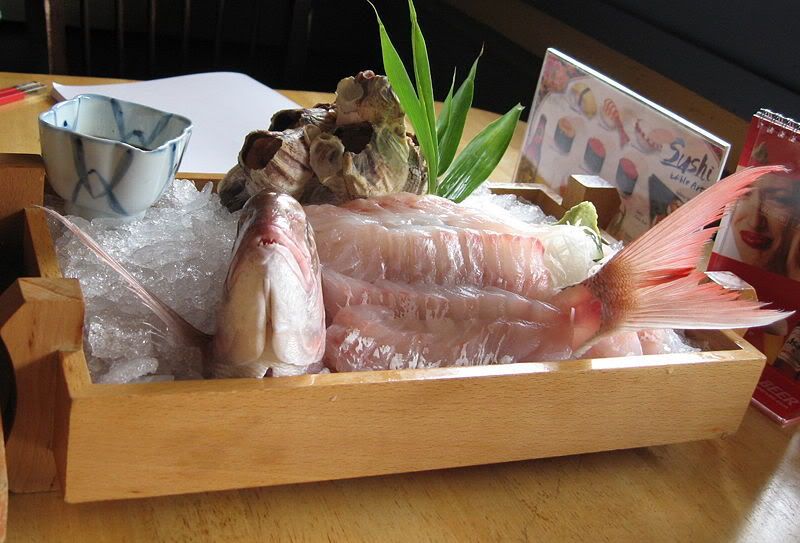
Yes, you just saw a fish twitching with its flesh made into sashimi.

They Actually Eat That?! 

Yes. That fish was prepared in a traditional Japanese cooking style called ikizukuri (生き作り)- literally, "made/done alive."

It starts out somewhat like a good lobster dish in the West: A customer selects a live fish (or squid, whatever) from a tank, which is then cut up like...that on the spot.  (Wikipedia mentioned something about the fish swimming around in the tank with its flesh cut like that in between courses, but given the next paragraph, I'm taking it with a grain of salt.)


Exactly how alive the fish is when it gets to the table is up for debate. Some sources say that the fish is reacting in the exact same way that a chicken with its head cut off does - that is, it is twitching because of a massive chemical flood that occurs after successfully dying. Others swear that the fish is still breathing. No matter how you slice it (...I'm sorry, I did not even MEAN that one), it is a fresh dish. A very fresh, sadistic dish.


Although not as hot a topic as dog is in Korea, ikizukuri is controversial in Japan. Like in Greek drama, some people over there prefer their fish to be killed off-screen. Good choice.

Tuesday, November 16, 2010

Creature Feature: Roseate Spoonbill.

Off the top of your head, name five creatures that are naturally pink. Albino morphs of red reptiles do not count. The elephant you see when you are drunk does not count either.


Not real. Unless you count albino elephants.

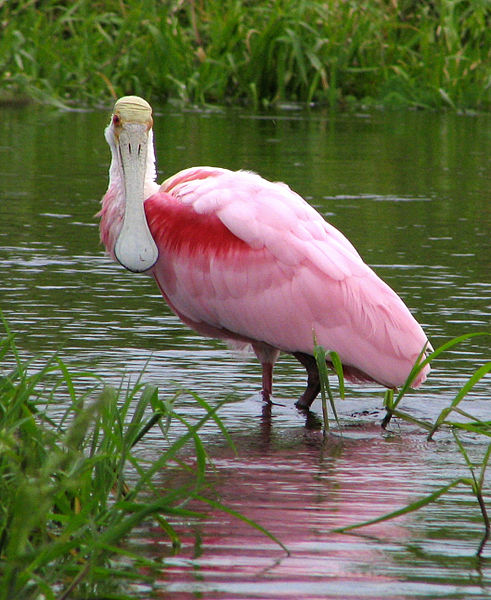
Now, if I told you that there was something pink with a spoon on its face, you would probably think that I was tripping on acid. Of all the fantastic pink animals that you probably imagined, that one is actually real:


Science does not call this bird "pink." They use the more Latinate "Roseate Spoonbill" (Ajaja ajaja - no, really, that is this thing's scientific name). Even science cannot get over how ridiculous-looking this thing is; they were able to avoid 'pink' in the name, but the 'spoon' in there makes taking out 'pink' an exercise in futility. There is just no way not to laugh at this bird.


Even the scientific name is funny.

The Roseate Spoonbill has a habitat and diet similar to that of the pink flamingo, but evolved a slightly different way of eating. Instead of using a flamingo's sieve-like beak, it dabbles in the marshes of Florida (as well as Mexico and Central and South America) like a duck.


Its flat bill snaps shut whenever something tasty, like a newt, fish or crustacean swims by. Baby spoonbills are, in turn, eaten  by eagles, vultures, fire ants, and anything else that thinks a bright pink bird with a spoon on its head is too ridiculous to exist.

But, hey...how often am I going to get to quote The Tick on this blog?


SPOON!

Monday, November 15, 2010

Creature Feature: Ocelot.

A lot of focus is put on the giants of the big cat world - specifically, lions, tigers, and anything reasonably large with a melanistic morph. This leaves a lot of felids ignored. True, many of them look like big kittens, but is that any reason to glance over them?


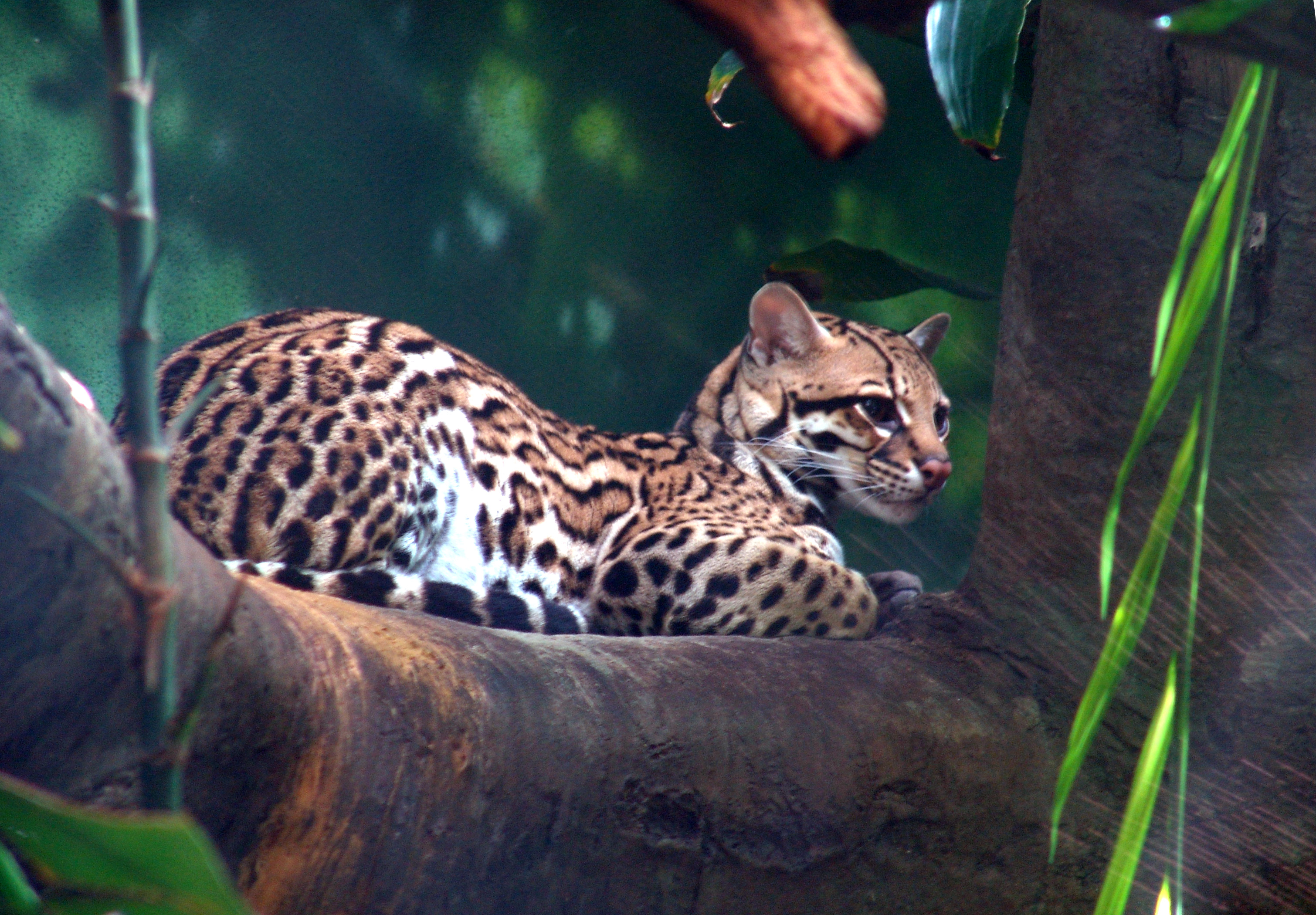
This is an ocelot (Leopardus pardalis). This small-ish wildcat is native to a large area, stretching from the bottommost tip of the U.S. to the rainforests of South America. If this kitty created a sense of deja vu for you, it is probably because its coat resembles that of a clouded leopard - another rarely talked about wildcat. Despite all visual similarities, a full-grown ocelot is twice the size of a domesticated cat and can swim.


The kittens are still adorable as all D'AWWWWWW~! 

The ocelot's status on the endangered list recently went from "vulnerable" to "least concern."They are still protected in many areas due to, in the U.S., being possible roadkill and hunted for their pelts.  Ocelots are generally rare animals.

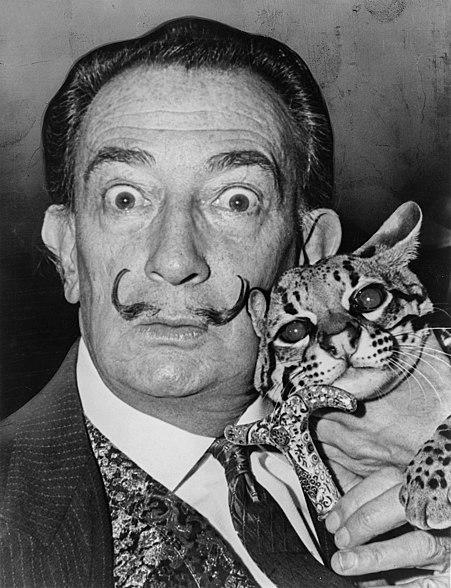
As its similarity to a house cat might indicate, ocelots can indeed be kept as pets. They seem to be particularly popular with artists; Salvador Dali had an ocelot named Babou, and musician Gram Parsons kept one at his winter home in Florida. These days, most big-name artists prefer tigers (including Katy Perry). If you are the thriftier sort of artist, consider an ocelot.


Dali even took it on a boat.

Creature Feature: Irish Elk.

How could I not have done the Irish Elk (Megaloceros giganteus) yet? I have, to date, mentioned it twice.


Oh, right. Deer just are not very weird until you start going prehistoric with them.  This giant deer is dead. It's pushing up daisies. It has CEASED to BE. THIS is an EX-DEER!


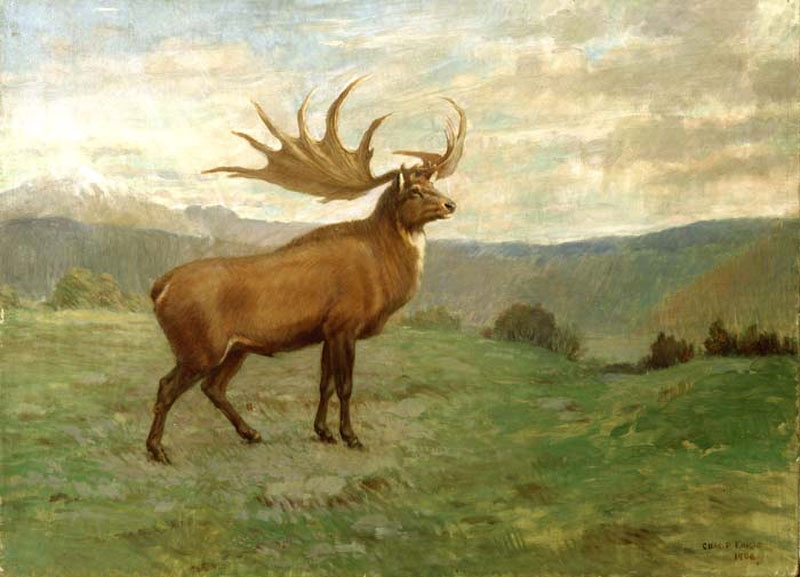
The Irish Elk, AKA the Giant Deer, lived around 400,000 years ago. Like the aurochs, it was a Pleistocene megabeast. It was not related to any modern elk; it was a HUGE deer, getting approximately 7 feet high at the shoulder. An antler spread of up to twelve feet from tip to tip made a male of the species even more imposing and majestic than that one shot in Bambi.


Then Disney sequelled the hell out of it. 

 The Irish Elk is one of the "textbook standards" for a very specific type of extinction: Its sexually-attractive antlers eventually got so huge that they killed the species. Its rack was either so big that it actually impeded movement, or a climate change simply made that headgear impossible to sustain. Essentially, it was like that overly-decorated cell phone that your best friend has; y'know, the one with so much shiny junk on it that you wonder how the eff it works.


I've seen worse.

Humans played a minimal part in its extinction; after all, we also had cows to deal with back then. The Irish Elk and humans shared space for a good long time; it's not like humans suddenly went around killing these weird giant deer that they had never seen before. Again, the hugeass antlers likely hindered the deer when they tried to avoid hunters. Either way, that headgear was their downfall.

Now, when I say "Irish Elk'd" in an entry, you will know what I mean. Those horns are pimpin', but they ultimately killed the deer.


DAYUMN.