Showing posts with label albino. Show all posts

Saturday, November 17, 2012

Newsflash: A White Humpback Whale?!

Well, here's something refreshing. This blog rarely covers whales and dolphins, so when a friend showed me this, I had to show it to you all:


"Mariners who spend lots of time at sea are witness to all sorts of amazing sights, but very rarely does one get to witness the almost mythical white whale. Dan Fisher has seen and documented this animal. While crewing aboard the three-masted SV Antigua in August, in the waters of Norway's Svalbard Archipelago, Fisher made the sighting of what looks to be a pure white humpback whale from high on the mast. (For whatever reason, Fisher waited until recently to release his footage and share his story. These are his images, Wildlife Extra


The whale first appeared as a white hump on the horizon, and was swimming with other humpbacks.

"As I realized it was a white whale, I was amazed," Fisher told the Daily Mail. "I quickly climbed the mast to get a good vantage point and captured these pictures. Afterwards we were all talking and decided to dub him Willow the white whale."

News of the sighting began circulating on the Internet this week.

White whales are rare and the most famous among them, of course, is Moby Dick, a fictional sperm whale in the 1851 Herman Melville classic novel of the same name.

More recently, a white humpback known as Migaloo has been spotted sporadically off Queensland, Australia. A white humpback calf also has been seen off Queensland. According to Wildlife Extra there have been reports of white killer whales off Alaska and Russia (possibly the same animal), white right whale calves off South Australia and an albino dolphin off Louisiana.

The white humpback spotted by Fisher, who is Welsh, is either an albino or its coloration could be the result of a condition known as leucism, in which pigmentation cells fail to properly develop. Albinos are totally white and usually have red or pink eyes.

Fisher, 32, who for the past 10 years has worked as a maritime engineer, referred to the sighting as a "once-in-a-lifetime spot" and added: "I saw lots of humpbacks this year, but nothing as spectacular as this one.""
~ From GrindTV.com


Just to clarify: there is a good chance that these white humpback whales are leucistic, not albino. There are several differences between the two, including eye color (albinos have pink eyes, sometimes blue) and vulnerability to UV rays. Similar result, but not the same thing. Don't call a whale albino unless you're looking it in the eye.

Either case of suddenly abundant white whales speaks to a potential problem: a shrinking gene pool. Whaling in the old days made huge dents in whale populations.  Modern-day pollution can't be good for them, either. When creatures as large as whales are vanishing, the ecosystem in general and the cetacean gene pool are both adversely affected. Could the rise in white humpback whales be due to a shortage of breeding partners?

Mind, white whales have been around for quite a while. The story Moby Dick detailed one man's constant pursuit of a white sperm whale; since it's conception, the term "white whale" has come to mean something elusive to the point of being irritating. Still, to find a real white whale is very rare indeed. Let's hope it stays that way, no matter how awesome these white whales look.

Thursday, August 11, 2011

Prince On a White (but not albino!) Horse.

In looking at weird donkey breeds, I found something interesting: There is no such thing as an albino horse. There are a million different ways to make a white horse, but not an albino. Read this fascinating page on exactly why albino horses do not exist.

This gets back to my "Shades of White" entry. There are many traits, not just one, that can lead to a white animal. Although it may be easy for the public to call them all "albino," which does after all have the Latin word for "white" in there, it is technically incorrect! (Even within albinism, there are subtleties. Don't call white tigers albino unless you want to do the same for Siamese cats.) As the page says, there are many differences between how different types of whiteness is inherited, too.

Just sharing. The world is pretty darn fascinating, but if you must get into fantasy, don't assume your prince on a white horse managed to procure an albino.

Saturday, June 5, 2010

Albinism: Different Shades of White.


Holy cats. I hate to sound racist, but...wait...are those black people? That video is from the African country of Tanzania, and those people look light-skinned, but they certainly aren't Caucasian. There are other traits that make them look African. Again, no offense meant.

The people in that video up there are albinos. That is not a racist term. That is the exact same sort of albinism that you see in Burmese pythons, that white gorilla, lab mice, and those white frogs at Wal-Mart. It just so happens to occur in people as well. Even so, not all white people, or animals, can be properly called albinos. Why?

Albinism (derived from Latin albus, -a, -um, "white") makes any given organism a lot lighter than usual. It is commonly thought of as the trait that turns animals white, and, as such, tends to be incorrectly oversimplified into "any white animal." It is found across many, many species, from fish to humans.

Albinism is a simple recessive trait - that is, something can be 'heterozygous for albinism.' That means that the parents of an albino progeny will look completely normal. There is a 25% chance of getting an albino baby (of pretty much any animal) if both parents are heterozygous.


What I said up there can be roughly translated into this little box.


Although 'albinism' is the common name for this mutation, 'amelanism' would be more accurate. The mutation stops the production of melanin (Gr. melanos, black), a common natural pigment. As the name implies, it determines the amount of dark coloration on an animal. Since albinism essentially turns that one pigment off (making the organism white), why not get more to the point? As you will see, not all albinos are plain white...but they all lack black pigment.

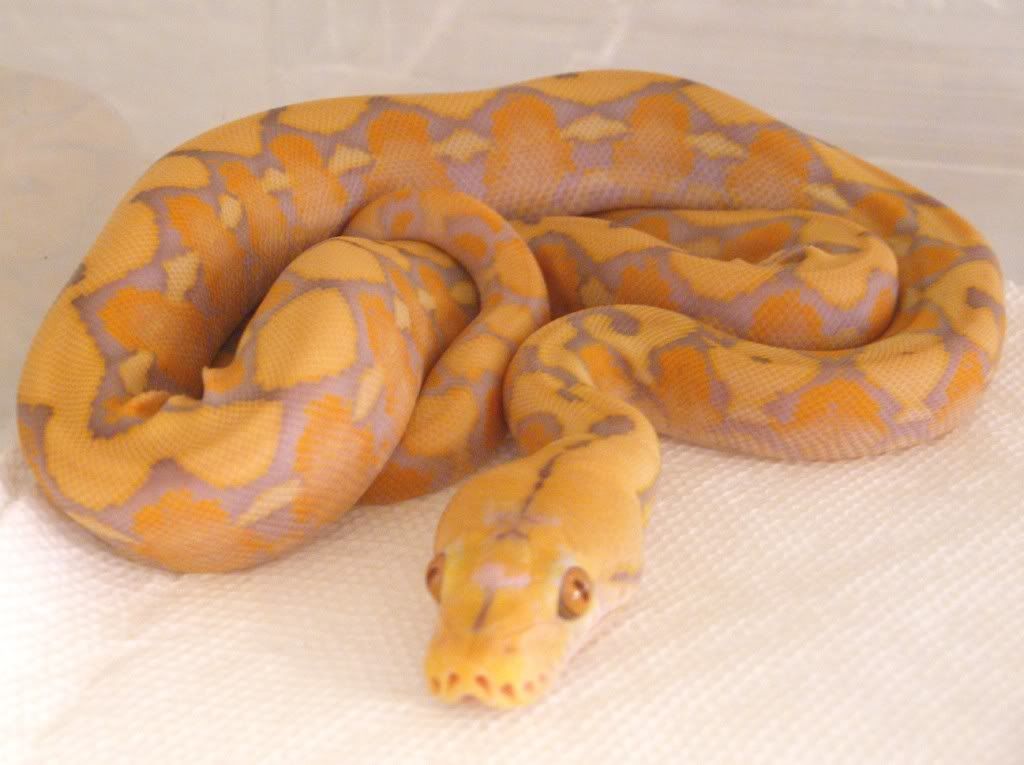
For mammals, melanin is the only pigment that they have to work with, so they end up being uniformly white. This is not so for birds, reptiles, amphibians, or fish - an albino Burmese python, for example, also has some yellow pigments to play with after albinism. The same also went for that crazy albino retic from my reticulated python entry - it had orange, peach and purple, of all things! A lot of people do not realize that albinism is just one giant PhotoShop tool that Mother Nature likes to play around with every so often.

Tweaking pigmentation is an awful lot like editing a picture in PhotoShop. For mammals, you can only work in a sort of sepia grayscale, but everything else has at least RGB to tinker with. This is why a lot of mammals share similar patterns and colors. When was the last time you saw a bright purple mammal?

Albino specimens also have vision problems. As with the light skin typical of albinos, the eyes also lack (or have very low) pigment. This makes them appear anywhere from light blue to the infamous pink with red pupils. Having pink eyes is not necessarily a criterion, but it is still a good rule of thumb when trying to pick out albinism from other types of whiteness.

That said, it's time for that pop quiz I promised. Which of the animals below are albinos?


The first two pictures - the white peacock and white tiger cubs - are not albinos. They are different variations of leucistic (from Greek leukos, white). Leucistics have no hard and fast rules or maladies like albinos. Even the heritability of the various leucistic types can vary. There are about a million types of leucism. Unlike normal albinism, leucism gels perfectly well with black.

So, yes, that infamous albino peacock is leucistic. It is hard to see the dark eyes on the peacock, but that it is not albinism is apparent when a white peacock meets and mates a regular blue peacock:


Remember what I said about albinism being a simple recessive trait? Breeding a truly albino peacock to a wild-type peacock should result in all normals that, when bred together, will yield 25% albino offspring. That's not what we're seeing here. Instead, we got a pied peacock due to that particular type of leucism's incomplete dominance. Eye colors aside, albinism doesn't roll that way.

White tigers are not albino, either. I have heard rumors of albino tigers, but the bold black and white specimens seen in Vegas are not albino. If they were truly albino, they would be completely white - the black stripes should be a warning flag. They have a type of leucism with a similar heritability pattern to albinism (i.e. it's simple-recessive). The gene is linked to a trait for severely crossed eyes; all white tigers are at least slightly cross-eyed. There are, supposedly, albino tigers - pure white tigers with no stripes at all - but the evidence for that is sketchy at best.

The squirrel is a real albino. I was not trying anything sneaky with that one.

These last two were trick questions. The blizzard corn snake (Elaphe guttata guttata/Pantherophis guttatus guttatus, depending on your gender today) is part albino, but true albino/amelanistic corn snakes look like something from Woodstock:


To get a truly 'albino' look, an albino corn snake has to be bred with an anerythristic (i.e. "lacking red") individual. (Since there are two types of anerythrism in corns, I may as well add that, should you desire a blizzard corn, the cross is Anery B/Charcoal x amelanistic/albino. Utilizing Anery A instead yields a snow corn, which usually looks far less pure than the blizzard above. Both are often mistakenly called albinos.) The resulting offspring will all be normal-looking hets for both traits. Breed them again for a 1/16 chance of a whiter snake.

The Siamese cat is also a type of albino.
In this case, the mutation is incomplete and temperature-sensitive. Like many albino animals, Siamese cats are susceptible to eye issues - mainly, crossed eyes - and tend to prefer daytime hours because they have poor night vision.

There seems to be a lot of misinformation going around. Keep your eyes peeled for mistakes, and somebody please correct me if I made any!

Thursday, May 20, 2010

Creature Feature: Reticulated Python


What? IT HAS A SPINE! :D

Yes, I am a sucker for snakes just as much as I am for worms. Some people would say that they're related - a few cultures believe that worms are related to dragons, thus leading to the term 'wyrm' for describing both creatures. The same case applies to snakes; 'wyvern,' 'dragon,' 'naga,' and even the oriental 'Orochi' are all directly related to words for snake. The word 'python' comes directly from the particular serpent slain by Apollo at Delphi in Greco-Roman mythology.

Why this python, then? Why not the giant yellow snake that appears on stage and in classroom presentations all the time? Yes, those are totally different snake species, but does it really matter? Won't they both eat puppies, kitties, and other cute furry things when all is said and done?


Surely, if Britney Spears can handle a giant python, anyone can do it...right?

Well, first off, don't get reticulated pythons (P. reticulatus) mixed up with Burmese pythons (P. molurus bivittatus). Both are Asian pythons that grow to considerable size, have similar dietary requirements, and have been featured in the news (often misrepresented) numerous times. Although they have similar range, diets, and get massive, woe to the poor soul who does not do his or her homework!

Like I said, both of these python species grow HUGE. Retics, however, grow bigger; a female Burm usually caps out at around 20 feet, but a retic may well get around 30 (making them the longest snakes in the world)! Retics are also far more inquisitive snakes than Burmese pythons, and have a reputation for being aggressive. This statement was made before the advent of the tiger morph, which, while not staying any smaller, seemed to be less mean than the normal retics. (Plus, it was a co-dominant trait, which encouraged breeding projects - a co-dominant trait usually shows up in 50% of the first clutch.)

Reticulated pythons one of the few snakes reported to eat people on a semi-regular basis. They are not, however, venomous or nearly as dangerous as some news reporters would lead you to believe. They can make fine pets in the hands of a competent handler, but as many of you have noticed, stupid people out-breed smart people by a considerable margin. Maybe this is Darwin at work.

So, if they're so deadly, why do people breed them to begin with? They are indeed very intelligent snakes, and just about the only species to exhibit instincts that one would normally associate with mammals. (For those curious, the Russian rat snake seems to be another personable species.) The most celebrated among these is the retic's ability to recognize its owner within a crowd of people. Some breeders have also reported a homing instinct in their retics - that is, they will return to their cage if set free. These snakes could be amazing pets a few years down the road. There are several dwarf retic strains that are considerably smaller than the monstrous, man-eating snakes that jump to many a mind at the word 'python.'


Silver Eyes are Real by =KuroKarasu on deviantART Yes, I took this. :D

This is why it's a real shame that so many people are trying to get retics, Burms, and several other constrictors banned. At the mention of the word "python," their mind immediately jumps to man-eating, giant snakes, even if one of the smaller species of the genus is in question. They operate under the pretense that giant pythons are some sort of nationwide threat (you're confusing that with stupidity), all the while completely ignoring the similar threat posed by cats, dogs, and cattle - three creatures considered 100% domesticated by most standards. People do not cut down acres of rain forest so that their giant pythons have space to roam; nor do pythons contribute to global warming, I have personally been attacked and/or bitten more often by dogs than by snakes, and every so often, it's rewarding to see a place's natural fauna take care of an invasive species all by itself.

Australia will kick your ass, but that's a topic for another entry.


Retics in particular also look really trippy as albinos. Yes, that's an albino up there; not at all like an albino mammal, is it? The reasons why will be discussed in another article. No PhotoShop was used in the pic above.

Now, imagine living around giant snakes on a regular basis like this kid in Cambodia. That's a Burmese python, which, in contrast to the retic's aggro reputation, is known for being a total sweetheart. The people of Asia may kill snakes for their skins from time to time (which is why the Burmese python is protected in Hong Kong, the land of cheapass EVERYTHING), but their reception is generally far more positive than in the West. Giant pythons such as retics probably inspired and encouraged legends of dragons. Korean folklore in particular has a creature called an imugi, which is a sort of proto-dragon that just so happens to look like a giant snake.

Unfortunately, the only exposure the West has had thus far to the imugi is this:


Try to picture it without the suck, please.

Yeah. I love oriental folklore, and even I thought D-War sucked balls.