Showing posts with label python. Show all posts

Tuesday, June 5, 2012

Green Tree Python and Emerald Tree Boa.

I know, I know - another snake entry. You're probably getting sick of these, but this is an entry I've owed you all for almost two years, now. To sweeten the deal, it's a double header...with good reason.

Look at the two snakes below. Tell me if you can tell that they aren't the same species.


Despite looking very, very, very similar, the two snakes above are not even the same type of snake. The one on the left is a green tree python (Morelia viridis); the one on the right (with the large white stripes) is an emerald tree boa (Corallus caninus). The GTP is native to the rainforests of Indonesia and Australia; the ETB is native to the rainforests of South America.

So, fact blitz: Both the ETB and GTP are green, arboreal constrictors that get roughly 6 feet long as adults. The young ones are usually either red or yellow in color, changing to bright green within a year. Both snakes will also loop a coil or two over a branch and set their heads dead center. In captivity, it can be really, really hard to tell them apart.

Remember when I said that snakes had some crazy convergent evolution goin' on? This is exactly what I meant. These two snakes live nowhere near each other. Unlike lions and tigers, which are genetically close enough to reproduce even though they've been separated for thousands of years, ETB's and GTP's aren't genetically compatible. Their similarity is solely based on the evolutionary process; because they adapted to the same environments, eat the same food, and so forth, they evolved similar adaptations. In this case, they happen to be creepily similar.

Yeah, umm...I'd wear a glove, too. This is an ETB.


Similar does not mean identical. For example, the emerald tree boa has, proportionately, the largest fangs of any non-venomous snake. The ETB eats birds to warrant these super-long fangs; for whatever reason, GTPs do not. ETB's also have more apparent white on them than do GTP's as a rule. Also, GTP's are a lot more common in captivity in general, even sporting a blue morph.

A few handy tricks if you're stuck identifying a random green snake in a tree and somebody asks, "hey, what is that?":

~ Emerald Tree Boas are from South America. GTPs are from Asia and Australia. Location is one of the main dividing points, here.

~Boas have live babies; pythons lay eggs. Even if it looks like a duck and quacks like a duck, it's gotta give birth like a duck to really be a duck.

~ Those TEETH. We do not advise testing this in the wild by sticking your hand over the snake's head. Hell, we don't even advise trying this at home. Messing with those fangs sounds like a Jackass bit waiting to happen.

~ Both of these are rather thick-bodied. If the snake in question is slender, it's probably one of the many types of vine snakes or some other colubrid. Some people apparently do not know the difference, so there ya go.

A blue GTP. More here.


Both the emerald tree boa and green tree python have a strong following in the exotic pet trade. GTP's in particular have a huge fanbase, both because of their diverse color morphs as adults and their cross-compatibility with another Morelia complex known as carpet pythons (who also SO deserve their own entry!). The ETB base is a bit smaller, but they are nonetheless particularly popular in the Netherlands. Both of these species are intermediate-level snakes requiring elaborate enclosures with humidity setups etc. These are not snakes you take out and play with; these are snakes that you spend thousands on a nice, realistic terrarium setup for, then show your friends that.

Sunday, April 15, 2012

Reptilefest '12!

Whew! Lots of neat things at Reptilefest this year! In particular, people were focusing on species of reptiles that could easily be caught in one's backyard. There were so many Illinois herps this year! Unfortunately, there were far fewer Burmese pythons and retics; the Lacey Act must have scared some people.

So, without further ado...PICS!
The snake-necked turtle that inspired yesterday's entry! I may have selected the wrong kind. There are some snake-necked turtles native to Argentina, too. Seeing as Australia has strict wildlife laws, this was probably the non-Australian type. Can any turtle freaks help me out here?


Here's a snapping turtle, just to make you pay attention. 


I wanna say this is an alligator, but the angle makes it a little hard to tell. Yes, we had gators and crocs, here.

And now for snake pics! These are black-headed pythons. Neat-looking, aren't they? 


Cottonmouth, one of the few venomous snakes found in the U.S. Easily the prettiest. *Gets mobbed by rattlesnake and coral snake fans.*

One of exactly three Burms I saw at Reptilefest this year. This one's a granite. It was so cute to see its owner petting it like a dog or cat (or cow). There was also someone with a shirt saying "savetheburms.org." I may have to check that out...


Although there were plenty of ball pythons around this year, this girl, who was named Persephone, was the only outstanding one. She's a bumblebee (spider x pastel) with a really photogenic personality. Beautiful snake!

Didn't see many Burms this year (and NO anacondas) but you know what I saw a lot more of? Carpet pythons and rosies! I'll be GIDDY if rosies catch on; Eclair, I love you. That doesn't mean you have to be my only rosy.


Bunch of average-looking rosies...but rosies!


Cleaner "normal" plus a cute albino.


House snake. Pretty sure it's albino. :) Good snakes for people who aren't into mega-killer-pythons...but so are rosies! 


Several normal JCP's and a jaguar morph carpet python.

Okay, last two, then I need to sleep:


Someone brought a siren. I'm starting to love them! :D


That's a cicada - the framer didn't know what species, though. Apparently Thailand has a lot of very interesting cicadas, for whatever reason. Just another reason to save pennies. 

Sunday, February 26, 2012

Creature Feature: Return of the Burmese Pythons- Morphs + Hybrids.

One entry does not do Burmese pythons justice. Call me obsessed, but they really are cool snakes. I'm going to miss the dent in their population.

Specifically, the Burm ban prevents me from getting my all-time favorite snake: A Borneo Bateater.


The Borneo Bateater is a hybrid between a reticulated python (P. reticulatus) and a Burm (P. m. bivittatus). It was probably not found in the wild, and, if it was, it certainly did not consume bats.  Please; it's the hybrid of two large snakes. Bats would be a poor diet for it.

The Burmese python was one of the snakes that really got the reptile trade started. There was something really special about the first albino Burmese that came over approximately 20 years ago (anyone got a date on this? I used  to know it). It was the white tiger of the snake world, if you will. They were bred so often that, for whatever reason, albino Burmese have a higher fertility rate than their normally-colored counterparts.


Since then, the Burmese python has been bred with no less than ten different color and pattern morphs. These have been mixed and cross to the point where, not only can one have an albino Burm, one can have an albino granite, albino green, albino labyrinth...you get it. They all look really nice. The leucistic once thought legendary also proved heritable, so expect to see more hypo crosses, soon. Codominant traits are fun because they show up in the first generation! The people in the business are currently working on dwarf Burms, too, so size will not be such a big issue after a while.

I'll host it myself later...but that is a BEAUTIFUL eye.


Back to the Bateater. This hybrid has to be the most identity-challenged serpent on the face of the planet. Not only is it a hybrid, but it has the pattern and facial markings of a wildcat. Weirder still is that it is capable of breeding back to either parent, creating "jungle Burms" (3/4ths Burm) and "jungle retics" (3/4ths retic). Both of them look substantially different from the original species. Goes to show you what a little bit of experimentation can do.

Burmese pythons can cross into a lot of things, in fact. There are cateaters, which are the ultimate horror story python: African rock x Burmese, leading to a huge and possibly aggressive animal.  Burmese pythons have also been able to mate with ball pythons, leading to this:

Freaky. Trippy. Can I get it in lavender? :D


As for my actually getting a Batater? Too expensive right now. I'd love to have one, but I'm a responsible owner. Current means will not allow the author of this blog to possess a giant snake. Yet.

Sunday, August 1, 2010

Creature Feature: Ball Pythons.


A piebald ball python - one of the more popular morphs, unsurprisingly.

Now that Freak Week is over, it's time for a few creatures that almost, but did not quite, make the cut. There is a fine line between breeds and captive-bred morphs. Captive-bred morphs are the ball python's (Python regius) specialty, but as of right now, snakes do not have any official breeds.


(Actually, it's just a REALLY nice coral glow...maybe with some pastel in there.)

Ball pythons are native to Africa, with most of the specimens in captivity coming from Ghana. They are quite popular in the exotic pet trade worldwide. They are small, docile, and exotic-looking constrictors that can be easily handled by a beginner, although corn snakes give balls a run for their money.


Be careful where you get your ball python if you choose to do so. Villagers in Ghana are paid for collecting eggs from, then releasing, female ball pythons. Most chain pet stores, in the true spirit of 'mart' and 'co.', get their ball pythons from Ghana, which leads to a host of problems with the snakes. One is far better off giving a breeder's 'reject' a new home; normal males are cheap enough to be sold in bulk by breeders.

Ball pythons have so many interesting variations that they could ALMOST have a week to themselves. There are so many traits (dominant, co-dominant, recessive...you name it!) and combos that breeders try whatever they can to make the new "it" ball python. Thus far, I am placing my bets on NERD; not only did they 'invent' the spider ball python, but some of the other morphs they have are simply eye-popping. If I ever needed a reason to go to the East Coast, NERD provided it.


Spider ball, spider ball. Does whatever a spider ball does.

The catch? Snakes are practically living art. It shows in their prices; a nice, clear blue-eyed leucistic ball python can run upwards of 1000 USD. Other morphs can soar higher, especially in combination.


Of course, I like my white with just a little bit of taint to it. ;) The Mojave x Mojave BEL looks a little bit different from the 'White Diamond' above:


(A super Mojave. Mojaves are also one of the ingredients in many more pure BEL projects.)

Sunday, July 25, 2010

Breeds VS Species.

Hello, everyone! Welcome to Freak Week- a week devoted entirely to animals that makes NATURE spit her soda out in sheer WTF at. Although nature has made some pretty darn weird stuff herself, this week will be devoted to the most freakish breeds that mankind has mustered thus far.

Breeds. Not species.

"Wait, those are different?" you ask. Yes, they are. They are very different terms with different implications in modern society. They are different in terms of where they are found. Hell, they are even different on a linguistic level. Have a demonstration:

Imagine, for a second, that someone wanted to ban a certain breed of animal - say, pit bulls - from a certain area in the U.S. OK, no big deal - pit bulls are just one breed of dog, and they just so happen to be a breed specifically bred to fight in arenas. Dog fighting is illegal in most states. Since pit bulls are named and bred for that sport, a ban on pit bulls is a (horribly failed) attempt to curb illegal dog fighting. Normally, only pit bull owners and dog lovers will care about such a thing. After all, it's only one breed of dog, right?

Now for a contrasting scenario, imagine a ban on all species in the genus Python. That 2000-dollar piebald ball python (P. regius) that will never ever get more than 6 feet in length is suddenly put on the same level as the Burmese python (P. molurus bivittatus), which is only related at the generic level. The two do not share dietary habits, natural habitat, or sexual compatibility on a regular basis. They are not the same species. This came VERY close to happening, in part because of the confusion between "breed" and "species."

"Breed" denotes a certain type of domesticated animal. They are standardized, showed, and recorded. For example, Golden Retrievers and Labradors are both breeds of domesticated dog - Canis lupus familiaris. Holstein and Jersey are both different breeds of cattle. My tabby cats are a different breed from the hairless cats seen in Austin Powers and Lady GaGa's "Bad Romance" video. They are the same species of animal, but different breeds.


I still cannot tell whether this is a Canadian or Russian hairless. The ears don't look big enough to be a Russian, but part of me hopes that GaGa did her homework. No, I could not resist using a "Bad Romance" cap.

For a more technical definition: " A breed is a group of domestic animals or plants with a homogeneous appearance, behavior, and other characteristics that distinguish it from other animals of the same species. When bred together, animals of the same breed pass on these uniform traits to their offspring, and this ability—known as "breeding true"—is a definitive requirement for a breed."

Thanks, Wikipedia. So, what does that mean in real life?

If you breed, say, two Scottie dogs together, you will get nothing but Scottie dogs. No retrievers. No dogs that look like wolves. No Labradors. Just little, yappy black dogs that look like they were pulled off of a flapper girl's skirt. They look like Scotties, walk like Scotties, and bark like Scotties. You're pretty damn sure that you have a family of Scottie dogs on your hands, with all the temperaments, quirks, and appearances of their parents.


Scotties can mate with any of those breeds mentioned above, as well as wolves. On a regular basis. With no decrease in fertility. In the 'wild,' i.e. the dog park. This compatibility is, in part, what makes Scotties their own breed rather than their own species. Even then, they would be a subspecies of the subspecies Canis lupus familiaris - yes, the domesticated dog is still a wolf, albeit a subspecies.

Here's why: Not only are dogs descended from wolves to begin with, but they can interbreed with ease, and the hybrid pups show no decrease in fertility. Any dog with any wolf in them within 5 generations is technically considered a wolfdog. The same is true with dingoes, another Canis lupus subspecies (which is technically a domestic dog turned feral). This is NOT true with coyotes, who not only have a premating barrier VS dogs, but whose bastard pups tend not to be very fertile. (I have heard conflicting info concerning coydogs in particular, but whatever the case, they don't do it very often.)


Yes, this is all about mating and survival of the fittest - just like Darwin's Origin of Species. There are, however, some differences between the selections that make a species and the selections that make a breed.

Let's look at the definition of 'breed' again, this time in PowerPoint form:

1. The animal in question has to be considered domesticated.
2. It has to look and behave differently from others of its species.
3. It has to breed true. I don't want a wolf in my litter of Scottie dogs.

Now, in greater detail:

1. Your mileage may vary on the term "domesticated." I have heard anything from 'has to be able to breed in captivity' to 'must be trainable and submissive (e.g. have some form of social hierarchy, allowing humans to be recognized as a 'leader')' to be considered domesticated.' In many cases, the domesticated form of a species differs greatly from, and sometimes replaces, the wild ancestor (as in the case of Bos taurus). For example, a Russian scientist bred silver fox (Vulpes vulpes) kits that were the least afraid of humans together; the results paralleled the changes that had occurred between C.lupus lupus and C. lupus familiaris.

2. This is really broad. For this, you need to find the 'wild-type'- i.e. the form and type most commonly found in the animal's natural habitat. Then, compare it with a captive specimen. Using out Scotties as an example again, let us put a Scottie alongside a gray wolf. The two look and act differently, but they would still be sexually compatible. There might be a size issue, but that would almost be like saying that a normal person can't make out with a dwarf.

3. When I breed Scottie dogs, I WILL get Scottie dogs. There was someone that I once met on my bike route who had lost a purebred Scottie in the past; she wanted nothing except another Scottie dog to fill the hole in her heart, even though it would cost a LOT more to purchase than a random shelter dog. The Scottie's personality, physical characteristics, and other differences from other dog breeds out there all had a hand in her decision. She knew how a Scottie dog would act, how big it would get, what it would look like, and how to take care of it. She could not have done this with any other dog, even though they are all Canis lupus familiaris. Even a Scottie cross would not do; breeding out cuts down the predictability of traits.

This is different from speciation on a number of levels. The definition of 'breed' is limited to domesticated animals - again, your mileage may vary on that term. Breeds are deliberately created for certain qualities, both physical and temperamental. They are substantially different from their wild counterparts, but not differentiated enough so as to prevent sexual compatibility.

I have been using Scotties thus far as an example of a 'breed.' It is a well-known breed with a decent amount of crosses, and has had good exposure in pop culture. I have had an experience in which someone wanted a Scottie and nothing else - a testament to its status as a true breed, not a mutt.

Let us look at a few things that are not breeds, and then at what makes a species a species and not a 'breed,' shall we?

Morphs are the traits most commonly mislabeled as 'breeds.' An albino animal is not that different from a wild-type member of the same species - it is a horse of a different color and nothing more or less.

As an example, Labradors can come in many colors (such as golden, chocolate and black, to name a few). These are all color morphs. In the wild, color morphs can vary with locality or be a simple recessive, dominant, or co-dominant trait. By definition, a morph must exist in the same wild population as at least one other morph.

In captive populations, when a morph deviates from a breed standard, as is the case with Holstein cattle, the morph may branch off into its own breed. It's pretty much a paint job most of the time.


Always putting the red folk down...

Although the Greek word 'morph' means 'form,' more often than not, the term is applied to some sort of color variation. In any case, the morph is usually one trait (although many traits are linked to some other trait, such as crossed eyes in white tigers). Breeds have many, many traits associated with them. That is why furred hairless dogs are still considered the same breed; there are other traits that make the breed. (Also, the heritability of hairlessness means that SOME furred puppies are inevitable.) Morphs can be one part of a breed, just like eggs are one ingredient in a cake.

Hybrids are also not, technically, breeds. I do not mean 'hybrids' like a Scottie-whatever mix; I mean mules, wolfdogs, coydogs, beefalo, zorses, ligers, jungle corn snakes (corn x king), Borneo Bateaters (retic x Burm), and other such crosses. Those are either species crosses or subspecies crosses. While they may have been induced in captivity (lions and tigers no longer share territory in the wild), they are still not breeds.


A Borneo Bateater, a fertile hybrid between Burmese and reticulated pythons. There is some debate over whether it is a natural intergrade or not...but DAMN if it isn't awesome!

Remember criterion 3: It has to breed true to be considered a breed. Some of those hybrids do not breed period, or have reduced fertility, mostly because of chromosomal differences. Even in hybrids that can breed, the abnormal ratio of parental DNA means that they will not necessarily look exactly like their parents, nor that their natures can be determined with consistency. Generally, hybrids are a one-time deal, and the results afterward are by no means steadfast. They are not themselves considered breeds, but can, like morphs, be grouped within breeds (e.g. German Shepherd x coyote).

Subspecies, although genetically compatible with other members of the species, are also not usually considered 'breeds.' Although they do breed true and differ sufficiently from other subspecies (there is never only one subspecies; the term is reserved for two or more), they are often not domesticated, and never seen as captive breeds. Unlike breeds, they are recognized as a scientific class due to their differences - for example, Morelia spilota cheynei VS Morelia spilota spilota.

A species refers to, again as per Wikipedia, "a group of organisms capable of interbreeding and producing fertile offspring." I would personally add "in their natural environment," or "frequently," but there is really not much to be said beyond that. Sure, there are DNA sequencing methods of determining species, but if you really want to debate whether Burmese and ball pythons are the same species or some such, just remember that they have different habits, live in COMPLETELY different environments, and only one is sold at Petco these days (with good reason).
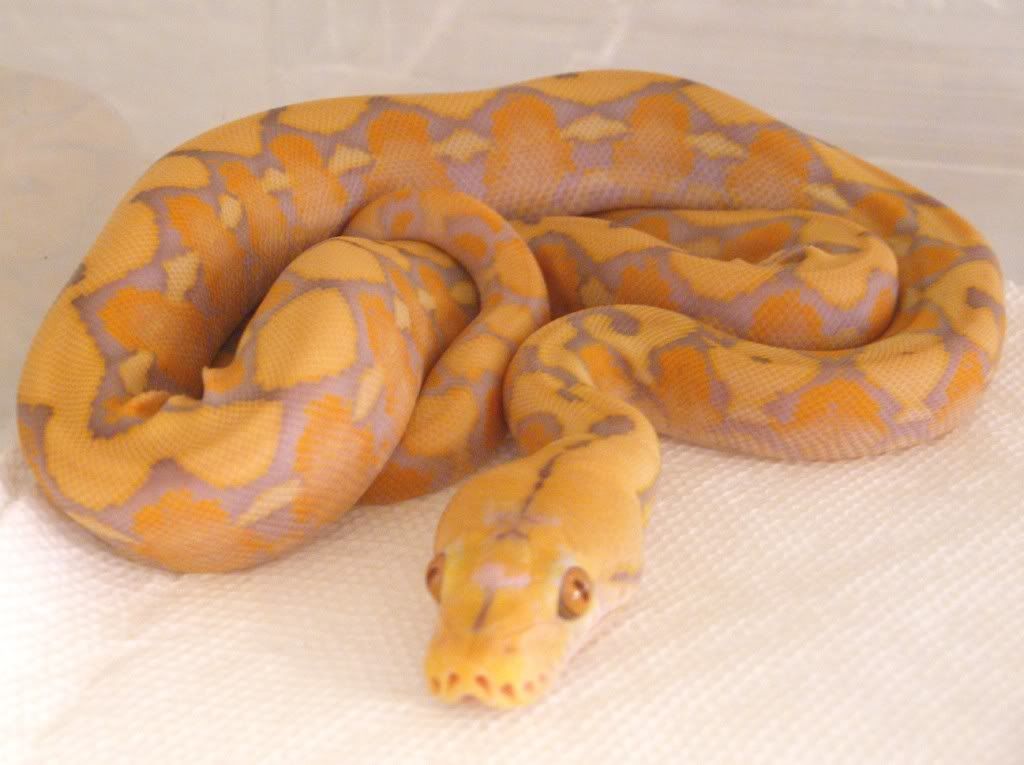
AS OF RIGHT NOW, THERE ARE NO BREEDS OF SNAKE - JUST MORPHS, SPECIES, AND SUBSPECIES.

To be fair, the albino Burmese python (P. molurus bivitattus) is close to the 'breed' title. Not only are they sweet enough to cause diabetes, but they exhibit higher fertility than most other types of Burmese python, as well as having the 'calm white snake' demeanor that seems to be consistent throughout snake species (as seen in the video below).

Even unrelated snake species, such as corn snakes (Pantherophis guttatus/Elaphe guttata), have very docile albinos. The increased fecundity, however, is not consistent between different species. This is probably due to the albino Burm's nature as one of the first snake morphs on the market. (And why not? I'm not saying that EVERYBODY should have a giant pet snake, but Burmese pythons are impressive and docile. Even a wild-type Burmese python can be sweet as a kitten.)


In my reticulated python entry, I mentioned that retics were actually one of the better candidates for domestication (even by the strict definition - retics are the closest snakes have to ANYTHING with a social hierarchy). I also mentioned that Tiger retics seemed to be more docile than their wild-type counterparts. This is an excellent example of correlated traits - it does not seem like the retic has lost its intelligence or famous/notorious ability to recognize its owner, and has less of a temper than other morphs. People who own and handle retics well often get attached to them (and, to some degree, vice-versa).

Now, if only they didn't get 30 feet long as adults. Oh, wait, there are a few subspecies of dwarf retic from various little islands...that are hyper and aggressive. This correlation between small size and scrappy nature deters many a potential owner from getting a dwarf specimen. They're also more expensive than solid gold caviar, and that doesn't even exist. It will be a while before snakes develop genuine breeds, if ever.

Please, please, please do not get the terms 'breed' and 'species' mixed up! Although it may be comforting to think of all of nature as one big happy family, it is not. Burmese pythons are different from reticulated pythons, which are different from ball pythons. Not all squirrels are the same species. Cows do not only come in black and white; they come in a rainbow of shapes and a variety of sizes, and they are all the same species (be on the lookout for Bos taurus). Your macaw is not that closely related to your parakeet, even though they look like darn similar birds sometimes. If it is not 'domesticated,' it is not a breed.

With that said...On with the freak show.

Thursday, May 20, 2010

Creature Feature: Reticulated Python


What? IT HAS A SPINE! :D

Yes, I am a sucker for snakes just as much as I am for worms. Some people would say that they're related - a few cultures believe that worms are related to dragons, thus leading to the term 'wyrm' for describing both creatures. The same case applies to snakes; 'wyvern,' 'dragon,' 'naga,' and even the oriental 'Orochi' are all directly related to words for snake. The word 'python' comes directly from the particular serpent slain by Apollo at Delphi in Greco-Roman mythology.

Why this python, then? Why not the giant yellow snake that appears on stage and in classroom presentations all the time? Yes, those are totally different snake species, but does it really matter? Won't they both eat puppies, kitties, and other cute furry things when all is said and done?


Surely, if Britney Spears can handle a giant python, anyone can do it...right?

Well, first off, don't get reticulated pythons (P. reticulatus) mixed up with Burmese pythons (P. molurus bivittatus). Both are Asian pythons that grow to considerable size, have similar dietary requirements, and have been featured in the news (often misrepresented) numerous times. Although they have similar range, diets, and get massive, woe to the poor soul who does not do his or her homework!

Like I said, both of these python species grow HUGE. Retics, however, grow bigger; a female Burm usually caps out at around 20 feet, but a retic may well get around 30 (making them the longest snakes in the world)! Retics are also far more inquisitive snakes than Burmese pythons, and have a reputation for being aggressive. This statement was made before the advent of the tiger morph, which, while not staying any smaller, seemed to be less mean than the normal retics. (Plus, it was a co-dominant trait, which encouraged breeding projects - a co-dominant trait usually shows up in 50% of the first clutch.)

Reticulated pythons one of the few snakes reported to eat people on a semi-regular basis. They are not, however, venomous or nearly as dangerous as some news reporters would lead you to believe. They can make fine pets in the hands of a competent handler, but as many of you have noticed, stupid people out-breed smart people by a considerable margin. Maybe this is Darwin at work.

So, if they're so deadly, why do people breed them to begin with? They are indeed very intelligent snakes, and just about the only species to exhibit instincts that one would normally associate with mammals. (For those curious, the Russian rat snake seems to be another personable species.) The most celebrated among these is the retic's ability to recognize its owner within a crowd of people. Some breeders have also reported a homing instinct in their retics - that is, they will return to their cage if set free. These snakes could be amazing pets a few years down the road. There are several dwarf retic strains that are considerably smaller than the monstrous, man-eating snakes that jump to many a mind at the word 'python.'


Silver Eyes are Real by =KuroKarasu on deviantART Yes, I took this. :D

This is why it's a real shame that so many people are trying to get retics, Burms, and several other constrictors banned. At the mention of the word "python," their mind immediately jumps to man-eating, giant snakes, even if one of the smaller species of the genus is in question. They operate under the pretense that giant pythons are some sort of nationwide threat (you're confusing that with stupidity), all the while completely ignoring the similar threat posed by cats, dogs, and cattle - three creatures considered 100% domesticated by most standards. People do not cut down acres of rain forest so that their giant pythons have space to roam; nor do pythons contribute to global warming, I have personally been attacked and/or bitten more often by dogs than by snakes, and every so often, it's rewarding to see a place's natural fauna take care of an invasive species all by itself.

Australia will kick your ass, but that's a topic for another entry.


Retics in particular also look really trippy as albinos. Yes, that's an albino up there; not at all like an albino mammal, is it? The reasons why will be discussed in another article. No PhotoShop was used in the pic above.

Now, imagine living around giant snakes on a regular basis like this kid in Cambodia. That's a Burmese python, which, in contrast to the retic's aggro reputation, is known for being a total sweetheart. The people of Asia may kill snakes for their skins from time to time (which is why the Burmese python is protected in Hong Kong, the land of cheapass EVERYTHING), but their reception is generally far more positive than in the West. Giant pythons such as retics probably inspired and encouraged legends of dragons. Korean folklore in particular has a creature called an imugi, which is a sort of proto-dragon that just so happens to look like a giant snake.

Unfortunately, the only exposure the West has had thus far to the imugi is this:


Try to picture it without the suck, please.

Yeah. I love oriental folklore, and even I thought D-War sucked balls.