Showing posts with label reptiles. Show all posts

Sunday, March 16, 2014

NARBC Spring 2014!

Confession time: The reason I've not been updating as much is simply because I've been using my other Gmail account more. Having both switchable at the ready is nice. Never fear; more entries are coming, and they'll be juicier and meatier than ever before!

This entry focuses on North American Reptile Breeders' Convention (NARBC) Spring 2014 (Mar 15-6). I love these - there's so much cool stuff to take photos of! These went on my Twitter (@kurokarasu), so some people got a live feed of this entry as it was being made. ;) Most things are way out of my price range, but there are also some really great bargains that remind one how expensive pet stores can be. You'll also see a lot of species that one would not ordinarily see, like...


...yes, that's a hognose (H. nasicus). They're really cool, little rear-fanged snakes that are only mildly venomous. Nobody has ever died from a hognose bite; the worst that's happened is an allergic reaction. I've complained about how hard they are to get in IL before, but all one really needs is a permit.


So, how can these people even touch poison dart frogs? Captive-bred poison dart frogs aren't poisonous. The poison needs a few things before it can activate: bacteria on the frog, UV light, and a certain species of insect. We can take that last one away, at least, meaning that these frogs are OK to handle. Still, wash your hands after handling. These are mostly display frogs, anyways.


Someone on my Twitter commented that these ball pythons (P. regius) were on the pricey side. Um...no, not for ball python morphs, they are not. Here are a few non-slashed (or very slightly discounted) ball python morphs for your gawking pleasure:


Yes, I deliberately took photos of acid trips for you. Bear in mind that your regular ball pythons (usually "loser males") can be purchased for 30-50 bucks from a reptile specialty store.


A leucistic rainbow boa! A shame it looks almost like every other white snake on the market. If there was any of the species' namesake iridescence in these guys, the light was not showing it well.


This is a legless lizard. It was hard to get a good look at its eyes, but several other features made me believe it anyways. I'd like to think someone at a reptile convention would correct the owner if he was BS'ing us.


Hypo Burms! One of them was sold as I was walking around. People acted like they were having trouble getting rid of them. Given the abundance of laws surrounding giant snakes, I understand why.


I absolutely love dwarf reticulated pythons! This picture also happens to be for science; I'm working on a paper concerning what makes for a good domesticated animal, and dwarf retics are actually a really good candidate for a domesticated snake. I asked if they retained their legendary intelligence (by snake standards) even when dwarfs; the seller said yes. Regardless, it was amazing to hold one of these beauties.


Finally, my own acquisition: A GFP axolotl! This little guy (or girl, we don't know) glows green under black light, just like a GloFish. His/her working name is "Fran," short for both "Frankenstein" and "Francesca/Francisco"- we aren't sure, yet. Once the little salamander grows a bit, the males get bulges near the base of the tail. We shall see! 

Tuesday, February 11, 2014

Creature Feature: Thread Snakes.

This picture is MINE...but was done with Field Museum equipment, and is for their use.  

Now for something I actually did: This is the head of a silver snake (Leptotyphlops albifrons), a type of thread snake from Argentina. It took forever to get a picture this good! The (dead) specimen had curled such that the head was hard to spread flat, but great side shots like this were still possible. It even shows the cute white spot at the front of the snake - handy, since the tail and head look very much alike on thread snakes. Just one of the many interesting things one can do by volunteering at the Field Museum!

Thread snakes in general are pretty neat, too. There are a few different families of thread snake, but they have enough in common to comfortably be called the same thing and share an entry page. Collectively, are found almost everywhere except Europe and some of the colder parts of northern Asia. Seeing them at all is a problem; these are secretive, quiet creatures that live in the soil and under rocks. Prepare to get your hands dirty. 

Thread snakes are also called "worm snakes" or "blind snakes," and with good reason. These snakes look like worms, if not burnt noodles. They are not slimy like worms; that should be your first clue if you happen to pick one up. As seen beneath a microscope, however, these snakes have scales, eyes, nostrils, and a spinal cord, just like every other snake in existence. All of them eat eusocial insects, particularly ants and termites, at all stages of life. Some may also be parthenogenic - capable of reproducing entirely without a male. More on that particular thread snake in another entry, though.

From National Geographic. Probably the only pic out there. 


Thread snakes are the tiniest snakes in the world. The smallest snake currently on record is the Barbados thread snake (L.carlae). As the name implies, this species is only native to Barbados, an island in the Caribbean. It is so small that it feeds on termites and their larvae. The adult is small enough to, well, fit comfortably on a quarter. The snake may be on the verge of extinction due to habitat threat, but not very much is known about it at all. It was just discovered and identified in 2008, so give it a bit longer.

Oddly enough, these snakes have the proportionately largest eggs of any snake type. The mother lays only one egg...which hatches into a baby almost half her size. Scientists think that, if the babies were any smaller, they would not be able to eat. The opposite case is true with giant pythons, who can lay clutches of hundreds! Size matters - just ask the people who take home Burmese pythons without realizing how monstrously huge they get.

Source. 


I love volunteering at the Field. I get inspired for so many entries, but only a few of them make the cut. Now, if only I could actually get paid to do things like that photo up top. 

Saturday, November 23, 2013

Why Petco Is A Rip-Off- Ball Pythons, Genetics, and You!

So, yeah. Still no job. Petco rejected me. I can nigh-guarantee that I know more about snakes than anybody else they're willing to hire, but since they did not want that, I will instead expose why you're pretty much guaranteed to get ripped off if you buy a snake from them - specifically, a ball python.

I'm going to venture a guess that the majority of ball pythons in Petco's tanks are normal, male ball pythons. They will probably cost anywhere from 50-80 USD. I will now be very blunt and say that you should be paying significantly less for the very same, if not a better, snake.

Why do I say this? Ball pythons are so overbred that they have been called the "dogs of the reptile world." Of all the ball pythons out there, the most useless, genetically, are the normal males. People will thus try to get rid of them as soon as possible, even going so far as selling them in bulk.

A brief refresher on how genetics work: Each parent has two alleles for any given gene. Both mommy and daddy pass on one allele each to the offspring. Each baby carries one allele from each parent, so no two babies will be exactly alike. There are a bunch of different ways to inherit traits (mostly recessive and co-dominant), but we will be focused on the almighty "co-dominant."

Ball python breeders, and snake breeders in general, love the word "co-dominant." It means that you can get something cool out of one breeding. Recessive traits like albinism are more widely-known, but take a grand total of 4-6 years to see the results of if you start with het babies. There is no way to tell whether the babies are het or not; this gets more problematic in future breeding, when you get things like "66% het." Co-dominance is favored because your first clutch might yield a baby that looks almost exactly like one of the parents. If you breed two co-dominants, expect even more craziness, but we won't be doing that. Instead, let's look at everybody's first python breeding: normal x pastel.

Square by NERD. Visit them for more awesome co-dominants!


This is a Punnett square for any normal x codominant ball python trait. For those of you who do not know what a Punnett square is, it is a grid showing potential offspring of two parents. In this case, the normal (probably the mom) is on the vertical axis, the pastel is horizontal, and the potential offspring are in the boxes.

NERD was awesome and used a subtle (or not so subtle, depending on your strain) color enhancer called "pastel" for their example. Pastels are ball pythons with the brightness/contrast messed with to the point where they look anywhere from bright lemon yellow to a slightly cleaner than usual normal. They are the cheapest of the co-dominant morphs. A lot of ball python traits, including the platinum and legendary banana ball, are co-dominant as well; if you're interested in those, simply copy-paste this Punnett with whatever fancy trait you like. Most of the good ones are co-dominant or dominant, and will thus pass their traits on in the first generation. This can lead to some amazing clutches!

That one normal in the back looks...kinda sad.


So, let's assume this clutch contained 4 ball python eggs with an even gender split. Four eggs, 2 male, 2 female. From what I've heard, this would actually be a pretty awesome clutch; four is OK for a first time ball clutch. The better size is 8-10, but let's keep it at 4 for simplicity's sake. Breeders breed so many of them that it seems like there are always more than enough. What we're looking for, here, is that codominant gene and the sex.

We have a 50% chance of getting another pastel ball just breeding a male pastel to a normal female. That one pastel could be male or female. The other members of this clutch could also be male or female. The pastels there can be bred/sold regardless. The normals might not be so lucky.

If one of the pastels is female, wow, we were lucky, right? Let's breed her back to daddy after a few years and see if we can get a super-pastel. Better still, cross her with a spider, pinstripe, mojave - whatever! Co-dominant traits blend excellently with each other and themselves. NERD has some 4-morph combos. I'm sure their prices range into the thousands, and if this sounds appealing to you, bear in mind that you're going to have to start with one trait like the pastel. With a female pastel, you're well on your way!

However.

If we're assuming everything came out with a nice, even split, this leaves us with two magical mystery balls. These, like the pastels, could be either male or female. Remember how co-dominance and simple dominance work: you've either got it or ya don't. In other words, barring any hidden recessive traits, any normal males are useless for breeding.

If both pastels turned out to be male, however, we would lose the dreaded normal male. Then we would wind up with two pastel males and two perfectly good females. Remember, it doesn't matter whether the females are pastel or not; as long as one copy of the pastel gene is passed on, the offspring will still have the pastel trait. Sure, it'd be a bummer to not have a female pastel, but those two females can still be sold for a decent price, and can be used in future breedings. "Breeder-size" females do sell. Normal males do not...unless you're smart.

Snake breeders will get rid of their loser males ASAP.  If you see a tank of normal ball pythons in a pet store, I will bet you money that 90% of that tank, if not all of it, will be composed of dud males. This site is selling them for 25 bucks. Compare that to whatever Petco's selling them for. It's just another reason to buy locally instead of not knowing where you snake's coming from, too.

You might also see beautiful babies like these from Genetic Gems.


In short, unless you are breeding super forms to super forms, every day, all day, you will get a normal male ball python. He will not be a good stud, but he will satisfy the kid down the street who's just itching for a pet snake because you happened to have one (or twenty). Normal males can potentially come out of every breeding, they won't sell very well, and thus, there are a million floating around in miscellaneous pet stores for people who just want a good pet snake.

Now, this is fine if you just want a pet ball python. If, however, you do a little homework and look for reptile conventions, I can guarantee that you will get a better deal on a male ball. These make fine pets and are absolutely ideal for beginners. Also, Petco.com says that they sometimes have co-dominant ball python morphs in stock; I have never seen these, so if you happen to find one for a decent price, snap it up.

P.S. - For those of you who might be interested, I still have baby corn snakes for sale! E-mail the_last_hetaira@yahoo.com

Sunday, October 20, 2013

Creature Feature: White Gators! and Wild Gators!

There are a number of advantages to visiting places that naturally have cool wild animals. One, you get to see wild animals in their natural habitats instead of behind glass. Two, the specimens that are behind glass are usually pretty cool. I tend to make it a point to visit the zoo whenever I go somewhere else; it's usually a good indication of how well-informed people are about exotics. The Audubon Zoo in NOLA had quite a treat, and I did not even get to see all of the grounds.


 Louisiana's zoo has a pair of leucistic American alligators (Alligator mississippiensis). Apparently they have wild white gators, too, but these were probably captive bred. These particular white gators are celebrities anyways.

A brief course in Alligators 101:the American alligator is native to most of the southern United States, from the Carolinas into Louisiana. These massive reptiles can get 999 lbs for males (who are indeed larger) and 13 feet long. As one could probably guess, most alligators are black- olive green, not white. They have powerful tails, can move faster than a human on land (25 MPH), and are armed with lots of teeth.

So, why is the gator above not albino? Take a close look. The eyes are black, and there is black speckling on the nose. An albino would have pink (or blue?) eyes and no black at all. Regardless, it looks like the swamps of Louisiana might be a "weird gene reservoir" like Florida is for corn snakes. They might also be intentionally protected like the Shirohebi of Iwakuni, but I wouldn't put money on that; the zoo got those white gators from somewhere, then probably bred them.


Along with seeing these unique gators in the zoo, I got to get up close and personal with wild alligators in the Louisiana bayou. Our savvy tour guide knew exactly where the gators were and fed  them marshmallows. (Our tour guide, by the way, was apparently the inspiration for a certain firefly in The Princess and the Frog.) Don't take a fan-powered boat; those things move so fast that I'd be amazed if you saw anything. We got to see gators snapping up marshmallows like nothing else. A waste of jaw power? Maybe, but it got us some incredible shots!


Unlike the whaling trip, on which I saw no whales, this tour boat had a guaranteed way to see an alligator: the boat had a baby on board! These gators are released into the wild when they get to be around two feet long. Imagine having an adult gator on a tour boat; at least you'd get your money's worth!

By the way, Louisiana is known as "hunter's paradise" for a reason. Alligator hunting is not only permitted, but encouraged. Some people also farm alligators (which have their own tours). Alligators certainly aren't an endangered species, and the Louisiana government allows a certain amount of them to be hunted. Don't worry about taking a tooth, paw, or gator head home; if any state knows what to do with alligators, it's Louisiana. Enjoy gator meat while you're there, too.


Friday, July 26, 2013

Creature Feature: Corn Snakes!

Remember when I said I had experience handling reptiles? Well...


These are all my hatchling corn snakes (Pantherophis guttatus; formerly Elaphe guttata). All of the above eggs hatched except for one, which unfortunately could not get out of its shell. They're rather neat little snakes, and one of the more common ones in the pet trade. It's totally worth doing an entry about them, if only because most people won't know what a corn snake is at a glance.

Corn snakes are mid-sized colubrids from the eastern United States, particularly the Carolinas and Florida. Like many snakes, they eat rodents. They are red, orange, and black, with speckled bellies that give corns Despite being called "red rat snakes," they are actually closely related to kingsnakes - one of the most beneficial snakes around, even according to people who hate snakes. They are also quite beautiful, even without a paintjob like my albino hatchies.


BEAUTIFUL normal from Ian's Vivarium!

Hey, speaking of paintjobs, you might notice that the wild-type ("normal") babies I hatched don't quite look like the awesome specimen above. That's because corn snakes exhibit something called "ontogenic color change." In laymen's terms, that means that they change color when they get older. It carries over into other morphs (color phases) too, so one really has to be patient to see what the adults will look like. Those drab normal babies will become bright red and orange in no time; that's part of the fun of corn snakes!

While ball python people have scores of morphs to mess with (the list is terrifying), corn snakes have a plethora of hybrids. "Jungle corns" are used to describe any mix between a corn snake and a kingsnake, and there are a lot of kingsnakes to choose from. One of the most common crosses, however, is with Emoryi's rat snake, leading to what are called "creamsicle" corns. It's almost as if, while insane breeding of ball pythons might narrow the gene pool to the point of being undesirable, the corn snake gene pool is expanding by incorporating other species. Dogs and cats, all over again. I can guarantee that we'll make a blue or green corn snake before a blue ball python, in any case.


That said, however, I still recommend a ball python for the first-time snake owner. There are several reasons for this, and they all come from personal experience. My first corn snake escaped from me and was never found again; likewise, colubrids are generally harder to catch than constrictors, being able to squeeze into a million tiny places. Especially if you have kids who might forget to lock the cage, balls are a better choice. There are millions of unwanted normal males out there for anyone wanting a first snake. Then, color your world with corns.

Sunday, May 26, 2013

Creature Feature: Leatherback Sea Turtle.

So, what is a leatherback, anyways? We gathered from the news video that it was an endangered sea turtle. How endangered? Are they really that rare? Let's find out!


Leatherback sea turtles are unique sea turtles in the genus Dermochelys. They are found worldwide, including around Japan. There are several subpopulations, but are all the same species as far as we know. Finding one in Japan would be unusual, but not unheard of. It's Japan we're talking about; all manner of odd spawns from those islands.

What's in a name? The main thing that sets a leatherback apart from other sea turtles: its lack of a carapace. Leatherbacks are effectively shell-less turtles. They have protrusions called osteoderms and ridges, but do not have a distinct, bony shell.  Their scales also lack beta keratin, which makes them unique among reptiles, and also lack true teeth.In other words, they're almost more torpedo than turtle. Make that a Pokemon: Tortpedo, Water/Steel, high speed for a turtle.

Leatherbacks are such oddball turtles that they are almost living fossils. The other members of this family evolved during the Late Cretaceous - AKA "that time with all the cool dinosaurs." Leatherbacks are the only extant members of their family; the rest of the carapace-less turtles are now extinct. They are also the largest extant turtles, getting up to 7 feet (roughly 2 meters) long. They are large, aerodynamic relics from the days of the dinosaurs. Enjoy.


Unfortunately, the news was right: Leatherbacks are indeed endangered. A fair amount of adults are caught by fishing. Although banned by CITES, some leatherbacks are indeed caught and traded (with some hopefully going to research projects - sorry, needed to point that out). A few are caught for meat, but generally, leatherbacks are not good turtle soup. The eggs are treated as a delicacy in Asia, however, which hits populations pretty hard. The only time the turtles are really vulnerable is when they're young, but they get hit hard and fast at that stage in life.

Y'know what? Despite being endangered, these turtles are not pandas. We actually have a very good reason to keep leatherback turtles alive. These things eat jellyfish. A lot of jellyfish. If I did not cover the jellyfish invasion in a previous entry, I should have. Our oceans are being overrun with jellyfish. We need sea turtles before the jellyfish take over the world.

Sunday, May 5, 2013

Creature Feature: Cuban Iguana.

Tip: You can tell how loose a state's animal laws are by how awesome their zoo is. If the reptile house in San Antonio was any indication, there were indeed some loose laws and low paperwork for venomous snakes. I did not expect to see this in the reptile house, either, and since a friend of mine's a big iguana fan, here goes:
Screw sourcing, I took this one.


The lizard lounging above is a Cuban iguana (Cyclura nubila), currently listed as "vulnerable" in terms of conservation. It is primarily an herbivore. This iguana lives in the rockier parts of Cuba, and is closely related to the Cayman Blue Iguana. It does not give a single flip that its island is communist, and walks around Guantanamo Bay quite freely. How fortunate that lizards can still enjoy the island because it's an island.

Cuban iguanas have some weird things about them just by being iguanas. All iguanids have what's called a "parietal eye" on top of their heads. It's a white dot that can detect light and shadow. The iguana's third eye is very active; their real eyes also have red scleras. There's more: their herbivorous diet, in this case, is supplemented by roundworms instead of the multiple stomachs and bacteria that ruminants have. This is just general iguana stuff- bet you didn't know they were strange by default.

Now THAT is eye-popping! Source.


Another weird thing: these iguanas are immune to cacti. Not just "they eat the stuff without getting pricked" - Cuban iguanas thrive around cacti. They make their nests in cacti, probably because other animals will avoid it. The cactus serves as a fortress complete with food. It's hard to get better than that.


Bizarrely, the Cuban iguana is probably the only reptile which has been viewed positively by the U.S. government. In a case concerning the legality of goings-on at Guantanamo Bay, attorney Tom Wilner pointed out that one could be punished for killing a Cuban iguana on-base, but torturing people was A-OK. Interesting argument, and props for looking it up. Not many lawyers would care about iguanas, even if they were endangered. Nicely done. 

Luckily, there are plenty of captive-bred Cuban iguanas. Most of the ones in the pet trade actually come from a feral population released south of Puerto Rico. Zoos breed them all the time. There is literally no need to take these guys off of Cuba, which is a good thing, considering humans, cats, dogs, and swine are responsible for the decline of the native population. They'll make a comeback; maybe the next leader of Cuba will be a lizard. ;)

Sunday, April 14, 2013

ReptileFest2013 Coverage.

Argus monitors...and how big they get.

It's a tigertic! For those of you who do not speak snake breeder, that means this fully-mature retic has a tiger gene. IT HAS TIGER BLOOD!

Me with a boa. :) And yes, I can wear a winter coat in 70-ish weather. It was cold enough outside.

Albino corns, but no porn.

A fairly standard garter snake. These are actually really cool little colubrids that deserve an entry or two if I haven't done so already.

Interesting ad.


Leucistic Texas Rat Snake. There were like...three. Maybe more.

Snakeskin jewelry!

A photo of a pink katydid, taken right here in IL.

Snake eggs!

Surprise retic. These usually aren't out for touching at the 'fest.
A few other things that were there, but escaped my pic run:

~A snappy dwarf caiman. I have the pic of him somewhere, but something happened that made him (I think?) turn around and snap at his handler. I heard it was a bathroom break. Still could have ended nasty.

~Red-tailed ratsnakes. I did get a few shots of these, but they weren't very good. For the record, those are not beginner snakes at all, and are usually wild-caught. Hundred-Flower ratsnakes have similar issues, being very hard to take care of. Still cool reptiles, but not good pics.

~A giant tortoise that I should have gotten the species name of. My bad that I didn't. It really was an impressive animal, carrying kids on its back and all.


Monday, March 11, 2013

Bio-Art: Snakeskin Nails.

***NOTE: Apologies for not doing an entry yesterday. There were two successive power outages that more or less prevented it from getting posted. Tuesday will have a double-header to make up for it. ***

As a person, nail art is one of the few forms of "makeup" I get remotely excited about. Time not withstanding, it's one of the easier types of body decoration out there. I also happen to be a reptile keeper who enjoys the aesthetic qualities and personalities of her serpents. So, naturally, snakeskin as a nail design tool caught my attention.


To clarify, this is not done with the skin of the snake as seen on handbags or shoes. Snakes occasionally shed their entire skins, leaving behind ghostly husks of their former selves that quickly dissolve into nothingness. This habit of appearing dead for a few days and emerging from the shed with a shiny new coat of scales has led the snake to be seen as a symbol of immortality.

The first technique I heard of involved, somehow, heat-cracking the snakeskin. My immediate thought was that this would make fragile, lacy skins shrivel up and burn after just a few minutes. Maybe this was just in order to sanitize the sheds, but it did not make initial sense. It makes more sense after seeing how it was done in this video:


The technique is actually simple, albeit time-consuming: cut some shed skins to the parameters of your nails and stick 'em on, sealing them with either a fancy sealant like Terri has or, for us cheapasses, with clear nail polish. Try it with a colorful undercoat if you're feeling creative; the hint of brown or gold natural in pigmented sheds looks quite cool. (Yes, I just tried some of my own sheds on my nails.)

The bitch of the treatment is the price: 300 USD and over two hours' worth of time. Also, you'd think that this woman could market it better; just call it "dragon nails" instead of snakeskin and a whole new pile of money would appear. Plus, it's Year of the Snake; this woman should be rolling, just for finding a use for a skin that most people would toss into the trash.

P.S.- Yes, there are easier, cheaper ways to get the snakeskin look. I found a few red herrings while looking for that link.

Sunday, February 10, 2013

Creature Feature: Chinese False Cobra.

Well!  Today is the first official day of the Chinese Year of the Snake! What better way to celebrate than do kick things off with a Chinese snake, eh?

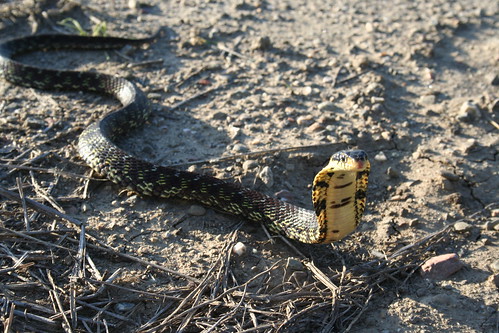
chinese false cobra 045
(This photograph belongs to its rightful owner. They are very lucky to have such a gorgeous, rare snake!)

This will probably be the first look at a Chinese False Cobra (Pseudoxenodon bambusicola) for many of you. It's native to the cool mountain forests of China. The species is rear-fanged venomous, so handle with care. In the wild, it feeds almost exclusively on frogs. This habit carries over into captivity.

The reasoning behind it being a false cobra is simple: like a cobra, this snake can flatten out a few ribs and raise its head. As Tom Crutchfield, one of the few people who works with these snakes, says, they're "the best monocled cobra mimics. Ever." 

Other than that, this snake is hard to find information on. This is largely because it's all but unheard of in the pet trade. You really have to know someone who's seen one, then done the homework, go to China and pray to Nuwa (China's local snake-bodied deity) that you can snap a pic, or randomly find it in a reptile magazine. Some Indian reptile guides also cover this species. Other than basic field information, very little is known.

These are not beginner's snakes. For starters, yes, they are venomous. There are only a select few people who will breed them, which means either spending a lot of money or getting parasitized wild imports. Finally, they only eat frogs, and nobody has found a way around it. That means no buying mousecicles for Chinese false cobras. Even pros have trouble keeping this shy, fairly docile snake alive. Please try something like a kingsnake or ball python before getting into cobras of any kind!

Just between you and me, I should have done a blue or more black snake for this entry. Happy Year of the Snake- don't worry, snakes guard your money like dragons do their treasure!

Tuesday, January 29, 2013

Megafauna Week: Intro + Titanoboa.

 Pinch, punch, last week of the month! You know what that means: It's a Theme Week! This month's theme is MEGAFAUNA. Let me say it in bigger letters:

MEGAFAUNA!!!!

Megafauna, in general, means "any animal larger than a human that has not been domesticated." The term can apply to both extant and extinct species. The term is usually reserved for giant, extinct animals that were much larger than their modern day counterparts. Giraffes, elephants, and many other famous African animals are also properly megafauna.  Believe it or not, the aurochs, the ancestor to the modern cow, was megafauna. We have bred cattle down a lot, and they're still pretty darn big. 

That said, there will be a lot of extinct creatures this week, too. Megafauna tends to vary inversely with human population - that is, the more humans there are in an area, the less megafauna there will be. There are a number of reasons for this.The most obvious is that humans are a lot like wolves in that anything big against us falls to coordinated effort. Less obvious things include competition for resources and habitat destruction (which kinda falls under "resources," in retrospect). Basically, humans and megafauna do not mix well.

So, without further ado, onto the first member of the heavyweight class:


Surprise, surprise: this week is starting with a giant snake. For those of you who have not seen this monster, its name was Titanoboa and it died out long before humans walked the Earth (so your hands are clean). The only known species, Titanoboa cerrejonensis, was found in the coal mines of Columbia.

Titanoboa was a giant, even among modern giant snakes. It was 48 feet long and weighed over 2,500 pounds. To put things in perspective, the longest snake, the reticulated python, is at least 10 feet shy of that. It was about as wide as a garbage can, if not slightly bigger. As for how dangerous it was, I believe the following demotivator makes the point best:


(Disclaimer: I love giant snakes.)

The discovery of a snake this big tells us a few very important things about its environment. For starters, there had to be prey big enough to accommodate such a large snake; large snakes need large food, after all. Huge reptiles also tend to live in tropical climates, meaning that Columbia was still hot millennia ago.

Before you ask, no, this snake did not eat dinosaurs. Titanoboa appeared in the Paleocene, around 60-58 million years ago. That is the time directly after the period when dinosaurs went extinct. If there were dinosaurs for it to eat, they would have been the stragglers from the KT event that refused to evolve into birds. The Paleocene had plenty of large mammals, birds, and reptiles for Titanoboa to feed on regardless.

Pop culture loves picking on giant snakes, and Titanoboa is no exception. The Smithsonian has a rather extensive page on Titanoboa, including what it would take to support one in a zoo. Primeval: New World also featured a Titanoboa, overlapping it with a Native American legend. Giant snakes are pretty common in folklore; who's to say that someone didn't discover Titanoboa before modern science? 


Saturday, January 19, 2013

Newsflash: TWO New Species Found In Vietnam.

One of the biggest reasons to save the rainforest involves finding new species. National Geographic does not slack in that regard, showing us a few new species that have only been documented in January of 2013. Here are two new herps recently identified in Vietnam:

Source.


This colorful fellow is called Calotes bachae. It is an agamid lizard, meaning that it is related to agamas and Uromastyx lizards. Since there are indeed several hundred agamids in Asia, this one is in good company. There are even other light blue ones to keep the male of this new species company.


As per the National Geographic article here, "During mating season, the colors of the male lizards—which can measure up to 11 inches (28 centimeters)—become especially vivid, ranging from cobalt blue to bright turquoise. This serves to attract females and to intimidate other males, said Hartmann.
While by day the lizard's blue and green coloration is striking, at night it appears dark brown, "showing no bright coloration at all," said Hartmann, a Ph.D. candidate at the Herpetology Department at the Museum Koenig in Bonn, Germany." Surprisingly enough, this striking lizard can be found in downtown Ho Chi Minh City, as well as some reserves. 

Source.


The other big discovery is Helen's flying frog, named after the researcher Jodi Rowley's mother. Ironically, it was found on a log instead of in the trees.

Flying frogs are pretty cool on their own, but this one has extra adaptations for parachuting from tree to tree. The hands are huge, even by flying frog standards; the hind legs are webbed on almost the entire limb. If this gliding style has kept it from being discovered, it's gotta be pretty effective!

Unfortunately, both of these unusual creatures are threatened by habitat loss and too much contact with humans. Both of them were also found fairly close to civilization. Go outside sometime; you might be surprised what can be found close to your house.

Friday, January 18, 2013

Creature Feature: Perentie.

Blah, porcupines. No matter how neat porcupines and horned gophers are, this blog needs more badassery. Enough about rodents. Let's just dive right into today's dose of badass, shall we?


Crikey! This fine Sheila is called a perentie (Varanus giganteus), and she's native to Australia. Perenties, being monitor lizards, are carnivorous and have astounding forked tongues. Like many monitors, they also have amazing skin patterning.

Crocodile Hunter jokes aside, perenties are the largest lizards in Australia. They can get over 2.5 meters (8 feet) from head to tail. Larger adults can even take down kangaroos, which, it merits reminding, can kick most predators to death and drown others. Perenties will eat virtually any kind of meat, however...including each other.

It looks so chill...then you see the claws.


Some of you are probably wondering why monitors are called "monitors," anyways. The answer lies in one particular behavior that many monitors, including the perentie, exhibit: they can "tripod," i.e. stand on their hind legs using their heavy tails like an extra foot. They do this to "monitor" their surroundings - just like we use a monitor to see what our computers are up to.

Despite their size, perenties would rather run than fight. They are notoriously shy. Perentie claws are meant to dig burrows in a flash. They can also climb trees very well. Excellent camouflage means that, all things considered, they are even hard to see while standing still. Guess that hardcore ecology down under has taught them a thing or two over the eons.

As with other types of monitors, yes, some people keep perenties as pets. They go for roughly 2,000 USD and you definitely need a license to keep one. There is still debate over whether perenties are venomous or not, but given the damage those teeth might do regardless, best leave handling them to people experienced with reptiles. Get a plushie instead.

Friday, November 2, 2012

Blasphemy Week: Golden Lanceheads.

Y'know how I keep saying "if you want to stop the exotic animal trade, stop humans from living there?" It turns out there is indeed a place where humans are not allowed, and that still doesn't stop people from taking venomous, hermaphroditic snakes off the island.

Wait, what?


Bothrops insularis, or the golden lancehead, is found on exactly one island in the entire world: Ilha da Queimada Grande, located off the coast of Sao Paulo, Brazil. It eats birds and lizards as an adult, and is occasionally cannibalistic. The island supposedly gets its name from a plotted banana plantation that did not go through thanks to one very obvious thing: There is at least one snake for every square meter of the place.

The golden lancehead is the only species of snake on this island. What it lacks in biodiversity it makes up for in sheer numbers. Locals say that there are 5 snakes per square meter on that island. Discovery Channel says there is really only one. The point is, everywhere you turn, there's a snake. It's amazing that good pics of this thing exist; most people would probably drop their cameras.

Think the brown tree snakes are more terrifying? Golden lanceheads are highly venomous. The snakes' closest relative is the jararaca, another lancehead whose venom's ACE inhibitors have recently been used in medicine to treat hypertension. The golden lancehead's venom is at least 5 times as potent as the jararaca's, and the fastest-acting of any lancehead. Luckily, no bites have been reported...yet.

Unless you have a deathwish or are a herpetologist, DO NOT GO HERE. (Source)


Oh, and no humans are allowed on the island. Period. The Brazilian Navy will arrest you if you are there without a waiver. The population is said to consist of exactly one human in a lighthouse and the occasional herpetologists that get waivers to go on the island. Even the natives avoid this place. There are no human settlements there except to warn people that they might land upon an island of venomous snakes. Lovely.

A lot of golden lanceheads are also intersexed. In not-so-polite terms, they're shemales, hermaphrodites, or chicks with dicks. They contain the sexual organs of both sexes, which usually results in infertility. Usually. Apparently some can breed, but regardless, this questionable sexuality is the result of extreme inbreeding.


In case you haven't guessed: Yes, these snakes are critically-endangered. The island is still farm potential, but as we all know, island ecosystems are fragile. That includes island ecosystems containing creatures of hermaphroditic, scaly death. They're terrifying, but goodness knows what'll happen if this one snake gets taken out of the great Jenga tower called nature.

And yet we somehow have photographs of these beautiful hellsnakes, as well as a few specimens in captivity. OK, fine- the reptile lover in me is showing her scales. I do, however, realize that an island full of poisonous snakes would be terrifying to most people, so there you have it. As for why it exists to begin with...either there's a holy relic there or God is a sadistic SOB.

Sunday, October 28, 2012

Creature Feature: Tentacled Snake.

Look at that title. Really, look at that title and use your imagination. There are a million ways to get creative from the title alone. Did a snake do it with an octopus, and is this entry devoted to their unholy lovechild? No. Is it the ultimate in tentacle pronz? No. It's just a water snake that just so happens to have tentacles on its face.


The tentacled snake (Erpeton tentaculatum) is a rear-fanged water snake native to Southeast Asia. It is wholly piscivorous. Its entire life is spent in muddy lakes and rice paddies. Some even venture into seawater.  Unlike some snakes, which come in a rainbow, tentacled snakes are only striped or blotched. Like many water snakes, they have live babies. 

The tentacled snake was not science's most creative naming venture. The most prominent thing about this water snake is that, yes, it has tentacles. These tentacles detect fish better than the snake's tongue ever would. They use a blend of sight and touch - yes, these tentacles loop back to the vision center of the snake's brain. Imagine sticking your tongue out periodically underwater; that is why they evolved tentacles.

The evolution of tentacles is far from this snake's most impressive feat; how it uses them is just as cool as their existence: 


The way the tentacled snake manages to catch the fish is a whole different matter. In the video above, you can see the snake bending its body right after it detects the fish. This motion is enough to trigger the C-start (escape) reflex of the fish, sending it straight into the jaws of death. This snake is predicting what its prey will do next. That's pretty impressive.


Most of us think of the reptile brain as primitive. The revelation that snakes can meter out their venom and the behavior of the tentacled snake above should be enough to make one wonder how intelligent snakes really are. This one just so happens to have tentacles, making it either cooler or creepier. Your mileage may vary, of course.