Showing posts with label frogs. Show all posts

Monday, October 19, 2015

Welcome to Jurassic World (Part 1): Stop Hating on Kermit!

e been playing waaaaay too much Jurassic World: the Game. No, that isn’t the reason I haven’t updated anything. That, well, I might be moving my blog to Tumblr, or at least another account. We’ll see, but it's pretty likely that this will be a massive, three-part "grand finale" of sorts. 

Anyways. Jurassic World. Fun ride of a movie, which is amusingly about an amusement park. I want to take a D-Rex home. Working on it in the game. D-Rex should have looked more freakish if they put cuttlefish in there - c’mon, at least give us the neat W-eye! My general thoughts on the movie will get their own blurb later. Also, for whatever reason, JW and JP both hate frogs, even though it’s probably entirely unwarranted. 

Why? Because, from the get-go, dinosaurs could reproduce without a male. 
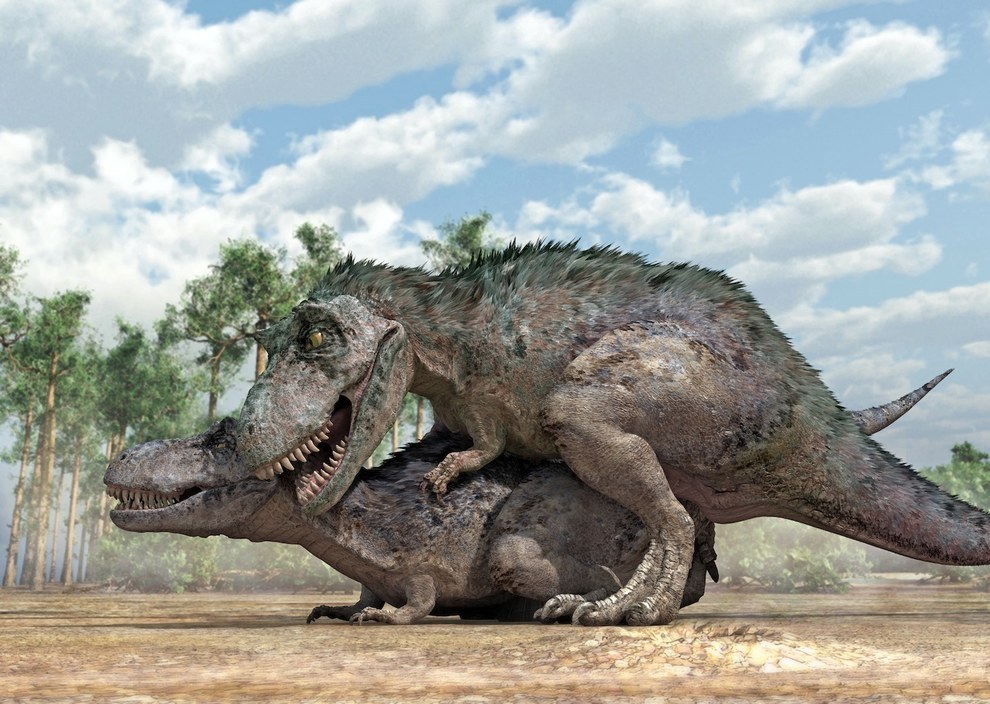
Who's the man in this, again? 


Read that sentence again. 

Read that sentence three times if you have to. Let it sink into your brain: even without as much genetic meddling that Jurassic Park had, from the get-go, the potential for every dinosaur on the island to reproduce asexually, and then sexually. 

Now, here’s my disclaimer: Crichton was largely using the frogs for genetic freak purposes. The whole point of Jurassic Park was that, maybe, there are some buttons science shouldn’t push. The frogs are the bad guys for art rather than any logical reason. I realize people back then didn’t know precisely how close birds were to dinosaurs, but there’s still no reason to use frogs other than HERPDERP SCIENCE EFFED UP. Use lizards. Or chickens. Science can get those very easily. 

So, just how is this possible, anyways? What could prompt natural dinosaurs to reproduce without a male? It’s all genetic…as nature intended?! 

I’m tempted to assume that most people reading this have taken basic biology in high school, sex ed, or both. All you really need to know for this is that human (and other mammal) females have XX sex chromosomes, and males have XY. Women are the only sex that could possibly reproduce without a male, but in mammals, that’s pretty much unheard of, and all of the offspring would be female clones of the mother. 

That is not the case with the rest of non-mammals. 


For many other creatures, including everything from butterflies (yes, butterflies are more like birds in this regard), to lobsters, to chickens, sex is determined by a system called “ZW.” What this means is that the males are ZZ (no, not ZZ Top, but if that helps you remember, go for it) and the females are ZW. 

That thing, with the females having two different letters (heterozygous), changes everything. Parthenogenesis, AKA “virgin birth” if you’re not a fan of Greek, occurs with a female egg effectively impregnating itself. It has been known to occur in lizards (most notably whiptail lizards, who are only female, and Komodo dragons), snakes (boas, Burms, and Brahminy blind snakes - again, that last one is only female) and a special breed of turkey literally bred because people thought this parthenogenesis thing was just too darn cool. No, chickens laying eggs by themselves doesn’t count; the eggs you buy at the grocery store are effectively chicken periods. Enjoy your Dunkin Donuts breakfast sandwich! 

ZW animals can produce parthenogenically by either all-out cloning or half-cloning. A full clone is exactly that: a perfect clone of the mother. The half-cloning, however, includes only half of mom’s genes - twice over. For ZW, that means one letter gets repeated. 

Umm...girls? Your lesbian sex is legal, now. Everywhere. 


Remember what’s special about ZW: the male has ZZ. Through half-cloning, a mother lizard can create an entire clutch of males. They’re almost identical to her in every way except sex. Then, they can just go ahead and do it again with mom, or maybe even the odd WW females. ZZ Top will always be male. I’m sure they’re thrilled to be in a lesson about dinosaur sex. 

Parthenogenesis gets less frequent down the evolutionary “line,” but it’s not like dinosaurs grew out of it. If you must make evolution linear, dinosaurs are like a link between reptiles and birds. We’ll get to crocodiles; for now, well, birds are capable of it, too. 

BUT…they’re not as good at it. 

Parthenogenesis in birds usually results in duds. Either the eggs aren’t quite fertile, embryos die early, or the offspring have reduced fertility. An exception occurs in turkeys, who, for reasons not entirely clear, have mastered the art of giving birth without a dad. These are all ZZ males, who have then been rebred to virgin-birthing females in order to create a more stable strain, and eventually a breed. These ZZ Toms (the joke will not die as I write it!) are almost indistinguishable from your average turkey. 


If half-female, half-male chickens are possible...imagine a raptor like that. 
This is just the tip of the genetic weirdness iceberg possible without the frog. ZW is also capable of the weird chimerism called “bilateral gynandromorphy,” in which individuals are literally half female and half male. (XY can also do this, but very rarely.) Also, what if, like crocodilians (read: other archosaurs) dinosaurs had temperature-determined sex determination? I realize Crichton was using the frogs for freak’s sake, but the poor frog seems to be the scapegoat for everything that goes wrong in that world. Give other animals a chance. 

Sunday, March 16, 2014

NARBC Spring 2014!

Confession time: The reason I've not been updating as much is simply because I've been using my other Gmail account more. Having both switchable at the ready is nice. Never fear; more entries are coming, and they'll be juicier and meatier than ever before!

This entry focuses on North American Reptile Breeders' Convention (NARBC) Spring 2014 (Mar 15-6). I love these - there's so much cool stuff to take photos of! These went on my Twitter (@kurokarasu), so some people got a live feed of this entry as it was being made. ;) Most things are way out of my price range, but there are also some really great bargains that remind one how expensive pet stores can be. You'll also see a lot of species that one would not ordinarily see, like...


...yes, that's a hognose (H. nasicus). They're really cool, little rear-fanged snakes that are only mildly venomous. Nobody has ever died from a hognose bite; the worst that's happened is an allergic reaction. I've complained about how hard they are to get in IL before, but all one really needs is a permit.


So, how can these people even touch poison dart frogs? Captive-bred poison dart frogs aren't poisonous. The poison needs a few things before it can activate: bacteria on the frog, UV light, and a certain species of insect. We can take that last one away, at least, meaning that these frogs are OK to handle. Still, wash your hands after handling. These are mostly display frogs, anyways.


Someone on my Twitter commented that these ball pythons (P. regius) were on the pricey side. Um...no, not for ball python morphs, they are not. Here are a few non-slashed (or very slightly discounted) ball python morphs for your gawking pleasure:


Yes, I deliberately took photos of acid trips for you. Bear in mind that your regular ball pythons (usually "loser males") can be purchased for 30-50 bucks from a reptile specialty store.


A leucistic rainbow boa! A shame it looks almost like every other white snake on the market. If there was any of the species' namesake iridescence in these guys, the light was not showing it well.


This is a legless lizard. It was hard to get a good look at its eyes, but several other features made me believe it anyways. I'd like to think someone at a reptile convention would correct the owner if he was BS'ing us.


Hypo Burms! One of them was sold as I was walking around. People acted like they were having trouble getting rid of them. Given the abundance of laws surrounding giant snakes, I understand why.


I absolutely love dwarf reticulated pythons! This picture also happens to be for science; I'm working on a paper concerning what makes for a good domesticated animal, and dwarf retics are actually a really good candidate for a domesticated snake. I asked if they retained their legendary intelligence (by snake standards) even when dwarfs; the seller said yes. Regardless, it was amazing to hold one of these beauties.


Finally, my own acquisition: A GFP axolotl! This little guy (or girl, we don't know) glows green under black light, just like a GloFish. His/her working name is "Fran," short for both "Frankenstein" and "Francesca/Francisco"- we aren't sure, yet. Once the little salamander grows a bit, the males get bulges near the base of the tail. We shall see! 

Tuesday, August 13, 2013

Creature Feature: Lake Titicaca Frog.

Some things in life are just funny.  For example, Lake Titicaca? That just sounds dirty. We know it's a Quecha word, but it sounds sexy, dirty, or both depending on what other languages you happen to speak. It doesn't help that some pretty darn weird creatures live there, too.

Source: Weirdimals.

This is a Lake Titicaca water frog (Telmatobeus culeus). It is entirely aquatic, spending all of its life in a relatively isolated lake. It lives only in Lake Titicaca and looks just as silly as one would expect of something living in such a hilariously-named lake. Its scientific name translates to "aquatic scrotum." Apt, scientists.

The Titicaca frog has a reason for looking like a nutsack. Lake Titicaca is 4,000 feet above the ground, making oxygen a bit hard to come by. The folded skin is effectively one giant gill for the frog. That doesn't mean we land-dwellers cannot make fun of it. At least it has a cute face. Seriously, take away the folded skin and this frog doesn't look half bad. 


Why are you laughing at me? You can't even stay underwater for an hour!

The Lake Titicaca water frog is also a pretty big frog. The famous diver Jacques Cousteau once went diving in Lake Titicaca, finding thousands of fairly large, wrinkly frogs. They used to get up to 50cm long - that's roughly 20 inches, or "almost as long as two footlong sandwiches." It's not even the largest aquatic frog, but that's still impressive. 

Also, we eat this guy. Surprise, surprise, people eat frogs, but this particular frog is sometimes juiced into a Peruvian aphrodisiac. The frog is skinned alive, then put in a blender with some honey and roots. I realize it looks like a scrotum, but...fine, that's more logical rationale than some aphrodisiacs. You win this round, Peru, but it's still not cool to hunt frogs just to put junk in your trunk.

Aphrodisiacs aside, the Lake Titicaca frog faces a number of other environmental threats. Trout were introduced to Lake Titicaca's ecosystem, upsetting the who ecosystem therein, but specifically eating this frog's tadpoles. Tribal people occasionally catch the frogs and put them in jars in hopes that the heavens with take pity on the scrotum frog and allow it to return to the water by making the jar overflow. If the gods somehow bring this frog back from being critically endangered, thank the Denver Zoo and whatever otherworldly entities made the Nazca lines.

Saturday, January 19, 2013

Newsflash: TWO New Species Found In Vietnam.

One of the biggest reasons to save the rainforest involves finding new species. National Geographic does not slack in that regard, showing us a few new species that have only been documented in January of 2013. Here are two new herps recently identified in Vietnam:

Source.


This colorful fellow is called Calotes bachae. It is an agamid lizard, meaning that it is related to agamas and Uromastyx lizards. Since there are indeed several hundred agamids in Asia, this one is in good company. There are even other light blue ones to keep the male of this new species company.


As per the National Geographic article here, "During mating season, the colors of the male lizards—which can measure up to 11 inches (28 centimeters)—become especially vivid, ranging from cobalt blue to bright turquoise. This serves to attract females and to intimidate other males, said Hartmann.
While by day the lizard's blue and green coloration is striking, at night it appears dark brown, "showing no bright coloration at all," said Hartmann, a Ph.D. candidate at the Herpetology Department at the Museum Koenig in Bonn, Germany." Surprisingly enough, this striking lizard can be found in downtown Ho Chi Minh City, as well as some reserves. 

Source.


The other big discovery is Helen's flying frog, named after the researcher Jodi Rowley's mother. Ironically, it was found on a log instead of in the trees.

Flying frogs are pretty cool on their own, but this one has extra adaptations for parachuting from tree to tree. The hands are huge, even by flying frog standards; the hind legs are webbed on almost the entire limb. If this gliding style has kept it from being discovered, it's gotta be pretty effective!

Unfortunately, both of these unusual creatures are threatened by habitat loss and too much contact with humans. Both of them were also found fairly close to civilization. Go outside sometime; you might be surprised what can be found close to your house.

Tuesday, December 11, 2012

Creature Feature: Purple Burrowing Frog.

With the exception of designer reptiles, it's really hard to color-coordinate things with animals. Purple is particularly rare in nature, despite it allowing creatures to blend in with flora. In some cases, however, it just makes us humans wonder what nature was on.


Why this purple burrowing frog (Nasikabatrachus sahyadrensis) is, well, purple, is a complete mystery. It is native to southern India and feeds exclusively on underground insects. Although numbers in the wild are still unknown, we are currently working under the assumption that the frog is endangered.

For the record, nobody seems to know exactly why this frog is purple. It does not seem to be camouflage; this frog spends 90% of its time underground. The color is actually the least interesting thing about the purple burrowing frog, in any case.

Since its (re)discovery in 2003, the frog was treated as being in its own family. Looking at skeletal evidence tells otherwise. Looking at fossil evidence, the purple burrowing frog looks very similar to the extinct Seychelles frogs, which were last seen 120 million years ago on Gondawanaland. The purple frog would have evolved independently from there; in other words, the purple frog is a living fossil. Always cool to have more of those. 

So, how did this frog evade scientists for so long? Short answer: It didn't. Almost a century before the adults were discovered in 2003, the tadpoles had been described in 1918. These are weird little buggers with suckers to help them deal with turbulent river currents. The adult frog was not visible at that time, so the chubby purple freak did not go on record until recently. 

The reason for the delay is that the adult frogs spend their whole adult lives underground. They surface only to mate in monsoon season. Otherwise, they're feeding on underground insects (particularly termites). Locals and lesser herpetologists had already known of the frog for decades; scientific literature had a hard time catching up. I guess "pig-faced purple frog" just sounded too crazy for them.

Found on Wikipedia. License unclear.

By the way, if you happen to see two purple frogs getting it on? The male is on top of the female, and he is tiny.

Unfortunately, this bizarre frog is also highly endangered. Less than 200 have been found by science. The main actual risk lies in deforestation. There is a very low chance that these frogs will be bred in captivity, although no doubt scientists are trying. If they get popular enough, they might even get their own color shade.

Saturday, October 27, 2012

Creature Feature: Sapo.

I am hard-pressed to find something terrifying that fits here and not in the theme week, "Proof That There Is No God." Yes, next week covers things so terrifying that we cannot believe that a merciful god exists anymore.

So here's a frog that gets you plastered. Enjoy!


The giant leaf frog (Phyllomedusa bicolor), or just Sapo, is a toad native to the Amazon rainforest. It is nocturnal, meaning that frog hunts must be done at night or in the early morning. The frog sings only after it rains. Presumably, it eats some of the many insects that fly rampant throughout the Amazon.

The five-dollar question: How giant is giant?  I'll put it this way instead of giving you numbers: It does not fit comfortably in a human hand. It was called a "beautiful, giant thing" by Vice Magazine.  Some people have also felt psychoactive effects just by touching it, so not only is it huge, it gets you high as a kite.

We have to presume you are not buzzed while holding this.


Before you ask: No, these are not toads you lick. The Sapo is a toad that the Mayoruna and Matses natives tie up with grass, then torment until the venom forms a gelantinous teal coating on the toad's skin. The venom is then put on sticks that are burned into a shaman's skin.

And then they get high on the frog venom. The frog affects everybody differently. It can lead to sedation, stimulation, hallucinations, anorexia, and apparently spiritual experiences. It reacts to the same receptors opium does, but the burn probably deters people from using it as often as opium. It almost makes you wonder "who tried this first and how long did he live?" Seriously, who thought this was a good idea?


As one might have guessed, the Sapo is the target of considerable research. Aside from being a great drug, the waxy venom might be able to cure cancer and AIDS. There have been a few attempts to patent Sapo venom compounds, but no headway has been made in the research department. Hmm...I wonder why? Could they have achieved spiritual enlightenment and gone "Screw patents?"

Friday, March 23, 2012

Creature Feature: Golden Toad.

Picture a toad for a minute. Chances are you just pictured a brown, lumpy little amphibian with warty skin. We are generally socialized that toads are the ugly ones used in witches' brews and that frogs are happy little fellows who sing in swamps.

But that doesn't mean they can't be friends!
 

Actually, there is no difference at all between a frog and a toad. The differences between the anurans we call frogs and toads are purely cosmetic. Only members of the genus Bufo are treated as "true toads." That's why we have toads that are pretty like the fire-bellied sort found in pet shops, as well as awesomely-colored specimens like this.


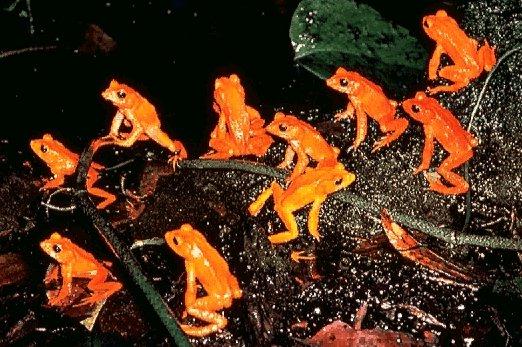
Yes, that is a toad. Or, rather, it was. This toad is no more. It has ceased to be. It used to live only in Monte Verde, Costa Rica, and went by the names Golden Toad (Bufo perigienes), Monte Verde toad, and a few other, more obscure names. It lived in exactly one part of one forest preserve.  It presumably ate insects like most other amphibians.

The most outstanding thing about the golden toad was, of course, its coloration. It has been described as being "Day-Glo" golden orange - certainly a treat for any researcher lucky enough to see one. The males had the bright gold, but the females had red and black coloration. Hey, for herpers, it's a relief when things are easy to sex.

Ultimate bachelor party.


Unfortunately, very little is known about this frog, toad, whatever. We have seen them mating and very little else. We think they spent most of their time underground, but have no confirmation. The population was short-lived, first being seen in 1966 and declining sharply over the next twenty or so years.The last of these amphibians was seen in 1989. Deforestation, climate change, and chytrid fungal infection are all cited as causes for the frog's extinction.

We've said it again and again:amphibians are important when it comes to environmental monitoring. Water purity in particular affects them big time. This representative just so happened to be a looker. It's a shame that more of us will not be able to encounter this awesomely-colored amphibian.

At least, that's what we think.

Sunday, January 1, 2012

Frog Week: Gastric-brooding Frog.

Alas, the time has come to end Frog Week. It's been a fun ride; frogs are usually taken for granted, but they really are cool creatures that deserve a lot more love than they receive. Hopefully, you all have been stunned by how strange and wonderful one of the most common types of animal can be.

But we still have one more. Remember how I said that today's would be a little more subtle? Take a looksie at this one and tell me if you notice anything weird about it:


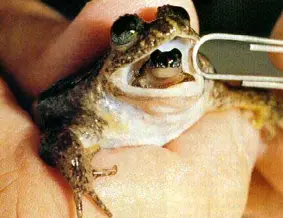
Looks like a fairly normal frog, doesn't it? Look again.


From www.global-greenhouse-warming.com.

Yes, that is a very tiny, immature frog in its mother's mouth. The frog in that picture is one of two types of Gastric-brooding frog (Rheobatrachus). Gastric-brooding frogs are - or were- native to Australia. They have been seen eating insects on land and in the water. They were discovered in 1984 and were among the few aquatic Aussie frogs (read: everything is backwards and on crack in Oz). They were called "platypus frogs" down under simply because they were aquatic.

As the non-Australian name might imply, Gastric-brooding frogs were the only frogs in existence that hatched their young in the mother's stomach. Some of the eggs were eaten; by the time all was said and done, the mother had approximately 21 young in her belly. The non-digested eggs were coated with a substance called prostaglandin E2, which turned off the mother frog's stomach acid. The babies emerged not as tadpoles, but as juvenile frogs. Reminder: The last frog we saw with highly-developed young was the pipa toad, whose babies emerged from her back in a fashion akin to Gremlins without any fluffy fur. Yeah, reptilian parthenogenesis doesn't hold a candle to the sheer weirdness amphibians can do to reproduce.

If you have been paying attention to the grammar of my paragraphs, 1. you're probably a linguist and 2. you will notice that many of the verbs concerning these frogs were in the past tense. These frogs are either extinct or very, very endangered, depending on whose list you check. They were officially discovered in 1984; the Southern variety may have gone out of existence before then, and the last Northern individual was seen sometime in the '80's. We thought the pearly tree frog was elusive; at least we are fairly sure that it still exists. The reasons for these frogs going extinct are multifold, but fungal infection and habitat loss are the most commonly cited causes.


This frog and the pearly tree frog both show how fragile amphibians can be. That's a shame, seeing as they're crucial to many ecosystems and often beautiful to look at.  With countless amphibian species vanishing right under our noses, this year, make a resolution to give them their due.


Saturday, December 31, 2011

Frog Week: Hairy Frog.

So many amphibians, so little time. As frog week winds down and the new year comes to a close, I find myself wondering what to end the year on. Something subtly freaky would not cut it, no sir! Saving a more subtle frog for tomorrow meant that I HAD to do this one...


The hairy frog (Trichobatrachus robustus) is native to Central Africa. It eats any small, squirmy thing that will fit in its mouth. It is mostly a terrestrial frog, but lays its eggs in the water. If you see a "monster frog" or "horror frog" list, there is absolutely no doubt you will see this frog on there. Cameroon seems to have horror frogs besides this guy, too. Be afraid.

The species is, obviously, named for the 'hair' on the body and thighs of the male specimens. Yes, only the males have the species's namesake 'hair,' and even then, only in breeding season. The females are much smaller and lack the growths entirely. It's sorta like in humans where the ladies are nude, but the men can have hair anywhere.

The 'hair' on this frog is, as one probably guessed, not really hair. They are technically called "dermal papillae." In mammals, these would be a part of regular hair growth. In frogs, they're extended into what scientists think are 'gills' of sorts. They have arteries running through them and a lot of surface area, just like the gills of larval salamanders. Since the male spends quite a lot of time guarding the water-bound eggs before they hatch, it makes sense for him to have this bizarre beard.

Source: Blackburn, NewScientist.


As if hair wasn't weird enough, this frog is one of the rare frogs sporting retractable claws. These weapons come with a sinister kick: much like Wolverine's signature blades, the hairy frog's claws can only be unleashed if they poke through the frog's skin. They are not true claws, being all bone, but they still hurt predators quite a bit. This is officially a frog who thinks he is a cat. Or Wolverine, take your pick.

Oh, and people in Cameroon roast and eat this froggie. It's not endangered except by habitat loss, either. Hoppy New Year! *Shot for horrible pun.*

Thursday, December 29, 2011

Frog Week: Pearly Tree Frog.


You know how every frog entry I make keeps bringing up the point about how frogs, of all animals, are the most prone to being endangered? This has to be among the most endangered frog species in existence...so much so that one of the few pieces of evidence that it exists is a children's trading card:
(I actually have this card, but the uploader was being screwy.)


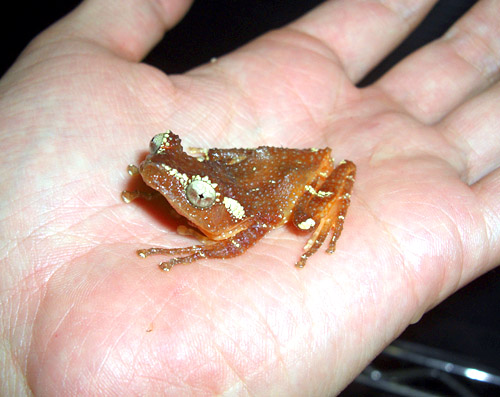
Yes, that's a thing. It's called a Pearly Tree Frog, but most sources, even Wikipedia and reptile-keepers, use its scientific name Nyctixalus margaritifer (disclaimer: this frog will not bring you drinks). It is native only to the island of Java in Indonesia. Although there are more photos of this guy than I originally thought (searching "pearly tree frog" will get you almost nowhere), it is still a very rare, very beautiful frog.


Although only listed on the IUCN website as "Vulnerable," just going by the description on that site, this frog should be at least endangered. They cite their reasoning as "Listed as Vulnerable because its Extent of Occurrence is less than 20,000 km2, its distribution is severely fragmented, and there is continuing decline in the extent and quality of its forest habitat in Java." The only reason it isn't outright endangered is because so very little is known about it. Fewer than ten specimens are known. Why is that not enough to put something on the Endangered list?

Furthermore, for a LONG time, this frog was thought extinct. Records of its existence miraculously resurfaced in 1997. The reasons behind this re-emergence are even more obscure than the storm that brought crested geckos back into existence. (Note to nature- thanks for that one.) If it can vanish and reappear once, it can do so again. Reminder: This is a bling-bling frog we're talking about, not a camouflaged gecko.

And THIS is how you propose to a herpetologist. No exceptions.


Apparently, some people DO have Pearly Tree Frogs in captivity. Many of them are probably smuggled in under the name Nyctixalus pictus - a frog close enough to mistake for this rare beauty.  Judging from the responses to the posts, the frogs were wild caught, and the care tips given for them looked basic to N. pictus. With any luck, N. margaritifer will at least get a strong captive base like the Scimitar-Horned Oryx. Otherwise, we may have another vanishing act with no encore.

Wednesday, December 28, 2011

They Actually Eat That: Psychoactive Toads.

...Well, crap. I've already done frogs on "They Actually Eat That." That means I can't fit this column into this theme week. Boo. Nothing to see here, folks. Go on home.

...

HAHAHAHA! Did you really think I couldn't find another way to slip frogs into here again? There's one aspect of frog-eating that, if memory serves, was not adequately covered the last time we looked at people eating frogs. That is, of course, the infamous idea of licking toads. Yes, They Actually Lick That.


I don't speak German, but I can if you like! ((C) Fox, Groening, etc.)

The popular concept of toad-licking originated in the 1970's. Supposedly, hippie teens were using toads as yet another way to get high. This has very little basis in fact, but there is a whole church for licking toads (called the Church of the Toad of Light). If getting high off of toads is just an urban legend, it's a very popular one.

Some toads do have psychoactive toxins in their skin. The main trip-frog is Bufo alvaris, the Colorado River/Sonoran Desert Toad. The skin and poison of this toad contains the substances bufotenin and 5-MeO-DMT - both powerful hallucinogens. The toads can be safely milked for these toxins once a month. If licking the froggies isn't your thing, smoking the powdered toxin works, too. Just beware; it has rules just like any other drug and is illegal to possess in several states.

Push there to be sent to a world of rainbows and froggies.


This does not mean that you should, by any means, go around picking up random toads just to lick them.  The mucous of many amphibians is toxic. As in, "kill you in a few hours, if not quicker" toxic. At the very least, many of them will make you sick. Also, there's NO five-second rule with amphibians...so don't use that as an excuse to lick wild animals. They really hate that.

Does licking toads work? Short answer: Yes. Long answer: Yes, but be VERY careful.

As an interesting side note, man's best friend has also taken up man's liking for acid amphibians. In Australia, dogs have been found getting plastered on the non-native cane toads. In this case, the toads are also invasive species, which Australia does NASTY things with. Getting licked now and again is not a bad spot to be in.

Close enough.

Tuesday, December 27, 2011

Frog Week: Turtle Frog.

Hello, hello! If you look above you, you will see a brand, shiny-new banner! Yes, I know it's still a little misaligned, but we have gerbils working on that. Welcome to Frog Week, one and all!  


Wait. Those are frogs? They look oddly reptilian for frogs. Holy carp, are they rejects for experiments to create real Teenage Mutant Ninja Turtles? That would be awesome.

Haha, rest assured, the pink, fleshy creatures up there are indeed frogs. They're turtle frogs (Myobatrachus gouldii) - burrowing frogs native only to one arid region in Western Australia. That these frogs are Australian should explain a lot to many of you. They are approximately 2 inches long, which only adds to their strange cuteness. They are the only members in the genus Myobatrachus, meaning that they're unique, even for Aussie creatures.

Turtle, turtle! :D


Turtle frogs do indeed look a lot like turtles. They have small heads, round bodies, and stumpy limbs. Even though there are other burrowing froggies out there, turtle frogs even dig like turtles.We really are not fit to judge if these little guys are turtle-y enough for the Turtle Club, but they sure do come close.

Turtle frogs are uniquely adapted to a hot, dry environment. They hatch underground, developing entirely within the eggshell. Most of their time is spent underground or digging for termites. Even when calling, the males only have their strange, alien heads above the ground. They only emerge after it rains, probably freaking out several bystanders.


These frogs eat termites. Only termites. (If you read the entry on numbats, another Australian termite eater, this should sound familiar.) We suppose this is a good thing if you ever find the buggers eating your furniture. Otherwise, termites may be a little bit difficult to find should you desire one of these weird frogs as a pet. I'm not even sure if they can be kept as pets due to this strange food source.

This frog, unlike many others this week, is under absolutely no threat. Phew! 

Monday, December 26, 2011

Bio-Art: Malamp.

So, I said I was going to do the flying silkworms this week. However, seeing as this week's theme will be frogs, change of plans. Frogs are one of science's most common organisms; of course somebody has done scientific art with them. Creepy, cool scientific art.

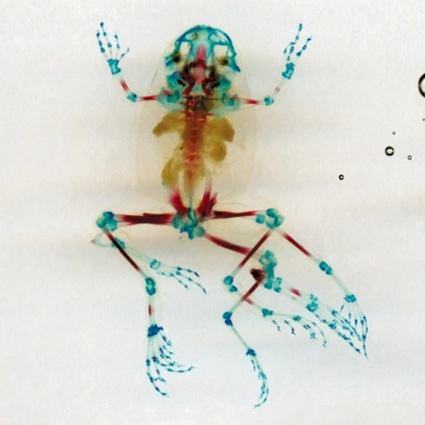
Malamp features specially-stained frog skeletons...gone horribly, horribly wrong. Some are missing legs. Others have far too many legs. The culprits are usually parasites like Ribeiroia or dragonfly nymphs, which, much like French and Vietnamese, find frog legs delicious. The result is either frogs with limbs missing or frogs with too many legs. Way too many legs.

The third leg is nothing...


Ecological artist Brandon Ballengée specializes in amphibian deformities. Freaky frogs are on every continent with frogs; Ballengée has been tracking them extensively in Europe and the U.S., where they are particularly abundant. Amphibians with crazy limbs can be found almost everywhere in the U.S.  and are only getting more plentiful. We get frogs with multiple limbs while frogs lose limbs in the rest of the world.


Ballengée, in cooperation with Arts Catalyst, was commissioned to turn his passion for deformed amphibians into art in 1996. The stain he uses on the skeletons for the project coats cartilage in blue and bone in red. The images are then printed and put on display for all to see. The actual skeletons are backlit below them.  Few things are crazier than a frog with twenty legs and a cool paintjob.

The video lied: I only count 6 legs! Art (c) Ballengee, but it's very cool.


This is, however, only half the project. The other part is actually going out with people and collecting the little froggies. This gives the general public a look at tadpoles as they've never seen them before: as freaky, swimming indicators of environmental health. You will be hearing a lot about how fragile amphibians can be this week, so I will only mention it once here. The art speaks for itself.

Malamp was installed in Turin, Italy in 2010, but has also been in Cincinnati. There will probably be an announcement if the multi-limbed, glowing frogs ever make their way to you. You'd think something like that would wind up on the news.

Tuesday, December 20, 2011

Creature Feature: Glass Frogs.

There are some areas in which being a frog must suck. Besides the sensitivity to pollutants in the environment,  a very interesting puberty, and having many things want to eat them, frogs also have the misfortune of being what science calls "model organisms." Basically, if a scientist wants to test something on a lesser vertebrate, it will probably be either a frog or a mouse. (Rabbits and pigs are common favorites, too.) Frogs are also extremely common in college biology labs, with nearly everybody cutting open at least one frog in their academic career.

Please do not touch my innards -  Kermit.


The frogs have protested: They have evolved skin that is as clear as crystal so that, if you want to see how their bodies work, all you have to do is turn them over. No knife required. You can see the systems in action without performing crazy vivisections! Seriously, this critter is a living biology model.

Pay attention. This'll be on the quiz.


There are a number of glass frogs native to Mexico and Central and South America. They form the family Centrolenidae, which consists entirely of small (5-7 cm) treefrogs with translucent bodies. In short, there are a lot of these guys, and therefore plenty of biology models if you should ever want to venture into the rainforest.

The translucent skin on these frogs serves as the best camouflage ever. There are few better ways to blend in with something than to have skin colored just enough that it does not show bones. That is, unless the frog gets turned over - then it's like showing a predator one of those revolving dessert tables. Fair enough.


Glass frogs also have some interesting egg-laying habits. Instead of laying their eggs in water, some species lay their eggs on leaves that are near water. Since there are a million things that eat frog eggs, the eggs on leaves have a slightly better chance of survival. (Hey, at least they aren't supermoms like the pipa toads.) They are also among the few frogs that give parental care to their eggs before they hatch. Males have been found protectively sprawled over their eggs...which looks a little odd.


As with all frogs, glass frogs are indicators of environmental toxins.  Some species are endangered; others are of least concern.  There are some people captive breeding glass frogs, so, if you really want to see one up close, go for a specimen that won't hurt the natural ecology. Here are some handy tips for keeping and identifying your very own glass frogs- sweet. Regardless of which glass frog you find, enjoy looking at it while it's still around!

(Y'know what? I've been doing too many frogs. Next week will be frog and toad week. Period. Any suggestions can go down below.)

Tuesday, December 13, 2011

Creature Feature: Vietnamese Mossy Frog.

If there is one thing that I can definitely thank the exotic pet trade for, it is the amazing potential it has to open people up to other species. Even if you personally do not have, say, a Baron's Racer, with exotic pets around we at least know they exist. One could even make the case that breeding for nifty colors in things like ball pythons is more sane than the crazy gene splicing scientists do. Most importantly, however, I would NOT have known that today's creature existed if I had not seen it in Reptiles magazine.


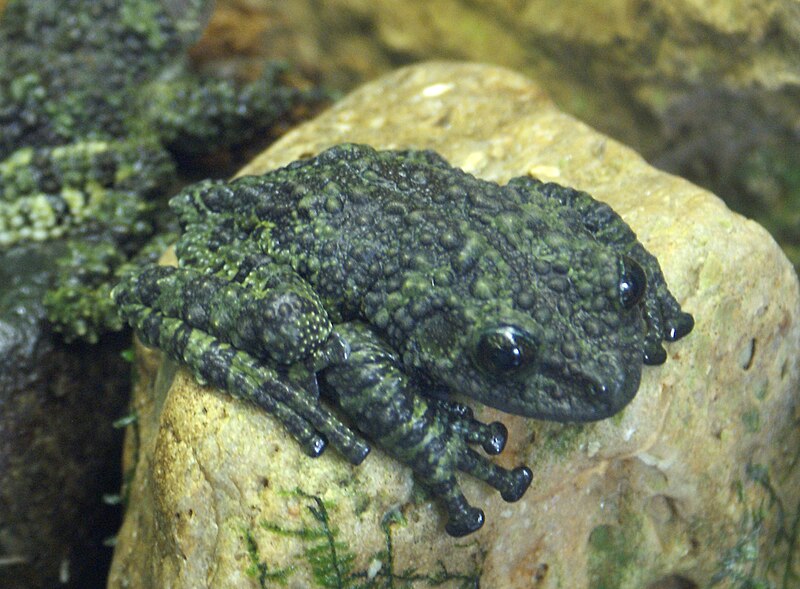
 The Vietnamese Mossy Frog (Theloderma corticale) is native to the wetter climates of Vietnam and China. Its habitat ranges from tropical-subtropical to the Hanoi mountain range. Much of its time is spent in shallow water with only its bug-eyes poking above the surface. It has been described as looking "alien" or like Godzilla. Neither of these descriptions do this frog's amazing mossy camouflage justice.


The camouflage of the mossy tree frog is said to be the best in the whole animal kingdom. (I personally think it has competition in the matamata, the three-toed sloth, and the tawny frogmouth.) It makes seadragon camouflage look like neon lighting. The tubercules on its skin and its coloration both contribute to the image of a lump of moss - nothing to see here! If the frog is sitting perfectly still, it is near-impossible to pick out.

Herpers (people who keep reptiles and amphibians) have several reasons to love this little frog. It can endure a wide range of temperatures and humidity. It eats crickets voraciously. If you make your terrarium right, you can observe this frog's whole life cycle in one cage. Of course, it's also fun to get one of these frogs, name him Waldo, and invite guests over to try and pick him out from his fancy foliage. These frogs like hiding, so they should be a challenge to find.

Like almost all cool frogs, the Vietnamese Mossy Frog is threatened by habitat loss. This makes captive breeding programs not only awesome, but critical to the survival of the species. They are currently protected by the Vietnamese government, so, should you invest in these frogs, be sure that they were captive-bred. In the worst case scenario, we will have another scimitar-horned oryx on our hands.

Wednesday, March 23, 2011

"They Actually Eat That:" Frogs.


"Frogs and snails and puppy dog tails..." That's what little boys are made of. We've done dog. We've done snails. Real-life Hypnotoad up there is not happy that frogs are, unfortunately, also fairly common food items around the world. No, we are not talking about a stupid dare in college to eat the frog on the bio dissection table. Frogs are haut cuisine in many, many places.

Frogs are often described as "tasting like chicken" (just like everything else) simply because they are closer to chickens than mammals on the evolutionary playing field. The meat of cold-blooded animals is also such that frog legs sometimes death-twitch while in the pan (or just with a little salt).


Eating frogs, particularly frog legs, has a link with French culture. If the French have touched a place, it has frog legs on the menu. Vietnam? Yep. Louisiana? Sure. France? Mais oui!


Several other places have frogs as food without French influence. China (surprised?) and Indonesia are also large consumers of frog meat. In China, frog legs are stir-fried; in Indonesia, frog legs are used in a soup called Swikee. Hell, most of the frogs eaten in France today were farmed in Indonesia.

Eating frogs has also been recorded in India, Spain, Greece, and a few places in California. In short, frogs are eaten just about everywhere in some way, shape or form. Maybe Kermit was right: It's not easy being a green frog.


Only Gaga wears them as clothing. We're pretty sure about that.


Next week: Just to prove that NOTHING is off the menu...dragons. And fortune-telling.