Showing posts with label india. Show all posts

Friday, July 4, 2014

Creature Feature: MONGOOSE!

So I'm in Hawaii, right now. There is flora and fauna that I've never seen anywhere else everywhere. Oh, and I've also caught a few glimpses of a species that one does not expect to see in Hawaii: the mongoose.

Source.


How did I not do the mongoose before? Mongooses are weird little carnivores that  are related to civets and hyenas- yeah, picture that family reunion for a sec. Like hyenas, they are more closely related to cats than dogs. Even the names "mongoose" and "ichneumon" are weird.  Although the Indian grey mongoose is the most well-known, there are some 33-odd species of mongooses, including the meerkat- which I did cover a very long time ago. Mongoose species are native to Africa and southern Eurasia, including India.

Like the honey badger, the mongoose is a badass. Its greatest achievement is taking down cobras. Mongooses are so well-known for this that Rudyard Kipling, the author of the Jungle Book (and the white man's burden) wrote "Rikki -Tikki-Tavi," an adorable little story about a mongoose saving a family of humans from a family of cobras. Seeing as mongooses are cute, fuzzy little things and cobras are cobras, it's obvious whom the audience will root for.

Nom nom nom nom nom....bring the kiddies. 


There's a bit of conflicting evidence about whether mongooses are technically immune to cobra venom or not. Almost everybody will cite that the mongoose has a thicker hide than most fuzzy animals. Most people will also cite a chemical immunity to at least part of a cobra's venom. Regardless, there's not much a snake can do against a mongoose. It's really not a fair match.

This snake-killing reputation has gone so far that researchers will consciously ignore everything else in order to sic a mongoose on snakes. There were efforts to curb the Okinawan habu, another venomous snake, by introducing the mongoose. Instead, it turned out that the two species were not even active at the same time, so the mongooses helped themselves to the native bird life. This incident was so famous that it remains a roadshow staple, and even got woven into Pokemon's Zangoose and Seviper. Y'know, even though it was an epic failure.


Image cropped from a Bulbapedia scan. N.B.- Zangoose has Immunity, and an overall better stat spread than Seviper. Once again, this is not a fair match.

Speaking of epic fail, introducing a mongoose to an island for any reason is a bad idea 99% of the time. Even if your excuse is rodent or snake control, mongooses are versatile little buggers. They don't really look to kill snakes as much as honey badgers do; if there's easier prey, they'll take it. Although they can kill venomous snakes pretty easily, the same really goes for almost anything smaller than the mongoose. The Hawaiian o'-o', among other birds, fell prey to the mongoose because they had no defenses against any predators. They had originally been brought over to kill rats and other vermin, but screw that- those birds had nothing to protect them. It's like choosing from a pre-packaged steak or getting out there and shooting the cow yourself. Maybe people trying to control pests should think of things that way!

Thing is, Hawaii also has Stitch. Mongooses are pretty awesome, but Stitch is immune to everything but water. Game, set, match, mongoose.

[Unfortunately, I could not find an image of Stitch VS a mongoose. You'll have to use your imagination. ]

Sunday, July 21, 2013

Creature Feature: Rufous-backed Kingfisher.

Some readers are bound to ask: what's the deal with the URL of this blog? Originally, it was intended to push the boundaries of fantasy and reality, showing how "mythological" things could either be real or have a solid basis in reality. Since this blog has covered phoenix bases in the past, I feel pretty safe putting this little bird up:


This is a rufous-backed kingfisher (Cyex rufidorsa), so named for its reddish back. It's native to Thailand, Indonesia, Malaysia, and the Philippines. It eats fish, insects, frogs, and reptiles. The bird is small enough to fit in one's hand.  Unlike many entries from steamy rainforests, this little bird is not even remotely endangered. The only threat it faces is a slight decline due to habitat destruction.

The rufous-backed kingfisher does not seem real. It's bright red and purple, like a little phoenix. Its head is disproportionately large compared to its body. The bill is particularly huge. It's adorable and psychedelic. This should be a Pokemon; make it a baby Moltres and it'll sell like hotcakes (pun totally intended).

The rufous-backed kingfisher's appetite is just as extraordinary as its coloration. Thesebirds will hunt a number of things from high perches overlooking water, then dive in after them; that's how kingfishers roll and should be no surprise. What's more surprising is that it's not afraid to eat things twice its size. How does it pack all that fish into its little stomach? Probably very carefully.


There is some confusion when classifying this kingfisher. Another species, Ceyx erithaca, was discovered first. Both are properly "Oriental Dwarf Kingfishers," depending on whom you ask. They also overlap in some areas, leaving one to wonder if there's a difference aside from color. Whatever you call it, it's quite remarkable for a little bird, no?

Tuesday, June 18, 2013

Little Shop of Horrors: Coral Cactus.

Now that summer has hit, various home improvement stores and sections are stocking all sorts of weird plants. Be on the lookout for celosia ("brain flowers"), geops, and a number of other weird plants that one can probably find at one's local nursery. It was almost inevitable that at least one odd, potted plant would wind up on this blog, but I had no idea it would be this odd:


This is a coral cactus. No, there's no scientific name for this oddball. It's 100% created by people. If I had not done glowing marmosets yesterday, I totally would have done this thing; it's a really impressive graft of two completely different plants. Oh, and neither of those plants are cacti, even if they're both still succulents. Both are also almost worth their own entries.

The coral-like crest comes from a plant called Euphorbia lactea, AKA mottled spurge or elkhorn.  Specifically, the coral part comes from a frilly mutation of elkhorn, which is propagated for this exact purpose. Otherwise, elkhorn is another houseplant with some medicinal potential in India. The milky latex on elkhorn is poisonous, as is the entirety of the plant. Keep coral cacti away from children and pets with this in mind.

The stem is from another species of Euphorbia, usually E. neriifolia. It's also called the "Indian spurge tree." Both of these plants have similar climate requirements, so it's no surprise that a graft of the two should be sustainable. It's still impossible to breed them, mind, but you can keep a coral cactus alive like most cacti. Weird? Yes. Difficult? Not really.


Where can you get this bizarre thing? Wal-Mart. These chimera plants are sold for relatively cheap at the world's most infamous big box store. We would not be surprised if the shop Audrey II came from suddenly started carrying these. If weird plants in one of the largest chains in the world is not a plot for botanical world domination, please tell me what is.

Friday, June 14, 2013

Creature Feature: Fishing Cat.

Most pet-owners in the world are either cat people or dog people. Me, I'm a cat person, and there are some really fascinating cats out there. Whether they are domesticated or not is of only mild relevance. Here's a cat I'd love to take home if red tape were not involved:


This is a fishing cat. It is one of roughly four species in Prionailurus, a group of small, spotted wildcats found in Asia. The fisher cat has spotty distribution in India and Southeast Asia and is endangered due to human activity. It is primarily found in wetlands and near running water, fishing for, well, fish. Rumor has it, however, that their very varied diet may also include certain carnivores- including dogs. Reminder: this is a small cat.

Doubtless, some cat lovers have noticed that cats like fish, but hate getting their paws wet. The fisher cat has its fish and eats it, too. They first lure fish with a tap of the paw upon the water, then scoop up the unwary little fishy before it knows what hit it. The fishing cat can also swim, sporting waterproof fur and a tail like a rudder. They can also dive for fish if need be. In summary, the fishing cat really loves water, unlike most cats who flinch at getting wet.

Now, here's one major difference between cat and dog people: dog people generally see inbreeding to create insane dog breeds as OK, but frown upon outcrossing with wolves and coyotes; cat people, on the other hand, will outcross with other small cats like crazy in order to create new breeds. The difference is in part genetic; dogs have 39 pairs of chromosomes, leading to an extremely versatile genome and a surprising amount of relatively stable dog breeds. Cats have a smaller genome, with only 19 pairs of chromosomes. (For the curious, humans have 23 pairs, meaning that chromosome count means jack in regards to intelligence.) What this means is that dog breeders have had a very extensive genetic palette to create living artwork over millennia, while the cat people simply do not have that range of genetic color. Cat people have gotten around that by breeding domestic cats to wild felines.

From here.


I recall someone once trying to equate comparing dogs with wolves to comparing cats with lions. This is BS for so many reasons, and the argument really deserves a sucker-punch to the gut, but the rule of thumb is that domestic cats can mate with a lot of small cats - including the fisher cat. The resulting hybrid cat is called a "jambi," and it's apparently brand new. Will these fishing cat hybrids be as hydrophilic as their wild counterparts? Who knows.

Tuesday, May 7, 2013

Nature Strikes Back: Drunk Elephants.

A lot of religions, and even nonreligious people, like to think that humans are something special. "Closest to God" comes up a lot. Basically, we think very highly of ourselves, even though we have screwed things up - sometimes irreparably. We may build skyscrapers, but whoops, that's more undiscovered species dead!

This week flies in the face of that vain way of thinking. In other words, nature doesn't give a **** about how special humans supposedly are and causes havoc anyways, treating them just like every other animal on the planet. Every so often, there are events that will remind humans that, hey, there's a huge wild world out there, and we're just a small part of it that is slowly decimating the rest. We aren't just talking about predators going on killing sprees; we're talking about craziness like...


...drunk elephants. You are reading that statement 100% correctly.

Yes, elephants like drinking. There are plenty of animals that like altering their consciousness on some level. Anybody who has given their cat catnip will tell you that most of them seem to like getting high as a freakin' kite on the stuff. It's kinda rare for animals to like liquor - or, rather, to like liquor and be able to tolerate it. (Please don't give your dog beer; it's not worth risking their health for something funny.)

It turns out that elephants might be able to get drunk without the aid of humans as well. In South Africa, there is a fruit called a "marula" that is not only delicious when ripe, but ferments into potent liquor after being ingested. There is some doubt as to whether elephants in particular get drunk off of a few fruits, but the "documentary" Animals Are Beautiful People at the very least shows us what a drunk elephant might look like so that we can get the eff out of the way.


Basically, elephants are smart, huge animals that like getting wasted. They have figured out that humans have booze, and will go out of their way to get it. Talk about nature being adaptive; these elephants will literally trample right over people to get their fix. They act aggressive and awkward while drunk, and presumably say all the things they want to say but normally wouldn't in front of their elephant buddies.

Sound familiar? Yes? Well, add on the usual human drunkenness to tons of muscle and a 30 mile-per-hour charge. Suddenly, the image of a drunk elephant is not so funny. Multiply it by fifty; elephants can rush their version of a bar en masse, too. It happens a lot wherever humans and elephants happen to coincide. Y'know, as if the elephant had not already been subconsciously linked with liquor.

As a reminder, this is a thing.

Tuesday, December 11, 2012

Creature Feature: Purple Burrowing Frog.

With the exception of designer reptiles, it's really hard to color-coordinate things with animals. Purple is particularly rare in nature, despite it allowing creatures to blend in with flora. In some cases, however, it just makes us humans wonder what nature was on.


Why this purple burrowing frog (Nasikabatrachus sahyadrensis) is, well, purple, is a complete mystery. It is native to southern India and feeds exclusively on underground insects. Although numbers in the wild are still unknown, we are currently working under the assumption that the frog is endangered.

For the record, nobody seems to know exactly why this frog is purple. It does not seem to be camouflage; this frog spends 90% of its time underground. The color is actually the least interesting thing about the purple burrowing frog, in any case.

Since its (re)discovery in 2003, the frog was treated as being in its own family. Looking at skeletal evidence tells otherwise. Looking at fossil evidence, the purple burrowing frog looks very similar to the extinct Seychelles frogs, which were last seen 120 million years ago on Gondawanaland. The purple frog would have evolved independently from there; in other words, the purple frog is a living fossil. Always cool to have more of those. 

So, how did this frog evade scientists for so long? Short answer: It didn't. Almost a century before the adults were discovered in 2003, the tadpoles had been described in 1918. These are weird little buggers with suckers to help them deal with turbulent river currents. The adult frog was not visible at that time, so the chubby purple freak did not go on record until recently. 

The reason for the delay is that the adult frogs spend their whole adult lives underground. They surface only to mate in monsoon season. Otherwise, they're feeding on underground insects (particularly termites). Locals and lesser herpetologists had already known of the frog for decades; scientific literature had a hard time catching up. I guess "pig-faced purple frog" just sounded too crazy for them.

Found on Wikipedia. License unclear.

By the way, if you happen to see two purple frogs getting it on? The male is on top of the female, and he is tiny.

Unfortunately, this bizarre frog is also highly endangered. Less than 200 have been found by science. The main actual risk lies in deforestation. There is a very low chance that these frogs will be bred in captivity, although no doubt scientists are trying. If they get popular enough, they might even get their own color shade.

Tuesday, November 20, 2012

Creature Feature: Rose-ringed Parakeet.

As Black Friday edges ever closer, be on the lookout for "robo-pets." These are cute, often remote-controlled amusements that will sate one's interest for a while, but generally get boring fast. They never quite have the thrill of a real animal; alas, moms generally will not buy their kids real tigers and cheetahs.


Wait a sec. That's a real bird?


Yep. He's a ringnecked, or rose-ringed, parakeet (Psittacula krameri). Specifically, he's most likely an Indian Ringneck Parakeet (P. krameri manillensis), the most common in the trade. These parrots are native to a small little ribbon in Africa and a much larger proportion of India, hence the name. There are several subspecies in this relatively wide range, which is only getting wider with time.

Unlike many common pet parrots, female and male rose-ringed parakeets are easy to tell apart: the male has a ring and the female doesn't. This is only visible in adult birds, however. Both make equally good pets, although it's usually said that male birds will talk more readily. For your convenience, they come in many colors, including blue, green, yellow (lutino) and albino. That said, please don't get one without doing your research; parrots are fairly high-maintenance as far as pets go.


Ringnecks are probably the oldest species of domesticated parrot. They go back to at least 200 B.C., when Indian religious leaders began keeping them for their ability to mimic human speech. The Greeks and Romans were also fond of the various ringnecks, meaning that keeping them goes back even farther in India. The ringnecks became even more popular in the 1920's, when birdkeepers started to breed them for the bright color palette seen above. Of course, the birds' intelligent, charming temperament helped in maintaining their popularity.

That said, this popularity has yielded an expected, yet still somehow surprising, result: Feral parrots. Everywhere. The U.S., Japan, South Africa (which isn't too far from home, really), Italy, and the war-torn Middle East all have thriving feral parrot populations. Even Australia has these guys. These birds are that hardy and adaptive to human "disturbances," plus they get so much yummy bird seed in those feeders. One wouldn't expect to see them in the U.K., but there ya go. India's revenge on the Brits is cute and feathery. No word on anything Hitchcock would write, though.

They still seem to be conspiring against us...

Friday, November 16, 2012

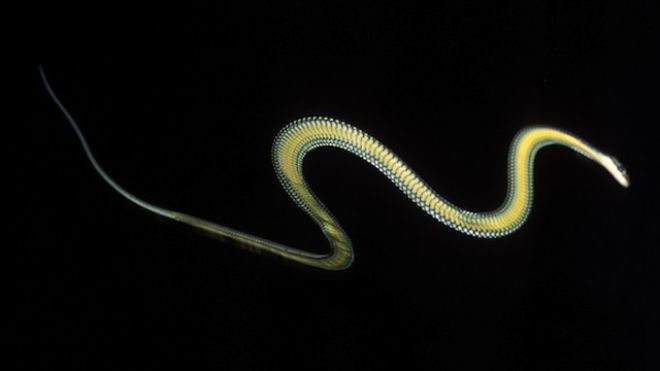
Creature Feature: Paradise Tree Snake.

Flying serpents are one of the staples of mythology around the world. Every place seems to have some sort of sky snake, possibly representing a rainbow. Even the Greeks had a few heavenly sun-snakes that pulled Medea's chariot.  Just ask conspiracy theorists: serpent deities are clear proof of our reptilian overlords, right?

But that's impossible. Something can't fly without limbs, ri- 


What the flying fark?!

That airborne serpent is a paradise tree snake. The paradise tree snake is one of a genus of snakes that can glide. It and its relatives are all native to the rainforests of Southeast Asia. It is a diurnal predator, feeding on birds, rodents, and lizards. It also has a fair amount of predators, being a relatively small snake.

Oh, and it can fly. Technically, it can glide for over 79 feet. Yep.


To those of you who blinked and missed it: To start gliding, the snake The people in this video honestly do a better job of explaining the physics behind this snake's gliding than I ever could, but in layman's terms, how many of you know of flying rings? Yeah, it's kinda like that, only alive. 


As if a flying snake was not enough to scare quite a few people, these gliding snakes are able to steer. To put into perspective how hard this is, other gliding animals with limbs have a hard time steering in mid-air. Precisely because these snakes slither through the sky, they have excellent control.  Cool...if you're a snake person, that is.

Paradise tree snakes are not readily available in the exotic pet trade. They're around, sure, but by no means common. Dietary questions come up; anoles and pinkies are usually the answer. Beware of any of these that you find at herp shows. Even the snake in the video had some nasty parasites. They are also rear-fanged venomous, so please check your local laws before buying!


Sunday, October 7, 2012

Creature Feature: Indian Cobra.

Looking at the title, one or both of two things are probably running through your head: one, this is totally typical of me, and two, why am I picking on such a well-known animal? The answer might surprise you: In the wake of yesterday's little video on morality, is it possible for evolution to occur via religion?

As a rule of thumb, humans do not kill animals that they like. Chances are, if you eat meat and live in the U.S., you do not personally know the cow that your hamburger came from, and you would not eat your own cat or dog unless it came down to survival. Culture decides which animals go and which ones stay. In stark contrast to America's picky eating habits, we have China, where the best way to absorb an animal's qualities is to eat it. If something is considered sacred to a culture, it will usually be left alone.


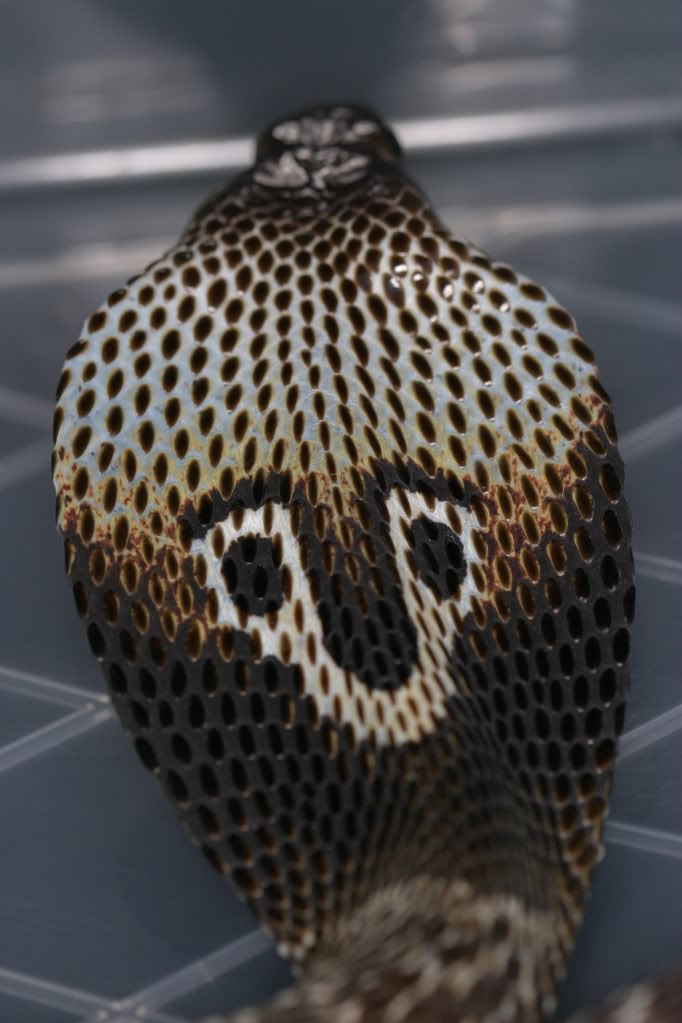
Everybody reading this probably knows something about the Indian cobra, AKA Spectacled Cobra (Naja naja). The first name comes from being found in India; the second, from the marks on its hood. It eats rodents, birds, frogs, and, yes, other snakes.  This is often the cobra used in snake charming, so you've probably at least seen a bad caricature of one.

India is practically known for snake worship. Buddha is sometimes seen shielded by a multi-headed cobra;  numerous deities show the cobra like a protective talisman; snake charming happened in India and almost nowhere else for a reason. India is the only place with an official 'Big 4' of poisonous snakes (although Australia probably has something similar). They have whole festivals in hopes of not getting bitten. They also have an interesting story to explain how the venomous Indian cobra got such interesting markings on its hood.

From http://www.profilekiss.com/.


Legend has it that Krishna, one of the biggest, most powerful gods in the Hindu pantheon, was asked by some cowherds to detoxify a river. All living things that drank from that river died, so yes, it was a pretty big deal. The source of the poisoning was the naga (big cobra) Kaliya, who, in some versions, was hiding from Garuda, a half-bird half-man that was the mortal enemy of nagas. Krishna still had to get the snake out of the river, and gave the cobra a stomping. Those footprints remain on the snake's flattened hood to this day. Another origin story reflects the pattern's similarity to the 'om' mudra, but that's far less exciting than a snake getting trampled.

The Indian cobra already has some respect for being in India's Big 4; that and the cobra's visually-impressive display were enough to get it deified. That has, intentionally or not, been taken a step further by selecting which snakes should live by the markings on their hoods. Although Indian culture is generally wary of killing any cobra, their neighbors in Pakistan are not so kind, and actually discriminate against cobras with hood marks and cobras without.

This really does look like footprints! Source:Wikipedia.


Pakistani culture (i.e. a culture in an area very close to India- no, I am not accusing the two of being the same) treats marked and unmarked cobras differently. As per Secrets of the Snake Charmer, black Indian cobras are called "Caro," "fierce," while the ones with hood markings are called "Padam," peaceful. Supposedly, a fierce cobra lives for 125 years before becoming 'peaceful.' Pure black cobras are usually killed; the ones with the footprints of Krishna on their hoods are spared. It is thus probable, although not really provable, that something similar could have happened in India.

If this is selective breeding, it is selective breeding of a most unusual sort. It's not like the snakes are being bred in a facility to have the most elaborate hood markings possible (although no doubt some have tried). It's more like snakes with the marks have a carte blanche to live fuller, happier lives than their unstamped counterparts.

Could India be unintentionally breeding cobras for hood markings? It seems likely. Now, what about other hood markings? You'd think that looking like a bull's-eye would be a bad thing.


Sunday, September 2, 2012

Creature Feature: Caracal.

The average human psyche has exactly two images in mind in regards to felines: big cats, like lions and tigers, and domestic cats. The small- and mid-sized wildcats are often overlooked. That's a shame, because a lot of them are really neat.


Enter the caracal, one of the most striking of the little cats. If you took a lynx and exaggerated its ears and tail, you would get something that looks like a caracal. Caracals are native to much of Africa and the Middle East, and the name derives from a Turkish word meaning "black ear." Although it looks related to lynxes, it is closer, genetically-speaking, to the African Golden Cat and the tabby cat down the street.

The ears are the most noticeable part of the caracal. They have long tufts that make lynxes jealous. Although nobody knows the exact purpose of those tufts,we have several theories as to why they exist. On lynxes, the ear tufts function almost like radio antennae, helping the cat to hear. They might also help break up the outline of the caracal's head.


There's more to caracals than just the ears. Their paws have stiff hairs that probably allow them to walk on the sand, sort of like snowshoes. The caracal is also known for snatching birds in mid-flight - sometimes many birds at once! They also get most of their water from their prey, and domesticate surprisingly well.

Caracals have been in human company since ancient times. India and Iran both have a good history with these cats. The Persians were fond of using them to hunt pigeons. They can kill up to ten pigeons in one hunt! Yes, these cats have been exotic pets for a very long time, and remain pretty popular today.


Keen observers probably noticed a while back that caracals look a looot like house cats; yes, the two can make babies.The Moscow Zoo tried it, and caracal-cat hybrids can be found in captivity as well. "Caracats" have many of the same traits Savannah cats do - larger size (12-14 inches at the shoulder, 25-30 pounds) and fertility issues in the males. (For those curious, yes, servals and caracals can breed, too.) They usually use Abyssinians as a domestic base. F2 (second generation) caracats still have the attractive ears of their wild relatives and make better pets than F1 hybrids. Above is a caracat kitten for your squeeing pleasure.

That said, this month's Theme Week is going to be a doozy. I'm a cat person,  darnit!

Sunday, August 12, 2012

Creature Feature: Coconut Crab.


...Wait, what? What is that? I don't know what it is, but it defies my "what is this I don't even -" mode. That has to be the biggest crab I've ever seen...and it's on land.

The above image circulated in a chain e-mail released in 2007. It features a coconut crab, AKA  robber crab, palm thief, or Birgus latro ("robber" in the species name).  Since then, other images and messages concerning this giant crab have circulated as well...and most of it is absolutely true. The coconut crab is not a bonsai kitten; absolutely nothing was Photoshopped; it's all 100% real.

OK, so coconut crabs are not the biggest crabs around. I lied a little. The proper title of "biggest crab" goes to the spider crab, a creature dwelling in darkness with long, spindly legs.They will get their own entry. For now, the coconut crab stands as the largest land invertebrate in the modern era; it sports a 3-foot leg span, can get up to 16 inches from head to abdomen, and weighs up to nine pounds. Unless Mothra shows up, the coconut crab will be king for a looooong time.

And then Ganimes showed up.


Guess what? These terrors are related to the cute little hermit crabs we covered yesterday. Like hermit crabs, young coconut crabs spend some of their lives in snail shells. They never go back to the ocean except to lay eggs, and will drown if placed in water. Much the same can be said of land hermit crabs, although hermit crabs still need humidity to be happy.You will never see hermit crabs the same way again after looking at a coconut crab.

Luckily for us, these monster crabs are primarily herbivores. True to their name, they are fond of coconuts, which they climb trees for and can crack open with those claws.  Other fruits and nuts are on the menu as well. The distribution of coconut crabs is tied exactly with coconut trees. Hell, they even have a remarkably well-developed sense of smell for a crab - enough that it's an eerily close parallel with that of insects. They'll eat meat (small animals and carcasses) on occasion, but for the most part, they will stick to fruit and nuts.


Coconut crabs are indeed edible, by the way. They are considered a delicacy on their island homes. Who cares if it's big and terrifying? That's a lot of crab meat.  The locals consider it a delicacy and an aphrodisiac, however, so the crab meat might be a little hard to come by.

Y'know what, though? It doesn't matter that these crabs are delicious. They've been here longer than humans and will be around long after we are gone. I actually saw one artist who validly pointed out that snakes and rodents will be around long after the human race is dead; cockroaches are survival experts. Now we can add giant, killer crabs to the list.  Basically, if you happen to be warm-blooded, global climate change will screw you over. We're doomed, and the whole rest of the animal kingdom is laughing at us. The creep shall inherit the Earth.

Wednesday, June 6, 2012

"They Actually Eat That:" Arugula.

"Arugula?" Well, the name certainly sounds exotic enough. It's also called "rocket," which can cause some befuddlement on English-language menus. These look an awful lot like dandelions to Americans, but they definitely are not. Dandelions are an all-American plant and are totally different. :)


Arugula (eruca, rocket, or roqette elsewhere; Eruca sativa) is a plant native to the Mediterranean, ranging from Morocco to Turkey. It has been used in Mediterranean salads for ages. The taste of arugula spread as far as India in the East and has also been very popular in Brazil. Only recently, however, has it become common enough in the U.S. to make it onto grocery store shelves.

Arugula is particularly popular in Italy. The Romans have been using it as a garnish, salad, and aphrodisiac since the days of the empire. Down in the Gulf of Naples, they even make digestive liquor out of arugula. Oh, and since Italian pizzas are totally in right now, you'll be seeing a lot more of it. (Before you say that's redundant: Italy has several unique pizzas that the U.S. is in the process of butchering.)


Arugula has a strong flavor for a leafy veggie. Spinach has a flavor, too, but arugula's stronger.  It has been described as "peppery," or "like cress," which I suppose suffices for those who have never tried it, but in the end, arugula is arugula. Trust me, if your salad has arugula and you've tasted it once before, you'll know it's in there. It's distinct from every other green out there.

Arugula is rich in potassium and Vitamin D. It also has a lot if dietary fiber and protein, so if you've been trying to stay away from meat, look into it. Just bear in mind that this particular green veggie does have a flavor all its own. Try it on a freshly-baked pizza; you might like it. :)

Thursday, May 24, 2012

Creature Feature: Hill Myna.

Birds are, without a doubt, nature's original artists. Although some of them may be rather morbid, they had colors before we did (and make better use of them), created music as we know it, and, we aren't even kidding, have complex enough songs that many songbirds have dialects - i.e. even though they're the same species, the songs are so dissimilar that two birds from different areas can't understand each other. Even today, what artist of any discipline has not felt the urge to fly into the great blue on wings or in song? Hell, even the great Beethoven kept a mynah bird.


The common hill myna (Gracula religiosa), or mynah, is one of the most famous talking birds in existence. It is native to South and Southeast Asia, ranging from India to Indonesia, and is most closely related to starlings. There are eight or so subtle subspecies which are mostly differentiated by the wattles on their necks. They eat fruit, nectar, and insects in the wild. There are several other species of mynah, but this is the one that most people are referring to.

Mynahs are among the several birds known for being excellent mimics. In their natural range, they can have anywhere from 3-13 calls per bird. The calls completely change within miles of each other. It's things like this that make us wonder if birds had language before people did, along with nearly every other art form.

So, just how well can mynahs talk? They're amazing. Parrots have a sort of 'parrot dialect' whenever they speak; mynahs have no such thing. If we didn't know that the clip below was a bird, we might've very well mistaken it for a monotonous screenplay:


Mynahs are listed as 'least concern' according to CITES, but populations have been declining in recent years. The only place in SE Asia in which the mynah is not plentiful is Bangladesh, due to both habitat destruction and over-hunting for the pet trade. They are so easy to breed otherwise that they have established feral populations in Hawaii, Puerto Rico, and Australia (with disastrous results). If you do want a myna bird, I'm sure there are people breeding them in captivity in the States, and several farmers in India have learned the right time to take the young out of the nest in the wild. Who knows? Get a mynah bird and you might write the next great symphony.

Saturday, May 19, 2012

Creature Feature: Black Skimmer.

With all of the 'weird' animals in Africa, Asia, and Australia, it's easy to take far more local birds for granted. After all, everything in nature has to be unique. Here's a weird one that can be found right in the U.S. of A.:


Those slick-looking birds are black skimmers (Rynchops niger). Skimmers are a small family of birds native to North America, South America, South Asia, and Africa. The family has been considered both a sister group to terns (who are actually pretty awesome in their own right) and gulls. They are total piscivores, possessing one very specific tool for eating fish in a unique way.

Two words: That beak. Keen observers will notice that the black skimmer's beak is just slightly longer on the bottom than on the top. This is so that they can skim fish quickly from the surface of the water. Skimmers are the only birds with this weird little under bite, so they really stand out even among other fishing birds. That's just scratching the visual surface.


Most birds are diurnal, and seabirds are no exception. The black skimmer is one of the few crepuscular fishing birds - that is, it hunts mostly at dawn and dusk. Since skimmers hunt mostly by touch, they can hunt in low light as well. This way of feeding has been called "unworldly" by one R.C. Murphy, who further compared them to aerial beagles hunting aerial rabbits. What an interesting, uncanny image!

Weirder still, black skimmers are the only known species of bird to have slit-shaped pupils like cats, lizards, and snakes. This, again, ties with being able to function in low light. Just a little more tweaking and this bird could be quite the monster. Get on it, creature designers; we could use things that aren't dragons around.

Thursday, May 17, 2012

Creature Feature: Loa loa.

Part of the reason these entries have been so very delayed has been my fairly sudden, but completely foreseeable, interest in the Shin Megami Tensei franchise. That series has a whole compendium's worth of monsters from around the world, including the loa, a spirit from African folklore and voodoo rituals.


No, not all loa look like that. After a quick glance, loa are a lot like Greek daimones or angels - spirits between humans and God. I have yet to see a description of a loa resembling a bad goth tattoo attempting to be edgy, but if such a loa does exist, it would explain why Loa loa is the scientific name of the African eye worm.

Infinitely more terrifying than a skull-snake. Thank stanford.edu.


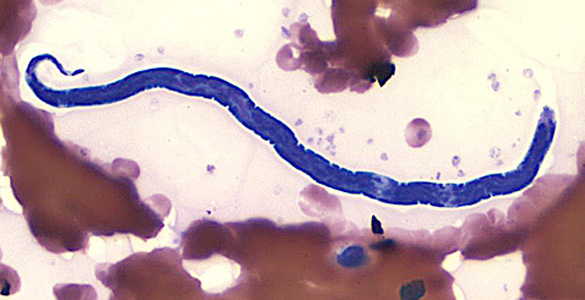
Yes, that is exactly what it looks like: A worm in a person's eye. Loa loa is a parasitic roundworm spread through horsefly bites. It is mostly found in Africa and India; please bring bug spray if you ever go to either of those places.The best way to avoid Loa loa is to avoid the bites, obviously.


Loa loa is spread entirely via fly bites. Specifically, they love using horseflies and deerflies (which are a type of horsefly) as vectors. Deerflies are vampiric like mosquitoes, yet suffer only a fraction of the hate. An infected fly bites a human, the larvae develop in the human, and another fly gets the same stage inside it. Then that fly infects another human. We're just the daycare center for those little worms while they breed. Even without the eye thing, that's a little bit nasty.

Because in your eye and blood is a LOT creepier than through your skull.


The presence of a Loa loa traveling through the eye is usually one of the first signs that somebody is infected. Otherwise, the most they feel is joint pain, called Calabar swellings, when the little larvae get stuck in one place. There are also some subtle disturbances in the lymphatic system and lungs in intense infestations. Like most parasites, Loa loa tend to be subtle. Until, of course, the worm appears in somebody's eyeball.

If symptoms persist, the host may die, but most of us are sensible enough to see a doctor for a freakin' worm in the eye. Really, that moment is not a good time to be a belonephobe. The worms can be surgically removed and/or slowly killed by diethylcarbamazine or Ivermectin. That doesn't mean that being infested with worms will not make one suspect voodoo afoot.

Wednesday, February 29, 2012

"They Actually Eat That:" Plantains.

(Apologies for the delay. I had a paper to write.) 

 So, it's time for another installment of "weird things Kuro found while shopping on Devon Avenue!" After doing an entry on Goya, the giant guinea pig, I came across these chips in Devon market. They're made of plantains, which are not usually found in North American cuisine.


But what exactly is a plantain, anyways?

A plantain (Musa) is kinda like a banana, only smaller and green. They are native to Indiaand Southeast Asia in general. However, they are popularly grown in the Caribbean and Africa as well. They are frequently used in Caribbean, African, Indian, and South American cuisine. Other areas such as the Philippines and some southern states use them as well. 

A plantain looks like a slender, green banana. If you manage to find ripe ones, they will actually be brown; don't let that throw you. They can usually be found in the fresh produce sections of most supermarkets.


Plantains and bananas are indeed closely related, but before you decide to try the other banana out of curiosity, there are a few key differences you should know. For starters, plantains cannot be eaten raw; they must be cooked regardless of what growth stage they are at. If cooking a banana sounds disgusting to you, plantains are a lot starchier than bananas. They are treated more like tubers (i.e. potatoes) when cooked. In short, they're almost vegetables.

Since the plantain is darn close to a potato, plantain chips are a rather popular snack food. They can also be cooked with a variety of spices. There are recipes for plantains from Ghana, Puerto Rico, and India. Yes, they have plantain curry. Pick your favorite way to eat 'em and dig in.

Tuesday, February 21, 2012

Creature Feature: Striped Hyena.

Hyenas are many things to many people: Enemies of lions, one of the noblest animals around (until you really look); the jokers of the savannah; the females of spotted hyenas darn near have, umm, lances where it counts. If you thought regular hyenas were crazy, wait until you leave Africa. They get a lot wilder as you head towards India. Seriously, this striped hyena has a mohawk running down its back.


Striped hyenas (Hyaena hyaena) are definitely not the hyenas that the media like to pick on. Their range covers most of northern Africa into the Middle East and India. At one point, they even wandered as far north as France and Germany. That said, they have very nice winter coats. Populations are generally declining, but not quickly enough to place this hyena on the endangered list.


Striped hyenas are a lot smaller than their spotted cousins. They also have a distinctly sloping back and very weak hind limbs.There is no significant sexual dimorphism - a rarity in mammals. The size difference is one thing; at least in striped hyenas, the males and females have normal junk. Overall, they look more distinctly canid than spotted hyenas, even though they are still more closely related to cats than dogs.

The striped hyena, unlike the 'normal' hyena, is a solo scavenger. At most, it hunts in pairs, and may live in groups of up to seven - not large at all. It feeds on small vertebrates and whatever meat it finds. This puts the striped hyena in the position of a detritivore rather than a predator. That's still valuable; you would not want to be in a world without scavengers and decomposers.


Finally, that mane is amazing. When threatened, the striped hyena erects all the hairs along its spinal cord in an effort to make itself look bigger. The mane is also used to communicate between hyenas; it is not a target in combat, even though everything else is fair game. We think making the hyena look like it should be a Fire-type Pokemon was an unintentional side-effect.

Wednesday, January 11, 2012

"They Actually Eat That:" Lotus.

We get so much into the strange animal foods every week that we tend to overlook plants. Veggies can be strange, too. One can learn a lot about cultural values by what plants they eat - for example, there was a time and place when it was forbidden to eat root vegetables because they were underground. Also, some places just plain don't have certain plants.


Lotuses (Nelumbo nucifera) are among those plants that some places do not eat simply because they are not native. To many Asian cultures, the lotus is a symbol of enlightenment because it emerges from grimy pond bottoms to float atop the water. It can also be interpreted as a symbol of chastity because it comes up so cleanly from the dirt. The Indian name "Padma" and its derivatives all come from the lotus. It's a very popular plant, to say the least. (Read: this is just scratching the surface of the lotus's cultural significance!) 

The popularity of lotuses extends into cuisine, albeit for more practical than spiritual reasons. The flowers, roots, seeds, and young leaves of the lotus are all edible. Nearly everywhere lotuses grow, people have found ways to eat them. Some cultures pop the seeds like popcorn; the not-very-edible stems can be used to flavor tea; the roots have a multitude of uses. (Yes, I have actually eaten lotus root.)


Lotus root is uncommon if not outright difficult to find in the U.S. It is easily identified by its lacy pattern and round shape. The root is crisp, crunchy, and often seasoned. Put them in salad, broil them, pickle them...eat them however you like! Lotus roots are very nutritious, particularly if one does not have enough fiber in one's diet. Buddhism and other religions that recommend vegan/vegetarianism should be flocking to lotus root and/or konjac. Remember, the latter is illegal in the United States.

Just because a plant is seen as pure and holy certainly does not mean it cannot be eaten. One could almost call it sacrelicious, but there are no prohibitions against eating lotus. It's just a little strange to most of us. Then again, in the West, a certain major religion encourages the symbolic practice of eating the flesh and blood of a certain magic individual, so we should be the last ones to judge other faiths.

Thursday, November 17, 2011

Creature Feature: Dhole.

Wolves are overrated. Yes, they are cool animals, and yes, they are the closest relatives to the domestic dog, but they aren't endangered, aren't the most powerful predators around, and are overanthropomorphized like crazy. They are not even endangered anymore, so wolf-lovers cannot use the generic "it's endangered so it must be cool!" defense. There, I said it.

Instead, how about investing your collective energy into canids that do need love and are actually rebellious? Dholes fit the bill nicely, and probably look just wild enough to incite the inner rebel that we all have during our teenage years.

From the University of Massachusetts.


Dholes (Cuon alpinus) are a type of wild dog native to South and Southeast Asia. They are called red wolves, red dogs, whistling dogs, chennai, and mountain wolves. The main differences between these dogs and official members of the genus Canis (wolves and domestic dogs) are the amount of teats and teeth. Yes, mammal classifications are that subtle.


 Dholes have a few other, more visible traits that sets them apart from wolves. For example, they always let their puppies eat first at a kill. As in the video above, they also whistle to talk to each other; it is a much more pleasant sound than barking. This creature should be instant mammal fan fodder, looking like a wolf mixed with a fox, but nope. No love. 

Dholes, like honey badgers, show almost no fear. Once they get in a pack, anything except humans becomes fair game.  They will attack boars, wildebeests, and even other big predators like tigers and leopards. Although instances of taking on tigers are rare and always come with casualties to the pack, dholes have been known to chase tigers into trees. Tigers that run rather than fight are nearly always killed. When was the last time one saw a wolf doing that?


Unlike wolves, even native cultures have nothing good to say about dholes. Until dholes were officially protected in 1972, farmers shot them in the name of protecting livestock. Their pelts were also valuable in China, but still had no "OMG DIVINE STATUS" like wolves tend to get, especially in modern times. In various European sources, such as the French passion plays and gothic sagas, dholes are characterized as hellhounds. Even Rudyard Kipling cut the dhole no slack in Red Dog, and he's the guy who made a giant python into a believable, fun character.

Alas, the dhole's range has shrunk considerably since prehistoric times. If art is any indication, the dhole once ranged across most of Eurasia. Now, its habitat is limited to India, Indonesia, and parts of China.  They have been shot by hunters and have niche competition with domestic dogs. (See, anti-exotic people? Even domesticated animals can cause ecological damage.) Sometimes, domestic dogs slip into dhole packs, just because, making things even more confusing.

By the way, dholes do not domesticate. At all. Go with the silver foxes from Russia.


Sunday, September 18, 2011

Creature Feature: Asiatic Lion.

Anyone who knows anything about lions knows that they live in Africa. Depending on your source, they either have a strangely anthropomorphic family or a harem system in which the big guy gets all the women. Lions are probably the most filmed predators on the African savannah.

So when one hears a story about lions in places like, say, Greece and India, brows go up. Where did the Nemean Lion (and, come to think of it, half of all Greek monsters) come from if Greece had no lions? Doesn't India have tigers instead? Hey, come to think of it, did the lions that devoured ancient Christians really come all the way from Kenya?

The Arabic text says "get in the car."


A not-so-long time ago, two species of lion roamed the lands: The African lion and the Asiatic lion (Panthera leo persica). The African lion gets thousands of documentaries every year and two charming animated films; the Asiatic lion gets this entry and a place on the Endangered Species list.

Asiatic and African lions differ almost solely by location. The African lion is, well, African; the Asiatic lion once spanned Europe (including Greece and Italy), the Arabian Peninsula, and India.  Fossil records suggest that they may even have been in Alaska.

Asiatic on the bottom.


At a glance, there are a few subtle anatomical differences between the Asiatic and African species that only lion-otakus can really pick out; look them up if you really must nitpick. The species are so close they can interbreed, leading to debatable species conservation practices. With only 400-odd Asiatic lions in the wild, genetic purity matters.

Yes, the population of Asiatic lions declined from thousands to only four hundred. Currently, habitat loss and hunting livestock are the main threats to their survival. All four hundred of them are thought to be somewhere around Gir Forest, India, which remains the only natural habitat of the Asiatic lion. (No, that is not a typo, Invader Zim fans.)

Even with the Asiatic lion's wide range, there were never lions in China. The "lions" found in Chinese lore are composite, nigh-mythical beasts that look more like dogs than lions to most Westerners. This happened because the only lions ever received came in the form of Asiatic lion pelts from India. A certain Chinese monk used his imagination and used the few images of lions he had to create the ultimate lucky beast:


...whatever that monk was on, we want some.