Showing posts with label little shop of horrors. Show all posts

Sunday, October 13, 2013

Little Shop of Horrors: Welwitschia.


Look at the above image. What do you see?

If you think that's washed-up seaweed, take note of how this image doesn't look like it's near the ocean. Trash off a truck? A plausible theory. Litter? Haha, no. A sign that the Great Old Ones are coming? I dunno; ask Bogleech about that one. If you said it's a Welwitschia, you either read the title or happen to be a botanist.

 Welwitschia mirabilis is a bizarre plant found on the Atlantic coast of Angola and Namibia, who has the odd plant on its coat of arms. The plant can only live in arid environments with occasional fog. It is named for the Austrian botanist Friedrich Welwitsch, who also discovered a few other botanical oddities in his lifetime. This particular plant happens to be a living fossil, going virtually unchanged since the Mesozoic. The Welwitschia's closest relatives are, of all things, pine trees. Yeah, bring a Welwitschia over next Christmas; I'm sure it'll go over well with the relatives. (Actually, you can grow your own!)

Welwitschia are amazingly odd plants. The 'mess' of leaves is actually just two very large leaves. These are the exact same leaves that the plant had as a seedling, and have grown very large over time. They have simply been shredded with wear. These two leaves are all the plant grows during its entire, very long life. There's not much beyond these leaves, either - just a stem and roots. Suddenly the most basic of plants has become a strange thing.

How long is its life, anyways? Oh, one or two millennia. A single Welwitschia can be anywhere from 1,000-2,000 years old. We're used to trees living that long- not displaced patches of seaweed. Bear in mind that this thing is still just a stem, roots, and two leaves. Yes, it's always just two throughout thousands of years. During that time, it can also grow huge.

Disclaimer: May eat old ladies.


The relatives of Welwitschia dominated Late Paleozoic and Mesozoic fauna. The tattered dregs in the sand are all that remains of this unique genus. It can still live for thousands of years. If nothing else, Welwitschia proves one thing: sometimes the simplest answer is the best.


Friday, July 12, 2013

Little Shop of Horrors: Queen Anne's Lace.

Did you know you might have wild carrots growing in your backyard? It's true. Most flower guides, however, will not mention that the plants are in fact carrots. If you've ever wondered what carrot flowers look like, wonder no more. Anyone who's taken a hike through dry fields or alongside roads  may well have seen this bloom around:

Source.


 This is Queen Anne's lace, AKA the wild carrot (Daucus carota). It originated in Europe, but has since become wild in the United States and Australia. It is relatively easy to identify by its many clusters of small, white flowers in a lacy, overturned umbrella. It's largely considered a weed, but more on that later.

The plant supposedly gets its name from one or both of two Queen Annes: one from Denmark, who was in turn the mother of Anne, Queen of Britain. Legend has it that the red flower in the center is from an accidental prick of the needle when Queen Anne was weaving said lace. Of course, its real purpose is to attract insects, but that's not nearly as fascinating, is it?

Although a close relative of the domestic carrot, the wild carrot can be considered either helpful or harmful. Mostly, it is a wild weed perfectly capable of consuming one's garden. However, certain plants such as tomatoes may actually grow better in the presence of Queen Anne's lace. Queen Anne's lace is also used for several medicinal purposes, including general skin issues (burns and the like) and, surprisingly, anything relating to menstruation. If carrots can cure that time of the month and/or be a contraceptive, I'm on board.


That said, it is not advised that you attempt to eat wild Queen Anne's lace for a number of reasons. The first is that it strongly resembles poison hemlock, so a misidentification could be lethal. The other is that wild carrot roots are not nearly as tasty as the carrots one finds in the supermarket. The root becomes woody after a very short amount of time, and even then, there isn't much there to eat. It'll save you

Sunday, June 23, 2013

Little Shop of Horrors: Burro Tail.

Remember how I said that there would be more weird plants now that summer has hit? I was right. Lo and behold, there was something very weird at a farmer's market in Frankfort. The lady at the stand called it "burro tail."


Burro tail is an odd one indeed. It's also called "donkey tail," but so are a few other things, so we'll still with "burro tail" or Sedum morganianum, thanks.  Like the chimeric "coral cactus" from earlier, it's a succulent, meaning that the plant's very wet on the inside as a means of surviving in dry climates. In this case, that means Ecuador and Mexico.

Burro tails are one type of trailing sedum - that is, they can get long. One of the most popular ways to present this houseplant is via hanging basket. As the plant grows, the "tails" drip down over the sides of the basket. These tails can get up to 24 inches - that's 2 feet- long. That's pretty impressive, especially after looking at its fleshy leaves.

This plant is weird in part because nobody is quite sure where it came from. Specifically, we aren't sure whether burro's tail is a domesticated subspecies of S. morganianum or a true cultivar. This is not weird compared to, say, Saliva divinorum, and there is no loss in fertility as would be expected of a hybrid, so at least it's stable regardless. It's a breedable plant, all right, but also sort of alien.

Y'know that advice I keep giving about how desert animals are easy to keep? That applies to plants, too. You can forget to water burro tails once or twice and they will do just fine. They also love sunlight, so keep succulents like this in a sunny spot with high temperatures. They're very hard to kill and look out of this world.

Tuesday, June 18, 2013

Little Shop of Horrors: Coral Cactus.

Now that summer has hit, various home improvement stores and sections are stocking all sorts of weird plants. Be on the lookout for celosia ("brain flowers"), geops, and a number of other weird plants that one can probably find at one's local nursery. It was almost inevitable that at least one odd, potted plant would wind up on this blog, but I had no idea it would be this odd:


This is a coral cactus. No, there's no scientific name for this oddball. It's 100% created by people. If I had not done glowing marmosets yesterday, I totally would have done this thing; it's a really impressive graft of two completely different plants. Oh, and neither of those plants are cacti, even if they're both still succulents. Both are also almost worth their own entries.

The coral-like crest comes from a plant called Euphorbia lactea, AKA mottled spurge or elkhorn.  Specifically, the coral part comes from a frilly mutation of elkhorn, which is propagated for this exact purpose. Otherwise, elkhorn is another houseplant with some medicinal potential in India. The milky latex on elkhorn is poisonous, as is the entirety of the plant. Keep coral cacti away from children and pets with this in mind.

The stem is from another species of Euphorbia, usually E. neriifolia. It's also called the "Indian spurge tree." Both of these plants have similar climate requirements, so it's no surprise that a graft of the two should be sustainable. It's still impossible to breed them, mind, but you can keep a coral cactus alive like most cacti. Weird? Yes. Difficult? Not really.


Where can you get this bizarre thing? Wal-Mart. These chimera plants are sold for relatively cheap at the world's most infamous big box store. We would not be surprised if the shop Audrey II came from suddenly started carrying these. If weird plants in one of the largest chains in the world is not a plot for botanical world domination, please tell me what is.

Sunday, July 22, 2012

Little Shop of Horrors: Lithops/Living Stones.

It's about time I did another plant. I'm sure the botanists are all raging at me for focusing on the cool animals instead of giving plants more room. It's actually a pretty big problem in ecological sciences; people go into biology to learn about animals, so botany is shunted aside in favor of zoology. Fie upon me for not doing more plants. You rock, you stone, you worse than senseless...


...plant?

Yes, I swear by Arceus, Ra, and all the various deities that exist that that is a plant. It's called "living stone," "pebble plant," or just plain Lithops. It is native to Nambia and South Africa and has never become invasive. There are some 400-odd populations, each with their own unique colors.

For a plant, Lithops does a very good job of being a rock.  Most of the time, it's not even green. Those rocklike projections can come in as many different colors as rocks themselves: blue, brown, red, you name it. During droughts, they cannot be seen at all, so you never know when living rocks will randomly pop up. Lithops has some of the best camouflage ever -seriously, it was discovered when a scientist wanted to pick up a strange pebble.


Those stonelike bodies are modified leaves. Between them is a very small stem. Occasionally, you will see a yellow or white flower poking up in between the leaves. These plants do yield fruit, but it is capsule-like and probably not edible. They're mostly there to look weird and store water in the scorching desert.

You can find Lithops at your local garden store. Be warned that these are desert plants and require special soil - cactus formula will do. Do not over-water. Too much sunlight will actually burn the plant.  Keep all these things in mind and you will have the best pet rock ever - a plant.

Saturday, May 12, 2012

Little Shop of Horrors: Wolfsbane.

Am I the only one getting ads about this one "werewolf VS vampire" MMO? It's getting old. It's not that I don't like both of them, but both are overused, no matter how cool they are. Really, once one realizes that werewolves and vampires are both metaphors for different types of sex, there's nothing to talk about anymore. Still, I may as well sate  the werewolf fans out there by covering one of the few aspects of their fandom that actually exists:


Wolfsbane, also known as acontium, can be used to describe any of the various species of monkshood (genus Acontium).  It is usually used in reference to Aconitum vulparia, one of the varieties found in Europe. The internet has confirmed the complication in Ginger Snaps that monkshood (in general) grows virtually everywhere, but blooms mostly in the spring (perennial). Of all things, it is closely related to buttercups.

Wolfsbane originally had little to do with werewolves. The plant was probably used to kill wolves, and may have been used to ward off werewolves, but that's the extent of it. Wolfsbane only became popular from Universal's Wolf Man movies - as did the full moon transformation, silver bullets, and a million other modern werewolf conventions.  FYI, the Universal Studios version of Dracula was repelled by wolfsbane as well. Maybe they're not so different after all, eh?

Can't we all just get along? Or at least not have blood feuds?


Along with being associated with werewolves, wolfsbane has certain other occult applications. The plant was considered sacred to Hecate, the Greco-Roman goddess of witchcraft and crossroads. It's also linked to the planet Mars, both for its helmet-like shape and because of its heat-inducing toxin. Legend has it that witches dipped their flints in wolfsbane and threw them at enemies. This was the Wiccan equivalent of poison daggers, and considering they were tipped in wolfsbane, these shards were not to be taken lightly.

By the way, yes, wolfsbane is very poisonous to humans. Do not ingest it unless you reaaaallly think you're becoming a wolf - in which case, all you're doing is sparing the rest of us from your wolfish agony.  Monkshood works almost like tetrodotoxin - you know, the stuff that makes fugu so notoriously poisonous. Even handling wolfsbane requires gloves and hand-washing. Some people in China and Taiwan have tried eating monkshood, but one wrong step in the cooking and things turn deadly. Point goes to vampires for having a doable, if still dark, way of playing in real life. You can't even play werewolf unless, well...


 ...but let's not go there.

Sunday, January 15, 2012

Little Shop of Horrors: Mandrakes.

From www.columbia.edu.


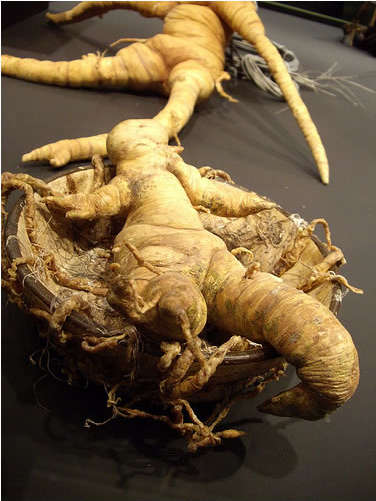
If you are familiar with the fantasy genre, the mandrake (or mandragora) is one of the most notorious plants you will ever come across. The mandrake, a plant with a humanoid root, screams very loudly whenever it is pulled from the ground, enough so that all who hear the scream die instantly. It is, however, magically potent, so people have devised all sorts of crazy tricks to get one. This, for example:

"A furrow must be dug around the root until its lower part is exposed, then a dog is tied to it, after which the person tying the dog must get away. The dog then endeavours to follow him, and so easily pulls up the root, but dies suddenly instead of his master. After this the root can be handled without fear."

Yep. People would kill puppies to get a mandrake. Mandrakes do exist, but they are not worth killing anything over. 

The plant is actually rather pretty.


Real mandrakes are plants of the genus Mandragora. It is in the nightshade family, meaning that it is related to (obviously) nightshade, tomatoes, eggplants, tittyfruit, datura, and at least one other weird plant on this blog. The type species is Mandragora officinarum, which has been around in Europe (and Israel?) since time began. All parts of the mandrake plant are toxic and should be handled with care.

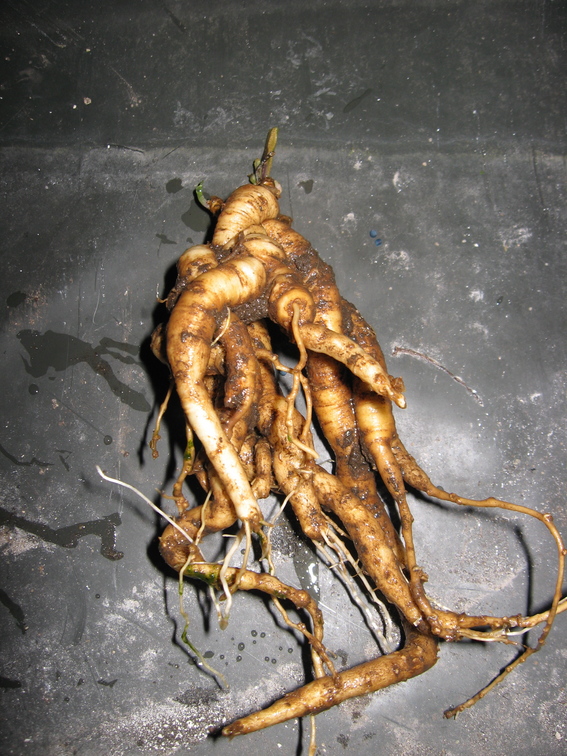
No, plants have not become so freaky that they have evolved the capacity to scream. Mandrake roots, however, can sometimes look uncannily like people. The way the roots split sometimes create a 'stick figure.' They are not alone in this regard; a few other plants, namely ginger and ginseng, also tend to look like people. Pythagoras, the creator of the Pythagorean Theorem, was such a staunch vegetarian that he refused to eat beans because they resembled human fetuses. Imagine how he would react to a mandrake!

IT'S PEOPLE!


The 'magic' effects of mandrake probably originate from the chemical cocktail found in every part of the plant. Along with several other compounds such as scolopomine and atropine (both trippy on their own), mandrakes have their own substance called mandragorin. Mandragorin produces a hallucinogenic, dreamlike state of mind; in spiritual terms, this is a shortcut to astral plane. They have also been used as medicine for infertility (magic man-plant, remember?) and as a painkiller by many an ancient physician. The jury is still out on whether or not mandrakes have the same zombie-making potential as datura.

Mandrakes are still used in modern tweaks on ancient religions such as Wicca. Bear in mind that some of the mandrakes talked about in ancient texts may instead be referring to things like ginseng and ginger- plants that also have roots that look eerily like people.We really cannot blame them for the mistake (the resemblance to people is uncanny) but please do not take a draft of mandrake to put more junk in the trunk. You might not wake up.

Go catch an Oddish instead.

Sunday, December 25, 2011

Little Shop of Horrors: Poinsettia.

MERRY CHRISTMAS! I'm not going to go "it's the most wonderful time of the year," but if Christmas makes you happy, I hope you had a good one. Today's entry is just as festive as yesterday's, so hold onto your Santa hats!


Around this time of the year, poinsettia pop up all over grocery stores, flower shops, and advanced nurseries.The poinsettia (Euphorbia pulcherrima) is a classic Christmas plant owing to its red and green coloration. It is a shrub-slash-very small tree native to Mexico. It is named after Joel Roberts Poinsett, the first United States Minister to Mexico. Since ancient times, its red leaves have been used as a dye and to soothe fevers.

The poinsettia has a number of legends concerning its origin in its native Mexico. One legend has it that an angel told a child to pick some weeds from the road and bring them to the altar of a church; the poinsettia resulted. The poinsettia's starlike shape supposedly represents the Star of Bethlehem. The red could also be from Christ's dripping blood. No matter how you slice it, some religious significance can be attached to this plant.


The "flowers" of a poinsettia are actually specialized leaves called bracts. The actual flowers of a poinsettia are in the center of these bracts. The bracts reach their brightest when left in the dark for half of the day. The ideal brightness occurs after 12 hours of darkness for a few days- don't expect an instant change. 

The first poinsettia plants were introduced to the U.S. in 1825 by, go figure, Joel Poinsett. However, much of the cultivation was done almost exclusively by the Ecke family. Using grafting to make the plants become more tidy than their weedy counterparts, they became the sole cultivators of the popular, bushy poinsettias we know today. Others eventually figured out the grafting trick, but the Ecke family still owns a large amount of the poinsettias on the market - roughly 70% in the U.S. and 50% worldwide. In short, we owe them.

In case red and green was not festive enough, have some "ice crystal" poinsettias.


Contrary to popular belief, poinsettia are not deadly to humans. They are only slightly poisonous. The most eating poinsettia will do is make one vomit. To put things in perspective, a 50-pound child would have to eat 500 poinsettia leaves to feel any ill effects beyond that. We would still advise keeping pets away from the plants, however; plants have poison for a reason. Look, don't eat.

Saturday, August 13, 2011

Little Shop of Horrors: Puffballs.

Aww, puffballs! Those sound adorable! Surely they must be cute, fluffy furry things, right? Headcat would never lie to us!


Haha, no. Actually, puffballs are a type of fungus:


"Puffball" can refer to any type of mushroom that reproduces using gasterothecia - a basidiocarp that holds the spores inside instead of outside like on other mushrooms. They span several orders and genera, meaning that there are several hundred species of puffball to choose from. Touch one wherever you are and it puffs millions of spores into the air.

To truly appreciate a puffball, one must first learn how fungi reproduce. When a man-mushroom and a lady-mushroom love each other very, very much...


...Kidding, it's not like that at all. Fungi give birth by releasing spores via fruiting bodies (such as mushrooms or puffballs). Yes, those 'shrooms are a fungus's junk, making every piece of your veggie pizza an unholy exercise in fungal castration. The spores are usually on the underside of the mushroom, scattered along the gills and waiting to be blown away.


Puffballs take a different way out. Whenever something brushes against a puffball, the shell breaks, scattering millions of spores into the wind. This is a faster reproductive strategy than the average mushroom.  Plus, if humans decide to be douchebags, so much the better for the puffball.

Puffballs are usually not poisonous. Some, however, look very similar to poisonous mushrooms like "Death Caps." Care must be taken when hunting for immature puffballs to be made into 'steak.' Food-grade puffballs are cut in half lengthwise, just to be sure they aren't ninja death mushrooms. Yes, they actually eat puffballs.

In CANADA, no less!