Showing posts with label plants. Show all posts

Sunday, October 13, 2013

Little Shop of Horrors: Welwitschia.


Look at the above image. What do you see?

If you think that's washed-up seaweed, take note of how this image doesn't look like it's near the ocean. Trash off a truck? A plausible theory. Litter? Haha, no. A sign that the Great Old Ones are coming? I dunno; ask Bogleech about that one. If you said it's a Welwitschia, you either read the title or happen to be a botanist.

 Welwitschia mirabilis is a bizarre plant found on the Atlantic coast of Angola and Namibia, who has the odd plant on its coat of arms. The plant can only live in arid environments with occasional fog. It is named for the Austrian botanist Friedrich Welwitsch, who also discovered a few other botanical oddities in his lifetime. This particular plant happens to be a living fossil, going virtually unchanged since the Mesozoic. The Welwitschia's closest relatives are, of all things, pine trees. Yeah, bring a Welwitschia over next Christmas; I'm sure it'll go over well with the relatives. (Actually, you can grow your own!)

Welwitschia are amazingly odd plants. The 'mess' of leaves is actually just two very large leaves. These are the exact same leaves that the plant had as a seedling, and have grown very large over time. They have simply been shredded with wear. These two leaves are all the plant grows during its entire, very long life. There's not much beyond these leaves, either - just a stem and roots. Suddenly the most basic of plants has become a strange thing.

How long is its life, anyways? Oh, one or two millennia. A single Welwitschia can be anywhere from 1,000-2,000 years old. We're used to trees living that long- not displaced patches of seaweed. Bear in mind that this thing is still just a stem, roots, and two leaves. Yes, it's always just two throughout thousands of years. During that time, it can also grow huge.

Disclaimer: May eat old ladies.


The relatives of Welwitschia dominated Late Paleozoic and Mesozoic fauna. The tattered dregs in the sand are all that remains of this unique genus. It can still live for thousands of years. If nothing else, Welwitschia proves one thing: sometimes the simplest answer is the best.


Friday, July 12, 2013

Little Shop of Horrors: Queen Anne's Lace.

Did you know you might have wild carrots growing in your backyard? It's true. Most flower guides, however, will not mention that the plants are in fact carrots. If you've ever wondered what carrot flowers look like, wonder no more. Anyone who's taken a hike through dry fields or alongside roads  may well have seen this bloom around:

Source.


 This is Queen Anne's lace, AKA the wild carrot (Daucus carota). It originated in Europe, but has since become wild in the United States and Australia. It is relatively easy to identify by its many clusters of small, white flowers in a lacy, overturned umbrella. It's largely considered a weed, but more on that later.

The plant supposedly gets its name from one or both of two Queen Annes: one from Denmark, who was in turn the mother of Anne, Queen of Britain. Legend has it that the red flower in the center is from an accidental prick of the needle when Queen Anne was weaving said lace. Of course, its real purpose is to attract insects, but that's not nearly as fascinating, is it?

Although a close relative of the domestic carrot, the wild carrot can be considered either helpful or harmful. Mostly, it is a wild weed perfectly capable of consuming one's garden. However, certain plants such as tomatoes may actually grow better in the presence of Queen Anne's lace. Queen Anne's lace is also used for several medicinal purposes, including general skin issues (burns and the like) and, surprisingly, anything relating to menstruation. If carrots can cure that time of the month and/or be a contraceptive, I'm on board.


That said, it is not advised that you attempt to eat wild Queen Anne's lace for a number of reasons. The first is that it strongly resembles poison hemlock, so a misidentification could be lethal. The other is that wild carrot roots are not nearly as tasty as the carrots one finds in the supermarket. The root becomes woody after a very short amount of time, and even then, there isn't much there to eat. It'll save you

Sunday, June 23, 2013

Little Shop of Horrors: Burro Tail.

Remember how I said that there would be more weird plants now that summer has hit? I was right. Lo and behold, there was something very weird at a farmer's market in Frankfort. The lady at the stand called it "burro tail."


Burro tail is an odd one indeed. It's also called "donkey tail," but so are a few other things, so we'll still with "burro tail" or Sedum morganianum, thanks.  Like the chimeric "coral cactus" from earlier, it's a succulent, meaning that the plant's very wet on the inside as a means of surviving in dry climates. In this case, that means Ecuador and Mexico.

Burro tails are one type of trailing sedum - that is, they can get long. One of the most popular ways to present this houseplant is via hanging basket. As the plant grows, the "tails" drip down over the sides of the basket. These tails can get up to 24 inches - that's 2 feet- long. That's pretty impressive, especially after looking at its fleshy leaves.

This plant is weird in part because nobody is quite sure where it came from. Specifically, we aren't sure whether burro's tail is a domesticated subspecies of S. morganianum or a true cultivar. This is not weird compared to, say, Saliva divinorum, and there is no loss in fertility as would be expected of a hybrid, so at least it's stable regardless. It's a breedable plant, all right, but also sort of alien.

Y'know that advice I keep giving about how desert animals are easy to keep? That applies to plants, too. You can forget to water burro tails once or twice and they will do just fine. They also love sunlight, so keep succulents like this in a sunny spot with high temperatures. They're very hard to kill and look out of this world.

Wednesday, June 19, 2013

"They Actually Eat That:" Hibiscus.

 Every so often, a new 'superfood' suddenly floods the market. Usually, it's something only a small amount of people have heard of, comes with a fancy Greco-Roman science word attached, and has a long history of being medicinal from the ancient past. Recently, the buzzword has become "antioxidants," and acai and pomegranates are leading the way in that regard. Here's what is slowly becoming the next "superfood:"


This flower should look familiar to a lot of you. It's a type of flower called hibiscus, and is probably the most marketable superfood yet. Yeah, that flower on tacky Hawaiian shirts? That's hibiscus. Hibiscus iced tea is becoming more and more popular, popping up in Starbucks, Argo Tea, and Panera. It has "from Asia" and "might have antioxidants" going for it already.

But is it actually edible?

First off, the nectar and tea are usually pretty safe. Hibiscus has been used as a tea for centuries in Asia and Nile Valley Africa. The tea has been believed to cure everything from high blood pressure to cancer.  I've had hibiscus tea and nectar plenty of times with no adverse reactions. The only confirmed medicinal effect of hibiscus is as a diuretic, but people are looking into antioxidants.

The diuretic effect is particularly noticeable if animals eat it. I've heard varying reports, but the general consensus is that hibiscus plants are toxic to cats, dogs, and horses. It probably isn't the end of the world after one little bite, but just to be safe, hibiscus is on the list of "plants that are not pet-friendly." If your pet starts acting odd after eating hibiscus, call poison control.


As for actually eating hibiscus, there are dos and don'ts. Some hibiscus varieties are not edible, period. Others, like Hibiscus sabdariffa, can be eaten in salads and stir-fries like red spinach (which is its own thing). Most restaurant chains and such will not be using the poisonous varieties of hibiscus, so please enjoy the summer's latest iced tea craze. Just don't use it to cure cancer or give it to your dog, OK?

Wednesday, March 20, 2013

"They Actually Eat That:" Capers.

Capers are one of those plants that occasionally turn up on the menus of medium-high quality restaurants. It's one of those plants that a lot of people are probably just barely aware of. Still, if it turns up on a menu, one can't help but wonder if there is a Scooby Snack involved.

And they would taste awful in cupcakes.

Caper, the plant (Capparis spinosa), is native to the drier areas of Asia and the Mediterranean. Capers are related to mustard and dill, for those of you who aren't culinary experts. You can expect a certain sour-salty taste from them if they happen to be in something. The buds, flowers, and fruit of the caper are all edible, with the smaller buds supposedly having the best taste. 

By no means are capers a rare plant. In fact, they're so tolerant of things like poor soil salinity and drought that they can be grown almost anywhere. They can be propagated by cutting and are largely resistant to insects. Wild capers are on a vine while cultivars are more shrublike, but neither is really hard to find. In other words, we're pretty much looking at an edible weed.


The ingestion of capers goes beyond gourmet food. They can also be used as a new age remedy for intestinal issues, menstrual symptoms, liver problems, worms, and urinary disorders. Capers can help anything that involves detoxification. Just don't go around saying that they can cure snakebite or something; I cannot be held responsible for any that die because a seasoning herb didn't stop the venom.

So don't worry if you see capers on a menu. It's not as fancy as it sounds and is definitely not linked to mysteries. It might make sauces go down easier if you do not consider it a weed, though.

Wednesday, October 31, 2012

"They Actually Eat That:" (Pattypan) Squash.

Luckily, today's "They Actually Eat That" isn't too terrifying. In the face of a week of things that will leave your mind reeling with how terrifying they are, squash seems relatively tame. But hey: It's Halloween. Pumpkins happen to be a type of squash. Deal.


First off, cool as pumpkins may be, there are a lot of cool squashes out there. Squashes in general are New World fruits, and are considered one of the Three Sisters (major crops) along with the corn and beans cultivated by Native Americans.That said, they probably also fall under the category of "things used in foreign cuisine that you didn't know were from the Americas." Hey, that's actually a good article idea.

For purposes of this blog, however, a lot of squashes just look weird. They're knobbly, bumpy, twisty things. There are some advertised as looking like snakes. They're almost like the token alien fruit. You could paint a squash blue, stick it in a sci-fi B movie, and nobody would ever be able to tell that fruit was from Earth.


Pattypan squash (Curcurbita pepo)  just looks like a UFO. As the name would imply, these are small squash that can be fried in the same size pan as a hamburger patty. This actually led me to buy some out of curiosity. There were a few recipes online, and I thought that some sort of unique flavor would come with the unique appearance.

I was wrong: pattypan squash has no taste whatsoever. Pumpkin and zucchini have flavors; pattypan has a flavor so faint it's an anti-flavor. All of the flavoring comes from whatever you drench it in. The recipes are good because of the butter and herbs added to the squash. Not that I liked squashes to begin with, but I was expecting...a flavor. It's one of those things that I'm stunned people eat simply because it did not agree with me. (For the record, I don't like pumpkin either, but I can see why people like the flavor; here, it's more like liking the sauce than the squash itself.)  No offense meant; the fruit still looks amazing, and would make an awesome decoration.

 I think I'm starting to get a grudge against the whole squash family. Be right back; Christmas mint spree is just around the corner.


Tuesday, October 9, 2012

Ethics Week?: Sensitive Plant.

Well, OK. This month is probably going to be short a theme week. Luckily, it seems to have warped itself into a sort of "ethics week" devoted to making you think. That problem smoothed itself out. Enjoy...or don't, depending on whether you enjoy thinking or not.

One of the chief tenets of animal rights is that animals feel pain. They suffer just like humans, and as a rule, it's good to minimize suffering.  Animals used for meat lead particularly dreadful lives in factory farms unless stated otherwise. Again: Suffering = bad, especially since humans have consciences.

So what do we do if plants can feel pain?


Mimosa pudica is usually marketed as a "sensitive plant." Numerous other names are cited in the video. Outside of novelty marketing, it is native to tropical Central and South America. It has since been spread to every other place with that climate as well.

M. pudica exhibits rapid plant movement. Like something out of Avatar, those leaves fold inward when faced with any sort of stimulus. Just touching these plants is enough to make the leaves curl. The reaction to fire is particularly dramatic. Nobody knows exactly why the plant evolved this way, but the current theory is that it is some sort of predator deterrent.


M. pudica has uses beyond being fast. Chemicals in mimosa have been found to be helpful against larvae of the roundworm Strongyloides stercoralis, which causes abdominal pain and diarrhea in infected individuals. Aqueous solutions may also dull the effects of the chemicals found in the venom of the monocled cobra. Freakish and can cure snakebite? HM, I may have to invest in some.

Not all plants are as sensitive as Mimosa pudica. Does this mean that they can't feel like a sensitive plant? They probably can, but they do not react as quickly. Letting dogs vote sounds pretty ridiculous; will "let corn vote" be next? Honestly, their vote would outweigh the entire population of the United States and count for about as much!

Tuesday, September 11, 2012

Datura Revisited - Scopolamine and Brugmansia.

A while back, this blog covered a genus of plants called Datura. All Datura species are highly poisonous in every single part. It's related to nightshade and...tomatoes. Yeah, be very afraid of tomatoes.

Datura was also mentioned in a book called The Serpent and the Rainbow. The Serpent and the Rainbow centered around the creation of zombies through drug use. Datura was one of those substances. Recent investigation suggests that Datura may be all that is needed to create a zombie mind slave.
Datura is closely related to the trees mentioned above. The video is slightly incorrect in that the plant in question is in Brugmansia, not Datura. The plant is so feared in Columbia that children are discouraged from sleeping under it. Apparently the plant can also be found in New Zealand, where people just plain don't touch it because of the horror stories. Yeeep.

Scopolamine, the active chemical in Brugmansia, is notorious amongst conspiracy theorists. The Czech police, and supposedly the U.S. government as well, have used it as a truth serum of sorts. However, this may not have been the best idea; the victim, while suggestible, is still tripping. In theory, they could answer "how many fingers am I holding up?" wrong.  Greeeat truth serum, guys.


Now, as per Wikipedia, scopolamine can be used for things besides carrying out crimes using another person's body. It is mostly used for treating things like motion sickness and seasickness. Some people do use it for tripping, but by no means is it a regular thing. Most people stick with the dozens of other drugs available in those parts.

As I noticed, though, the data in the video is slightly off. The interviews seem legit, so it's probably not the drug dealers' fault that they got the genera mixed up. A drug that inhibits free will like that sounds unbelievable, but since when has anything been impossible in this world? Who knows? Truth might be stranger than fiction this time around.

Sunday, July 22, 2012

Little Shop of Horrors: Lithops/Living Stones.

It's about time I did another plant. I'm sure the botanists are all raging at me for focusing on the cool animals instead of giving plants more room. It's actually a pretty big problem in ecological sciences; people go into biology to learn about animals, so botany is shunted aside in favor of zoology. Fie upon me for not doing more plants. You rock, you stone, you worse than senseless...


...plant?

Yes, I swear by Arceus, Ra, and all the various deities that exist that that is a plant. It's called "living stone," "pebble plant," or just plain Lithops. It is native to Nambia and South Africa and has never become invasive. There are some 400-odd populations, each with their own unique colors.

For a plant, Lithops does a very good job of being a rock.  Most of the time, it's not even green. Those rocklike projections can come in as many different colors as rocks themselves: blue, brown, red, you name it. During droughts, they cannot be seen at all, so you never know when living rocks will randomly pop up. Lithops has some of the best camouflage ever -seriously, it was discovered when a scientist wanted to pick up a strange pebble.


Those stonelike bodies are modified leaves. Between them is a very small stem. Occasionally, you will see a yellow or white flower poking up in between the leaves. These plants do yield fruit, but it is capsule-like and probably not edible. They're mostly there to look weird and store water in the scorching desert.

You can find Lithops at your local garden store. Be warned that these are desert plants and require special soil - cactus formula will do. Do not over-water. Too much sunlight will actually burn the plant.  Keep all these things in mind and you will have the best pet rock ever - a plant.

Wednesday, June 6, 2012

"They Actually Eat That:" Arugula.

"Arugula?" Well, the name certainly sounds exotic enough. It's also called "rocket," which can cause some befuddlement on English-language menus. These look an awful lot like dandelions to Americans, but they definitely are not. Dandelions are an all-American plant and are totally different. :)


Arugula (eruca, rocket, or roqette elsewhere; Eruca sativa) is a plant native to the Mediterranean, ranging from Morocco to Turkey. It has been used in Mediterranean salads for ages. The taste of arugula spread as far as India in the East and has also been very popular in Brazil. Only recently, however, has it become common enough in the U.S. to make it onto grocery store shelves.

Arugula is particularly popular in Italy. The Romans have been using it as a garnish, salad, and aphrodisiac since the days of the empire. Down in the Gulf of Naples, they even make digestive liquor out of arugula. Oh, and since Italian pizzas are totally in right now, you'll be seeing a lot more of it. (Before you say that's redundant: Italy has several unique pizzas that the U.S. is in the process of butchering.)


Arugula has a strong flavor for a leafy veggie. Spinach has a flavor, too, but arugula's stronger.  It has been described as "peppery," or "like cress," which I suppose suffices for those who have never tried it, but in the end, arugula is arugula. Trust me, if your salad has arugula and you've tasted it once before, you'll know it's in there. It's distinct from every other green out there.

Arugula is rich in potassium and Vitamin D. It also has a lot if dietary fiber and protein, so if you've been trying to stay away from meat, look into it. Just bear in mind that this particular green veggie does have a flavor all its own. Try it on a freshly-baked pizza; you might like it. :)

Saturday, May 12, 2012

Little Shop of Horrors: Wolfsbane.

Am I the only one getting ads about this one "werewolf VS vampire" MMO? It's getting old. It's not that I don't like both of them, but both are overused, no matter how cool they are. Really, once one realizes that werewolves and vampires are both metaphors for different types of sex, there's nothing to talk about anymore. Still, I may as well sate  the werewolf fans out there by covering one of the few aspects of their fandom that actually exists:


Wolfsbane, also known as acontium, can be used to describe any of the various species of monkshood (genus Acontium).  It is usually used in reference to Aconitum vulparia, one of the varieties found in Europe. The internet has confirmed the complication in Ginger Snaps that monkshood (in general) grows virtually everywhere, but blooms mostly in the spring (perennial). Of all things, it is closely related to buttercups.

Wolfsbane originally had little to do with werewolves. The plant was probably used to kill wolves, and may have been used to ward off werewolves, but that's the extent of it. Wolfsbane only became popular from Universal's Wolf Man movies - as did the full moon transformation, silver bullets, and a million other modern werewolf conventions.  FYI, the Universal Studios version of Dracula was repelled by wolfsbane as well. Maybe they're not so different after all, eh?

Can't we all just get along? Or at least not have blood feuds?


Along with being associated with werewolves, wolfsbane has certain other occult applications. The plant was considered sacred to Hecate, the Greco-Roman goddess of witchcraft and crossroads. It's also linked to the planet Mars, both for its helmet-like shape and because of its heat-inducing toxin. Legend has it that witches dipped their flints in wolfsbane and threw them at enemies. This was the Wiccan equivalent of poison daggers, and considering they were tipped in wolfsbane, these shards were not to be taken lightly.

By the way, yes, wolfsbane is very poisonous to humans. Do not ingest it unless you reaaaallly think you're becoming a wolf - in which case, all you're doing is sparing the rest of us from your wolfish agony.  Monkshood works almost like tetrodotoxin - you know, the stuff that makes fugu so notoriously poisonous. Even handling wolfsbane requires gloves and hand-washing. Some people in China and Taiwan have tried eating monkshood, but one wrong step in the cooking and things turn deadly. Point goes to vampires for having a doable, if still dark, way of playing in real life. You can't even play werewolf unless, well...


 ...but let's not go there.

Monday, March 19, 2012

Bio-Art: Edunias.

Ah, Eduardo Kac. Whenever I miss the chance to see a bio-related movie, I know I can always count on you to monkey with nature in ways that make us question the definitions of things like "art"and "hubris." For those of you new to this column, Kac's specialty is bio-engineered art. The thoughts behind this art are usually pretty cool.


One of Kac's more recent pieces is the Edunia- or, if you prefer, Natural History of the Enigma. Each flower has a sample of Kac's DNA in its veins via a single protein. The idea behind these flowers was to create a man-plant hybrid that did not exist in nature. Way to go Moreau on us.

The Edunia contains Eduardo Kac's flesh and blood...in a way. It actually has a genetic marker in it from Kac's DNA that makes the fluids in the plant's veins turn red. The idea was that the pink petals of the flower and the red of the veins would be analogous to Kac's own flesh and blood. Creepy? Yes. Art? Your mileage may vary.


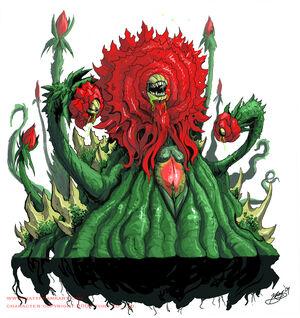
Wait a second. This sounds familiar. Wasn't there a monster that was part plant, part-human? We're sure Japan has several, but the one that comes to mind is Biollante - a rose created out of plant DNA, Godzilla gene scraps, and the life essence of a botanist's dead daughter. If Kac's stuff gets anywhere beyond a basic gene marker, we're screwed.

The fun does not stop at crazy hybrid flowers, no siree! Kac also made six seed packs, each designed to look pretty and house mutant plant seeds of doom. There were six packets made for the Weis,man Art Museum (Minneapolis, MN)  in 2009. They are not available to the public insofar as I know, but the mere thought of the Edunia breeding is enough to scare me after Biollante. Do not want man-plants.

Wednesday, February 29, 2012

"They Actually Eat That:" Plantains.

(Apologies for the delay. I had a paper to write.) 

 So, it's time for another installment of "weird things Kuro found while shopping on Devon Avenue!" After doing an entry on Goya, the giant guinea pig, I came across these chips in Devon market. They're made of plantains, which are not usually found in North American cuisine.


But what exactly is a plantain, anyways?

A plantain (Musa) is kinda like a banana, only smaller and green. They are native to Indiaand Southeast Asia in general. However, they are popularly grown in the Caribbean and Africa as well. They are frequently used in Caribbean, African, Indian, and South American cuisine. Other areas such as the Philippines and some southern states use them as well. 

A plantain looks like a slender, green banana. If you manage to find ripe ones, they will actually be brown; don't let that throw you. They can usually be found in the fresh produce sections of most supermarkets.


Plantains and bananas are indeed closely related, but before you decide to try the other banana out of curiosity, there are a few key differences you should know. For starters, plantains cannot be eaten raw; they must be cooked regardless of what growth stage they are at. If cooking a banana sounds disgusting to you, plantains are a lot starchier than bananas. They are treated more like tubers (i.e. potatoes) when cooked. In short, they're almost vegetables.

Since the plantain is darn close to a potato, plantain chips are a rather popular snack food. They can also be cooked with a variety of spices. There are recipes for plantains from Ghana, Puerto Rico, and India. Yes, they have plantain curry. Pick your favorite way to eat 'em and dig in.

Sunday, January 15, 2012

Little Shop of Horrors: Mandrakes.

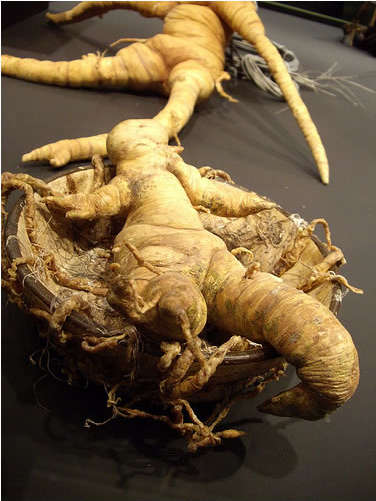
From www.columbia.edu.


If you are familiar with the fantasy genre, the mandrake (or mandragora) is one of the most notorious plants you will ever come across. The mandrake, a plant with a humanoid root, screams very loudly whenever it is pulled from the ground, enough so that all who hear the scream die instantly. It is, however, magically potent, so people have devised all sorts of crazy tricks to get one. This, for example:

"A furrow must be dug around the root until its lower part is exposed, then a dog is tied to it, after which the person tying the dog must get away. The dog then endeavours to follow him, and so easily pulls up the root, but dies suddenly instead of his master. After this the root can be handled without fear."

Yep. People would kill puppies to get a mandrake. Mandrakes do exist, but they are not worth killing anything over. 

The plant is actually rather pretty.


Real mandrakes are plants of the genus Mandragora. It is in the nightshade family, meaning that it is related to (obviously) nightshade, tomatoes, eggplants, tittyfruit, datura, and at least one other weird plant on this blog. The type species is Mandragora officinarum, which has been around in Europe (and Israel?) since time began. All parts of the mandrake plant are toxic and should be handled with care.

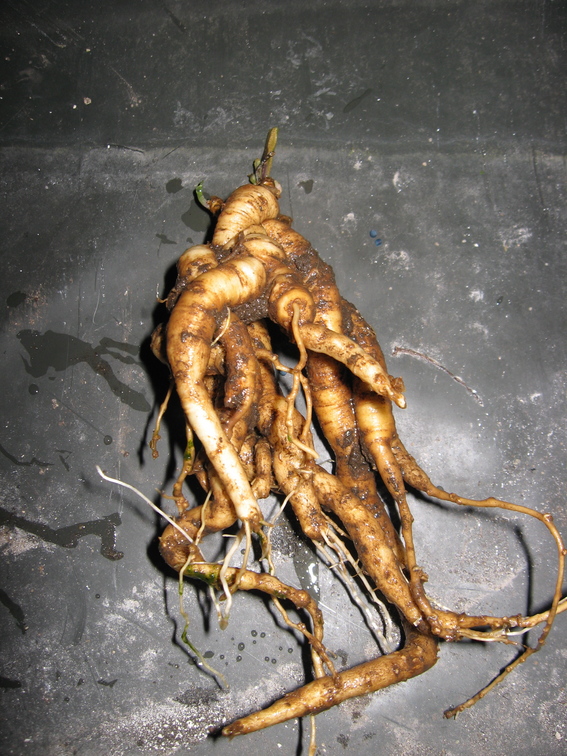
No, plants have not become so freaky that they have evolved the capacity to scream. Mandrake roots, however, can sometimes look uncannily like people. The way the roots split sometimes create a 'stick figure.' They are not alone in this regard; a few other plants, namely ginger and ginseng, also tend to look like people. Pythagoras, the creator of the Pythagorean Theorem, was such a staunch vegetarian that he refused to eat beans because they resembled human fetuses. Imagine how he would react to a mandrake!

IT'S PEOPLE!


The 'magic' effects of mandrake probably originate from the chemical cocktail found in every part of the plant. Along with several other compounds such as scolopomine and atropine (both trippy on their own), mandrakes have their own substance called mandragorin. Mandragorin produces a hallucinogenic, dreamlike state of mind; in spiritual terms, this is a shortcut to astral plane. They have also been used as medicine for infertility (magic man-plant, remember?) and as a painkiller by many an ancient physician. The jury is still out on whether or not mandrakes have the same zombie-making potential as datura.

Mandrakes are still used in modern tweaks on ancient religions such as Wicca. Bear in mind that some of the mandrakes talked about in ancient texts may instead be referring to things like ginseng and ginger- plants that also have roots that look eerily like people.We really cannot blame them for the mistake (the resemblance to people is uncanny) but please do not take a draft of mandrake to put more junk in the trunk. You might not wake up.

Go catch an Oddish instead.

Sunday, December 25, 2011

Little Shop of Horrors: Poinsettia.

MERRY CHRISTMAS! I'm not going to go "it's the most wonderful time of the year," but if Christmas makes you happy, I hope you had a good one. Today's entry is just as festive as yesterday's, so hold onto your Santa hats!


Around this time of the year, poinsettia pop up all over grocery stores, flower shops, and advanced nurseries.The poinsettia (Euphorbia pulcherrima) is a classic Christmas plant owing to its red and green coloration. It is a shrub-slash-very small tree native to Mexico. It is named after Joel Roberts Poinsett, the first United States Minister to Mexico. Since ancient times, its red leaves have been used as a dye and to soothe fevers.

The poinsettia has a number of legends concerning its origin in its native Mexico. One legend has it that an angel told a child to pick some weeds from the road and bring them to the altar of a church; the poinsettia resulted. The poinsettia's starlike shape supposedly represents the Star of Bethlehem. The red could also be from Christ's dripping blood. No matter how you slice it, some religious significance can be attached to this plant.


The "flowers" of a poinsettia are actually specialized leaves called bracts. The actual flowers of a poinsettia are in the center of these bracts. The bracts reach their brightest when left in the dark for half of the day. The ideal brightness occurs after 12 hours of darkness for a few days- don't expect an instant change. 

The first poinsettia plants were introduced to the U.S. in 1825 by, go figure, Joel Poinsett. However, much of the cultivation was done almost exclusively by the Ecke family. Using grafting to make the plants become more tidy than their weedy counterparts, they became the sole cultivators of the popular, bushy poinsettias we know today. Others eventually figured out the grafting trick, but the Ecke family still owns a large amount of the poinsettias on the market - roughly 70% in the U.S. and 50% worldwide. In short, we owe them.

In case red and green was not festive enough, have some "ice crystal" poinsettias.


Contrary to popular belief, poinsettia are not deadly to humans. They are only slightly poisonous. The most eating poinsettia will do is make one vomit. To put things in perspective, a 50-pound child would have to eat 500 poinsettia leaves to feel any ill effects beyond that. We would still advise keeping pets away from the plants, however; plants have poison for a reason. Look, don't eat.

Monday, November 7, 2011

Bio-Art: One Tree(s) Project.

Plants are often overlooked when it comes to crazy artistic projects. Our minds are so entangled with freakish animals when it comes to science projects that weird plants get hardly any notice. Fact is, many 'taboo' procedures done on animals have been done on plants for ages. That includes splicing, super-inbreeding, and, of course, cloning.


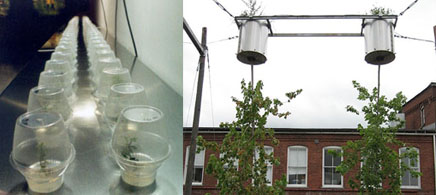
Natalie Jeremijenko had a unique idea: Since plants are cloned arbitrarily, she would plant clones of the same tree in various places. The only difference, then, would be the environment they had been planted in. There are over one thousand cloned trees scattered around the Bay City area, and a few saplings in an art gallery as well.

This project brings the question of nature VS nurture to the fore. Now that we can essentially photocopy life, what effect will the environment have on genetically-identical trees? Since trees grow slowly, the results are not quite certain. The project is ongoing, so if you live in New York, do check those trees out. You can even get one for your desktop!


Now, the big question: Is it art? It sounds more like a science experiment gone wild, but there is also a strange beauty to the idea of having the same tree in many places. Post below. :)

Wednesday, September 7, 2011

"They Actually Eat That:" Rhubarb.


If you ever see "rhubarb" on a menu, chances are you will wonder what it is unless you are a gardener. Rhubarb is a leafy green plant with a bright red stem, and has been used as a laxative for centuries (starting in China).  It is now grown worldwide. Rhubarb is usually found in dishes with strawberries, because red and red totally go together, dahling. 

No, you aren't eating the nice, green leaves of the plant. You're eating the stems. Just the stems.


The leaves of rhubarb are poisonous. They contain high levels of oxalic acid, a corrosive and nephrotoxic substance found in naturally high amounts in rhubarb. Spinach, often touted as one of the healthiest plants around, contains enough of this stuff to be worrisome (and would make a great entry on its own). The poison is usually used as a cleaner, especially for removing rust. Symptoms of rhubarb poisoning include weakness, burning in the mouth, difficulty breathing,  coma, and, umm, death. We warned you about the glue; this is even worse.

Crystal death.
 

Cooking does not get the toxins out of rhubarb. Ordinarily, one would have to eat a lot of rhubarb (5 kg of leaves) to die from it. When rhubarb was used as a cheap vegetable in WWI, people ate enough of the leaves to die of *gasp* RHUBARB POISONING.  There is still a small amount of the toxin in the stem, but it would take eating rhubarb like a crack addict to make one throw up. (Disclaimer: We are not responsible for the consequences of rhubarb being dealt in alleyways. K. Thanks.)

Remember that rhubarb is poisonous next time you chow down on strawberry-rhubarb pie. You have just eaten one of the fugu-ish members of the plant world.

Wednesday, August 10, 2011

"They Actually Eat That:" Roses.

Ah, roses. They're the flower of romance, encompassing all the danger and velvet pillows involved therein. Red roses have been recognized around the world as symbols of particularly classy love. They can also state one's political position in Europe, but roses are mostly about love. Go get some for your significant other on Valentine's Day, if you celebrate it.


Oh, and they're also a popular flavoring. Knew I was forgetting something.

They Actually Eat That?! 

Eating roses is nothing new. For a long time, rose hips were considered an anti-magic potion in Rome. The protagonist in Apuleius's novel The Golden Ass is required to eat some roses to leave his donkey form. This stems from an actual belief the Romans had about roses being used to ward off black magic, from evil eye glances to vampires. Eating them was a good way to keep one from being an ass.

Although being a donkey did get one chicks.
 

The practice of eating roses survives today. That was not an innuendo. Rose-water is very common in Asian and Middle Eastern cuisine. It can be used for medicine - roses contain Vitamin C, making them one of the few legit Chinese medicines out there - or just for flavoring. Interestingly, there is no mention of roses being used as an aphrodisiac (again, unlike the rest of Chinese medicine).

Rose Turkish delight. Exactly what it sounds like.
 

Europeans and Americans use roses in cuisine, too. Rose syrup is a popular flavoring in France, considered one of the strongholds of Western cuisine. The same syrup is used to make rose marshmallows and scones in the U.S. The authoress has also personally tasted rose ice cream. Seek and ye shall find - chances are there's some lovely rose food near you!

Saturday, April 2, 2011

Freak Week II: Semper Augustus and Tulipmania.

Happy April 2nd, everyone! What better way to celebrate the coming of Spring (in one part of the world) than with a flower?


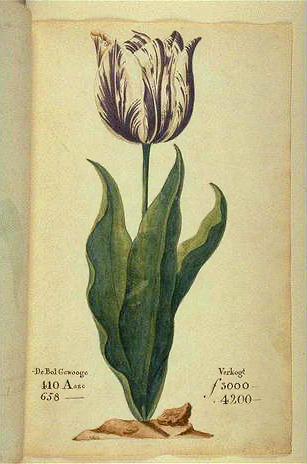
Yes, those are tulips (genus Tulipa), one of the most popular ornamental flowers in the world. These are very special types of tulip called Semper Augustus that was grown back in 17th-century Holland. Do not try to look for one in a flower catalog. You may find similar-looking tulips, but Semper Augustus is an extinct strain of tulip.

What the hell happened?

Back in 1593, tulips were introduced to Europe via the Ottoman Empire. Since they were new and very hard to grow (a tulip bulb only forms once every 7-12 years), they were seen as status symbols. The Dutch became particularly fond of them.


They might STILL be crazy.

By 1637, the Dutch had gone completely nuts raising tulips. They not only had red, yellow, and white varieties, but began to breed tulips with odd "flames" and streaks on their petals. Several of these odd tulips, including the Semper Augustus and the Viceroy, were so rare and expensive that people would sell the farm to get just one bulb.


Watercolor drawing of a Viceroy. Not worth as much as the actual flower.

No, seriously. Here is what people paid for a Viceroy, which was not even the most expensive bulb in existence:

Two lasts of wheat 448ƒ
Four lasts of rye 558ƒ
Four fat oxen 480ƒ
Eight fat swine 240ƒ
Twelve fat sheep 120ƒ
Two hogsheads of wine 70ƒ
Four tuns of beer 32ƒ
Two tons of butter 192ƒ
1,000 lb. of cheese 120ƒ
A complete bed 100ƒ
A suit of clothes 80ƒ
A silver drinking cup 60ƒ
Total 2500ƒ


In modern money, that's around 1,250 USD. Semper Augustus ran for at least twice that. That's a few bills. It is also a lot more than the average Dutch worker made.  Hell, see the cows on that list? Cows are expensive animals. These were very pricey tulips.

Rare color patterns like those found on the Semper Augustus and Viceroy were caused by the tulip breaking virus. It is spread by aphids and also called "tulip mosaic virus," "Lily streak virus," or simply "TMV." This virus causes abnormal white streaks in the tulip's petals. Modern strains of tulip with streaks are just bred that way; no tulips were harmed to make the bulbs available in magazines.

Utilizing this virus to give tulips unique patterns came with a downside: The virus severely stunts the growth of the plant. Successive breeding accelerated this effect so much that the bulb did not develop into a flower, thus ending the genetic line.


People lost millions breeding impermanent tulips. There were investment pamphlets advising against tulips, frequently citing religious material. Much like homosexuals and abortions today, tulips were considered against Christian morals.  We hope they were not likening it to genitalia, but given how the Christian mind works, it would not have been out of bounds.


Suggestive, much?

Since then, "tulip mania" has been used to describe any economic bubble. The dot-com bubble, expensive ball pythons, and the subprime mortgage crisis have all been compared to the tulip craze in Holland. Although reports of exactly how many people got into tulips are likely exaggerated, some people were certainly mad about flowers.


Tomorrow: Incense and peppermints...and White Widow.

Sunday, March 20, 2011

Little Shop of Horrors: Solanum mammosum.

Forgive us for changing the title for plant entries from a rather awkward modification of "Creature Feature" to something more fitting. Plants really are weird enough to warrant their own header, even when done sporadically.


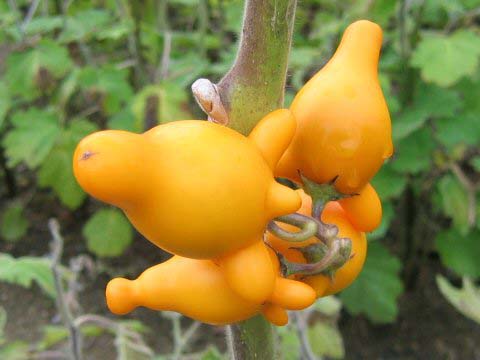
Like this one. Plants are full of wonderful "what the hell?" fodder that surfaces by accident in one's daily searching. What the hell is that? Why does it look like a cow's udder? What does it taste like?

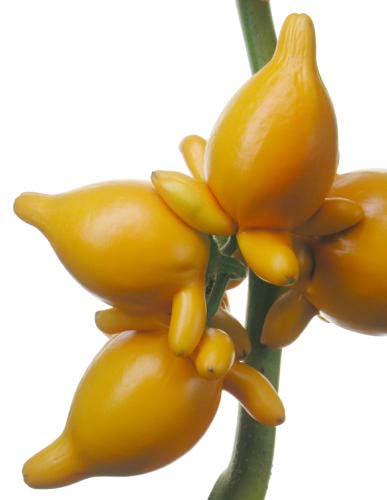
In order: That is a Solanum mammosum fruit, we have no idea why it looks like a cow's udder, and nobody who has tried it has lived. The name Solanum should have been a hint; it's related to nightshade and datura. Were you really expecting it to be innocent (y'know, aside from looking like something out of a Japanese porno)?


Innocent this fruit is not, and hooo boy does it show. The scientific name, Solanum mammosum, suggests tits; the fruit itself resembles a human breast on one end and a cow's udder on the other.  Common names for it include nipple fruit, tittyfruit, cow's udder, or "Apple of Sodom." The Japanese call it "fox face" (wow, REALLY?) and the Chinese simply refer to it as a five-fingered eggplant. Talk about seeing the same fruit from different perspectives.

The, umm...tittyfruit is native to South America, but has been cultivated as an ornamental plant almost everywhere. The Chinese are particularly fond of it due to its bright gold color. It can also be used as a treatment for certain ailments or for washing clothing. Nobody mentions using it for...pleasure. Probably a good thing.


No matter how tempting it is, do not eat this fruit. Unlike eggplants, tomatoes, and other 'innocent' Solanaceae, tittyfruit is toxic. The plant will kill you for molesting its naughty bits.

Tomorrow: MEERKATS! 

(Why, yes, my brain is, in fact, baked thanks to recent tests and a Sappho paper.)