Showing posts with label australia. Show all posts

Tuesday, August 27, 2013

Tunicate Week: Sea Tulips.

Back to tunicates. Tunicates are sessile chordates that make everything else go "WTF?" with their sheer bizarre lifestyles. They start as tadpole-like larvae, find a place to settle down, then, umm, reabsorb their primitive spinal chords and brains. They also use cellulose to build the advertised "tunic." In fact, if they didn't eat things and have larvae, we'd be darn sure tunicates were plants.

Apparently linked to Calvinism, somehow?


...weird plants that prove that Hell is probably underwater. Yep.

Those strange, stalky things are sea tulips. Like all tunicates, sea tulips are effectively spineless vertebrates, siphoning in plankton through one hole and pushing water out through the other.  If you wish to tiptoe through the sea tulips, head to the waters around Australia and New Zealand. Sea tulips are actually among the friendlier things there, so please watch out for the other toxic fauna instead.

Sea tulips are the largest individual tunicates out there. They can get up to a meter (roughly a yard for us Americans) long. It's worth noting, however, that some free-swimming tunicates can form longer chains. For something without a true spinal cord, a meter is still pretty impressive.

Clearly the easiest underwater photograph ever. Source.


Sea tulips are symbiotic with another strange, sessile animal: the sea sponge. Many sponges, including the symbiotes present on these tunicates, have predator deterrents - bad taste, poison, and so on. Remember that both sponges and sea tulips lack teeth, so chemical defense is the best bet for both of them. These sponges also provide a lovely array of colors for your viewing pleasure.

Indeed, that seems to be the main purpose of these things: They look really neat. They also lend some credence to the ancient idea that everything on land has a counterpart somewhere in the ocean. If nothing else, sea tulips make for a neat, living bit of undersea scenery that should really be used more often. Even the fields of the sea have strange, filter-feeding flowers.

Friday, July 12, 2013

Little Shop of Horrors: Queen Anne's Lace.

Did you know you might have wild carrots growing in your backyard? It's true. Most flower guides, however, will not mention that the plants are in fact carrots. If you've ever wondered what carrot flowers look like, wonder no more. Anyone who's taken a hike through dry fields or alongside roads  may well have seen this bloom around:

Source.


 This is Queen Anne's lace, AKA the wild carrot (Daucus carota). It originated in Europe, but has since become wild in the United States and Australia. It is relatively easy to identify by its many clusters of small, white flowers in a lacy, overturned umbrella. It's largely considered a weed, but more on that later.

The plant supposedly gets its name from one or both of two Queen Annes: one from Denmark, who was in turn the mother of Anne, Queen of Britain. Legend has it that the red flower in the center is from an accidental prick of the needle when Queen Anne was weaving said lace. Of course, its real purpose is to attract insects, but that's not nearly as fascinating, is it?

Although a close relative of the domestic carrot, the wild carrot can be considered either helpful or harmful. Mostly, it is a wild weed perfectly capable of consuming one's garden. However, certain plants such as tomatoes may actually grow better in the presence of Queen Anne's lace. Queen Anne's lace is also used for several medicinal purposes, including general skin issues (burns and the like) and, surprisingly, anything relating to menstruation. If carrots can cure that time of the month and/or be a contraceptive, I'm on board.


That said, it is not advised that you attempt to eat wild Queen Anne's lace for a number of reasons. The first is that it strongly resembles poison hemlock, so a misidentification could be lethal. The other is that wild carrot roots are not nearly as tasty as the carrots one finds in the supermarket. The root becomes woody after a very short amount of time, and even then, there isn't much there to eat. It'll save you

Saturday, March 30, 2013

Killer Cute: Koalas.

Is there anything cuter than a koala? No; koalas (Phascolarctos cinereus), which by the way are eucalyptus-munching Australian marsupials, look more like teddy bears than actual bears.  It's really hard to take a koala seriously. A koala could tell us that Yurlungr is awakening and the world will end as a result, but we'd bee too busy melting into baby talk to care. Awww, wookit his widdle head!


Oh, wait. Shoot, it's from Australia, the land where everything wants to disembowel you! Run for your life- KOALAS!

Actually, they aren't that bad. Koalas just have killer claws. These claws can dig into the bark of trees no problem; imagine, for a second, what they could do to your soft flesh. There are innumerable bacteria that will make those claw marks even nastier. Also, they can bite, but anything with a mouth can bite. Anything "stuffed animal" suddenly went out the window with those claws.

From scienceblog.com. Point made regardless.


Then there's the thing called a drop bear. Certain subspecies of koala have evolved into carnivorous little buggers that drop from their perches onto the unsuspecting Americans below. Rumor has it that wearing forks on your head or smearing Vegemite behind your ears can ward off drop bears, but don't hold your breath. Luckily, dropbears are about as real as jackalopes. You may take the forks out of your hair, now.

Here's the real deal: Koalas are slow, stupid, and usually asleep. 80% of their day is spent asleep. Their brains do not fit in their fuzzy little heads because they are so small. Anyone unfortunate enough to get hit by a koala who fell out of a tree was simply in the wrong place at the wrong time. It's not like these things are out to get us.

While not as dramatic as the hippo, koalas can still be very nasty animals. Approach wild koalas with caution. They may look like teddy bears, but they have claws like real bears. You don't know where they've been. On the bright side, at least they cannot crush your head with their rears like our friend the wombat. Now that is lethal cute.

Saturday, March 9, 2013

Newsflash 2: Many Finding Nemo Species Endangered.

Now for something completely different but nonetheless heartbreaking: A lot of the species in  Finding Nemo are in danger of going extinct. Scientific American put out this little tidbit in 2011:

"One in every six species related to characters in the movie Finding Nemo is threatened by extinction, according to a new study out today. The authors examined the extinction risk of 1,568 species within 16 families of well-known marine animals represented in the 2003 Academy Award-winning animated film.

All species of marine turtles (“Squirt” and “Crush”) and more than half of all hammerhead sharks (“Anchor”), mackerel sharks (“Bruce” and “Chum”), and eagle rays (“Mr. Ray”) are threatened. Seahorses (“Sheldon”) are the most threatened group of bony fish in Finding Nemo, with two in five species at risk of extinction. Clownfish aren’t safe now, either, and they certainly weren’t in 2003 after the film’s release when local RotoRooter dispatch centers received calls from families whose kids flushed the fish after watching the movie. Charisma, in other words, is not enough. Despite a demonstrated need for conservation action, regulation of trade in endangered marine species is severely deficient for those with high economic value, like sharks."

- Source. 


So even though the film reeeeeaaaalllly pushed "kids, don't snag fish straight from the reef," a bunch of kids went and did it because NEMO! Yes, clownfish are adorable. No, one should not go all the way out to the reef to get one of a kid who has not kept anything beyond a goldfish. Aquariums are complex, difficult to maintain systems, with saltwater (as Nemo's would be) being even harder than fresh. Not cool.

It also really doesn't help that Australia has been hit hardest by global climate change. Much of the Great Barrier Reef is suffering from bleaching - not tossing bleach in there, but a strange whitening of the coral. It's pretty much the equivalent of chopping down an underwater rainforest.Yeah, that pretty reef in the movie won't be around much longer.

Remember, do your homework when buying exotic fish. Buy captive-bred only. The reef's suffering enough; harvesting is the last thing it needs.

Tuesday, February 19, 2013

Creature Feature: Spiny Leaf Insect.

There is a rather bizarre game that I like to play in the shower at my local health club. For whatever reason, there are a strange number of small flies in the women's locker room - usually one or two to a stall. (I haven't said anything; they've been there for as long as I can remember, and I'd presume the various renovations they've done would have fixed something.) My goal, as soon as I hit the shower, is to go fly-hunting. I show no mercy; rather, the night is not complete without swatting one fly on the marble. After all, I'm only selecting out the flies who aren't fast or clever enough to camouflage themselves, right?


That said, some insects, like this spiny leaf insect (Extatosoma tiaratum), have stunning camouflage. It is so good at camouflage that it is also called "Macleay's Spectre." This insect is native to Australia and possibly New Guinea. It is related to walking sticks despite looking a fair amount like a mantis, and is not a true leaf insect at all.

One word can sum up the spiny leaf insect: Impressive. It's large, for a bug, able to stretch across a grown man's fingers. Both sexes will occasionally curl their long abdomens like scorpion tails when threatened, creating a sort of mantid-scorpion look. Again, that camouflage is a real treat; it even has thorns. 


There are a number of interesting things about spiny leaf insect reproduction. For example, the males can fly, and only the females have that godly camouflage. The females, after getting knocked up, flick their eggs out of their bodies and onto the forest floor. These eggs hatch better in cooler temperatures, - under 25 degrees Celsius. Also, the girls are parthenogenic- that is, they can produce other female progeny without a male.

Know what's awesome? These unique insects make excellent pets. They can be found in schools and laboratories as test animals, and are very good for the first-time insect fancier. They are vegetarians, and can feed on any number of plants. Find a care sheet on them if you're interested; I'm sure they're around. It would be hard to find a better pet or display insect, if that's up your unique alley. Look closely at that tree branch- it might be a bug.

Friday, February 15, 2013

Creature Feature: Major Mitchell's Cockatoo.

Who wants something more friendly than an entry on eating hearts? You know you do. Something bright and colorful makes winter nice. So, here is a healthy dose of pink:

From Wikipedia.


 Rounding off Valentine's Day is the peachy-pink Major Mitchell's Cockatoo (Lophochroa leadbeateri). It is also called the Leadbeater's Cockatoo, or, simply, "pink cockatoo." It is native to central and western Australia, which is a semi-arid climate.

The above picture has not been altered: Mitchell's cockatoos are really pink, red, white, and yellow. They stand out.  Pink cockatoos are widely considered the most beautiful of all cockatoo species, even by the guy who named them. Sir Major Thomas Mitchell - as in, the guy the bird was named after -  said that, "Few birds more enliven the monotonous hues of the Australian forest than this beautiful species whose pink-coloured wings and flowing crest might have embellished the air of a more voluptuous region". There's no region I can think of where a bright pink parrot wouldn't stand out.

Strangely, these giant pink birds are probably among the most primitive of all cockatoos. It shares a yodeling cry with the corella parrot, which is definitely not a cockatoo. The rounded wing shape is more or less unique to cockatoos, but this bird has the pink plumage and pale bill of other Australian parrots. It's a sort of transition cockatoo.


Anyone who has ever owned a non-Petco parrot will tell you that parrots can be very long-lived. One such parrot happens to be a Mitchell's Cockatoo named Cookie, who is now 79 years old. He is the only surviving member of the zoo's original set of animals from 1934. Unfortunately, Cookie has officially been taken off-display as of June 2012; it's a shame that I couldn't snap a good photo of him for this blog. If there was ever a candidate for a real phoenix, this parrot might be a good base.

No, these beautiful parrots do not make good pets. Parrots - big parrots, not cute little parakeets - are horribly high-maintenance birds, requiring tons of socialization and cleaning. Cockatoos are considered particularly poor pets. Major Mitchell's is not exception, but if you must get one, get a female. Make sure the bird was captive-bred; although not threatened, these birds are on the decline due to habitat fragmentation. Keep the pink cockatoos alive, mate!

Friday, January 18, 2013

Creature Feature: Perentie.

Blah, porcupines. No matter how neat porcupines and horned gophers are, this blog needs more badassery. Enough about rodents. Let's just dive right into today's dose of badass, shall we?


Crikey! This fine Sheila is called a perentie (Varanus giganteus), and she's native to Australia. Perenties, being monitor lizards, are carnivorous and have astounding forked tongues. Like many monitors, they also have amazing skin patterning.

Crocodile Hunter jokes aside, perenties are the largest lizards in Australia. They can get over 2.5 meters (8 feet) from head to tail. Larger adults can even take down kangaroos, which, it merits reminding, can kick most predators to death and drown others. Perenties will eat virtually any kind of meat, however...including each other.

It looks so chill...then you see the claws.


Some of you are probably wondering why monitors are called "monitors," anyways. The answer lies in one particular behavior that many monitors, including the perentie, exhibit: they can "tripod," i.e. stand on their hind legs using their heavy tails like an extra foot. They do this to "monitor" their surroundings - just like we use a monitor to see what our computers are up to.

Despite their size, perenties would rather run than fight. They are notoriously shy. Perentie claws are meant to dig burrows in a flash. They can also climb trees very well. Excellent camouflage means that, all things considered, they are even hard to see while standing still. Guess that hardcore ecology down under has taught them a thing or two over the eons.

As with other types of monitors, yes, some people keep perenties as pets. They go for roughly 2,000 USD and you definitely need a license to keep one. There is still debate over whether perenties are venomous or not, but given the damage those teeth might do regardless, best leave handling them to people experienced with reptiles. Get a plushie instead.

Friday, December 28, 2012

Creature Feature: Dugong.

Ever wonder how stories of mermaids got started? Like, who decided to put a hot lady on a fish's body? It was obviously someone very drunk and/or creative. It's not like a normal person could look at any sea mammal and go, "hey, that looks like a woman with a tail! I should say hi."

Source.


Oh, hell. With a tail like that and a little bit of liquor, that could totally pass for a mermaid.

That, by the way, is a dugong (Dugong dugon). No, not Dewgong- the animal came first. Dugongs are sirenids, making them related to manatees and, more loosely, elephants, tenrecs, and hyraxes. They live in most of the warmer waters around the world, including those around Africa, Australia, China, and the islands around those areas. They are mostly herbivorous, but some populations are omnivores, munching on invertebrates when grass is not available.

For those of you curious about the nomenclature, the odd name comes from the Malayan word for "mermaid." The idea seems pretty universal, with people all the way in Kenya considering dugongs feminine. Indonesians even consider them reincarnations of women. If any sea mammal can be considered a basis or mermaids, this is the one. Instant mermaid: just add rum.

(c) Mandy Episton.
 

That said, outside of being mermaids, dugongs are fascinating creatures. The tail is fluked like that of a whale or dolphin; this allows it to 'stand' in shallower waters and keep its head above the sea in order to take a breath. Speaking of, dugong lungs are very long, extending all the way down to their kidneys. This arrangement helps balance out the dugong's buoyant blubber.

The dugong is always culturally-significant in the areas in which it is found. Catching a dugong can be seen as either good or bad luck, depending on where you go. In Thailand, the tears are an aphrodisiac; the Indians are more rational and use its meat for sexual potency. The list of things dugong can be used for goes on, possibly into the Bible.

Under the sea, under the sea~


Alas, the dugong is nearing endangered status, and it's entirely our fault. Its meat, oil, skin, and bones are all valuable. They are big, docile, and slow-moving, making them easy targets.  Let's not even get into how humans are polluting the ocean and cutting up sea cows with boats. Once you learn that everybody eats dugong meat, all other reasons seem miniscule by comparison. Luckily, most areas with dugongs have some regulations on hunting them. Good luck enforcing that.

Oh, and yes, dugong has a Poke-sona in Dewgong, the evolution of Seel. Real dugongs, however, cannot handle icy water period, let alone swim through it at high speeds. Sorry, but this Water-Type will not be learning Ice Beam aaaany time soon. Still, save the mermaids!

Monday, November 12, 2012

Bio-Art: Victimless Leather.

After playing more Pokemon White 2, I was once again reminded of PETA. For eff's sake, humans are omnivores, but does that really mean that we need to use animals for clothes? We in the modern world like to think that we're a bit more advanced than that. 


Well, it turns out that we're a lot more advanced than that. This is a miniature leather jacket...grown from rodent stem cells.It is two inches long and lives in a bio-reactor that serves as a "body" to keep it from decaying.Surprise surprise, it was done by the Australian SymbioticA as part of their Tissue Culture and Art Project.

Along with "Disembodied Cuisine," "Worry Dolls," and "Pig Wings," "Victimless Leather" is part of a series on PETA's dream world: a futuristic vision in which no animals are harmed except for the occasional lab rat or frog. It puts viewers into direct confrontation with the fact that, yes, humans use animals for weird things like clothes. It also puts forth the idea of a living garment - albeit one that can only survive in that little bubble up there.

The jacket itself consists of living mouse tissue over a polymer modeled after a coat. Once the polymer base has degraded, the flesh retains the shape it was mounted on. In theory, this could at least create sheets of victimless animal skin for sewing, if not remove the need for sewing altogether. It would save people a ton on sewing supplies, if not alleviate some suffering in the world.

Could this really replace leather, though? Leather has been a sign of prosperity for some time now. It's expensive, and cows are also useful for meat and milk. I also have to admit that there's a certain thrill to having something genuinely made from a dead animal. Until the elite stop wearing leather and start wearing coats made out of mouse cells, leather will retain its status as a classy fabric. Sorry, PETA.

Saturday, November 3, 2012

Blasphemy Week: Irukandji.

There is no better way to disprove "Jesus loves you" than to look at Australia. Kangaroos? They're smart enough to drown dogs. Speaking of dogs, dingoes- you know, the canids that eat babies - originated from the pet dogs brought over by Aborigines. See that koala? That'll kill you, too. Australia is the monster ballad of "HUMANS SHOULDN'T BE HERE," as if an island of venomous snakes was not bad enough. Oh, Australia has those, too, by the way.

So how do you choose one unholy terror in an island chock-full of demonic wildlife? You go a little bit outside the island and into the ocean. Then you die, because you didn't count on this thing giving you a tap on the shoulder:

Source.


That little jellyfish is called an Irukandji. It is found only in the waters of Northern Australia - y'know, as if the rest of the island wasn't trying to kill you already. There are several species in at least two different genera, meaning that those waters are a breeding ground for a number of unknown, lethal jellies. It eats fish, but incidentally, anything that touches it dies.

Yes, it really is that small- only 2.5 centimeters at the bell. Since this is a jellyfish we're talking about, it's also that invisible; you don't even see the thing coming. Its tentacles are finer than human hair and can get up to a meter long. Good luck detecting it. And, yes, it is also that venomous.

Source.


The Irukandji is officially the most venomous animal on the planet. Five minutes in, most humans (y'know, the ones without mongoose blood coursing through their veins) start feeling achy in the back, muscles, and generally all over, as well as sweating, anxiety, and other ill signs. If left untreated, it becomes a pain so excruciating that survivors tell doctors to kill them.  Even morphine fails to dull the pain this little jelly dishes out.

So we have a tiny little creature that is not only invisible, but also manages to encapsulate sadism so thoroughly that people beg for a merciful death. This creature was actually horrifying enough to make it into Franken Fran. Still think that there's a loving God? The jellyfish disagrees.

Friday, October 19, 2012

Creature Feature: Australian Hopping Mouse.

Australia is both the land of weird and the one place where everything is out to kill you. Seriously, even the koalas and kangaroos are capable of leaving nasty marks, and there are few more humiliating deaths than "head smashed by a wombat's rump." Dingoes- you know, the things that eat babies - started out as dogs brought over by Aborigines, which then went right back to being wolves. The rule of thumb is, if it has a placenta, it doesn't belong in Australia. That includes humans.

Thing is, there are exceptions to every rule.


There are roughly five species of hopping mouse (genus Notomys), with five others completely extinct. Several are vulnerable. All are herbivores, feeding on whatever seeds, roots, and leaves they can find. They live in most arid areas of Australia.

Australian hopping mice are actually mice. As in, rodents. As in, they have a placenta and did not come there as stowaways with humans. That makes them weird by Australian standards. Although not the only native placentals there, these jumping mice are among the few.

Of course, this is Australia. Everything that comes to or lives on Australia becomes weird, aggressive, or both. Since diverging from the common ancestor with normal mice, hopping mice have become larger and, well, hoppier. The good news is that they reproduce a little more slowly than other rodents. Insofar as we know, they have not killed anybody, even with unintentional parasites.

A Dusky Hopping Mouse. I promise, it won't bite.


In this case, the hopping mice have several similar rodents to call distant cousins. The kangaroo rat and jerboa are both desert rodents with parallel adaptations. It's not that somewhere along the line, kangaroo rats were transported to Oz; this is another cool example of convergent evolution.  Desert mice suddenly becoming bipedal seems to be a trend.

Hopping mice, like jerboas and kangaroo rats, are capable of surviving on very little water. They do not drink. They also have larger ears than most rodents; as in jackrabbits, these large ears help redistribute heat. Their urine has less fluid than that of the average mouse. Plus, they're adorable. Chalk another one up for convergent evolution.

Hopping mice are so adorable, in fact, that Australia will let people keep some of them as pets. The two species up for consideration are the Mitchell's Hopping Mouse and the Spinifex Hopping Mouse (which can already be kept as a pet in New South Wales). This study from 2010 favors keeping the Mitchell's as a pet in order to preserve the species. That's right: Even Australian customs might be letting this one slide. YAY.

Monday, October 1, 2012

Bio-Art: SymbioticA Worry Dolls.

Art is meant to throw the status quo into question. It's meant to make you think. At the same time, you're supposed to 'get it,' which cannot be said of much modern art. Good art is not only aesthetically-pleasing, but comprehensible. That applies to bio-art as well.

Credit goes to the lab, obviously.


Thus SymbioticA's Semi-Living Worry Dolls. They are based off of Guatemalan talismans that effectively absorb the worries of the owner. The idea is that they "worry in the person's place." These particular worry dolls just so happen to be made of bone and muscle tissue, courtesy of Australian lab SymbioticA.

If the name SymbioticA sounds familiar, it's because we've already covered at least one of their projects. They also did Pig Wings, which played with gallery-goers' expectations, and Disembodied Cuisine, which was part of the no doubt PETA-desired "victimless utopia." Both of these have features on this blog.  I may have to make a tag for this Australian bio-art team.

Now we have the symbolism of the worry doll to factor into science. Take three guesses of exactly what worries these dolls are meant to absorb. Go ahead. I'll wait.


If you said "stem cell research," "cloning," or anything related to the fears about genetic engineering, you get a gold star. When it comes to manipulating life, progress is inevitable. Science itself takes no responsibility for how the research is used, so it's up to us to worry. What should we do with the ability to manipulate life? According to Zurr, one of the workers at SymbioticA, we have to become "post-humanist. Species is not important."

The team at SymbioticA took things to an even further level: If growing artificial cells was not enough, they were also grown in an artificial womb. In-vitro fertilization is already alive and well; it won't be long until 'natural' sex becomes obsolete, or so people fear. Personally, I don't think sex is going to die any time soon. If it worries you, however, we have a doll for that.

Saturday, August 11, 2012

Creature Feature: Hermit Crabs.

So I'm now back in a little area of Illinois I like to call "Suburban Hell." There are whole strip malls that have died just by being in this suburb. Most tragically, the local magic shop, and several other stores in its little strip, have decided to close shop. Even other suburbanites say my suburb sucks.

That said, here's a critter known for moving: the classic hermit crab.


The name "hermit crab" is a little bit misleading; they are more closely related to squat lobsters and porcelain crabs than 'standard' crabs. They are usually native to tropical regions or completely marine. There are several kinds of hermit crabs (over 1100 species), but they all have one thing in common: As they grow, they need to move into another animal's shell or shelter. 

Unlike most crustaceans, hermit crabs have squishy abdomens.  They are designed such that, as they grow older, they can fit into another animal's shell. When a nearby snail dies, hermit crabs line up to see who can fit in the shell. When that owner gets too big for it, the cycle starts again, and smaller crabs line up to take the abandoned shell. I would hate to see the real estate prices on those shells.

Quick, find it an apartment!
 

Not all hermit crabs live in shells. Some of them inhabit burrows of sea worms.Others prefer coral, sponges, and bivalves to snails. They've been around since the Cretaceous- of course they've evolved to do better than single snail shells.  A few of them deliberately put sea anemones on their shells as a form of home security. Despite the names, hermit crabs can and should live in communities, making housing slightly easier to come by.

Most of you have probably seen land hermit crabs in pet stores. These are terrestrial hermit crabs of the genus Coenobita; I usually see some Ecuadoran hermit crabs around. As hermit crabs grow in popularity, more and more species of this genus are appearing for sale. They used to be thought of as a "throwaway" pet, but can live a surprisingly long time if their rather strict environment is maintained. Now that people are catching on, books and other items for hermit crab care are becoming readily available. They even make little painted shells for your hermit crab to move into.


For those of us who don't have the space or time to manage hermit crabs (they aren't that bad, really), Pokemon has four hermit crabs total. The Slowpoke family is  based off of hermit crabs, with Slowbro outright called "hermit crab" as its title. The other hermit crab family, Dwebble and Crustle, is newer. 

Friday, August 10, 2012

News Flash: A Real Jurassic Park?!

I would have posted this earlier had it not been fungus week. An Australian billionaire has decided to turn science fiction into science fact by making a real-life Jurassic Park. I wish I was kidding, but he's also apparently trying to build a working replica of the Titanic. You know, because the original worked so well and had no architectural flaws whatsoever. Here's the story on this nutter's latest plot:

"It could be the most incredible case of real life imitating Hollywood.
A controversial Australian billionaire is believed to be drawing up secret plans for a real life Jurassic Park.

Mining magnate Clive Palmer, who has already embarked on a project to rebuild the Titanic, is rumoured to be announced the plans at a Brisbane press conference tomorrow. 

Online reports claim the billionaire is already working with the team who created Dolly the sheep for the incredible plan.
It would be based at Palmer's recently purchased super resort in Coolum.

Mr Palmer has refused to comment on the plans, and is believed to be saving his big reveal for Friday's press conference.

However, the Sunshine Coast Daily claimed it had received a tipoff from the same source who provided the it details of towering hotels and a giant ferris wheel, similar to the London Eye, at the resort.

A spokesman confirmed Mr Palmer would hold a press conference in Brisbane on Friday.

He has already revealed plans to bring one Hollywood blockbuster to life, and announced earlier this year he would build a replica of the ill-fated cruise ship Titanic."

Read more: http://www.dailymail.co.uk/sciencetech/article-2182751/Is-Australian-billionaire-launch-real-life-Jurassic-Park.html#ixzz23DDwaXm7


Did this guy honestly learn nothing from the books? Or movies? Part of the point of Jurassic Park was that there was such a thing as going too far with science. The dino-park was an example of science gone wrong.  This is not a good idea.

Fun for the whole family!
On the plus side: If you do decide to make this, and it does work, would a pet Dimorphodon be too much to ask?

Tuesday, June 19, 2012

Creature Feature: Giant Water Bug.

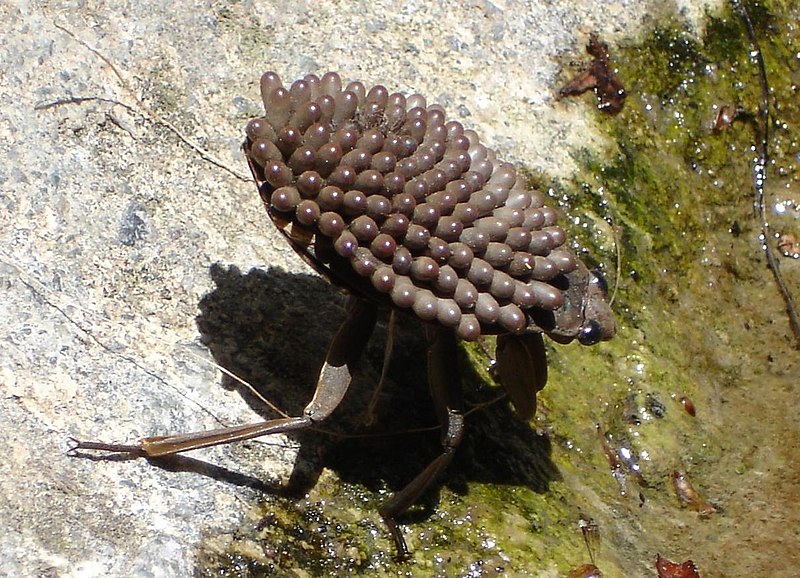
It's been a while since we did something creepy. No, I do not mean "rip you face off" terrifying, but genuinely, skin-crawlingly creepy. It's been a while since I did something like that. Brace yourself:


Giant water bugs are exactly what they say on the label: giant bugs that live in water. They can be found in the slow-moving streams of almost every place except Africa, Europe, and India. They are big and strong enough to take down everything from insects to crustaceans to fish, frogs, and reptiles. This entry is unfortunately going to focus on the entire family Belostomadidae simply because there's more to say about them.

As with most things with "giant" in their names, one must ask "how giant is giant?" It depends on the species. Specimens range from 1.5 inches to 4 inches solid. The picture up there gives one a very good idea of how big that is without using a measurement converter. For a water bug, that's pretty big.


Water bugs have some impressive hunting tactics. They have evolved to hunt entirely underwater. They look exactly like a dead leaf from above. While lying in wait for prey, they breathe through a natural snorkel. When something tasty comes around, they quickly spring with their powerful front legs and inject enzymes into their quarry with piercing mouthparts. Sometimes they mistake human toes for salamanders, leading to the nickname "toe-biter."

Remember how I said these water bugs could take down vertebrates? They do that with the most painful bite in the insect world. In other words, they're everywhere and they sting like little bastards. Do not pick up a dead one unless you want to be hurt - they can play possum. The bite has no harmful side-effects, it just hurts.

Happy belated Father's Day!


Many giant water bug species have a parental care system rivaled in weirdness only by that of seahorses. For starters, the females do all the courting; the opposite is usually the case. After copulation, the female lays her many eggs on the father's back. The male cannot mate while he's got eggs on his back; that would be awkward on so many levels. It's like everything Discovery Channel told you has been turned upside-down.

Giant water bugs are also eaten. They are particularly popular in Thailand, where they are served as a snack food. People draw them in with blacklights during breeding season, catch them, then, well, heat them. For more on that, use the handy-dandy search function to find a very old "They Actually Eat That" entry.  Bon appetit!

Tuesday, June 5, 2012

Green Tree Python and Emerald Tree Boa.

I know, I know - another snake entry. You're probably getting sick of these, but this is an entry I've owed you all for almost two years, now. To sweeten the deal, it's a double header...with good reason.

Look at the two snakes below. Tell me if you can tell that they aren't the same species.


Despite looking very, very, very similar, the two snakes above are not even the same type of snake. The one on the left is a green tree python (Morelia viridis); the one on the right (with the large white stripes) is an emerald tree boa (Corallus caninus). The GTP is native to the rainforests of Indonesia and Australia; the ETB is native to the rainforests of South America.

So, fact blitz: Both the ETB and GTP are green, arboreal constrictors that get roughly 6 feet long as adults. The young ones are usually either red or yellow in color, changing to bright green within a year. Both snakes will also loop a coil or two over a branch and set their heads dead center. In captivity, it can be really, really hard to tell them apart.

Remember when I said that snakes had some crazy convergent evolution goin' on? This is exactly what I meant. These two snakes live nowhere near each other. Unlike lions and tigers, which are genetically close enough to reproduce even though they've been separated for thousands of years, ETB's and GTP's aren't genetically compatible. Their similarity is solely based on the evolutionary process; because they adapted to the same environments, eat the same food, and so forth, they evolved similar adaptations. In this case, they happen to be creepily similar.

Yeah, umm...I'd wear a glove, too. This is an ETB.


Similar does not mean identical. For example, the emerald tree boa has, proportionately, the largest fangs of any non-venomous snake. The ETB eats birds to warrant these super-long fangs; for whatever reason, GTPs do not. ETB's also have more apparent white on them than do GTP's as a rule. Also, GTP's are a lot more common in captivity in general, even sporting a blue morph.

A few handy tricks if you're stuck identifying a random green snake in a tree and somebody asks, "hey, what is that?":

~ Emerald Tree Boas are from South America. GTPs are from Asia and Australia. Location is one of the main dividing points, here.

~Boas have live babies; pythons lay eggs. Even if it looks like a duck and quacks like a duck, it's gotta give birth like a duck to really be a duck.

~ Those TEETH. We do not advise testing this in the wild by sticking your hand over the snake's head. Hell, we don't even advise trying this at home. Messing with those fangs sounds like a Jackass bit waiting to happen.

~ Both of these are rather thick-bodied. If the snake in question is slender, it's probably one of the many types of vine snakes or some other colubrid. Some people apparently do not know the difference, so there ya go.

A blue GTP. More here.


Both the emerald tree boa and green tree python have a strong following in the exotic pet trade. GTP's in particular have a huge fanbase, both because of their diverse color morphs as adults and their cross-compatibility with another Morelia complex known as carpet pythons (who also SO deserve their own entry!). The ETB base is a bit smaller, but they are nonetheless particularly popular in the Netherlands. Both of these species are intermediate-level snakes requiring elaborate enclosures with humidity setups etc. These are not snakes you take out and play with; these are snakes that you spend thousands on a nice, realistic terrarium setup for, then show your friends that.

Wednesday, April 25, 2012

Let's Go Spelunking/They Actually Eat That: Bats.

It was difficult to pick a "They Actually Eat That" for this week. One, this week is Hell Week, meaning that a lot of tests and reports are due this week. Two, humans don't live in caves, so we haven't had that much time to turn the life there into cuisine. Three, umm, people eat bats, even if they aren't necessarily the cave-dwelling kind.


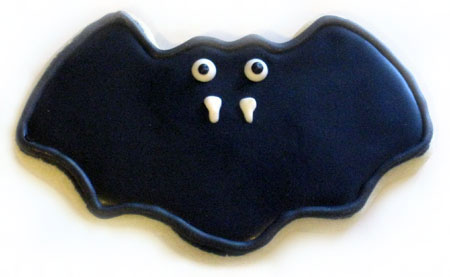
No, not like that! If you look up bat recipes, you get a million fake Halloween bat cupcakes, "bat wings" (black chicken wings made by Martha Stewart. May contain some seasoning from hell, but still not real bat), and so on. In America, we love eating bat-shaped things around Halloween...so long as no actual bats are involved.

Actually, a lot of places eat bat. If a place has bats, specifically flying foxes, someone will find a way to eat them. This restricts chiropteran cuisine to Africa, India, and Southeast Asia. China eats everything; no surprise that bats are on the menu. Sometimes, you can even find bat in Australia. A few places may eat microbats, but by and large, it's only flying foxes on the menu.


(This does not look like a flying fix to me...but there may be a scale issue.)

Eating flying foxes may not be particularly good for you. There is at least one flying fox species that has become endangered due to over-hunting. Flying foxes have also been linked to a number of diseases, including, but not limited to, SARS, Ebola, and Nipah virus. No offense to the cultures that regularly have bat on the menu, but there is a perfectly logical reason that some of us avoid it. Not that beef is really good for you, either...but that's for another entry.

As for what it tastes like? Rumor has it that bat meat smells, but otherwise tastes like chicken. It can be roasted like chicken, seasoned like chicken, and thrown in a stir fry like chicken. There really not much special about bat meat to most people except its sheer oddity.  It's mostly a big treat for foodies.

Tuesday, April 17, 2012

Creature Feature: Palm Cockatoo.

Aww, parrots! Pirate references aside, there are few things that have the charm of a rainbow-colored, bright-eyed hookbill. There is very little bad to be said about parrots (unless you try owning one - then you get dust issues). Overall, they're happy, brightly-colored, intelligent, fun-loving birds.

Then you remember they have beaks. Parrots have strong, heavy beaks that can crush nuts with ease. Seriously, your finger is screwed if a large parrot bites it. If only they had the aggressive look to match that badassery...

(From thepetwiki.)


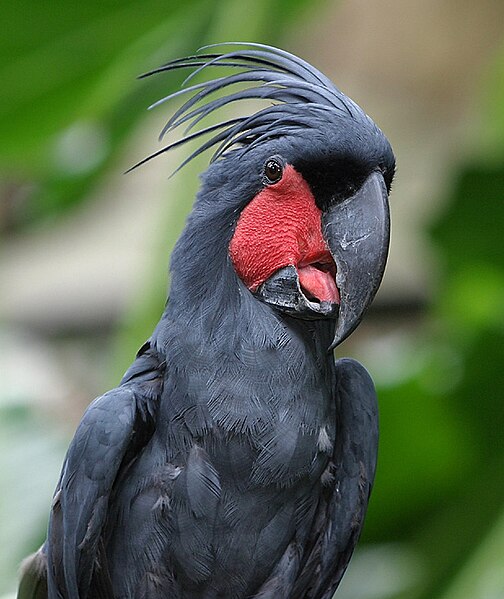
....yep, perfect candidate for "heavy metal parrot," there.

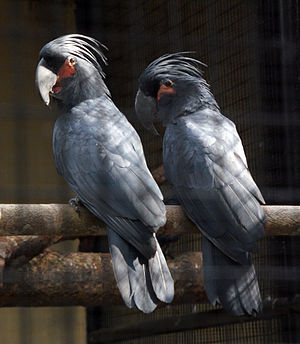
The Palm Cockatoo (Probosciger aterrimus) is probably the best parrot-y logo for a band ever. It crushes nuts for food, which is a good threat to anybody's masculinity.  It is native to Indonesia, New Guinea, and northern Australia. Unlike many of the creatures in that range, the palm cockatoo is nowhere near endangered. This is somewhat of a miracle, but more on why later.

Palm cockatoos are in a class all their own. No, really; they're the only members of their genus. Molecular testing says that they're distantly related from most other cockatoos.  If any cockatoo is an ancient cockatoo, it's probably the Palm.


Genetics talk aside, palm cockatoos are impressive birds to look at. They're the largest species of cockatoo in the world. Those red patches get brighter if the cockatoo gets stressed, making them one of the few birds that can change color. Their bill size is second only to that of the hyacinth macaw. Again, please think about that before you piss one of these birds off. (Is this guy nuts?)

These cockatoos have one of the neatest-sounding behaviors in the world: they drum. As in, they take a seed pod or heavy stick and drum it against a dead tree. Nobody really knows why they do this - dress rehearsal, perhaps? Their vocal repertoire isn't lacking, either, sporting a large vocabulary, a variety of whistles, and a call that sounds like a human's "hello." These guys truly are the rock stars of the parrot world!

You lookin' at me?


Palm cockatoos are available in the exotic pet trade with a price tag over 5,000 USD (I've seen snakes worth more). I'm honestly surprised they are not worth more; one of the candidates for "good pet" is a relatively fast breeding rate compared to humans. Some palm cockatoos do not breed until their 30's or 40's. They also live into their 80's, so if you do happen to be able to afford one, be sure to provide for it in your will.

Also...they can eat meat.

Sunday, April 15, 2012

Creature Feature: Eastern Snake-Necked Turtle.

ReptileFest is awesome. For those of you who aren't so into reptiles, ReptileFest is an annual convention in Chicago with snakes, lizards, turtles, crocodilians, and a ton of cool merch. It's not as hardcore as a breeder convention, and is a good crash course in reptiles for those of you who are just curious about scaly creatures. We certainly have plenty of people into reptiles, here, including some in-state Burm breeders!

That said, I was bound to find some good blog fodder there. My own photos will be up on this blog tomorrow, but for now, please make due with one of the very few turtles on this blog thus far:


Looking like a snake did it with a turtle, the common snake-necked turtle (Chelodina longicollis) is probably one of the freakiest  turtles on the planet. It is native to the swamps, lakes and slow-moving rivers of Queensland down to Southern Australia, the land where monsters are born. It eats any animals small enough to fit in its mouth, so mostly fish, insects, and worms.

Starting with the obvious again, that neck is probably the longest, proportionately, amongst turtles. It can stretch longer than the turtle's carapace - which is all of its body, by the way. It has to bend its head sideways to fit it into its shell rather than withdrawing completely.


Aside from its strange appearance, this turtle has at least one odd thing about it: It stinks. No, really. When threatened, snake-necked turtles musk like certain ratsnakes do. If their smell is anything close to what some snakes can produce, it is definitely worthy of the nickname "stinker."

It's really a shame I'm not more of a turtle person. I'm sure there are plenty of weird turtles out there, but I don't look at them enough to pick out the particularly outlandish ones. Fear not, turtle fans; vote on my next poll for a Turtle Week and this problem shall be remedied.

Sunday, April 8, 2012

Creature Feature: Australian Rabbits.

Hoppy Easter, everyone! Hope you all had lots of good times with your family, fun egg hunts, and, of course, candy!

Of course, bunnies aren't always fun. Wait, what?

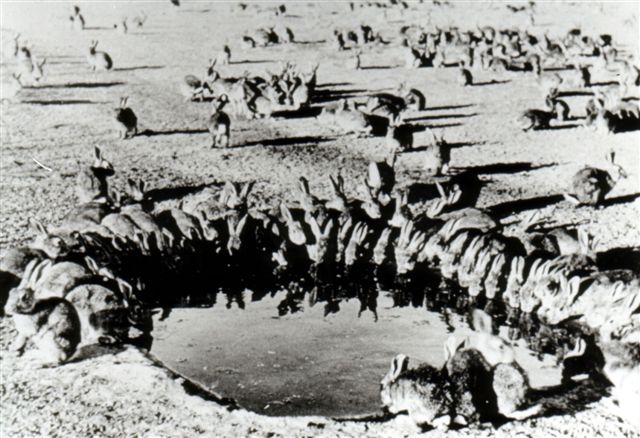
Like The Birds, only with fluffy bunnies.
 

Australia has serious issues with invasive wildlife. Much of its ecosystem evolved in isolation from the rest of the world. So, when something prolific like a rabbit gets brought over by Europeans as a game animal on an island with plenty of resources, guess what happens?

Backing up a little, rabbits were brought to Australia by Europeans in the 1770's. In that day and age, colonists didn't particularly care that Australia had unique wildlife or indigenous people. They wanted to make everything in Australia as European as possible. That meant introducing rabbits as game animals.

Unfortunately, it is almost impossible to eradicate a population of rabbits. Some of the original 24 brought for hunting escaped and began running around Australia.  With no real natural predators and plenty of grass, the rabbits did what they do best: Eat, spread, and, most importantly, get it on. 

Disclaimer: Found on Photobucket. May or may not be in Australia.


Let's put it this way: In an ecological system not used to dealing with mid-sized mammals that reproduce, well, like rabbits, bunnies wreak havoc. They attack plants - the base of the food web in many cases - leading many local species to go hungry. Predators often aren't equipped to handle bunnies, either. Those feet and teeth can seriously hurt. Yes, we're still talking about rabbits.

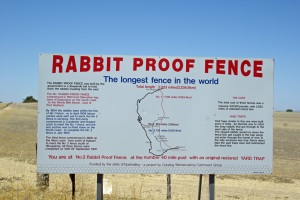
With no predators and plenty of food, the rabbits spread from Victoria to New South Wales and into the rest of Western Australia. People tried to build fences in the 1990's to keep the bunnies out, but they had already crossed the line. What started as 24 rabbits in the 1700's had ballooned to 10 billion in the 1920's.

Silly humans, rabbits can't read!
 

The rabbits have been causing havoc in Australia ever since. They reduce native plant species by nibbling sprouts as soon as they bloom. They invaded the burrows of native species. There just aren't enough hunters to keep them at a stable level. Hell, bunnies are bacteria with spinal cords in terms of how versatile they are.

There have, of course, been attempts to stop the killer rabbits. The most successful of these has been a virus that specifically targets rabbits, causing them to develop mucus-filled lesions (myxomatosis). They die of hemorrhages and seizures within ten days. This virus, as with most things that target bacteria, eventually lost its effectiveness. Now the bunnies are on the rise again, ready to terrorize Australia with their cute, fluffy...yeah, it's hard to make rabbits sound intimidating. They're a big deal, OK?


So, when you open your chocolate rabbits (I know you have some left over), please think of Australia. Then go nuts biting that sugary rabbit's head off.