Showing posts with label asia. Show all posts

Sunday, July 21, 2013

Creature Feature: Rufous-backed Kingfisher.

Some readers are bound to ask: what's the deal with the URL of this blog? Originally, it was intended to push the boundaries of fantasy and reality, showing how "mythological" things could either be real or have a solid basis in reality. Since this blog has covered phoenix bases in the past, I feel pretty safe putting this little bird up:


This is a rufous-backed kingfisher (Cyex rufidorsa), so named for its reddish back. It's native to Thailand, Indonesia, Malaysia, and the Philippines. It eats fish, insects, frogs, and reptiles. The bird is small enough to fit in one's hand.  Unlike many entries from steamy rainforests, this little bird is not even remotely endangered. The only threat it faces is a slight decline due to habitat destruction.

The rufous-backed kingfisher does not seem real. It's bright red and purple, like a little phoenix. Its head is disproportionately large compared to its body. The bill is particularly huge. It's adorable and psychedelic. This should be a Pokemon; make it a baby Moltres and it'll sell like hotcakes (pun totally intended).

The rufous-backed kingfisher's appetite is just as extraordinary as its coloration. Thesebirds will hunt a number of things from high perches overlooking water, then dive in after them; that's how kingfishers roll and should be no surprise. What's more surprising is that it's not afraid to eat things twice its size. How does it pack all that fish into its little stomach? Probably very carefully.


There is some confusion when classifying this kingfisher. Another species, Ceyx erithaca, was discovered first. Both are properly "Oriental Dwarf Kingfishers," depending on whom you ask. They also overlap in some areas, leaving one to wonder if there's a difference aside from color. Whatever you call it, it's quite remarkable for a little bird, no?

Wednesday, June 19, 2013

"They Actually Eat That:" Hibiscus.

 Every so often, a new 'superfood' suddenly floods the market. Usually, it's something only a small amount of people have heard of, comes with a fancy Greco-Roman science word attached, and has a long history of being medicinal from the ancient past. Recently, the buzzword has become "antioxidants," and acai and pomegranates are leading the way in that regard. Here's what is slowly becoming the next "superfood:"


This flower should look familiar to a lot of you. It's a type of flower called hibiscus, and is probably the most marketable superfood yet. Yeah, that flower on tacky Hawaiian shirts? That's hibiscus. Hibiscus iced tea is becoming more and more popular, popping up in Starbucks, Argo Tea, and Panera. It has "from Asia" and "might have antioxidants" going for it already.

But is it actually edible?

First off, the nectar and tea are usually pretty safe. Hibiscus has been used as a tea for centuries in Asia and Nile Valley Africa. The tea has been believed to cure everything from high blood pressure to cancer.  I've had hibiscus tea and nectar plenty of times with no adverse reactions. The only confirmed medicinal effect of hibiscus is as a diuretic, but people are looking into antioxidants.

The diuretic effect is particularly noticeable if animals eat it. I've heard varying reports, but the general consensus is that hibiscus plants are toxic to cats, dogs, and horses. It probably isn't the end of the world after one little bite, but just to be safe, hibiscus is on the list of "plants that are not pet-friendly." If your pet starts acting odd after eating hibiscus, call poison control.


As for actually eating hibiscus, there are dos and don'ts. Some hibiscus varieties are not edible, period. Others, like Hibiscus sabdariffa, can be eaten in salads and stir-fries like red spinach (which is its own thing). Most restaurant chains and such will not be using the poisonous varieties of hibiscus, so please enjoy the summer's latest iced tea craze. Just don't use it to cure cancer or give it to your dog, OK?

Tuesday, June 18, 2013

Little Shop of Horrors: Coral Cactus.

Now that summer has hit, various home improvement stores and sections are stocking all sorts of weird plants. Be on the lookout for celosia ("brain flowers"), geops, and a number of other weird plants that one can probably find at one's local nursery. It was almost inevitable that at least one odd, potted plant would wind up on this blog, but I had no idea it would be this odd:


This is a coral cactus. No, there's no scientific name for this oddball. It's 100% created by people. If I had not done glowing marmosets yesterday, I totally would have done this thing; it's a really impressive graft of two completely different plants. Oh, and neither of those plants are cacti, even if they're both still succulents. Both are also almost worth their own entries.

The coral-like crest comes from a plant called Euphorbia lactea, AKA mottled spurge or elkhorn.  Specifically, the coral part comes from a frilly mutation of elkhorn, which is propagated for this exact purpose. Otherwise, elkhorn is another houseplant with some medicinal potential in India. The milky latex on elkhorn is poisonous, as is the entirety of the plant. Keep coral cacti away from children and pets with this in mind.

The stem is from another species of Euphorbia, usually E. neriifolia. It's also called the "Indian spurge tree." Both of these plants have similar climate requirements, so it's no surprise that a graft of the two should be sustainable. It's still impossible to breed them, mind, but you can keep a coral cactus alive like most cacti. Weird? Yes. Difficult? Not really.


Where can you get this bizarre thing? Wal-Mart. These chimera plants are sold for relatively cheap at the world's most infamous big box store. We would not be surprised if the shop Audrey II came from suddenly started carrying these. If weird plants in one of the largest chains in the world is not a plot for botanical world domination, please tell me what is.

Friday, June 14, 2013

Creature Feature: Fishing Cat.

Most pet-owners in the world are either cat people or dog people. Me, I'm a cat person, and there are some really fascinating cats out there. Whether they are domesticated or not is of only mild relevance. Here's a cat I'd love to take home if red tape were not involved:


This is a fishing cat. It is one of roughly four species in Prionailurus, a group of small, spotted wildcats found in Asia. The fisher cat has spotty distribution in India and Southeast Asia and is endangered due to human activity. It is primarily found in wetlands and near running water, fishing for, well, fish. Rumor has it, however, that their very varied diet may also include certain carnivores- including dogs. Reminder: this is a small cat.

Doubtless, some cat lovers have noticed that cats like fish, but hate getting their paws wet. The fisher cat has its fish and eats it, too. They first lure fish with a tap of the paw upon the water, then scoop up the unwary little fishy before it knows what hit it. The fishing cat can also swim, sporting waterproof fur and a tail like a rudder. They can also dive for fish if need be. In summary, the fishing cat really loves water, unlike most cats who flinch at getting wet.

Now, here's one major difference between cat and dog people: dog people generally see inbreeding to create insane dog breeds as OK, but frown upon outcrossing with wolves and coyotes; cat people, on the other hand, will outcross with other small cats like crazy in order to create new breeds. The difference is in part genetic; dogs have 39 pairs of chromosomes, leading to an extremely versatile genome and a surprising amount of relatively stable dog breeds. Cats have a smaller genome, with only 19 pairs of chromosomes. (For the curious, humans have 23 pairs, meaning that chromosome count means jack in regards to intelligence.) What this means is that dog breeders have had a very extensive genetic palette to create living artwork over millennia, while the cat people simply do not have that range of genetic color. Cat people have gotten around that by breeding domestic cats to wild felines.

From here.


I recall someone once trying to equate comparing dogs with wolves to comparing cats with lions. This is BS for so many reasons, and the argument really deserves a sucker-punch to the gut, but the rule of thumb is that domestic cats can mate with a lot of small cats - including the fisher cat. The resulting hybrid cat is called a "jambi," and it's apparently brand new. Will these fishing cat hybrids be as hydrophilic as their wild counterparts? Who knows.

Friday, May 10, 2013

Nature Strikes Back: The Infamy of Japanese Crows.

Crows are the last thing one would suspect after drunk elephants. Sandwiching them between elephants and big cats seems almost unfair. Nonehtheless. when it comes to species humbling humanity, it's hard to find a better example than Japanese crows. Well, that, or various bacteria and insects. Let's just stick with crows for now. Japan is in an all-out war with crows.

For starters, Japanese crows (Corvus macrorhynchos) are big. They're a great deal bigger than the crows in the United States. We'd make a joke about how this is the opposite of everything else in Japan, but one, that would be a lame joke, and two, Japanese hornets. For those of you who need a refresher, Beedrill, I choose you.


Japanese crows are not just big, they are smart, too. They have figured out how to use some big and fast like, say, a car or train to crack open a nut or shellfish. Step one: Put a nut or other crackable thing in the middle of a road. Step 2: Wait for a car or train to run it over. Step 3: Wait for said vehicle to pass. Step 4: Enjoy inner meat. It's quite an ingenious way to crack a nut, if I do say so myself.

Japanese crows take this to horror flick levels. There are several recorded instances of Japanese crows putting stones, not delicious nuts, on train tracks. This naturally caused train delays, although the jury is still out on While officials assure us that the crows were only putting small bits of gravel on the tracks, it's still a very odd behavior, and suggests a strange spirit to these birds - pardon the joke.

That's not all. These crows are evidently master trolls, too. In efforts to chase the crows away, exterminators look for crow nests...and hopefully find an inhabited one.Japanese crows are so smart that they'll predict where humans will look for a nest, then make a completely fake nest just to fool people. That's almost diabolical. If every criminal did that, the police wou- oh, wait. Was the Monster With 21 Faces in cahoots with these crows, by any chance?

Suddenly, what seems like "hey, that bird's using people technology to crack what it thinks are nuts or oysters - that's pretty smart" has become "we're glad these birds are using their intelligence to give us red herrings instead of outright killing us, Hitchcock-style." Welcome to Japan; it's a very scary place when you know some of the fauna. If corvid intelligence in Japan is any indication, they'll be around even longer than the people will.

Friday, April 26, 2013

Creature Feature: Chevrotain.

Life is interesting. Sometimes it even completely surprises you, unearthing things you never thought possible.  Then there are things that come right the eff out of nowhere and make you wonder what you're on. That's what this blog is all about: freeing your mind with stuff you never knew was there.


This, good followers, is a mouse-deer (Tragulidae). It is also called a "chevrotain," which sounds like Chevy's latest attempt to appeal solely to the female demographic. There are four extant genera, with more being discovered and named every so often. Locations include Asia, Africa, and India. The English name "chevrotain" is actually French meaning "little goat." An Indian word means "deer and a pig." That's how crazy this thing is. It can't even decide what animal it's most like.

And why should it? Chevrotain are very primitive creatures, having not changed in over 34 million years. Chevrotain are probably close to what the first ruminant ungulate looked like. Ruminants include deer, cattle, sheep, and most cloven-hoofed animals except swine. Whales were once ungulates, too, so this little guy is related to Flipper. Sure, it's distant, but the little chevrotain like water enough to make it a distinct possibility.

Keen readers will notice that pigs are not ruminants. The chevrotain, being a transitional beast, has some piglike traits. Like pigs, both sexes of chevrotain have elongated canine teeth and no horns. The herbivore parts are there, but not quite complete. Chevrotain will also scavenge meat alongside botanical diets. They're "deer and pigs" as in India. Somebody got it right.

I wonder how many creationists know about this thing? It looks like the fossil record may well fill itself if this keeps up. Evidence of life being amazing happens every day. Look around for it.

Saturday, April 20, 2013

Creature Feature: Myrmarachnids.

Not many people like spiders. The awesome lady with the spider jewelry last night was more an exception to the rule than anything. They are, however, fascinating creatures that really deserve more entries on this blog.


Look out, here comes the Spider-Ant! Actually, it's an ant-mimicking jumping spider (Myrmarachne formicaria), but close enough. It's native to Africa, with relatives in many places.

In all seriousness, though, there are a number of jumping spiders who have ants as alter-egos. They span at least two genera, and are native to most tropical parts of the world. A few live in temperate regions. Yes, they eat insects, like most other spiders. Despite awesome mimicry, this is not cannibalism. There are an amazing amount of these spiders. Cue mass-entry guilt.

For those of you who know nothing about arthropod anatomy, here's a little primer. Insects have three body segments and six legs. Spiders have two body segments and eight legs, plus two pedipalps. A number of tricks are used to pull off that visual trickery, including raising the forelegs like antennae and making the pedipalps look eerily close to an ant's head. It's a darn good job.


Why the spiders do this is something of a mystery. Always suspecting the worst of a venomous creature, scientists first thought that spider-ants were infiltrating anthills by going in undercover. This turned out not to be the case for many, but not all, ant-mimics. Unbeknownst to most humans, ants taste bad, and can also sting with formic acid. Not a bad thing to disguise oneself as.

Of course, this won't protect them from humans who hate ants, too...and there are quite a lot of those. You fooled nobody with A Bug's Life, Disney - ants are crafty little buggers who wind up in my bathroom every spring. Yeah, disguising yourself as an ant won't work well all the time.

Tuesday, April 9, 2013

Creature Feature: Jacanas.

Ever notice that animals seem capable of miracles? Axoltols and planaria can heal at astounding rates. Ants can lift millions of times their weight.  Then there's this bird, who almost pulls off the basilisk's ability to walk on water:
Jesus bird? Hardly. That's an African Jacana (Actophilornis africana), a bird also called a lily-trotter. Technically, it's walking on lilypads, not the surface of the water itself. Jacanas of various sorts (in a few genera) can be found throughout the tropics, eating snails, insects, and other small critters while striding above the surface.

First off, even if these guys are not walking on water, you will see them. The younger ones are white and brown; older jacanas usually have striking patterns of brown, white, and black.  That may not sound too stunning, but it's a high-contrast design. There are lots of different types of jacana, and they all have pretty striking colors. Jacana eggs are glossy, dappled things that look more fake than real. There's even a pheasant-tailed jacana, which is exactly what it sounds like:


Source.


Jacanas have the ability to walk on water flora. They do this using very long, slender legs and wide feet, which distributes their weight so that the birds do not sink. This gives the illusion of walking on water. They can also swim, which is less impressive, but still cool.

Jacanas also have a few interesting mating habits. Unlike many birds, which mate using many females and one male, jacanas do it the opposite way.  The guy also does all of the work raising the chicks. The female is off philandering and reproducing as much as possible. Talk about your double-standard...turned on its head.

Source: San Diego Zoo webpage.


Remember, for every miracle, there's usually a more logical explanation. Science is all about finding out what those explanations are. In this case, it's a bird walking on lily pads instead of water- not as miraculous, but still quite astounding.

Sunday, March 31, 2013

Killer Cute: Hooded Pitohui.

Ah, spring is in the air! Flowers are blooming, the air is warm, and songbirds fill the air with music. What could possibly be more representative of spring than a brightly-colored songbird?


...a brightly-colored, poisonous songbird?!

This colorful little bird is a hooded pitohui (Pitohui dichorus). It is native to all places called "New Guinea," and quite common there. Both females and males have bright colors, so it's not like we can tell if that's a dude or a chick. Yes, that pun was intended; it's Easter.

And, yes, the songbird is poisonous. The hooded pitohui was one of the first documented poisonous birds, and is frequently touted as the most poisonous.

How does a songbird become poisonous? By eating lots and lots of poisonous beetles. The process is called bioaccumulation, and is roughly the same method by which DDT accumulated in various bird species during the 60's - only, well, more beneficial. It's virtually the same way that lorises and monarch butterflies become toxic.

This bird is going to KILL you.


The resulting poison works like a charm. It is a neurotoxin called homobatrachotoxin, and can be found in most places in or on the bird's body. Merely touching this bird causes tingling and numbness (nerve tampering). Imagine what eating this bird could do. No wonder they're labelled as "least concern."

Need more of a trip? These beetles are related to the same bugs that poison dart frogs (i.e. the little froggies so lethal that natives dip arrows in their poison) eat. The pitohui is a bird who thinks it's a poison dart frog. You thought you knew songbirds? Don't trust those bright colors. They might not be for mating.

Tuesday, February 5, 2013

Creature Feature: Apple Snail.

I apologize in advance for the video I am about to show you:


Yes, snails can actually be interesting to watch. I had the pleasure of seeing one of these up close and active. These are apple snails (family Ampullaridae), and they are among the most popular freshwater aquarium snails in the trade. The 6 genera in the family can be found in the freshwater areas of South America, Europe, Africa, Asia, and the lower parts of North America.  They are also marketed as "mystery snails," which is a complete marketing gimmick. These snails are far from a mystery, but still quite cool. We'll focus on Pomacea for now; other apple snails are fascinating in their own rights.

Apple snails are among the few truly amphibious snails. They have both primitive lungs and gills.  The mantle - the part of the body that yields a shell - is actually divided between the two types of respiration. Thankfully, most apple snails can stay aquatic; only if food runs out in the water will they move onto land. They have survived for over 50 million years for a reason.

The shell even looks apple-y.


That said, if you intend to breed apple snails, it is not as easy as it is with some other snails. Unlike most snails, apple snails have sexes - they aren't hermaphrodites. Each species of apple snail has its own egg-laying style and preferences, so adjust accordingly. We wish there was a cute Valentine's Day pic with snails, but these guys and girls sound difficult to sex properly.  If taken care of, some snails can get shells up to 6 inches in diameter.

Apple snails have mixed effects when introduced to non-native ecologies. In Taiwan, apple snails were marketed as a protein source, but fell flat on their not-faces and escaped into the wild after being unprofitable. The population then exploded; remember, these are versatile, adaptable creatures. Before they were bred in captivity, many apple snails were actually unwelcome hitchhikers in aquaria. Times change.

 Other people deliberately introduce apple snails (but not Pomacea) to out-compete and even eat more harmful snails that are vectors for parasites - some deadly, some just annoying. They are even eaten in Mexico. Mystery snails no more; apple snails are here to stay, but we make no promises about keeping the doctor away.

Wednesday, January 30, 2013

"They Actually Eat That:" Rhinoceros.

Remember when I said that humans will eat megafauna like no tomorrow? I wasn't kidding. Humans have been eating giant animals since Homo sapiens were a thing, still eat giant animals today, and will continue to eat giant animals in the future.Nothing is safe unless it is explicitly poisonous. Even then, fast food is worse for you than rhino meat:

Image by National Geographic. Look at how red it is compared to domestic meat...


Today is no exception. Everything is fair game, including the powerful rhinoceros. As long as rhinos exist, people will hunt them, just like we did to most other megafauna. We will also be eating them to the end of time. Habitat destruction is almost a new one, but this is about the edible side of things, so let's stick to that.

China, of course, is in on rhino meat. Rhinoceros horn has been touted for various medicinal properties, just like almost any other part of almost any other animal. Its main use is as a painkiller, with rhino horns fetching up to $30,000 per kilogram. There is also a concoction involving a rhino skull and coconut oil. All of this has no potency whatsoever.

A lot of people already know about the rhino horn trade. A lot fewer people realize that there is a lot of meat there. The meat itself supposedly has properties as well. It has been touted as a cure for leprosy, diarrhea, and tuberculosis. There is absolutely no basis for this.

Eating rhino is not at all common. Rhinoceroses are big, fierce animals. They're hard to kill, even with rifles and other modern weaponry. Rhino meat is still quite valuable as exotic meat. There are roughly 275 Sumatran rhinos left; we'd like to keep some around, so please don't eat rhino meat or buy...anything rhino-based, really. It may be delaying the inevitable, but let's try to keep megafauna around for as long as we can.

Saturday, January 19, 2013

Newsflash: TWO New Species Found In Vietnam.

One of the biggest reasons to save the rainforest involves finding new species. National Geographic does not slack in that regard, showing us a few new species that have only been documented in January of 2013. Here are two new herps recently identified in Vietnam:

Source.


This colorful fellow is called Calotes bachae. It is an agamid lizard, meaning that it is related to agamas and Uromastyx lizards. Since there are indeed several hundred agamids in Asia, this one is in good company. There are even other light blue ones to keep the male of this new species company.


As per the National Geographic article here, "During mating season, the colors of the male lizards—which can measure up to 11 inches (28 centimeters)—become especially vivid, ranging from cobalt blue to bright turquoise. This serves to attract females and to intimidate other males, said Hartmann.
While by day the lizard's blue and green coloration is striking, at night it appears dark brown, "showing no bright coloration at all," said Hartmann, a Ph.D. candidate at the Herpetology Department at the Museum Koenig in Bonn, Germany." Surprisingly enough, this striking lizard can be found in downtown Ho Chi Minh City, as well as some reserves. 

Source.


The other big discovery is Helen's flying frog, named after the researcher Jodi Rowley's mother. Ironically, it was found on a log instead of in the trees.

Flying frogs are pretty cool on their own, but this one has extra adaptations for parachuting from tree to tree. The hands are huge, even by flying frog standards; the hind legs are webbed on almost the entire limb. If this gliding style has kept it from being discovered, it's gotta be pretty effective!

Unfortunately, both of these unusual creatures are threatened by habitat loss and too much contact with humans. Both of them were also found fairly close to civilization. Go outside sometime; you might be surprised what can be found close to your house.

Wednesday, January 16, 2013

"They Actually Eat That:" Porcupine.

Is there any vertebrate that sounds less appetizing than porcupine? It's big, and there's a lot of meat there, but it has spines, teeth, and claws to deal with. Granted, boars and bulls can be pretty nasty, but their skin won't turn your face into a bloody mess (plus, bacon). Who looks at a porcupine and goes "yeah, that looks delicious?" Well...a fair amount of people, actually.


Wherever there are porcupines, people will eat them. They usually do not want to, though. Native Americans can and will use porcupines as meat during the winter. Kenya had a porcupine crisis in 2005 - the most logical solution, after the porcupines had dug up graves and destroyed crops, was to eat the buggers. This may have been dirty porcupine meat, but there is no greater revenge than eating the ones who ate your food.

Porcupine meat is not just for the non-industrialized, either. Porcupines are assholes, for lack of a better word, on a regular basis. They carry diseases, nibble on everything, stick you or others with their hair-turned-needles, and generally are just unpleasant to have around. Last year, people in Pennsylvania started eating porcupines, too- or at least made hunting them legal in the wake of a porcupine outbreak. Again, revenge.


The practice of eating porcupine is still largely reserved for Native Americans and people with porcupine issues in the West, but China and Vietnam at porcupine regularly. It is so popular over there that porcupines are actually threatened. We knew that Vietnam and China ate almost anything. It seemed unlikely that they would hunt a rodent enough to cause a population decrease of 20 percent. Revenge? Noooo, this is just how Southeast Asia rolls. They even farm porcupines.

So how does it taste? Supposedly...weirdly good. It has been described as being "like duck meat, but with more flavour and very crunchy." That particular person actually liked it better than duck; given what I've seen from people's reactions to duck, that is quite the compliment. Maybe the Vietnamese are onto something.

Tuesday, December 18, 2012

Creature Feature: Cream-Colored Giant Squirrel.

Any environmentalist  will tell you that every animal alive today has its place in the world. Every single species is a special little snowflake and a piece of a much bigger puzzle. This blog was made to celebrate how wicked awesome other species are. If you've been reading this blog, this paragraph was a broken record to you.

Then there are some animals that make us go, "the fark, nature? Why is this thing still alive?" The panda bear is on that list. So is this:


The Cream-colored Giant Squirrel (Ratufa affinis) is one of those animals. It can be found only in Thailand, Brunei, Indonesia, and Malaysia. It eats seeds, leaves, bark, and insects. It is almost completely arboreal. It is thought extinct in Singapore and Vietnam, making the stamp above very ironic. 

So, let's get some facts down. The Cream-colored Giant Squirrel ("creamy-squirrel") is exactly what it says on the tin: a pale squirrel that is giant. It can get almost a yard long from the tip of its nose to the end of its long, bushy tail, which helps it balance like a tripod while eating. Along with being pale, these giant squirrels are usually boldly marked. The name alone says that this animal should not survive.


Surprise surprise: It just barely lives. OK, so it's not on the Endangered List  yet, but it is near-threatened. These squirrels are easy to hunt and prone to deforestation. As arboreal animals, even sustainable logging might be a threat. What else is new? Well...


Along with human interference, the creamy-squirrel has competition from the giant black squirrel. In most of its range, these two squirrels share habitat. The only place where creamy-squirrel is truly safe is in Borneo, where it is the only giant squirrel. The main difference is that creamy-squirrels do not so much as go to the ground to feed, whereas the black squirrels leave the trees every now and then; otherwise, the creamy-squirrels have no real niche. Regardless of how many enemies the cream-colored squirrel has, I bet this is one of the few times you will ever hear of a squirrel going extinct.

Wednesday, December 12, 2012

I Actually Ate That: Basa.

If you are ever in Houston and like fish, check out the Kemah Boardwalk. They have a restaurant there called "The Aquarium." It delivers what it promises: a giant aquarium makes up the centerpiece of each level, with smaller aquaria along the sides and a pillar aquarium along the stairwell. O.K., plug over.

They also had an exotic Asian fish on the menu that, as it turns out, is debatably-legal:

Source.


The "whitefish" hidden beneath a mountain  of fruit and breadcrumbs was a Vietnamese fish called basa (Pangasius bocourti). It's native to the Mekong River delta. This fish is wholly herbivorous, making it actually a bit healthier and easier to farm than most fish on the market. Several other fish may be erroneously labeled as basa, so have your wits about you at the fish market. Basa are also called "panga," "bocourti," or "river cobbler," so...just ask the right questions.

Here's where the sketchiness comes in: basa cannot be legally labeled as catfish. (The menu called it "Asian whitefish;" I pressed for more details.)  Even though they are technically catfish, there have been a few SNAFU's when it comes to labeling this oriental fish.  People in the U.S. and Britain seem to have a really hard time deciding what to name this fish.


The U.S. has a particular concern with this one. There was a "catfish war" in the early 2000's. In short, the Vietnamese were accused of flooding the market with basa and marketing it as "catfish" - also the name for the whiskered fish native to North America. Catfish farmers and the USDA were worried that basa might interrupt the profits of the native American catfish, so basa sellers were forever banned from using that word. They have to use other words instead.

Luckily, a rose by any other name indeed tastes as good. The taste if largely neutral to most people (another selling point), but 75% of taste-testers preferred basa to catfish.Whether it is ethical or not is another matter; I am unsure on the veracity of this thread, but given what we know about factory farming fish in Asia, no surprises there. The U.S. is not any better in this regard; nearly all fish farms have skeletons in their closets. Sorry, catfish farmers; best be graceful in defeat this round. 


Friday, November 16, 2012

Creature Feature: Paradise Tree Snake.

Flying serpents are one of the staples of mythology around the world. Every place seems to have some sort of sky snake, possibly representing a rainbow. Even the Greeks had a few heavenly sun-snakes that pulled Medea's chariot.  Just ask conspiracy theorists: serpent deities are clear proof of our reptilian overlords, right?

But that's impossible. Something can't fly without limbs, ri- 


What the flying fark?!

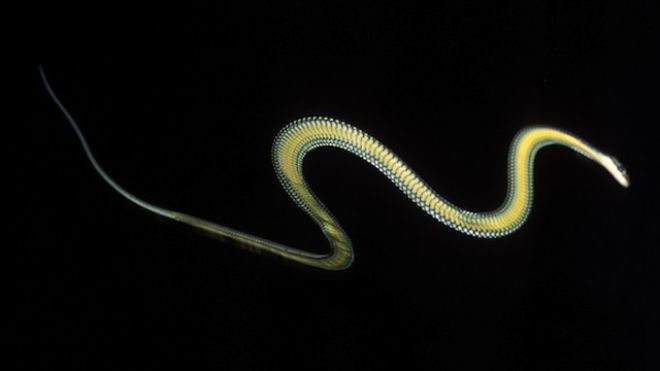
That airborne serpent is a paradise tree snake. The paradise tree snake is one of a genus of snakes that can glide. It and its relatives are all native to the rainforests of Southeast Asia. It is a diurnal predator, feeding on birds, rodents, and lizards. It also has a fair amount of predators, being a relatively small snake.

Oh, and it can fly. Technically, it can glide for over 79 feet. Yep.


To those of you who blinked and missed it: To start gliding, the snake The people in this video honestly do a better job of explaining the physics behind this snake's gliding than I ever could, but in layman's terms, how many of you know of flying rings? Yeah, it's kinda like that, only alive. 


As if a flying snake was not enough to scare quite a few people, these gliding snakes are able to steer. To put into perspective how hard this is, other gliding animals with limbs have a hard time steering in mid-air. Precisely because these snakes slither through the sky, they have excellent control.  Cool...if you're a snake person, that is.

Paradise tree snakes are not readily available in the exotic pet trade. They're around, sure, but by no means common. Dietary questions come up; anoles and pinkies are usually the answer. Beware of any of these that you find at herp shows. Even the snake in the video had some nasty parasites. They are also rear-fanged venomous, so please check your local laws before buying!


Sunday, October 28, 2012

Creature Feature: Tentacled Snake.

Look at that title. Really, look at that title and use your imagination. There are a million ways to get creative from the title alone. Did a snake do it with an octopus, and is this entry devoted to their unholy lovechild? No. Is it the ultimate in tentacle pronz? No. It's just a water snake that just so happens to have tentacles on its face.


The tentacled snake (Erpeton tentaculatum) is a rear-fanged water snake native to Southeast Asia. It is wholly piscivorous. Its entire life is spent in muddy lakes and rice paddies. Some even venture into seawater.  Unlike some snakes, which come in a rainbow, tentacled snakes are only striped or blotched. Like many water snakes, they have live babies. 

The tentacled snake was not science's most creative naming venture. The most prominent thing about this water snake is that, yes, it has tentacles. These tentacles detect fish better than the snake's tongue ever would. They use a blend of sight and touch - yes, these tentacles loop back to the vision center of the snake's brain. Imagine sticking your tongue out periodically underwater; that is why they evolved tentacles.

The evolution of tentacles is far from this snake's most impressive feat; how it uses them is just as cool as their existence: 


The way the tentacled snake manages to catch the fish is a whole different matter. In the video above, you can see the snake bending its body right after it detects the fish. This motion is enough to trigger the C-start (escape) reflex of the fish, sending it straight into the jaws of death. This snake is predicting what its prey will do next. That's pretty impressive.


Most of us think of the reptile brain as primitive. The revelation that snakes can meter out their venom and the behavior of the tentacled snake above should be enough to make one wonder how intelligent snakes really are. This one just so happens to have tentacles, making it either cooler or creepier. Your mileage may vary, of course.

Sunday, September 30, 2012

Creature Feature: Musasabi.

Before you immediately assume that the title above is some sort of Japanese liquor, consider the following: 1. you know this blog only covers "LET'S BREW!" topics on Wednesdays, and 2. Japan is a chain of islands with a bunch of unique wildlife by default. Did you really think that their weird mythology just happened? Nooo, their wildlife inspired a lot of it, just to make things extra-disturbing!

Nocturnal = shiny eyes. The squirrel is not possessed...as far as we know.


The musasabi (Petaurista leucogenys) is known as the "Japanese giant flying squirrel" in English. Specifically, it lives in Honshu, Kyushu, and Shikoku in the Japanese archipelago, as well as Guangzhou in China. It eats fruits and nuts. They can be found fairly close to civilization, with Mt, Takao being only an hour away from Tokyo.

Once again, the question is "how giant is giant?" This video actually gives you a pretty good idea. For those of you who prefer stats, it can weigh up to 1500 grams and can be up to 90cm long including the tail. Aside from being a darn big squirrel, the musasabi can also glide up to 160 meters. It's almost as big as a cat, and it can all but fly. Japan has fine nightmare fuel indeed.

From here.

The weird does not stop at its size. Like something out of a hentai, the musasabi plugs the female's vagina with a sticky protein called a coitus plug after sex. There could be a number of reasons for this, such as increasing chances of fertilization. It also prevents other males from mating with the plugged female. Supposedly, they're monogamous, too. Between these guys and raccoon-dogs with overlarge testicles, we should not be surprised that Japan has a reputation for weird porn.

Although not as well-loved as the momonga, the musasabi does have some representation in Japanese culture. It can be found at Japanese exotic pet conventions, although, aside from having an easy diet, I cannot see these squirrels being good captives. There is also a popular Italian restaurant on the Keio line called "Musasabi." The mususabi, like the momonga, also has the rather funny honor of being a Kaiyodo sculpture and featured on a children's trading card:


Frankly, we're surprised that the electric momonga in Gen V doesn't evolve into this monster-squirrel. That would be kinda cool. FUND IT.

Wednesday, August 29, 2012

"They Actually Eat That:" Cat.


But it isn't like this. No, this was a lucky photo I snapped with my phone. Styx conveniently decided a frying pan was a good place to try and take a nap. We did not intend to make her into kitty bacon, she just so happened to be in the pan for it.

That said, there are places that eat cats as food. No, it is not just restricted to China. It looks like quite a lot of people enjoy cat meat, even in "civilized" places. Unlike dog, this is a taboo food that a lot of people eat. Let's look at a list, shall we?


THIS is what cat meat looks like. Or, well, it's not nearly as cute as Styx in a frying pan.


For starters, yes, cat is a common food in the more rural parts of China. You will not find it by going into restaurants in Beijing or any other major city. Supposedly, cats are illegal to sell as food, but the laws are not as strict in the countryside. Guangdong is particularly notorious for a dish called "dragon tiger phoenix," which contains snake, cat, and rooster meat, respectively. The dish is, as with most Chinese food, medicine.If the name Guangdong sounds familiar for another reason, it's because a billionaire was poisoned by the cat meat there. Ceiling Cat was watching him twitch in agony.

Eating cat is also not limited to China. Cat was legal in Japan until the 19th century. We like to think that Hello Kitty helped make it even more disliked after that point. Korea still eats cat as they do dog. All three of the major "WTF food" Asian countries are slowly moving away from eating cat as more furballs find their way into homes, however, so expect it to be restricted to rural areas by the end of the decade.


The other big area famous for cat meat is, supposedly, Rio de Janeiro, Brazil. Now, we aren't saying that this place serves cat in five-star restaurants - far from it. Street meat is commonly accused of being cat meat. There have been busts on Brazilian slaughterhouses selling cat and dog meat. We have reason to believe that the name "cat meat skewers" has some basis in fact, here. Nobody likes the concept, even in Brazil, so please don't jump to conclusions. Just sayin', if your barbeque tastes a little off...

Australian aborigines also hunt feral cats. Now, let's be fair in this instance; the domestic cat wrecked the Australian ecosystem. Remember, the rule of thumb with Oz is, "If it has a placenta, it's not from around here." Cats are no exception to that rule. In the case of Australia, turning cats into food is pest control. After all, what happened with rabbits was terrifying.

Basically, if there is a rural area, there is a high chance that someone, somewhere has tried to turn cat into cuisine. Europe has it. South America has it. The internet doesn't say that hicks in North America eat cat, but it wouldn't surprise me.

Tuesday, August 28, 2012

Creature Feature: Alligator Gar.

Ever notice how people are oddly limited when it comes to terrifying fish? We have piranhas, sharks, and barracudas that have a track record of being merciless killers.By comparison, killer snakes get a million movies,

So, tell me: How come someone hasn't made a flick about this mean fish, yet?


For those of you who did not just run away screaming, that ugly mug belongs to an Alligator Gar (Atractosteus spatula). Alligator Gars are native to much of the United States, but can also be found in Asian aquaria, leading to horror stories after floods run through SE Asia. As a freshwater fish, however, there are oceans separating the two populations.

My first reaction upon looking up how terrifying the Alligator Gar could be: "MOSASAURS LIVE!" This thing is called an alligator gar for a reason. That snout and those teeth look like they belong on a crocodilian. Despite this, the alligator gar is actually a primitive fish, meaning that nature just really likes giving things pointy sharp teeth. As if we didn't know that already.


These fish are also huge. They get 8-10 feet long - over 2 meters for you metric people. That's a lotta fish, to quote the horrible Godzilla movie. This length, and the meat that comes with it, has led to restrictions on its fishing, but there are still a few restaurants with it if you know where to look.

Did we mention that  'gator gars' can last up to two hours above the surface of the water? How about their potential to seriously injure anyone who catches them by weight alone? Even their scales were sharp and hard enough to be used as arrowheads. The oldest of these fish just happens to be somewhere in the 50's-70's, so this terror will be around for quite a while.

Although usually illegal to keep as pets, it is possible to get a massive terror-gar for your pond. Yes, you need a pond to hold these guys. The "alligator gars" found in most pet stores will usually be a smaller species. Please do your research thoroughly; it may save you money and limbs.