Showing posts with label felidae. Show all posts

Tuesday, May 10, 2016

New Pokemon Starter Fun Facts! + Hello again!

It's been a while.

At first, I wanted to do more Jurassic World: the Game. I had a nice list of my favorites...but they added more, and the list changed.

So, what brought me back? Sun and Moon starters. Yes, Pokemon is my drug, at least in part due to its creature designs. Although the creativity off Gen VI was severely lacking (the Starters were way too repetitive for my tastes), the news of Gen VII's starters and Legends merits an entry of its own.

I don't have much to say on the Grass-Type owl, except "it's about darn time." Hoothoot and Noctowl have been the only owls in the Pokemon world for a long time. Owls spend a decent amount of time in trees, so Grass/Flying? Why not? Kinda wish more Pokemon used logic like that.

Source: Serebii.net. Official art. 


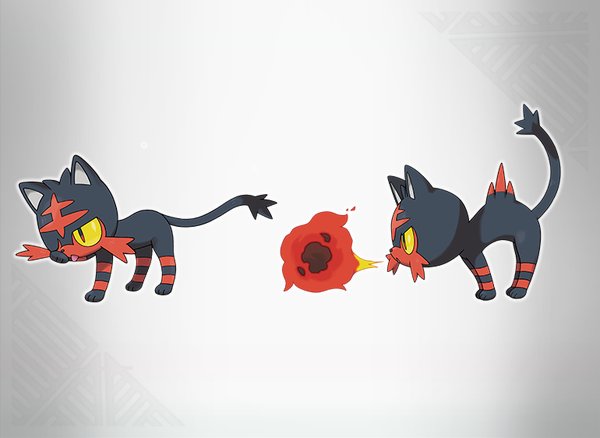
Now, things get interesting with Litten. For the unaware, there's been a theory that all the Fire-Type Starter Pokemon follow the theme of Chinese zodiac animals. So far, in order, we have a dragon (Charmander), monotreme "mouse" (Cyndaquil), chicken/rooster (Torchic), monkey (Chimchar), pig (Tepig), and...canine (Fennekin). While the Chinese zodiac does have a cat in its lore (as anyone into Fruits Basket knows), Litten is almost certainly our tiger as well.

I sense nitpicking. After all, not all striped cats are tigers, regardless of what the cats themselves have to say on the matter. Who's to say that this isn't a normal tabby cat, right?

The designers. No, really, there's a sneaky design hint that we're looking at a tiger in the making rather than your average tabby cat. You probably didn't even notice it unless you're from Asia already, or really into cats. You ready? Look at the mark on Litten's forehead.

Just look at it.

You done? Okay.


While we may think of both tigers and tabbies as striped cats, one of the least noticeable ways in which they are different involves the marking on their foreheads. A tabby cat has a distinct "M," which monotheistic religions usually cite as some type of divine blessing. A tiger has the symbol for "king." Have I mentioned before that the tiger is the king of beasts in China? While we could argue that the marking is still incomplete, the horizontal stripes versus the zig-zagging M is uncanny.

Source: NPS.gov 

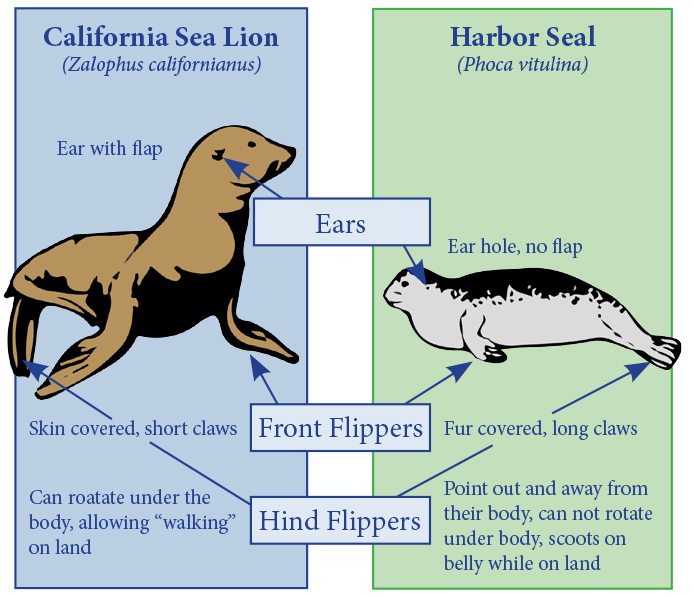
This isn't the only thing that fans missed. A lot of people glossed over that Popplio is not a seal - it is a sea lion. Despite having a Pokemon named "Sealeo" and Seel having flippers similar to those of a sea lion, we never had a sea lion Pokemon until this point. In a nutshell, seals are more marine (barely able to move on land, no ear flaps) while sea lions are more amphibious. The pinnipeds you see balancing balls are usually sea lions, not seals! What a clever idea for an amphibious Water-Type!

The lunar bat for Moon is awesome. Looks like the world's largest microbat - the kind of bat that has huge ears and uses echolocation. At the same time, I'd love a flying fox. I'd like every species on the planet to get its own Pokemon. Still a gorgeous, if impractical, design.

Source: KPBS.org 


Finally, yes, white lions exist. Though rare, they can be found in the Kruger and Timbavati reserves in South Africa. You can go squee about Kimba being real, now.


Friday, June 14, 2013

Creature Feature: Fishing Cat.

Most pet-owners in the world are either cat people or dog people. Me, I'm a cat person, and there are some really fascinating cats out there. Whether they are domesticated or not is of only mild relevance. Here's a cat I'd love to take home if red tape were not involved:


This is a fishing cat. It is one of roughly four species in Prionailurus, a group of small, spotted wildcats found in Asia. The fisher cat has spotty distribution in India and Southeast Asia and is endangered due to human activity. It is primarily found in wetlands and near running water, fishing for, well, fish. Rumor has it, however, that their very varied diet may also include certain carnivores- including dogs. Reminder: this is a small cat.

Doubtless, some cat lovers have noticed that cats like fish, but hate getting their paws wet. The fisher cat has its fish and eats it, too. They first lure fish with a tap of the paw upon the water, then scoop up the unwary little fishy before it knows what hit it. The fishing cat can also swim, sporting waterproof fur and a tail like a rudder. They can also dive for fish if need be. In summary, the fishing cat really loves water, unlike most cats who flinch at getting wet.

Now, here's one major difference between cat and dog people: dog people generally see inbreeding to create insane dog breeds as OK, but frown upon outcrossing with wolves and coyotes; cat people, on the other hand, will outcross with other small cats like crazy in order to create new breeds. The difference is in part genetic; dogs have 39 pairs of chromosomes, leading to an extremely versatile genome and a surprising amount of relatively stable dog breeds. Cats have a smaller genome, with only 19 pairs of chromosomes. (For the curious, humans have 23 pairs, meaning that chromosome count means jack in regards to intelligence.) What this means is that dog breeders have had a very extensive genetic palette to create living artwork over millennia, while the cat people simply do not have that range of genetic color. Cat people have gotten around that by breeding domestic cats to wild felines.

From here.


I recall someone once trying to equate comparing dogs with wolves to comparing cats with lions. This is BS for so many reasons, and the argument really deserves a sucker-punch to the gut, but the rule of thumb is that domestic cats can mate with a lot of small cats - including the fisher cat. The resulting hybrid cat is called a "jambi," and it's apparently brand new. Will these fishing cat hybrids be as hydrophilic as their wild counterparts? Who knows.

Sunday, September 2, 2012

Creature Feature: Caracal.

The average human psyche has exactly two images in mind in regards to felines: big cats, like lions and tigers, and domestic cats. The small- and mid-sized wildcats are often overlooked. That's a shame, because a lot of them are really neat.


Enter the caracal, one of the most striking of the little cats. If you took a lynx and exaggerated its ears and tail, you would get something that looks like a caracal. Caracals are native to much of Africa and the Middle East, and the name derives from a Turkish word meaning "black ear." Although it looks related to lynxes, it is closer, genetically-speaking, to the African Golden Cat and the tabby cat down the street.

The ears are the most noticeable part of the caracal. They have long tufts that make lynxes jealous. Although nobody knows the exact purpose of those tufts,we have several theories as to why they exist. On lynxes, the ear tufts function almost like radio antennae, helping the cat to hear. They might also help break up the outline of the caracal's head.


There's more to caracals than just the ears. Their paws have stiff hairs that probably allow them to walk on the sand, sort of like snowshoes. The caracal is also known for snatching birds in mid-flight - sometimes many birds at once! They also get most of their water from their prey, and domesticate surprisingly well.

Caracals have been in human company since ancient times. India and Iran both have a good history with these cats. The Persians were fond of using them to hunt pigeons. They can kill up to ten pigeons in one hunt! Yes, these cats have been exotic pets for a very long time, and remain pretty popular today.


Keen observers probably noticed a while back that caracals look a looot like house cats; yes, the two can make babies.The Moscow Zoo tried it, and caracal-cat hybrids can be found in captivity as well. "Caracats" have many of the same traits Savannah cats do - larger size (12-14 inches at the shoulder, 25-30 pounds) and fertility issues in the males. (For those curious, yes, servals and caracals can breed, too.) They usually use Abyssinians as a domestic base. F2 (second generation) caracats still have the attractive ears of their wild relatives and make better pets than F1 hybrids. Above is a caracat kitten for your squeeing pleasure.

That said, this month's Theme Week is going to be a doozy. I'm a cat person,  darnit!

Wednesday, August 29, 2012

"They Actually Eat That:" Cat.


But it isn't like this. No, this was a lucky photo I snapped with my phone. Styx conveniently decided a frying pan was a good place to try and take a nap. We did not intend to make her into kitty bacon, she just so happened to be in the pan for it.

That said, there are places that eat cats as food. No, it is not just restricted to China. It looks like quite a lot of people enjoy cat meat, even in "civilized" places. Unlike dog, this is a taboo food that a lot of people eat. Let's look at a list, shall we?


THIS is what cat meat looks like. Or, well, it's not nearly as cute as Styx in a frying pan.


For starters, yes, cat is a common food in the more rural parts of China. You will not find it by going into restaurants in Beijing or any other major city. Supposedly, cats are illegal to sell as food, but the laws are not as strict in the countryside. Guangdong is particularly notorious for a dish called "dragon tiger phoenix," which contains snake, cat, and rooster meat, respectively. The dish is, as with most Chinese food, medicine.If the name Guangdong sounds familiar for another reason, it's because a billionaire was poisoned by the cat meat there. Ceiling Cat was watching him twitch in agony.

Eating cat is also not limited to China. Cat was legal in Japan until the 19th century. We like to think that Hello Kitty helped make it even more disliked after that point. Korea still eats cat as they do dog. All three of the major "WTF food" Asian countries are slowly moving away from eating cat as more furballs find their way into homes, however, so expect it to be restricted to rural areas by the end of the decade.


The other big area famous for cat meat is, supposedly, Rio de Janeiro, Brazil. Now, we aren't saying that this place serves cat in five-star restaurants - far from it. Street meat is commonly accused of being cat meat. There have been busts on Brazilian slaughterhouses selling cat and dog meat. We have reason to believe that the name "cat meat skewers" has some basis in fact, here. Nobody likes the concept, even in Brazil, so please don't jump to conclusions. Just sayin', if your barbeque tastes a little off...

Australian aborigines also hunt feral cats. Now, let's be fair in this instance; the domestic cat wrecked the Australian ecosystem. Remember, the rule of thumb with Oz is, "If it has a placenta, it's not from around here." Cats are no exception to that rule. In the case of Australia, turning cats into food is pest control. After all, what happened with rabbits was terrifying.

Basically, if there is a rural area, there is a high chance that someone, somewhere has tried to turn cat into cuisine. Europe has it. South America has it. The internet doesn't say that hicks in North America eat cat, but it wouldn't surprise me.

Wednesday, March 28, 2012

Mythbusters: Alien Big Cats.

Now, here's a question: When does a cryptid stop being a cryptid? By definition, a cryptid's existence has to be disputed by science. Science disputes a lot of things; hell, take a look at quantum physics and String Theory sometime. Nitpicking is super-common in scientific circles, and cryptozoology is no exception.


Within the (unrecognized) discipline of cryptozoology, sightings of big cats outside of their native ranges qualify as cryptids. They are called "Alien Big Cats" (ABCs) or "Phantom Cats." ABC's have been found in most areas of the world. They often generate local legends, given enough time. Some are considered Ice Age "living fossils," but most of them can be traced to extant species. I know what you're thinking: Extraterrestrial cats would be pretty awesome, too.

Although found throughout the world, Great Britain seems like a real hotspot for ABC's. They are usually pumas, panthers, or general large black cats. The first sighting of a 'weird' big cat in Britain was a report of a North American lynx in 1760. The sightings really hit a boom in the 1960's, and then again after a law made in 1976 banned the keeping of several wild animals, including most big cats. This could easily have led to a mass-release of a genetically-diverse population.

According to the ten definitions of a cryptid by a man named Eberhart, Alien Big Cats fall under the "distribution anomaly" type of cryptid. Bless this man for trying to make a method to the madness that is cryptozoology. Note, however, one of the disqualifiers: "Erratics. "The out-of-place alligator […] that turns up in an odd spot, undoubtedly through human agency, is not a zoological mystery […]" The recent sightings in the 20th century speak of human release. The Scottish wildcat hybridizing with normal cats is also a common source of ABC's.


When it comes to ABCs, we know what we're dealing with. These aren't mythical creatures. These aren't even extinct creatures. These are mostly non-native species with full documentation. The only mystery is how the cats got there. Human intervention can easily be assumed, especially since many big cats wind up with irresponsible owners. Is every invasive species and escaped exotic pet on par with Nessie and Bigfoot, now?

Granted, there are some truly mysterious Alien Big Cats. India has a gray phantom cat, the Pogeyan,  that we really do not know much about. One ABC even turned out to be a canine. Some mythology buffs like to think that the sightings of black cats are a modern variation on Britain's legendary black dogs (which should be familiar to Harry Potter and Sherlock Holmes fans). I'm not doubting whether these Alien Big Cats exist or not; I'm questioning how science classifies them.

Thursday, March 15, 2012

Creature Feature: Kimba!


Those of you who are old and/or nerdy enough may remember Osamu Tezuka's classic cartoon, Kimba the White Lion. (It's the same thing as Leo the Lion.)  Basically, the series was about a white lion cub who escaped from a poacher's ship, went back to Africa, and became king of the beasts. He proceeded to nudge everybody into getting along, even though, given the nature of some beasts, many of his solutions would never work. Hell, he even tried to patch up the human-animal rift. Yes, this is still the cartoon that people have accused Disney of basing The Lion King off of.


But surely a white lion like that would never survive, right? Yeah, it's still got teeth and claws, but white animals rarely make the cut in nature...


...except in this case. Not only do white lions exist, there is a whole population of white African lions.

First off, let me make a few things clear about lions in general:

1. Lions are primarily savannah hunters. Sure, the name card reads "King of the Jungle," but they're mostly in places with not a lot of trees. The females do the hunting, the males tend to sit there being fabulous.

2. Lions have harems. No matter how touching Simba and Nala were in The Lion King, Simba had hookers. Lions will kill the cubs of another male just to make sure their own young survive. Hell, I've heard of male lions killing their own cubs just to bring a lioness into heat again.

3. The only place lions and tigers have ever met in the wild would possibly be in India. Rule of thumb is lions = Africa, tigers = Asia. Europe also had lions at one point. Europe had a lot of cool things at one point.

That said, wild white lions are a morph of Krueger's lion, a subspecies of lion (Panthera leo krugeri) native to Timbavati, South Africa. They are usually found on reserves, but some wild specimens have been reported. Several zoos also boast white lions in their collection. Trust me, you'll know if your zoo has one; they usually put it on the news. 

The gene that creates white lions is, once again, the chinchilla mutation. I have heard so many things about this gene that I do not know what to believe anymore. Whatever it is, it's apparently the same 'white' gene found in tigers, meaning that it's either leucism or not quite albinism. Supposedly, this gene was proven to not be albinism in 1997, but even www.whitelions.org says that there are still some genetic uncertainties concerning these big cats. Nobody has yet attempted a white liger, but if they did, it would be interesting to see how the two genes intersected. 

White lions have a surprising range of shades. Their coats can range anywhere from very pale tan ("blond") to snow white. They can have eyes that are hazel, green, or blue. The most stunning specimens are, of course, pure white with blue eyes. This is uncommon in the wild, but can be bred in captivity.

Kimba was not available for comment.


Despite being a white morph of one of the world's most revered animals, none remain in the wild (outside of preserves). The first sighting of a white lion occurred in 1938. Since then, numerous specimens were taken to zoos and hunted because "DUDE it's a white lion!" The last wild (non-reserve) specimen was seen in 1994. They were doing just fine before their 'discovery' if ancient African folklore is anything to go by.

(Now I'm wondering: would any of you like a week's worth of "La Vie En Blanche?" There are so many awesome white animals out there. Some of them just look cool; others have cultural significance like the Shirohebi.)

Saturday, January 28, 2012

Big In Japan: Iriomote Cat.


Japan is notorious for many things: A hard language (which really ISN'T that hard), animated porn, sushi, giant robots, more animated porn, and decent beef, to name a few. One of the lesser talked-about aspects (usually within animated porn) is catgirls. Catgirls have come up a few times on this blog, usually as "what has science done?" examples. That, and the author finds them kinda adorable.

For today's animal, however, the catgirl serves a different purpose: Ichigo, the almost nauseatingly-cute catgirl above, is based off of a very rare Japanese wildcat. After looking into it a bit more, the author of this blog found that Ichigo just barely looked like the Iriomote Cat, but making a tribute to such a rare animal was still a lovely gesture. Apparently the same cat also made a cameo in Azumanga Daioh with more accurate markings. 

IRIOMOTE CAT


And here's a real one.


The Iriomote Cat (Prionailurus bengalensis iriomotensis) is a small wildcat that does, indeed, look a lot like a regular housecat.As its name indicates, it is found exclusively on the (tiny!) Japanese island of Iriomote. It is an opportunistic predator that can usually be found near water. (Unlike domestic cats, they love water and catch their own seafood.) The Iriomote Cat looks a little strange, but it'd be easy enough to confuse one of these kitties for somebody's pet.

The Iriomote Cat may look like a normal house cat, but don't let size fool you. The Iriomote Cat is, genetically, probably one of the first felids to ever walk the earth. It has weird teeth and non-retractable claws as well. It has been called a "living fossil" and sports the status of "national treasure" along with tomorrow's creature. Precious cat is precious.


Unfortunately, the Iriomote Cat is getting more and more elusive. There are less than 250 individuals alive today, meaning that it definitely merits its "Critically Endangered" status.  That number is only shrinking as feral cats mate with these wild cats, diluting the gene pool. Human habitation and road-building are also causing problems. There is no captive breeding population, so, like the panda, this cat has an extremely low chance of surviving past this century. Maybe an Iriomote Catgirl is not such a bad idea after all...just watch out for those claws!

Thursday, January 12, 2012

Creature Feature: Servals.

When most people think Africa, they think big animals: Lions, elephants, wildebeest, gorillas, occasionally hyenas, and other creatures generally treated as "big game." In spite of this, Africa also has some of the most fascinating smaller animals out there, including meerkats, ball pythons (yes, that was a plug), and, of course, smaller cats.


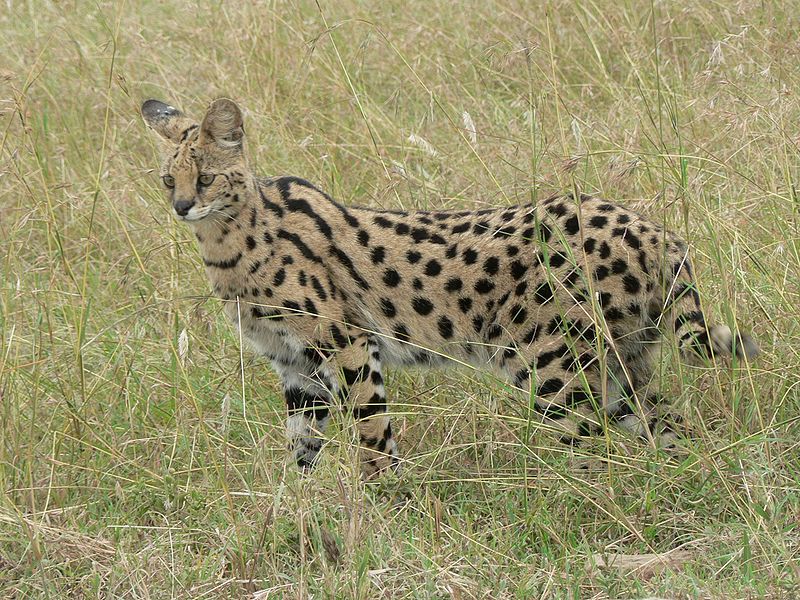
Servals (Leptailurus serval - also Felis serval) are among Africa's lesser-known felines. They are not big cats (considered "medium-size" -approx. 3 feet long), meaning that, like smaller cats, they can chirp and purr.  They are native to a good portion of Africa, including Tanzania, Angola, and Ethiopia. There are several subspecies, although exactly how many depends on who you ask. They eat any vertebrate small enough to fit in their mouths, although there are some reports of them taking down game as big as gazelle. They are not endangered at all, but that does not make them any less special than the other African big-shots. It's fairly hard to find a zoo with servals in the U.S.

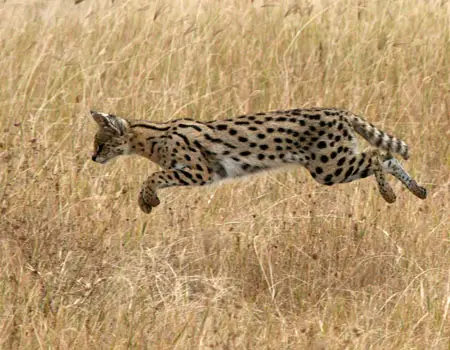
Servals are well-adapted to hunting on the African savannah. They have the longest legs (proportionately) of any feline, allowing them to jump up to 3 meters high and see over tall grasses with ease. Their large, erect ears let them hear the tiny scritchings of small prey, sort of like fennecs. Although mainly nocturnal, you will find several serval pics with excellent lighting.

The serval is definitely not related to Nyancat.
 

Serval coats can fetch a very high price on the black market. They are often sold as young cheetah or leopard pelts. The demand for their fur plus their tendency to sneak into chicken coops (they're smart like foxes!) makes them targets for hunters. As such, servals are rarely seen around populated areas...with one exception.

Look at the rest of the page for your daily dose of cute.


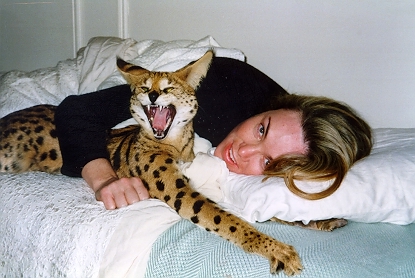
Finally, yes, servals can be kept as pets. If you so desire, you can even breed them with a regular cat and get a hybrid called a Savannah. These were covered briefly in my not-quite-breed week, but here's a refresher: A cat that acts almost like a dog to the point of being leash-trainable, eats raw meat, and is by far the largest domesticated cat breed around. Servals themselves are adept problem solvers and  come in black and white phases, just in case you want to be even MORE different. Even if zoos are a little short on servals, there are plenty around in the U.S. Just know your laws, mmkay?

Sunday, September 25, 2011

Freak Week III: Ankara Kedisi.

Ah, time for the hardest part of Freak Week: that one last entry to round it all out. Since last Freak Week, I have found a lot of breeds that would have made for interesting entries. The two candidates for today's entry were another cow and a certain very precious type of cat.

That said, have a kitten snapped with my own camera:

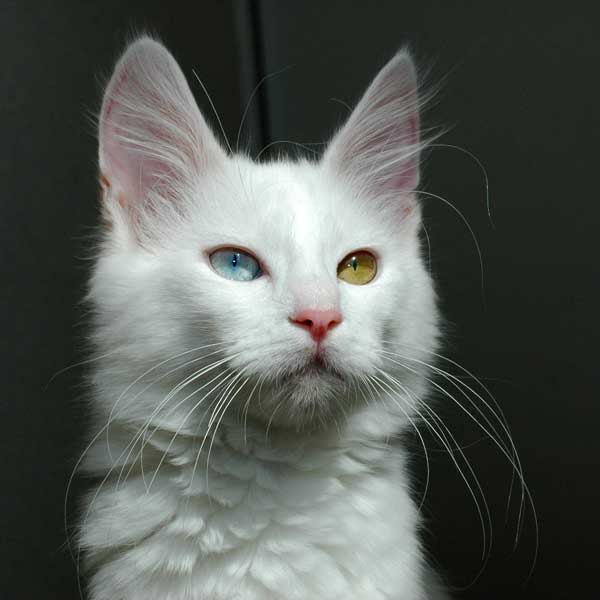
Before you gasp at how inhumane it is to put a cat in a cage like that, that little white kitten is very special. He and his cagemates are pure white, and considered precious and rare enough that the Ankara Zoo has a breeding program just to keep the cats alive. If the name "Ankara" was not enough of an indication, yes, that little fuzzball will one day become an elegant Turkish Angora cat.


The Turkish Angora was developed in central Turkey sometime between the 14th and 16th centuries. This cat is most known for its long, silky coat and plumed tail. It was bred with Persians (those longhair cats that look like they have run face-first into brick walls) to the point where the breed almost died out. They were recognized as an official breed in 1973.

Although Angora cats can come in almost any color, for a long time, only the pure white Angora was showable. If you have been keeping up with my 'white animal' entries, the usual drawbacks to being white include deafness, impaired vision, or both. Some Angora cats are deaf; in cats with heterochromatic eyes, only the side with the blue eye will be deaf. Many Angora cats can hear just fine, and even deaf Angoras can lead perfectly normal indoor cat lives. (The same CANNOT be said of Dalmatians, by the way.)

These cats are actually creepy after a while.


The Turkish LOVE their Angora cats. White cats like the kitten at the zoo have been considered a national treasure by the Turkish government since the 20th century. Especially prized are those cats with one blue eye and one eye of another color. All over Ankara, there are giant statues of furries Angora cats, all white with odd eyes. Even the logo for Ankara exemplifies its unique cats.


At least they know how to market themselves.

Saturday, September 24, 2011

Freak Week III: Egyptian Mau.

"Thousands of years ago, cats were worshipped as gods. Cats have never forgotten this."-  Unknown. 


Most people who like cats know that the Egyptians loved cats. Along with being the first people to 'domesticate' the cat, they had a cat goddess named Bastet. Keenly aware that the cat was still a wild animal, Bastet had a dark side, the lioness Sekhmet. Say what you will about the incest in their pantheon, but they had cats right on the money. 


Without getting into hybrid cats, Egyptian Maus are easily the most exotic-looking breed of cat around.  They are the only naturally spotted breed of cat, possessing cheetah-like spots even beneath their fur. They also run like little cheetahs - up to 36 miles per hour, which, for reference, is about as fast as a giraffe. 

Besides a nearly unchanged look compared to ancient Egyptian depictions, the Mau has several genetic and behavioral differences that suggest a wilder ancestry. The Mau distinctly prefers hotter temperatures, much like its native climate. Besides meowing, Maus can also chirp and chortle. Like ancient dog breeds, Maus are very loyal and intelligent, but usually only bond with one or two people. Finally, they are excellent ratters - as well as snake-hunters if the image below is any indication.


Like most breeds of animal, Maus can be put up for show. However, only the bronze, silver,and smoke can be shown (because markings must be visible). The eyes must be green. Black and pewter are still used in breeding. If you want a cheap, but still classy-looking Mau, go for a black one. It will look more like the modern perception of Bast - spotless. 

Sunday, September 18, 2011

Creature Feature: Asiatic Lion.

Anyone who knows anything about lions knows that they live in Africa. Depending on your source, they either have a strangely anthropomorphic family or a harem system in which the big guy gets all the women. Lions are probably the most filmed predators on the African savannah.

So when one hears a story about lions in places like, say, Greece and India, brows go up. Where did the Nemean Lion (and, come to think of it, half of all Greek monsters) come from if Greece had no lions? Doesn't India have tigers instead? Hey, come to think of it, did the lions that devoured ancient Christians really come all the way from Kenya?

The Arabic text says "get in the car."


A not-so-long time ago, two species of lion roamed the lands: The African lion and the Asiatic lion (Panthera leo persica). The African lion gets thousands of documentaries every year and two charming animated films; the Asiatic lion gets this entry and a place on the Endangered Species list.

Asiatic and African lions differ almost solely by location. The African lion is, well, African; the Asiatic lion once spanned Europe (including Greece and Italy), the Arabian Peninsula, and India.  Fossil records suggest that they may even have been in Alaska.

Asiatic on the bottom.


At a glance, there are a few subtle anatomical differences between the Asiatic and African species that only lion-otakus can really pick out; look them up if you really must nitpick. The species are so close they can interbreed, leading to debatable species conservation practices. With only 400-odd Asiatic lions in the wild, genetic purity matters.

Yes, the population of Asiatic lions declined from thousands to only four hundred. Currently, habitat loss and hunting livestock are the main threats to their survival. All four hundred of them are thought to be somewhere around Gir Forest, India, which remains the only natural habitat of the Asiatic lion. (No, that is not a typo, Invader Zim fans.)

Even with the Asiatic lion's wide range, there were never lions in China. The "lions" found in Chinese lore are composite, nigh-mythical beasts that look more like dogs than lions to most Westerners. This happened because the only lions ever received came in the form of Asiatic lion pelts from India. A certain Chinese monk used his imagination and used the few images of lions he had to create the ultimate lucky beast:


...whatever that monk was on, we want some.

Wednesday, March 30, 2011

Freak Week II: Scottish Folds and American Curls.


Notice something a little bit...off...about that adorable little kitten?


OH MY GOODNESS, A CATGIRL STOLE ITS EARS!


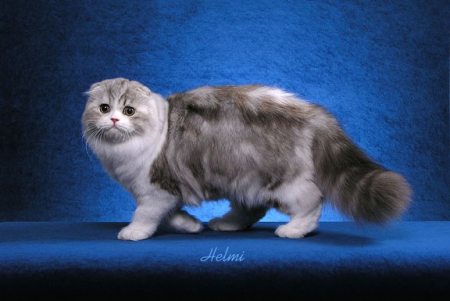
Actually, no kittens were harmed in making catgirls. The cat above is of a special 'breed' called a Scottish Fold. As the name implies, the ears on Scottish Fold kittens have the cartilage folded downward. This gives them a round-headed look that has been described as "owlish."


O rly?

The Scottish Fold breed started with one cat, Suzie, who lived on a farm near Perthshire, Scotland. When she had kittens, two of them were born with folded ears like their mother. One of the kittens was taken in by a nearby cat-fancier, and the breed developed from there. Ear-folding is dominant, so the trait was easy to pass on to many varieties of cat. Thus the breed was born.

Before you ask: Yes, all Scottish Folds are directly related to Suzie. They are not necessarily inbred (responsible breeders encourage outcrossing), but have an amazing amount of issues from the one trait of folded ears. Even well-bred kittens develop osteochondrodysplasia - or, in English, bone problems. This can include anything from malformed bones at birth to severe arthritis in later years. These issues are so common with Scottish Folds that one vet discouraged breeding them entirely; they are also not recognized by European fanciers as a breed.


Of course, a breed needs more than one trait to be considered a breed. As in canids, cats with folded ears tend to have amicable personalities. Folds are very communicative cats; they also sleep on their backs and sit in "Buddha Position." Aww, they think they're people!

A DS is not included with Scottish Fold cats. Sorry.

If folded ears are not your thing, the American Curl has the exact opposite mutation of the Scottish Fold: A Curl's ears curl upward for an expression of eternal surprise. Pet Curls can have the ears curling almost straight upward; show-quality curls demand a definite curl, but not so much that the ears touch the skull. Both longhair and shorthair Curls have very silky coats. If you like your cats a little bit odd but still with hair, the ears have it.

Not to be confused with the American Girl franchise.

Tomorrow: We swear, this was the weirdest horse we could find...

Saturday, February 12, 2011

Creature Feature: Clouded Leopard.

Said it before and will say it again: "Middle felids" need more love. To most people, there are only small, domestic cats and giant wildcats like lions and tigers. What do you think happened to all the cats in between, guys? Did they disappear thanks to some natural phenomenon that did not play to one extreme or the other?

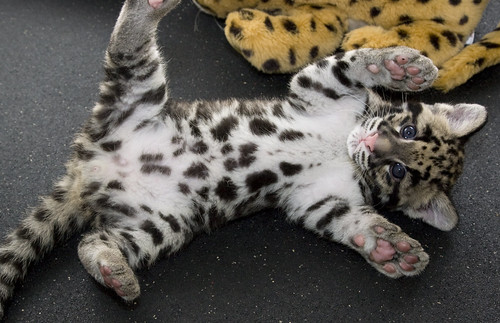
No. People just do not think that mid-sized cats can be awesome. Here's a Clouded Leopard (Neofelis nebulosa) to prove them wrong:


Clouded leopards live in Southeast Asia, from the Himalayas to China to Indonesia. They, like all cats, are carnivores; clouded leopards may be big and bad enough to take down large mammals. Its exact diet is largely speculation due to the clouded leopard's very small wild population size. It is estimated that there are no more than 1,000 adult cats in one area. Deforestation is not helping.

 In many ways, the Clouded Leopard is the mid-sized cat.When scientists first saw this cat's skeleton, they could not tell whether they were looking at a large or small felid. They do not purr like small cats, but can meow, hiss, growl, and make a number of other noises. This was all learned from captive specimens.


(Turn off the Thai music if you must.)

Clouded Leopards have several other strange things about them that neither big nor small cats have in spades. They have the largest canine teeth (proportionately) of any felid; picture a tiger's teeth on a little kitty like that and one wonders if it will eventually evolve into a stealthy, arboreal Smilodon.


Show me your teeth!

As if saber-teeth were not enough, clouded leopards are the best climbers of the feline world. Their ankles rotate so that the animal can climb upside-down on tree braches and down tree trunks headfirst like a squirrel. That long tail helps it balance. All of these adaptations put together lead researchers to believe that the Clouded Leopard, besides hunting arboreal prey, might be able to drop down upon unsuspecting ungulates. Again, nobody's sure.


If you want to support conservation of the clouded leopard and other big cats, take a snap of your own cat. Send it and five dollars to National Geographic's Little Kitties for Big Cats fundraiser and your furry friend may become cat of the week. Share the love! 

Tomorrow: Jaws just got a whole new meaning.

Wednesday, January 12, 2011

"They Actually Eat That:" Tiger.

Tigers are one animal that I bet you thought that you would never see under "They Actually Eat That." Sure, it's easy enough to torment songbirds, make a soup out of duck's blood, use Rover as food, or shoot a kangaroo, but removing the Chinese king of beasts? That's almost blasphemy, isn't it?


Uuhhhh...remember this thing? The snake enshrined in booze?

For starters, humans will eat anything - and on "They Actually Eat That," we mean anything. Homo sapiens is an omnivorous species of ape that, when not given the proper mixed diet, goes insane. There is a disorder called pica that develops whenever people are sorely missing a needed nutrient. Eating anything we can is no longer just an option; it is a way of life.

That said, being an omnivore is just part of what makes humans a "broken" species. Unlike most animals, we tend to systematically eradicate things that we find threats or food. Hell, sometimes we don't even mean to do it - it happens because of little animals that we bring along. When we do mean to eliminate a species, it is because we have put two and two together and found a way to stop whatever is terrorizing us. (Making this worse is what I call the "OMG They Killed Kenny!" reaction - one human dies and everybody gets upset over it.) Humans are mean like that; such behavior is beyond self-defense.


Tigers, being large, threatening animals that can potentially eat people, are wiped out a lot. The Bali Tiger was eradicated not because it was awesome, but because it was seen as evil. The Javan tiger was killed off by a number of things, including general forest clearing and many of its prey species being threatened by disease and poisoning.  The Caspian tiger became extinct because the Russians just plain wanted it dead [insert "Soviet Russia" joke here]. Point is, we know how to kill tigers and are very, very good at it.


In Soviet Russia, tiger kills...no, wait. No it doesn't.

 What the hell made you think we wouldn't try eating big, bad tigers, just to prove that we really are the "1337 H4XX0rz" of nature?

They Actually Eat That?! 


China is big on eating and drinking tigers. Surprise, surprise.

In China, the tiger is king. Their symbol for 'king' is derived from the forehead marking of a tiger. There are no lions in China, so they made the tiger the ruler of everything with fur. A white tiger ("Bai Hu" or "Byakko") is the ruler of the Western quarter of the Chinese sky. It is also the sign in the Zodiac most likely to 'rise to the top,' so to speak, and is considered one of the most masculine animals out there.

This symbolic potency means that they are used for...everything that you would not use a dead tiger for. Their pelts are burned to keep centipedes out of the house. Their blood is used as a general "good health" tonic. The bones cure almost anything you can think of, including burns and malaria. The genitals, welllll...


You're gonna cut off my WHAT for WHAAAT?! 

Yes, they eat tiger penis as an aphrodisiac. If you see "Tiagra" appearing at your local organic health food store, stay faaaar away.

Before you all say how horrible this is already, China has over 6,000 (often abused) tigers in captivity thanks to the popularity of tiger medicine. After banning the trade of those magical tiger bones, tiger breeders are trying a new tactic: tiger bone wine. Apparently you can sell bones in wine but not by themselves. Oh, Chinese laws. 

This farming does, however, have an up-side. The Scimitar-Horned Oryx had a similar situation; its population is now limited to game reserves, but they're alive. At least if the wild tigers go extinct, there will be tigers left to replenish the Asian jungles. It is not a good situation, but it could be a lot worse.


I love you. Now stop eating my organs.

Sunday, January 2, 2011

Creature Feature: Sand Cat.

Face it: I belong in a zoo. This blog is nothing but animal rants, I know a million people I can talk to about exotic pets (i.e. stuff that most people think belongs in zoos), and it's been my childhood dream to be some sort of animal-related scientist. (Then I found that not being able to do math worth a crap put a dent in that dream, and became aware of the exotic pet industry. I now have a zoo in my room.)

When you see this face, you might want to work in a zoo, too:


No, that is not a stray cat that wandered into  zoo exhibit. It is a sand cat, Felis margarita. Despite the name, it is not native to Mexico; it lives in the deserts of Africa and the Middle East with some general range around Pakistan. It is related to the domesticated cat on the generic level only, and I will be DAMNED if somebody has not tried to interbreed the two. Whether they succeeded or not, I don't know, but the result would be adorable.


What you say about breeding?

Sand cats differ from domestic cats in many ways. Aside from being perpetually cute (those aren't babies up there), they have larger ears that can hear prey scurrying underground, sandy coats, and extra fur on their paws that protects their feet from the sand (or, in some cases, snow). These fuzzballs can survive both scorching hot and freezing cold temperatures. They also get all the water that they need from their food. Desert animals just roll that way; the fennec fox has similar adaptations. 


Warning: Do not attempt to keep these cats as pets. Although my usual "I want one" tendency kicked in around these guys, they do not live long in captivity, and are vanishing from the wild for a number of reasons. Habitat loss and general human encroachment (a dog can eat one of these guys, remember) are the main factors. (Sand cats are actually too cute for their own good - the exotic pet trade is one of their main threats.)  One would think that an animal that can survive the harshest of conditions would be well-suited to captivity, but unlike fennecs, budgerigars, rosy boas and bearded dragons, these guys do not make good pets.


Lick it, bitch! 

Then again, some people would say that regular cats are not domesticated, either.