Showing posts with label carnivordiae. Show all posts

Thursday, February 23, 2012

Creature Feature: Sea Otter.

Speaking of sea otters...


Yes, yes, let's get it off our chests now: Sea otters (Enhydra lutris) are adorable. They're like koalas, only more or less bound to the ocean. They look like stuffed animals capable of floating on the water.  It is impossible to stay mad at sea otters. Go ahead and try. Oshawott is officially the exception to the rule.

Adorable-ness aside, sea otters, like all mustelids, are carnivores. They feed on ocean-dwelling invertebrates like bivalve molluscs and sea urchins as well as small fish. Sea otters can be found in the northern parts of the Pacific ocean - i.e. California to Japan.  Japan loves them even more than I do, by the way.

Even their boogers are KAWAII.


Sea otters have a number of behaviors that only add to their cuteness. They swim on their backs and rotate while eating. They use rocks to break open hard-shelled mollusks (yes, using tools). Sea otters have got to be among the most maternal mammals out there; otter moms don't let their pups out of their sight, tether them in kelp while they go out hunting, and, if their pup happens to die, they still huggle the corpse for a few days. What? That's the most adorable use of a corpse ever.

No, I have not gone soft. The sea otter was recently brought to my attention for a very special reason in my Environmental Sustainability class. Specifically, the sea otter is a keystone species in many parts of its range. Allow me to explain exactly what that means:


Long story short, a keystone species is a species so unique that absolutely nothing else in its ecosystem does what it does. That means, if something happens to that keystone species, the whole food web will go out of whack. Guess what happened when the sea otter was nearly hunted to extinction for its plush fur?

OHMYGAAAWD!


Answer: Total ecological chaos. In the sea otter's natural habitat off the coast of California, it was the only thing eating sea urchins. Sea urchins, as I briefly touched upon yesterday, eat kelp - a sophisticated alga (not a plant) at the bottom of the ocean food chain. If the bottom of a food chain/web is effectively removed, everything that centered its life around it is bound to suffer.  Killing the sea otters meant major fish losses for everybody else.

Now, we have become smarter. The sea otter is now listed as an endangered species. It is illegal to hunt sea otters for their fur. It helps that they're so darn cute that they are hard for anyone with a soul to hunt. The problem is slowly being fixed, but not as quickly as we would like. After all, who would mind more sea otters?

Best case scenario!


Mind, the sea otter happens to be a very cute textbook example of a keystone species. There are several other important species out there that require attention and are not nearly as cute.

Saturday, January 28, 2012

Big In Japan: Iriomote Cat.


Japan is notorious for many things: A hard language (which really ISN'T that hard), animated porn, sushi, giant robots, more animated porn, and decent beef, to name a few. One of the lesser talked-about aspects (usually within animated porn) is catgirls. Catgirls have come up a few times on this blog, usually as "what has science done?" examples. That, and the author finds them kinda adorable.

For today's animal, however, the catgirl serves a different purpose: Ichigo, the almost nauseatingly-cute catgirl above, is based off of a very rare Japanese wildcat. After looking into it a bit more, the author of this blog found that Ichigo just barely looked like the Iriomote Cat, but making a tribute to such a rare animal was still a lovely gesture. Apparently the same cat also made a cameo in Azumanga Daioh with more accurate markings. 

IRIOMOTE CAT


And here's a real one.


The Iriomote Cat (Prionailurus bengalensis iriomotensis) is a small wildcat that does, indeed, look a lot like a regular housecat.As its name indicates, it is found exclusively on the (tiny!) Japanese island of Iriomote. It is an opportunistic predator that can usually be found near water. (Unlike domestic cats, they love water and catch their own seafood.) The Iriomote Cat looks a little strange, but it'd be easy enough to confuse one of these kitties for somebody's pet.

The Iriomote Cat may look like a normal house cat, but don't let size fool you. The Iriomote Cat is, genetically, probably one of the first felids to ever walk the earth. It has weird teeth and non-retractable claws as well. It has been called a "living fossil" and sports the status of "national treasure" along with tomorrow's creature. Precious cat is precious.


Unfortunately, the Iriomote Cat is getting more and more elusive. There are less than 250 individuals alive today, meaning that it definitely merits its "Critically Endangered" status.  That number is only shrinking as feral cats mate with these wild cats, diluting the gene pool. Human habitation and road-building are also causing problems. There is no captive breeding population, so, like the panda, this cat has an extremely low chance of surviving past this century. Maybe an Iriomote Catgirl is not such a bad idea after all...just watch out for those claws!

Wednesday, September 21, 2011

"They Actually Eat That:" Truffles.

Forgive my lateness. Had to stay up at campus a little later on Wednesday, but don't worry, I would never miss a chance to show you all some seriously weird food. This is a little bit hard during Breed Week - whoever would admit that certain breeds are good for food? Even if they are, most of them are not remotely weird. (The Belgian Blue is an obvious exception.)

So this is something different and tangentially-related to domesticated animals.


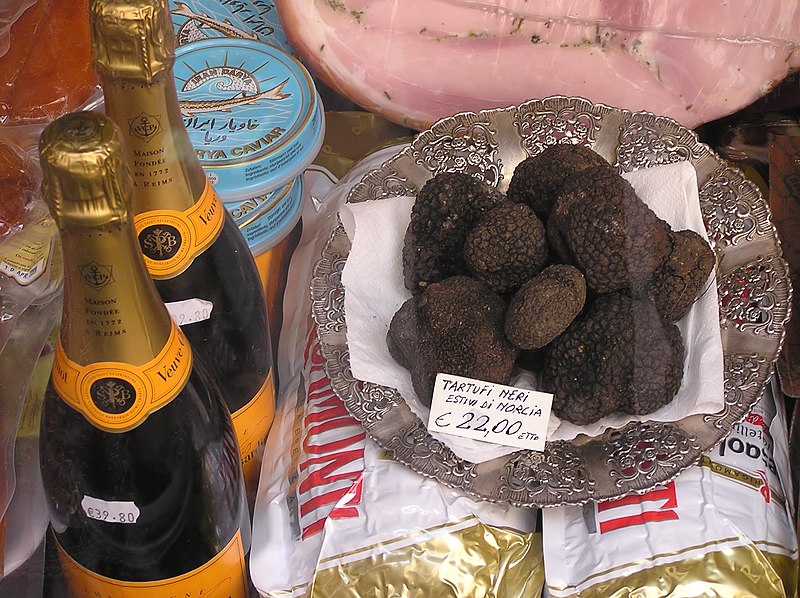
Connoiseurs of my blog have probably heard of the fungi called truffles. Besides being a delicious chocolate treat, truffles are a type of fungus usually found near the bases of various trees, particularly oak, beech, hazel, and pine. The European black and white truffles are delicious, but very, very expensive. Chinese truffles are often used as a cheap substitute.

Truffles are not domesticated, per se. They can be farmed (Australia has had the best luck), but are not sufficiently differentiated enough from their wild counterparts to be considered breeds. Truffle fields return to wildness easily, sending the search for easy truffles back to square one. These things are so hard to find that humans need special animals just to discover them, thus explaining the price tag...


...even though piggies can find them no problem.

The classic way to find truffles is to get a healthy sow and take her out for a little walk. Since truffles smell like a horny boar's saliva, the pig's sensitive nose will pick up the scent. Sows can smell the fungi up to three feet underground. We can only imagine that her desire would be doubled if she herself wanted some lovin'. As one might expect, pigs do sometimes eat the truffles. If your Playboys came with a hamburger inside the pages, you probably would, too.

Japan has the right idea.


Of course, pigs are not the only animals with a keen sense of smell. Dogs, specifically the Lagotto Romangolo (Romagna Water Dog) can also be trained to sniff for truffles. The Lagotto breed has been in the business for only 100 years, which is a short time compared to ancient Roman truffle hogs.

You can also tell it's hypoallergenic because of its poodle-ish fur.


For the record, yes, I have actually eaten truffles. If you want to try some good ones, they have truffles in everything in Piazza Navona, a certain square in Rome. They put truffles on pizza, in fettucine, and have a godly gelato called tartufo- no real truffles involved, just using the name. Truffles are delicious, but I personally would not go into any pig sties after eating them!

Monday, March 21, 2011

Creature Feature: Meerkats.

Mongooses are already pretty cool creatures as far as their relationships with humans go. Even though they do not necessarily make good pets, they kill snakes, which humans generally consider a good thing.  Anything that gets rid of snakes, the rough antithesis of humanity in many cultures, is A-OK.

So how is it possible that a mongoose could be even more human-friendly? By making them act like people.


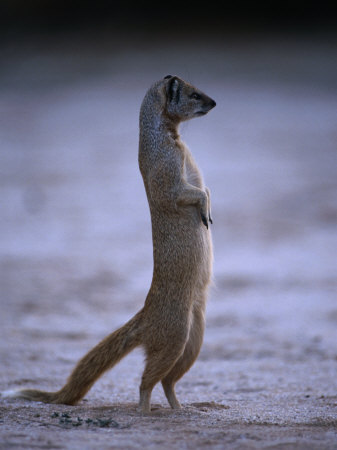
Meerkats (Suricatta suricatta) are close relatives of the mongoose. They are native to the Kalahari Desert (covering Botswana and South Africa). Like mongooses (mongeese?), meerkats are carnivorous, chowing down on insects, snakes, small mammals, and scorpions.  They are partially-immune to the venom of some species and 100% immune to the venom of scorpions.

Meerkat Manor is a slight stretch, but unlike many mongoose species, meerkats are social animals. They normally live in colonies of 20-30 meerkats all sired by the same male and female pair. Some colonies contain around 50 members, still all inbred cousins. As in wolves, only the alpha male and female are allowed to mate; the other meerkats show signs of submission such as licking their alpha's faces. This should sound like another social animal that we all know.

Can I be a mongoose-dog?
 

Meerkats have amazingly complex burrow networks throughout their territories. These allow a meerkat colony to escape whenever danger is around using nearby "bolt holes." Meerkats will also rotates burrows so as to let an insect population flourish in one section for a while. Call us crazy, but that sounds almost like farming. Almost.


Meerkats also have several different types of call. There are distinct warning cries uttered by a sentry, i.e. one of the meerkats standing on its hind legs all the time. These cries can be very, very specific, telling the exact location and type of predator. Meerkats also make several other noises that boggle human minds. Some say that only humans have language; social animals like meerkats come darn close.

Do not, however, attempt to make a meerkat a pet. They are adorable and act a lot like dogs, but they get hysterical if only one meerkat is around, scent mark like crazy, and will tear up things in an attempt to make a burrow. Hell, even owning regular mongooses is illegal...except in Hawaii.


STILL not like this. 

There are, however, some people who have gotten sick to the teeth of meerkats. An extremely popular ad campaign in Britain for "Compare the Market" has led to a slew of meerkat-related merchandise. The Russian meerkat from that commercial, Aleksandr Orlov, even has his own autobiography. No matter how much you love meerkats, this is like the Geico gecko suddenly getting his own book. Simples? 

In Soviet Russia, meerkat compares you!


Tomorrow: A pig under the sea. Kinda.


Tuesday, March 8, 2011

Creature Feature: Red Panda.

Now for a million-dollar question (without any money involved): Do you use Mozilla Firefox to surf the 'net?

If so, did you know that Firefox is not based off of a fox at all? Most of us probably know it better as the red panda (Ailurus fulgens). It does indeed look more like a fox than a panda, but whatever you prefer to call it, it is adorable. Cool of Firefox to get us live red panda footage!


The red panda is native to China (like the giant panda) as well as some parts of the Himalayas. It is a small, omnivorous mammal about as large as a house cat. It spends most of the daylight hours sleeping, just like a cat. It cleans itself and climbs just like a cat. Even its generic name, "Ailurus," is a nod to how catlike it is...even though it is closer to raccoons and weasels. It is suspected to be a species isolate; its closest relatives died off 3-4 million years ago. Cutest fossil ever.


The red panda's diet consists largely of bamboo, even if it does eat insects and small mammals as well. It has evolved a "false thumb" like the giant panda to help it hold its food. The similarities end there; it eats bamboo like a panda, but otherwise, red pandas are completely different creatures. Just as cute, though.

Red pandas have a few characteristics all their own. They waddle due to their short front legs, but that same build allows them to climb down trees headfirst. They communicate via a call known as twittering. Yes, you heard that right: The red panda had Twitter long before humans made up the concept. Holy carp, they own the internet!

The little red ball is the internet.


Now, we know what you're thinking: "Can I have one as a pet? PLEEEEASE, mommy?"

Haha. No. Red pandas are vulnerable, sporting less than 10,000 individuals in the wild. If you want one, become an endangered animal breeder. They would make pretty bad pets anyways, even though they thrive in zoos. For the record, raccoons do not make good pets either. We've looked.


Tomorrow: So what CAN you have as a pet? How about a fox as tame as a dog! Also, breast milk.

Sunday, September 12, 2010

Who's That Pokemon? - Eevee #133

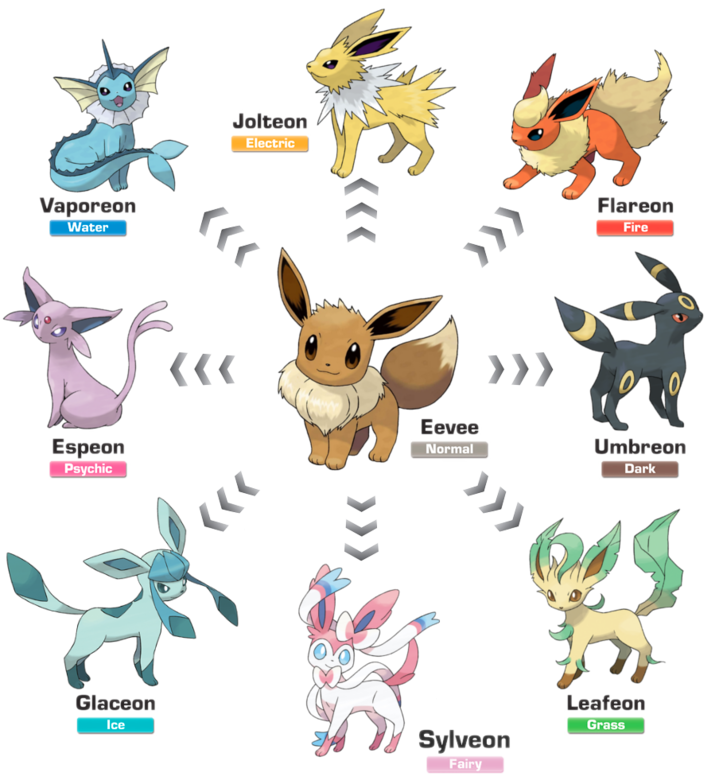
It is physically impossible not to like Eevee. It's cute, it's versatile and it comes in what...seven flavors, now?

Rainbow sherbet will have to come eventually...

There is still a bit of debate over whether Eevee and its seven mature forms are felid or canid (especially given how Espeon CLEARLY resembles a nekomata). Allow me to answer that:


Give a nickname to the newly hatched EEVEE? Kidding, foxes are born hairless.

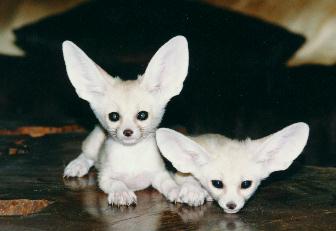
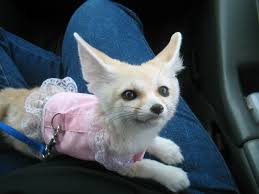
Eevee is totally based off of the fennec fox (Vulpes zerda). The colors are a bit off and the fennec lacks the ruff of fur that becomes a different sort of collar in each of the first three Eeveelutions, but the resemblance is still darn close. The bushy tail, short snout, pointed ears and overall adorable appearance all say "I'm a Pokemon!"

Fennec foxes are native to the Sahara Desert in Africa. They are nocturnal foxes well-adapted to desert life with extremely acute hearing and adaptations that gather water as efficiently as possible. They are omnivores, eating everything from insects to eggs.


I'm gonna kill you...

Fennecs are the smallest canid species alive - I am quite sure that some freaks have bred their dogs to be even tinier, probably with massive defects. (Only the Chihuahua is slightly smaller and considerably uglier.)


Those ears are effing huge and are the largest, proportionately, of any fox. Fennecs can hear their prey scurrying underground with those large ears. Plus, they're nocturnal; at night, hearing is more important than vision. Just ask owls and bats.


Ya rly.

As one can probably imagine, these little foxes are popular as exotic pets. They are one of the two foxes thought to be properly tameable. This requires a little bit more work than with 'domesticated' animals, but really, you should do your research with those, too. (Why do you suppose so many dogs wind up in shelters, eh?)


This outfit demeans both of us. You realize that, right?

Before you ask, no, you cannot use radiation to evolve a fennec into seven different forms. Radiation does weird shit to creatures. Just ask Japan.

Thursday, August 19, 2010

Creature Feature: Fossa.


As the Madagascar movie adequately highlighted, the island does indeed have a few familiar-looking carnivores. Nah, just kidding; they are just as weird as the lemurs, geckos, chameleons, and ground boas.


Fossas (Cryptoprocta ferox) are neither cats nor dogs. Like hyenas, they are more closely related to cats; boy does it show in that face! Again, they are fairly closely related to civets and mongooses. Even that is under scrutiny; nobody can seem to give the fossa a solid scientific classification.


I know what this is: DARN CUTE.

The video up top demonstrates the fossas' agility in the treetops. They are the only predator that can take down any species of adult lemur, even if the size and weight difference is huge. Half of the fossa's diet consists of lemur meat. There has been one detailed observation of fossas hunting in packs, but such reports are few and far between.

The fossa's species name, Cryptoprocta, addresses the creature's hidden anus. That's lovely, science; seriously, though, fossas have insane junk. Fossas have awesome enough balance to mate in the trees, a feat made easier with the male's spiked penis. Females get a similar development, albeit not as noticeably as in female hyenas. The mating lock is almost impossible to break once created. (I got a healthy dose of this in ZooBot class; now it's your turn!)


(If mating fossa noises aren't your thing, play "The Bad Touch" instead.)

Unlike lemurs, which are seen as ancestral souls, the fossa is treated a lot like the sneaky, greedy fox. People tend to avoid fossa meat because they do not wish to acquire its undesirable characteristics. Nonetheless, it is still hunted for bushmeat. Is this mortifying enough to merit a "They Actually Eat That?" Eh, well, it's not nearly as weird as the Chinese eating tiger dick.