Showing posts with label fungi. Show all posts

Tuesday, December 25, 2012

Christmas Special: Amanita Mushrooms.

Have you ever realized how many things about Christmas just don't add up? Who would really put presents under an evergreen tree? Who gave a fat old man the right to enter houses in the presence of kids, anyways?Why do we have Christmas trees?

Well, there's a perfectly logical explanation for all of this:

Source.


Yep: Stoner mushrooms. In this case, the specific mushroom in question is Amanita muscaria. They are native to most places in the northen hemisphere, particularly in areas with pine trees. A fair amount of X-mas loops back to these mushrooms. Jesus was never involved in Christmas; the makers of the calendar just decided to celebrate it around the day the pagans were celebrating solstice. It was a marketing move to sync Jesus with 'shrooms, in other words.

Amanita muscaria is also called "fly agaric." The reasons for this are rather strange, but the most common is that one could sprinkle some of the mushroom in milk to ward off flies.We can't tell exactly where this practice originated (possibly Germany or Sweden), but it's strange. Flies can actually get high just by landing on the caps of Amanita muscaria.  Just another reason to pick up mushrooms.

Its most notorious use, however, is as a potent hallucinogen. The culprit is muscimol, with ibotenic acid helping it along. The effects are so varied that it would be madness to say that there are any standards beyond "tripping the eff out." Symptoms usually wear off after 24 hours. Severe poisoning only occurs after 15 caps or so; nobody has gone on record dying from these. When other types of hallucinogenic mushrooms get banned, Amanita suddenly becomes popular. Get on your cloaks and start flipping tree skirts!


So, how does this tie in with Christmas? Amanita muscaria mushrooms are commonly found beneath fir and evergreen trees. Replace "mushrooms" with "gifts." Link it with the solstice for good measure. Boom, Christmas.

 Oh, and guess what else likes Amanita mushrooms? Reindeer. Yes, they also get high off of the 'shrooms, causing them to leap about like giddy idiots - that's the origin of flying reindeer. Other possible origins include the flying sensation and hallucinations (sometimes of winged reindeer) brought about by the mushroom.  People can also get high off of the remaining active toxins in reindeer (or human) urine, which is actually safer than taking the mushrooms straight. Yes, I just said that drinking reindeer piss is safer than eating a mushroom off of the ground. (That said, A. muscaria are edible with proper cooking.)


After this, things start to get a little hazy.  We aren't sure whether Santa has any real shamanic basis or not. It is, however, awfully suspicious that St. Nicholas is usually pictured with A. muscaria colors, that he laughs oddly, and that his Coca-Cola-designed image is almost too flushed to be sober. A fluffy coat like that also seems like a good idea when mushroom-hunting in the winter, although whether it's really red and white could be debated. Use a critical eye when browsing these theories.

Of course, A. muscaria's fame extends well beyond Christmas. All of the mushrooms in Mario-land look like Amanita. Pokemon also makes some use of them, with "Amanita" being the name of the storage system manager in B/W and the two new mushroom Pokemon slightly resembling red Amanita. There was also a dancing mushroom sequence in Fantasia, which speaks for itself.


Merry Christmas to all, and to all a stoned night! It's traditional! (Actually, I DID get a mushroom garden for Christmas...)

Monday, August 27, 2012

Bio-Art: Moyashimon.

Ever wonder what it would be like to see the whole microscopic world with the naked eye? If you said "TERRIFYING," you're totally right. Several animated programs have featured some sort of "germ vision," and once you have it, you realize everything has germs.  No exceptions!

Enter Moyashimon: Tales of Agriculture. The protagonist of the series, Tadayasu Sawaki, has been blessed/cursed with the ability to see microbes since birth. He and one of his friends from the countryside get into an agricultural university in Tokyo, only to find that one of the professors there knows about Sawaki's ability. After running a few tests, his talent proves legit. Bacteria- and fungus-related hijinks ensue.


Of course, this is Japan. It would be no fun to see microbes that, if expanded, would look like hey just came off an alien spaceship. They instead proceeded to make the microbes as adorable as humanly possible. Seriously, just look at this OP. This has got to be the most KAWAIIDESU show of microbes ever!
 
Then there are the little "Microbe Theatre" bits at the end. These introduce you to one of the main microbes in the episode - literally, they say their names and everything. For example, the spot on yeast microbes shows all the great things yeast does- from miso soup paste to alcohol. They don't mention bread, but that's there, too.


Is Moyashimon good as a series? I'm not 100% sure after only seeing two episodes. What I will say is that, if you're curious about the wonderful world of microbiology and want to see what athlete's foot would look like if it went Hello Kitty, please give it a watch.  These guys do a pretty good job, and now you, too, can have adorable yeast on your cell phone.

Wednesday, August 8, 2012

"They Actually Eat That:" Chocolate Mushrooms.

If you dip anything in chocolate, it instantly sounds more palatable. I've seen chocolate pasta, chocolate bacon, and now, chocolate mushrooms. No, I do not mean those cute little "Chocorooms" cookies; I mean honest-to-goodness mushrooms coated in chocolate.

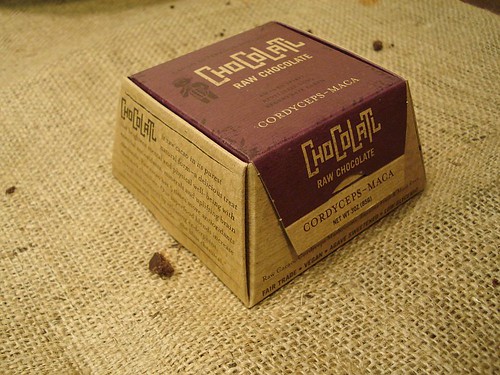
Unfortunately, I can't find the ones I actually ate at GreenFest one year. They were super expensive, but definitely worth trying. They were made by CordyChi, a brand that uses mushrooms (specifically a Cordyceps-Reishi blend) for all sorts of things. Go figure, the 'shrooms in question were Cordyceps- the parasitic mushroom from China that's becoming more and more popular for helping with respiratory issues, among other things.Alas, the chocolate-covered mushroom caps seem to have vanished off of the face of the planet.

From the official site.


Instead, something new has surfaced. Several sites have started making their own mushroom chocolate. Rather than simply covering mushrooms in chocolate, these Cordyceps are mixed into the chocolate. Better still, sometimes it's raw, vegan chocolate. I'd give it a shot if it's anything like the chocolate Cordyceps caps I had. Hell, even if they were just a product of my imagination, this odd  chocolate has my curiosity piqued.

What? You want an explanation for why dried mushrooms are being made into chocolate? Pff. Everything gets put into chocolate at some point. It's just the mushrooms' turn. This is still not as weird as chocolate-covered ants, which probably started as an unfortunate accident in the kitchen. Bacon chocolate is weirder still; at least mushrooms and ants have some nutritional value to compensate for the sinfulness of chocolate.

Chocolate is probably the Murphy's Law of food: Anything that can be put into chocolate will be put into chocolate. The issue, then, is whether it actually tastes good or not. Surprisingly, mushrooms work. Maybe ants and bacon aren't so far out, after all.

Sunday, August 5, 2012

Fungus Among Us: Honey Fungus.

(Stupid thing didn't publish. I don't know why, but it didn't at first.) 

Welp, the power came on right after we went out to get a generator. Fancy that.  Looks like I get to continue with Fungus Among Us, which could be good for some of you and downright terrifying for others. Without further ado, let us look at today's terrifying...jaw-dropping...


Aww, aren't they cute? I mean, cute for mushrooms. They're called "honey mushrooms" due to the color, and Armillaria solidipes  otherwise. They are found throughout the northern hemisphere, particularly in the Pacific northwest. They loooove feeding on pine trees and have their own blight.

Let's be honest, here: These are not impressive-looking mushrooms. They're cute and yellow. Yes, they feed on wood like many a fungus.  On the plus side, they're safe for work.

Thing is, remember: Those mushrooms are only the fruiting bodies. It's impossible to judge the size of the whole fungus by the size of what are effectively its genitalia. While we humans tend to judge 'size' based on junk, this is an extremely poor way to gauge the size of an organism that has most of its body underground. Big mushrooms do not make a big fungal organism. In fact...

Somewhere in this forest is a HUGE mushoom.


...those tiny little mushrooms? They belong to the single largest, and possibly longest-lived, organism in the world. Forget the blue whale; if a mass of these things in Malheur National Forest,  Oregon are indeed one organism, it spans 2,000+ acres. We aren't even going to try and weigh that. Again, if it is indeed one organism, it is also 2,400 years old, making even tuataras and Galapagos tortoises whippersnappers by comparison. It only got that huge because there was very little competition for land and resources.

Do not, however, try this at home. Outside of being crazy and massive, these mushrooms are dangerous to trees -  Douglas firs in particular. They can remain on a tree for up to 50 years and are very, very hard to remove entirely. Please to not be trying to make a Guinness Record out of this.


Friday, August 3, 2012

Fungus Among Us: Athlete's Foot.

Today's entry has to be one of the least glamorous ever. Really, we've done the majestic bald eagle, cool big cats, and giant blue iguanas...but athlete's foot? This has to be a new low for the blog. That's coming from the woman who finds tapeworms kinda cute.

Actually, I find athlete's foot fascinating in the same way I find pigeons fascinating. Athlete's foot is one of those mundane things that we take for granted. I'm sure people still consider fungi gross, but isn't it at least somewhat impressive that one has evolved seemingly specifically to invade our bathing spaces?


Yes, athlete's foot is caused by a fungus. Also called tinea pedis, it's usually the work of Trichtophyton rubrum or T. mentagrophytes. It thrives in dark, moist areas and is spread in places where people go barefoot, such as gym lockers and For whatever reason, it prefers the crevice between toes 4 and 5 on most individuals. Who knew a fungus could be so picky?

Athlete's foot manifests itself as a rapid peeling of the skin on the bottom of one's foot. It's more of an annoyance than truly painful unless you obsessively peel away the skin. Most of the time, you know athlete's foot when you see it. It itches like crazy, but has a million easily-accessible cures to prevent you from clawing your feet red. If you haven't encountered it yet, you have never been in a gym.

Do NOT pick on athlete's foot. I know it's tempting.


Usually, athlete's foot is nothing to worry about. There are plenty of over-the-counter remedies and  If left untreated, however, it can lead to the exposure of raw skin and bleeding. Such cuts open the way for more severe bacterial infections. Athlete's foot can also spread to the crotch, by the way, but "athlete's groin" is so unceremonious that we have to call it "tinea cruris."

Never badmouth a fungus that can attack your crotch. You never know when it might be listening. 


Wednesday, August 1, 2012

Fungus Among Us/"They Actually Eat That:" Mycoprotein.

Lately, there are just so many reasons to go vegan: cows contribute to global warming; meat is expensive; oh gods, factory farms are horrific.  There are so many reasons to not eat meat that it makes one wonder what else there is. Well, this is a fungus week; you can probably guess that mushrooms are on the list.


Fungi have been used as meat subs since vegetarianism was a thing. Even outside of being marketed as a meat substitute, large mushrooms are sometimes used as a "meat" in sandwiches due to their texture. Mycoprotein, however, is even more blatanly a meat sub.  It is marketed as Quorn in the U.S. and Europe because, y'know, long Greek names just don't sell. 

Mycoprotein comes from the filamentous fungus Fusarium venenatum. It was first discovered in Buckinghamshire, Britain in 1967. The high-protein fungus was officially approved for human consumption in 1985. Since then, it has been in our grocery stores - not only as a meat sub, but also as a sub for fat in dairy and or actual grain in cereal. Yep, even the meat subs are using 'shrooms.

Wrong species, same basic idea, here.


Mycoprotein was originally developed to combat food shortages that would arise from a booming population. F. venenatum's fibers are roughly the same length and width as animal protein, however, and thus is a feasible meat substitute. Now it joins tofu and various nuts as being a "meat"  for people who don't like the idea of hurting animals.

Before you ask: Yes, some people do have allergies to mycoprotein. Fusarium species have been found to contaminate food to the point where it was touted as an herbicide in the past.  If you're sensitive to mold, be wary. For the record, I'm allergic to penicillin, and I've had no problems aside from it kinda tasting funny. If this is what we'll be stuck eating at the end of the world, you'll probably be able to handle it.

Tuesday, July 31, 2012

Fungus Among Us: Basket Stinkhorns.

Still don't think fungi can be made into art? Well, sometimes, nature decides to do the work for us. There are some fungi that look like pieces from a modern art museum, only alive and spontaneously making the landscape a little weirder.


Stinkhorns, particularly those in the Clathus genus, resemble some sort of weird, alien art. Most of the time, they just look strangely like mammalian genitalia. Clathrus ruber, however, has a fruiting body that is bright red and would not look out of place in a museum of modern art. It is also called the basket stinkhorn. Although originally native to Europe, it has since spread to every continent bar Antarctica.

In the case of basket stinkhorns, you guessed it, the fruiting body looks like a basket. It starts looking like a sort of egg on the ground, but blossoms into the strange, netlike structure after some time. Like something out of a sci-fi story, a greenish, spore-filled goop called "gleba "coats the inside of this structure with spores. Just about the only thing creepier would be an alien fetus resting within that net.


Wait, no. There is something creepier than an alien fetus in that net. As the name 'stinkhorn' might indicate, this fungus reeks of rotten meat. This scent, combined with the latticed structure and bright colors, lures flies into the cage to help spread the spores. Luckily, this only lasts 24 hours after the 'egg' ruptures, so threat of a massive alien invasion are unlikely. The coming of the Lord of the Flies is another story.

For centuries, there have been superstitions about simply touching this fungus leading to illness. It's called "witch's heart" in Yugoslavia. Nobody knows if it's really edible or not; the eggs might be, but the one person who was daring enough to try a 'blossomed' basket wound up getting sick. Something that smells like rotten meat would probably not be good to eat by the smell alone; China's tried anyways.

But is it art? 

Monday, July 30, 2012

Bio-Art/Fungus Among Us: Mold Garden.

Yes, it's that time of the month. No, it's not werewolf or PMS time - it's Theme Week time! This week's theme is FUNGI, mostly because they get very little press on this blog. It's a shame; they happen to be fascinating plant...animal...things. Yeah, fungi are fungi, sorry. They're their own thing.

So what makes a fungus a fungus? It's almost like a plant...but not. Fungi reproduce by spores, lack chlorophyll, and have cell walls toughened by chitin - a common polymer also found in the shells of insects and crustaceans. They usually feed on decaying matter, but some have amazing symbiotic relationships with plants and animals. The only part of the fungus we usually see are the fruiting bodies - yes, those giant portobello mushrooms are mushroom naughty bits. You're welcome. 

CENSOR IT!!


Fungi are everywhere. Open your refrigerator, for example. If something has started turning fuzzy, that's a fungus.Athlete's foot? That's a fungus, too. Of course, mushrooms are fungi. The yeast used in making bread is a fungus as well. Cheese inevitably contains at least one kind of fungus - sometimes many. Hmm...does that mean that the mushroom sandwich that they used to have at Panera is technically X-rated? Sooo many fruiting bodies.

With fungi being just about everywhere, it's no wonder that people have started making art with them. Some of it is absolutely beautiful and stunning; you'd be amazed how much moldy cream cheese looks like a cosmological phenomenon. Others are just depressing.

My personal favorite among them, however, are Stacy Levy's Mold Garden pieces. Each panel consists of a sandblasted image of an actual mold culture. If that wasn't cool enough, Stacy put real mold on those images to grow. Is this life mimicking art, or art mimicking life? Whatever you call it, it's neat.

Please support the artist here.


Mold: It's not just for science projects anymore. 

Wednesday, September 21, 2011

"They Actually Eat That:" Truffles.

Forgive my lateness. Had to stay up at campus a little later on Wednesday, but don't worry, I would never miss a chance to show you all some seriously weird food. This is a little bit hard during Breed Week - whoever would admit that certain breeds are good for food? Even if they are, most of them are not remotely weird. (The Belgian Blue is an obvious exception.)

So this is something different and tangentially-related to domesticated animals.


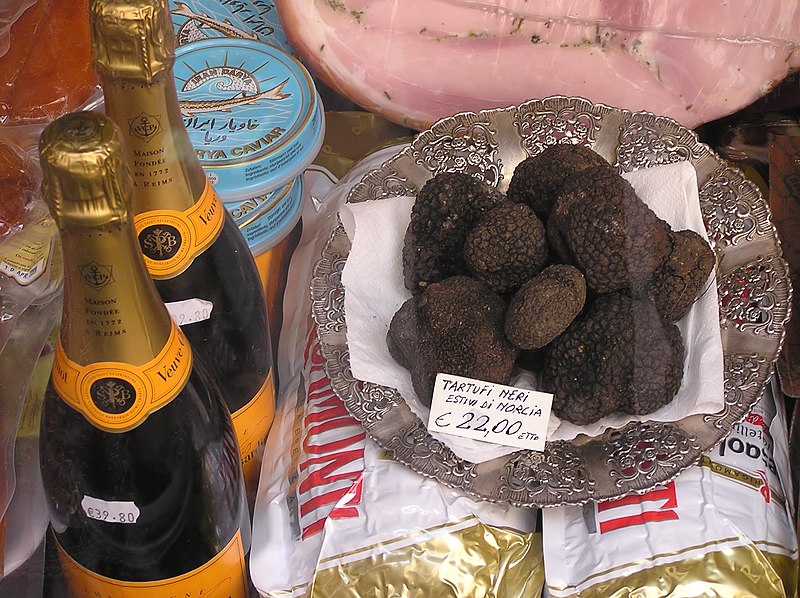
Connoiseurs of my blog have probably heard of the fungi called truffles. Besides being a delicious chocolate treat, truffles are a type of fungus usually found near the bases of various trees, particularly oak, beech, hazel, and pine. The European black and white truffles are delicious, but very, very expensive. Chinese truffles are often used as a cheap substitute.

Truffles are not domesticated, per se. They can be farmed (Australia has had the best luck), but are not sufficiently differentiated enough from their wild counterparts to be considered breeds. Truffle fields return to wildness easily, sending the search for easy truffles back to square one. These things are so hard to find that humans need special animals just to discover them, thus explaining the price tag...


...even though piggies can find them no problem.

The classic way to find truffles is to get a healthy sow and take her out for a little walk. Since truffles smell like a horny boar's saliva, the pig's sensitive nose will pick up the scent. Sows can smell the fungi up to three feet underground. We can only imagine that her desire would be doubled if she herself wanted some lovin'. As one might expect, pigs do sometimes eat the truffles. If your Playboys came with a hamburger inside the pages, you probably would, too.

Japan has the right idea.


Of course, pigs are not the only animals with a keen sense of smell. Dogs, specifically the Lagotto Romangolo (Romagna Water Dog) can also be trained to sniff for truffles. The Lagotto breed has been in the business for only 100 years, which is a short time compared to ancient Roman truffle hogs.

You can also tell it's hypoallergenic because of its poodle-ish fur.


For the record, yes, I have actually eaten truffles. If you want to try some good ones, they have truffles in everything in Piazza Navona, a certain square in Rome. They put truffles on pizza, in fettucine, and have a godly gelato called tartufo- no real truffles involved, just using the name. Truffles are delicious, but I personally would not go into any pig sties after eating them!

Saturday, August 13, 2011

Little Shop of Horrors: Puffballs.

Aww, puffballs! Those sound adorable! Surely they must be cute, fluffy furry things, right? Headcat would never lie to us!


Haha, no. Actually, puffballs are a type of fungus:


"Puffball" can refer to any type of mushroom that reproduces using gasterothecia - a basidiocarp that holds the spores inside instead of outside like on other mushrooms. They span several orders and genera, meaning that there are several hundred species of puffball to choose from. Touch one wherever you are and it puffs millions of spores into the air.

To truly appreciate a puffball, one must first learn how fungi reproduce. When a man-mushroom and a lady-mushroom love each other very, very much...


...Kidding, it's not like that at all. Fungi give birth by releasing spores via fruiting bodies (such as mushrooms or puffballs). Yes, those 'shrooms are a fungus's junk, making every piece of your veggie pizza an unholy exercise in fungal castration. The spores are usually on the underside of the mushroom, scattered along the gills and waiting to be blown away.


Puffballs take a different way out. Whenever something brushes against a puffball, the shell breaks, scattering millions of spores into the wind. This is a faster reproductive strategy than the average mushroom.  Plus, if humans decide to be douchebags, so much the better for the puffball.

Puffballs are usually not poisonous. Some, however, look very similar to poisonous mushrooms like "Death Caps." Care must be taken when hunting for immature puffballs to be made into 'steak.' Food-grade puffballs are cut in half lengthwise, just to be sure they aren't ninja death mushrooms. Yes, they actually eat puffballs.

In CANADA, no less!


Wednesday, May 4, 2011

"They Actually Eat That:" Yeast.


Yeast is probably familiar to most of you. It is responsible for making bread rise. It ferments barley into beer. There is nothing bad about yeast...but how many people know what, exactly, yeast is?


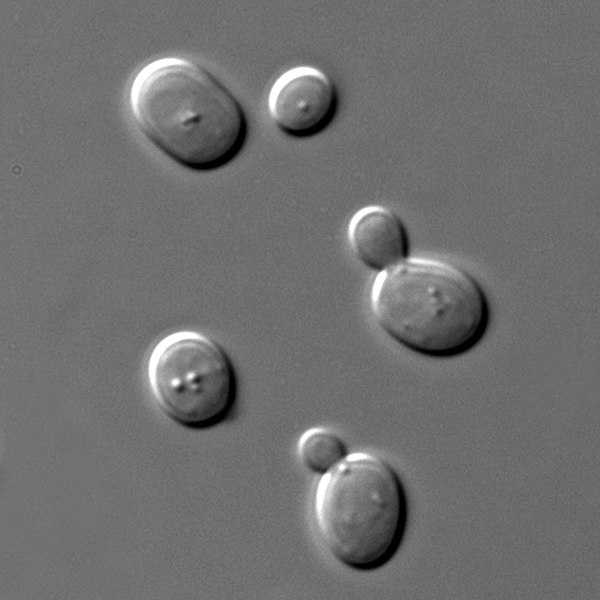
What? That's what yeast looks like beneath a microscope.

The grainy packet added to make bread rise is actually a fungus (Saccharomyces cerevisiae) waiting to feed on the delicious sugars in bread dough. Bread is mostly long chains of sugar, meaning that anything that can handle glucose can usually handle bread. Yeasts like the abundance of sugar in the dough and convert said sugar into CO2 and alcohol. Yes, there was once booze in your bread.  

S. cerevisiae is also responsible for making beer. Yeasts want the sugars in barley, hops, and grape juice, so of course they will multiply and ferment that sugar until it's all alcohol. Some breweries have their own, unique strains of yeast, just so that you know at least one thing is different from one bottle of wine to the next.

If beer and bread are not enough of a reason to like yeast, dried yeast (the same kind) is used in vegan cheese substitutes. It is high in protein and emulates the flavor pretty well. Go figure; a fungus tastes like rotten milk.


This looks like an acid-tripped slice of fruitcake.

Of course, there are many kinds of yeasts, and not all of them are helpful. Cryptococcus neoformans and any yeast from the genus Candida are all known to cause yeast infections. Many yeasts dwell in the moist environment created by mucus membranes, only becoming infectious if the immune system is compromised. Candida infections are the most common, and rarely fatal. Cryptococcus is one of the defining infections for AIDS. Even if they are only present in those with weakened immune systems, yeast can still be a threat.

It's just so tasty that we usually don't care.

Saturday, April 9, 2011

"They Actually Eat That:" Mold.

Asian cultures have a problem with cheese. Not just milk - cheese. As we said in the dragon bone entry, their diets are often deficient in calcium. Milk is one thing (again, why is groping a cow a good idea?), but cheese is essentially rotten milk. It is also delicious for many, many people in the Western world.

Approved by some dinosaurs, too.
 

If you live in the Western world, we have a task for you: Go to your fridge. Look for some cheese. Then look at something that you haven't touched in days, all slimy and covered in a veritable rainbow of fungi.

Go on. We'll wait. 

Guess what? Unless you have not checked your fridge in a LONG time, that cheese is more rotten than the thing covered with black, white, and red. If you were observant, you may have noticed that some cheeses are "aged" with certain dates. That is how long it takes for the bacteria and fungi to turn milk into certain types of cheese.


So, what makes one bucket of rotten milk different from the next? It depends on what molds, bacteria, and other microbes are hanging out in the milk. Milk intended to be cheese is taken into caves and humid basements for the pleasure of the same organisms that make bread rot.

Many different types of cheese are made with various microbes (and, in some cases, larvae) to create their unique flavors, but European cheese takes the cake when it comes to utilizing mold. Blue cheese and cheese such as Camembert and brie use different Penicillium molds to create the white rind around their creamy middles. Roquefort and other blue cheeses utilize a different sort of Penicillium to manifest their colorful veins. These Penicillium varieties are sometimes named for the cheese they produce, e.g. Penicillium roqueforti.


On your plate...

Yes, the Penicillium molds used in making expensive cheese are relatives of the mold used to make penicillin, a very common antibiotic. If one is sick with something Gram-positive, penicillin is the fabulous cure-all. The thought process was the same: Bacteria does not grow on things with Penicillium on/in them. Mold was used as a preservative long before it was a processed medication.


Beneath the microscope...IT HAS CHICKEN LEGS!

Thank blue cheese next time you get a prescribed antibiotic. Then remember that antibiotics are slowly leading to resistant bacteria. Shooot.

Next week: A use for fungus as common as sea monkeys.


Tuesday, February 8, 2011

Creature Feature: Glowing Mushrooms.

For those of you who do not get the mushroom joke, please look up "Badger Badger" on Google. You're welcome. Now, without any further ado, something that we assure you is not a result of acid:


No, you are not on drugs. Those mushrooms really are glowing. They are members of one of seventy-one odd species of glowing mushroom. Thirty-three of those species are in the genus Mycena; this genus's bioluminescence is widespread enough that scientists theorize that the genus somehow lost its glow along the way.


Glowing Mycena mushrooms are native to Brazil, Australia, Malaysia, Jamaica, Puerto Rico, and Belize. They glow all the time, but the glow is not very visible in daylight. Take a few of these in a dark room and enjoy the night lights; one researcher compared a rain forest floor covered with glowing mushrooms to looking up at the night sky, glimmering with stars.

Why do they glow? Nobody really knows. Desjardin, a fittingly-named mycologist, theorizes that the mushrooms glow to attract nocturnal animals. This somehow helps them disperse their spores. Glowing is apparently sexy, now. (Do not give Kuro ideas, science! That's dangerous! Whoops, too late.)


Save the rain forest. It has glowing mushrooms!


Tomorrow: More 'reptile food' and a giant rodent!

Friday, January 7, 2011

Creature Feature: Cordyceps.

Have you ever wondered how certain health foods got their starts? Whose smart idea was it to climb an insanely high tree to pick the first acai berries? Granted, these things take balls, warranting a high price tag, but some other health foods make one wonder who had the idea.


Fungi of the genus Cordyceps is are among those things. The YouTube search listing for Cordyceps has both "killer fungus" videos like the one up there and "Cordyceps is a superfood" videos. It is darn near impossible to imagine someone looking at the insect below and saying, "hey, let's eat that!"


Superfood?

Cordyceps fungus is exactly what David Attenborough says it is: An endoparasitic fungus that uses insects as its host. (These can include cicadas, thus explaining where the idea for the Pokemon Paras came from.) There are over 400 species of Cordyceps, but the most well-known of these is Cordyceps sinensis - also known as the caterpillar fungus. Surprise, surprise; it's part of Chinese medicine.


Different species of Cordyceps use different insects as hosts. Some, like the ant shown in the video, are brainwashed before the fungus feeds off of their corpse. Climbing a branch like that goes against every instinct the ant has - oh, and it looks like it's on drugs, too.


Duuuude. It's, like, a mushroom cloud!

Cordyceps is one of the many parasites that influences the behavior of its host; yes, there are more parasites that use brainwashing techniques far more effective than any psychologist's prescription. They try their darnedest to make babies, and if our brains are in the way of that, they'll screw that ball of neurons and glia good. This makes us pretty darn sure that Lady Gaga is a legitimate artist and not an alien spreading space Cordyceps around the world. Given the rather...extreme claims about Cordyceps, however, we would not be surprised either way. (Remember: A lot of human habits VERY CLOSELY PARALLEL INSECT BEHAVIORS.)

I've had chocolate Cordyceps. They aren't that great.


Before 1993,  the Western world was scarcely aware that this bizarre mushroom even existed. It was brought to the world's attention after three Chinese athletes broke five world records at the Olympics in Beijing, China. After it was revealed that the athletes had been doing 'shrooms, not steroids, the value of Cordyceps increased by 200% over the course of ten years. Research on Cordyceps has since shown that it may be able to cure diabetes, serve as an antidepressant, and even prevent organs from being affected by radiation.

Or maybe that's what the Cordyceps fungi want us to think.

Tuesday, October 26, 2010

Creature Feature: Slime Molds.

Don't bitch at me for not doing an animal today. There is no animal quite as freaky as this crazy...thing:


The video above is sped up; slime molds do move, but they move slowly (or quickly for little organisms, take your pick). 1 millimeter per hour is not very fast, but it is something; some lucky slime molds can win marathons at 2 cm per hour. Most fungi do not move at all.


Unless you happen to be on 'shrooms. Then you can tell the purple unicorn in your bedroom that we said hi.

Slime molds are not molds. They are...themselves (the ones visible to the naked eye are myxomycetes). Nobody really knows where to put them; they used to be fungi, then were moved into their own taxonomic category. When all is said and done, they will still probably be classified as eccentric fungi or protists (which is sort of a catch-all category).


Or discarded bubble gum. There's another one called "dog vomit."

Slime molds start life as amoeboid, single-celled organisms. They eat bacteria, so, like most fungi, they can often be found on decaying logs. When they encounter an individual of the opposite mating type (sorry, not all tiny critters are as gay as rotifers), they form zygotes and soon become long, sticky plasmodia.

The plasmodia stage is what gives slime molds their name. In this stage, slimy, multinucleic threads start feeding like crazy. technically, this huge mass is a single cell with many nuclei. Eventually, the slimy mass forms fruiting bodies similar to larger versions of the sporangia found on regular molds. The cycle begins anew after that.


Not remotely like Japanese porn.

Still not creeped out? Slime mold feeding bodies can get several meters in diameter (and they are not even the largest unicellular organisms). They can pick the shortest road out of a maze despite lacking a nervous system, much less a brain. In the future, they might even evolve into something like this:


If you're slightly less optimistic, they may also evolve into giant blobs.

(P.S. - Like my fish? :D)