Showing posts with label bacteria. Show all posts

Tuesday, February 12, 2013

Creature Feature: Mycoplasma laboratorium.

People love reading and writing about artificial life. Predating Frankenstein was the idea of a homunculus - an artificial lifeform made by alchemists. Frankenstein made the concept even more popular. Since then, man-made creatures have been speculated time and time again. They will likely remain a fixture in art and literature for years to come.

Well, guess what? Science fiction is edging ever closer to science fact. Behold the first man-made creature!


In 2010, one Craig Venter announced the first artificial genome ever created. Its name is Mycoplasma laboratorium. Technically, only the genome was 100% synthetic, forming one circular chromosome. The genome has since been transplanted into another cell of the same genus. It is the first man-made life form ever.

That's not entirely correct, however. M. laboratorium is made from reconstructed DNA- that is, it still uses nature's blueprints. It can be more properly said that M. laboratorium is the most synthetic organism to date. It can supposedly reproduce just like a regular, parasitic bacterium, containing all the essential coding for life.

M. laboratorium's basis is a bacterium called M.genitalium. As the name would suggest, it resides in the genital and respiratory tracts of primates, including humans. It has the smallest known genome that can still be called a cell. That, and it must be very easy to acquire, being inside humans and all.

They have also done something which I'm not sure to praise or shun: they have watermarked this bacterium.This sounds similar to Eduardo Kac's messages involving DNA. The actual encoding system remains undisclosed, but the base text is pretty much English. No doubt someone will crack it eventually.

Even with this organism being mostly synthetic, the uproar surrounding the project has been substantial. The Vatican has not condemned this new creature, saying that it is not really new life. Expect more artificial life in the future; the same team that made M.laboratorium has been hired by Exxon Mobil to design algae for diesel fuel. Now if only more creative minds focused on solving the world's problems instead of making video games and movies.

Monday, August 27, 2012

Bio-Art: Moyashimon.

Ever wonder what it would be like to see the whole microscopic world with the naked eye? If you said "TERRIFYING," you're totally right. Several animated programs have featured some sort of "germ vision," and once you have it, you realize everything has germs.  No exceptions!

Enter Moyashimon: Tales of Agriculture. The protagonist of the series, Tadayasu Sawaki, has been blessed/cursed with the ability to see microbes since birth. He and one of his friends from the countryside get into an agricultural university in Tokyo, only to find that one of the professors there knows about Sawaki's ability. After running a few tests, his talent proves legit. Bacteria- and fungus-related hijinks ensue.


Of course, this is Japan. It would be no fun to see microbes that, if expanded, would look like hey just came off an alien spaceship. They instead proceeded to make the microbes as adorable as humanly possible. Seriously, just look at this OP. This has got to be the most KAWAIIDESU show of microbes ever!
 
Then there are the little "Microbe Theatre" bits at the end. These introduce you to one of the main microbes in the episode - literally, they say their names and everything. For example, the spot on yeast microbes shows all the great things yeast does- from miso soup paste to alcohol. They don't mention bread, but that's there, too.


Is Moyashimon good as a series? I'm not 100% sure after only seeing two episodes. What I will say is that, if you're curious about the wonderful world of microbiology and want to see what athlete's foot would look like if it went Hello Kitty, please give it a watch.  These guys do a pretty good job, and now you, too, can have adorable yeast on your cell phone.

Saturday, July 30, 2011

Microbe Week: Escherichia coli.

OH NOES. This blog is covering one of the most notorious little buggers ever: E. COLI! 

This is just ONE kind of E.coli. It would make a neat lightbulb.


DIE, DIE, DIE, you stupid little microbes! This is what you get for ruining our spinach and punishing us for sloppy sanitation! CLEARLY, ALL E.COLI MUST BE PURGED!

Kidding, of course. E.coli, much like Salmonella, are mostly a problem because we don't cook our food well enough. For those of you who take raw meat and look at it under a microscope, E.coli are Gram-negative, rod-shaped (bacillus) bacteria. They are a very popular model bacterium, even if they make all petri dishes smell like an outhouse after a while. E.coli may be doing your math homework within the next few years. 


Escherichia coli and its cousin genus Salmonella are the two most talked-about bacteria on the planet. Again, if food poisoning makes the news, E.coli could well be the culprit. There are 39 strains of E. coli known to date, and all of them have one thing in common: They live in mammals.  Since I can see all that porn on your computer, you qualify.

All mammals have some strain of E.coli in them. Humans usually get E. coli as benign inhabitants of the large intestine within 40 hours of birth.They are normal gut flora in mammals, just like Salmonella is normal microflora in birds and reptiles. Issues occur when the wrong strain of E. coli gets in one's gut, leading to a very bad case of diarrhea indeed.

Like sprinkles, only alive and in your colon.


Infections with E.coli usually occur when meat or veggies have not been properly washed or cooked. The main carriers of E. coli are cows, which may show no symptoms themselves. Anything raw is also at risk, especially if wild pigs have been running around. Watering with sewage is never a good sign. In short, crap reaches mouth - that is never a good thing in humans.

Symptoms of E.coli infection vary with the strain. In general, these are colon bacteria - expect a high fever, horrible diarrhea (sometimes with blood), urinary problems, and other crotch-kicking issues. There is a particular strain of E.coli that causes meningitis in infants by cleverly disguising itself as an antibody. E.coli infection makes Salmonella poisoning look like a walk in the park.

You don't know where it's been. Oh, wait, yes you do, and it's filthy.


Did we mention that it's nigh-unstoppable? Escherichia coli develops antibiotic resistance staggeringly fast. Not only does it have our antibiotics to dodge, but it also has to protect itself from the antibiotics found in livestock. E.coli can also trade DNA with Staphylococcus aureus - the other superbug people are worried about. Even mixing agar substrates doesn't work on E.coli. T4 phage therapy is one of the best ways to stop E.coli, but how do you market "get infected with a virus to make up for our sloppy food system?"

So stop worrying about Salmonella. You've got other shit to deal with just for being a mammal.


Thursday, July 28, 2011

Microbe Week: Archaea.

Remember how I mentioned that the Earth's atmosphere was not always filled with oxygen? Look out side for a minute at the clear white/blue sky, green plants, and maybe even that raccoon going through the garbage. Sure, it's not perfect, but life has never been perfect.

The Earth's atmosphere was not always as nice as it is today. Picture an atmosphere of water vapor, CO2, and nitrogen with methane and other lovely gases floating around. Volcanic activity was an everyday occurrence. There is no ozone layer yet, so the most powerful sunscreen in the world cannot protect you from the sun's scorching rays. The planet's cooling down with rain and clouds, but is taking its sweet time.


Now picture something living in that environment. Something that isn't a red man with goat hooves and a pitchfork.


Welcome to the home of archaea. As the name would imply, archaea are really, really old bacteria. They are their own domain. Not genus, not family, not phylum, domain. They are about as closely related to bacteria as animals are to plants. They reproduce by dividing and exchanging plasmids, little rings of DNA that bacteria regularly swap like trading cards just to give humanity the finger. They do not reproduce sexually at all.

Hear that? These bacteria were around before sex and oxygen. That's how old they are.


Archaea have some really trippy ways of getting energy. Some metabolize sulfur or ammonia- stuff that most 'normal' life forms would consider disgusting. Others make energy out of light without needing chlorophyll. Still others feed on methane - a chemical abundant in the Earth's primitive atmosphere. They have as many ways of getting energy as eukaryotes, things with nuclei and all that other nice membrane-bound stuff.

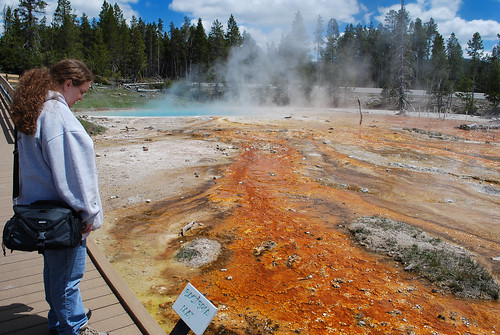
At first, it was thought that archaea could only be found in extreme environments like salt lakes and volcanic hot springs. Now that is no longer the case. Scientists can pick up the tiniest traces of these organisms everywhere. They have found traces of the archaic nucleic acids in everything, from soil to seawater. Luckily, they do not infect anything - presumably, most of their time is spent calling Staph bacteria and E.coli "whippersnappers."

Still the home of archaea.


Life. It's everywhere.

Tuesday, February 22, 2011

Creature Feature: Mycoplasma.


So there's this miraculous drug out there called penicillin. It was discovered when Alexander Fleming noticed that a mold in one of his Staphylococcus plates was resistant to the bacteria therein. (Technically, people in the Middle Ages had been using moldy bread for treating wounds, but a lot of them got plague, so never mind.) It has since gone on to become the biggest antibiotic against Gram-positive bacteria ever. More on exactly what makes Gram-positive bacteria Gram-positive later.

You know what happens when bacteria meet human medication? They say "FUCK YOU" in big red letters. We push, and the bacteria have a vat of acid that they have reserved just for the occasion. That Staphylococcus mentioned above has become particularly problematic as of late; antibiotics like penicillin have led to a super-strain of Staph that is especially prevalent in hospitals. Sure, they're super-Staph, but they're still Staph. We can identify them and think up a new, crazy way to attack them. We know how to treat the symptoms if nothing else.


Enter the type of bacteria called Mycoplasma. They're small, notoriously hard to identify, and the only reason I know they exist is because a friend of mine is a RN. Being bacteria, they can spread almost anywhere. Their name comes from being mistaken for a fungus at first. They are nowhere close; their position is somewhere between a bacterium and a virus.


Mycoplasma were first discovered in cows, manifesting as a form of pneumonia that regular antibiotics could not cure. There have been other mycoplasmas found in other animals, such as one that gives chickens respiratory issues and spreads in their eggs (OUCH). The two most well-known types in humans are M.pneumoniae and M. genitalium. They have the shortest genomes next to nanobacteria and are less than half the size of an E.coli cell. Unlike most bacteria, which usually have Gram stains, mycoplasmas can only be 100% identified through complex methods like DNA testing.

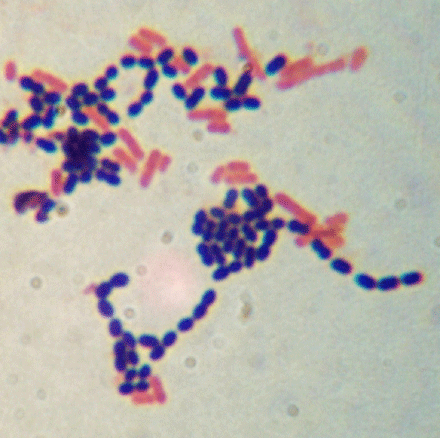
This is because some of the common antibiotics and identification methods depend on the cell wall. Gram-positive and Gram-negative bacteria get their names from a certain type of staining method. Gram-positive bacteria show up purple under this stain. Gram-negative bacteria show up bright pink. What stain works where is determined by the bacteria's cell walls. This test also determines what antibiotics will and will not work against a given organism; some, like penicillin, attack the cell walls of Gram-positive bacteria.


Wow, our bacteria sure are gay.

Mycoplasma do not have cell walls. (They have nonetheless been grouped with G+ bacteria due to genetic relations.) They are parasites in respiratory tubes and genitalia and use their host's cholesterol to make their membranes. Wow, they must be having a blast in America; plenty of cholesterol, for sure.


Pictured: Mycoplasma heaven. Y'know, if hamburgers were alive.

Since these bacteria are parasites, it is almost impossible to develop antibiotics for them in a lab. Being a parasite means that the host has to be present as well, which is a little bit hard given the choice environments of these bacteria. Zithromax works only because it does not attack the cell wall. Antiviral herbs such as hyssop might also be effective. Until we learn how to synthesize genitalia, mycoplasmas will be at large.

If we push nature, nature shoves back. Tough cookies.

Tomorrow: SPAM! And a deadly spider NATIVE TO SUBURBIA!