Showing posts with label viruses. Show all posts

Tuesday, June 11, 2013

Gone Viral: Bluetongue Disease.

My apologies to the shepherds in Africa. The disease covered in the entry is really no laughing matter, yet I have the hardest time taking it seriously. I mean no offense to anybody, but when the name of a potentially-lethal disease is reminiscent of the effect of blue raspberry candy in one's mouth, it's a little hard to not giggle.


Source.

This sheep has been affected with bluetongue disease, a Reovirus that pretty much goes wherever sheep happen to be. It started in Africa, then spread to Europe, the U.S., Australia, and other places with sheep. It's also called catarrhal fever. The disease affects mostly sheep, but can also hit cattle, deer, goats, and almost any other ruminant. It does not affect humans at all. Still, upon finding it, it was too weird not to write something about.

Bluetongue disease is carried by a small insect called a midge (Culicoides). This means that BTV season  coincides with midge season, which is usually summer/fall. This also means that it's not really transmitted from sheep to sheep; kill the bugs and it won't happen. Since it is very, very hard to eradicate every midge in the area, it's advised that sheep be kept indoors around dusk, when the bugs are most active.


The main symptoms of this thing are fever, swelling of the face, excessive salivation, and, sometimes, a blue tongue (called "cyanosis" if you want to be really technical). Some cases also involve foot lesions, giving it the nickname "dancing disease." Mind, the virus does not turn sheep tongues bright blue. The effect of cyanosis is more like a bruise-blue than any artificial blue one can think of, making the whole thing less attractive. It also happens that not every case involves a blue tongue anyways. 

 As one can probably imagine, there are cures for this disease. Many sheep die within a week of getting it; others can be treated with vaccines from local strains. Recovery takes months. Regardless, this is one blue tongue that is not so fun to have. Please stick to blue raspberry things, and do not give them to sheep.

Saturday, December 1, 2012

Newsflash: Airborne Ebola?

Remember when I cited Ebola as a sign that there was not a loving God? It turns out that it was a lot worse than I thought. Thanks in large part to conspiracy theorists believing that the elite are using human populations in Africa to test out biological weapons, this little gem found its way onto my screen:

"Canadian scientists have shown that the deadliest form of the ebola virus could be transmitted by air between species.

In experiments, they demonstrated that the virus was transmitted from pigs to monkeys without any direct contact between them.

The researchers say they believe that limited airborne transmission might be contributing to the spread of the disease in some parts of Africa. They are concerned that pigs might be a natural host for the lethal infection.

Ebola viruses cause fatal haemorrhagic fevers in humans and many other species of non human primates.
Details of the research were published in the journal Scientific Reports.

According to the World Health Organization (WHO), the infection gets into humans through close contact with the blood, secretions, organs and other bodily fluids from a number of species including chimpanzees, gorillas and forest antelope. 

The fruit bat has long been considered the natural reservoir of the infection. But a growing body of experimental evidence suggests that pigs, both wild and domestic, could be a hidden source of Ebola Zaire - the most deadly form of the virus. 

Now, researchers from the Canadian Food Inspection Agency and the country's Public Health Agency have shown that pigs infected with this form of Ebola can pass the disease on to macaques without any direct contact between the species. 

In their experiments, the pigs carrying the virus were housed in pens with the monkeys in close proximity but separated by a wire barrier. After eight days, some of the macaques were showing clinical signs typical of ebola and were euthanised. 

One possibility is that the monkeys became infected by inhaling large aerosol droplets produced from the respiratory tracts of the pigs.

What we suspect is happening is large droplets - they can stay in the air, but not long, they don't go far. But they can be absorbed in the airway.”- Dr. Gary Kobinger, Public Health Agency of Canada." - Source. More there.


So, basically, it turns out that pigs can carry Ebola too, and they might be able to get it through minimal contact with exhaled bodily fluids. Bear in mind that pigs are also very susceptible to respiratory infections.

This is another reason why one should watch where one's meats come from. Pigs can carry a lot of human diseases, not just Ebola, because they are so biologically-similar to humans. We eat them and make medicine out of them. We also ship them everywhere - not all farms are in the U.S. Pigs are already pretty bad environmentally; this is one nasty addition to the damage they can do.

That said, I do wonder why this hasn't been publicized more. Ebola's kind of a big deal.

Tuesday, October 30, 2012

Blasphemy Week: Ebola.

So I have to step it up. Although I usually rant on and on about how beautiful the world is, this is Halloween. I did just about the only thing I could think of that this blog has not done: Have a week full of things that disprove the existence of a loving God.

The keyword there is "loving." I'm OK with God or what have you being the bang-zoom that got the universe started. Nature, however, is a bloody, mangled, violent venture. One could argue that natural selection, which is pretty darn hard to disprove, ultimately makes a species 'better,' but that's still a lot of blood lost for one 'perfect' individual that will eventually die anyways - hardly 'loving' in any sense of the word. These are the things in nature that would make Saw sleep with his lights on asking "why?"

The squiggle that kills millions.


That said, onto our first monster of the week: Ebola haemorrhagic fever, AKA the Ebola virus. There are five species, each of which named more for its regional distribution than anything else.  All of them are rather nasty, although some are slightly nicer than others. The fatality rate can be up to 90% in an outbreak, and it is not a merciful death. The most common vectors are African fruit bats, but a fair amount of mammals, including humans, can pass it to people. If one person in an African village gets Ebola, that village is usually screwed.

This virus attacks everything. It starts as a general malaise, including fever, then escalates into a flu. Things quickly get worse with headaches, muscle and joint aches, diarrhea, sore throat, and stomach pain. Strangely enough, hiccups are also a symptom. Headaches indicate an attack on the central nervous system. Yeah, no part of the body is safe from this thing.

You must be at least THAT covered to approach Ebola.


The word "haemorrhagic" should be enough to tell you that the mild flulike symptoms get even worse. Someone with Ebola bleeds from everywhere. Any place with a mucous membrane (most notably nose and nether regions) starts gushing with blood. Their body gets covered in bleeding rashes, effectively making them sweat blood. On the plus side, this allows the virus to replicate itself further; contact with bodily fluid from anybody with Ebola is enough to spread it.  Small wonder Ebola is treated as a Class A Bio-weapon- it makes people suffer.

The good news is, Ebola happens mostly in underdeveloped countries in Africa. It rarely crosses over into places with proper sanitation.  The people really have enough to deal with, including starvation, military control, malaria, and vicious animals that are commonly shown on nature programs. There is an amazing amount of trouble there already. If the meek were really blessed, why create a disease that makes one bleed from all orifices? Not the work of a loving deity, there.

Monday, July 23, 2012

Bio-Art: Ginger Snaps.

Disclaimer: Official movie poster. Screenshots taken by me for this review. 

When I wrote the entry on Shiki for this blog, I covered how vampires could theoretically be made possible. Malaria has to be one of the most creative routes I've ever seen for making vampirism real. I also said in my wolfsbane entry that it was very unlikely that a werewolf could ever be made plausible. 

So is it actually possible to create a 'realistic' werewolf? Ginger Snaps (the movie, not the cookie) certainly tries.


In the middle of nowhere (here called "Bailey Downs"),  Ginger and her sister Brigitte have a fateful encounter with a strange, wolfllike creature. Slowly, they piece together that they do in fact have a real werewolf on their hands....and that Ginger's changes are far from anything a normal teenage girl would go through! Brigitte tries to find a cure with help from a hippie as her sister becomes more and more of a literal sexual predator. Without too many spoilers, it does not end well.

The encounter with the werewolf takes place right before a biology class on viruses. As the symptoms of lycanthropy proceed, Ginger realizes that's exactly what her new changes are: a virus. Before you say that this is impossible, bear in mind that the last few disease scares have been about cross-species viruses. Some viruses, called retroviruses, also rewrite DNA by definition; HIV is the most popular retrovirus out there. You're welcome.

THIS is how it would really be - a claw here, some fur there.


Unlike in most werewolf movies, Ginger's transformation does not happen all at once. It happens very slowly; she gains fur, dewclaws, and a tail over a month as opposed to all at once. She also feels the very real fear and shock that would come with even a slow change like that. Keeping the change a secret becomes harder and harder as the movie goes on. This is far more realistic than the "all at once" transformation that most movies go for. It really does progress like a terminal illness, getting steadily worse until...


I've read in several places that lycanthropy is always an analogue for puberty: growing hair, changing voice, general bodily changes, and, most importantly, a rise in animal urges. Ginger Snaps picks on one particular part of female puberty, menstruation, and runs with it. For example, one of the symptoms of this form of lycanthropy is bloody urine; this creates a rather funny scene after a male contracts the curse. Although wolves usually aren't associated with menstruation (snakes have an amazing amount of lore to that effect), the coincidence of modern werewolf lore with the period makes it work.

To recap: I'm not a werewolf fan, but I am interested in virtually anything with the potential to cross the human-animal barrier. As such, I have met my share of absolutely terrible writing and films. This is not among them. Ginger Snaps was refreshing on a number of levels. It not only used a woman as the main wolf in the movie (which has a number of interesting implications!), but provided a possible werewolf model for those of us into semi-realism. Surprisingly, very few people into werewolves have taken this route; I don't know what that proves except that it's yet another form of escapism. Woe to them should they ever be cursed for real...

...yes, it hurts that much.

Tuesday, April 10, 2012

NIPAH: When a meme goes viral.

Raise your hand if you know at least one internet meme, You know, those pics, videos, and crazy phrases that get emulated over and over? That is what we mean.  Such memes are said to have gone 'viral' if they are played with enough.


Well, it turns out NIPAH! is an actual virus. Who knew?

OK, so technically, the Nipah infection virus (NiV) is a virus of the Henipavirus genus. The only other known member of this genus is the Hendra virus. Nipah is native to Southeast Asia (virtually all of it), India, and Africa,  and could get really dangerous really fast. Despite its cute resemblance to an internet meme, it is named after a village in Malaysia that we hope has gotten tourist business from its similarity to Rika's catchphrase. It was named in 1999.

Nipah virus is nowhere near as fun as its name might suggest. It all starts with contact with coughing (or "barking") pigs. Then it escalates into flulike symptoms of fever and muscle pain. Then it moves on to inflammation of the brain and, in worst cases, comas and death. Twirling and repeating the word "nipah" is not a symptom; if you experience this, I suggest checking for Hinamizawa Syndrome instead.

I wouldn't touch that pig if I were you.


The main vectors of the Nipah virus are fruit bats.  Every place in Southeast Asia, from India to Vietnam, has fruit bats, and Nipah could be in any one of them. The bats themselves have antibodies to the virus. The virus can also be found in the urine and saliva of fruit bats. It should be common sense to avoid fruit that's been partially-eaten by gods-know-what, but someone must be silly enough to try it. The bats were probably as close and contagious as they were thanks to habitat destruction; chalk up another fail tally for humanity.

Nipah virus is a real threat. It can spread from virtually any mammal to another. It has already hopped from bats to pigs, leading to million-dollar losses for the farming industry in Malaysia. It can cross from humans to pigs just as easily as it can from bats to pigs. Oh, and it's mutating - just like a real meme- so whatever we come up with might not work in the near future. This thing attacks anything with hair, remember.

Image (c) Higurashi.


Nipah!- the only meme that turns villages into ghost towns.

Tuesday, October 25, 2011

Creature Feature: Swine Flu.

It seems like there's always some nasty disease threatening the world thanks to mankind's increased air travel capabilities and our own infestation of the planet. SARS, bird flu, and swine flu were all characterized as "OMG DEADLY" diseases that could whack even those in industrialized nations at any time. These scares are often blown out of proportion. Soon, we will not even be able to get colds without having a news story about it.

CALL THE PRESSES! (From iStockphoto.)
 

Viruses are great survivors. We could debate about whether viruses are alive or not until the mad cows come home with their non-living prions, but as one of the most primitive life forms, viruses have an amazing capacity for mutation. They swap DNA more often than bacteria, which should be enough to give most people shivers. That the common flu can evolve around vaccines is enough to make Walgreen's offer them every single year. Heaven help us if viruses ever find ways to cross the species barrier.

Oh, wait. Viruses cross species pretty regularly. Rabies is a good example, infecting many mammalian species with the same disease, but swine flu puts it to shame. Strains like H1N1 really gets around when it comes to infecting other species. 

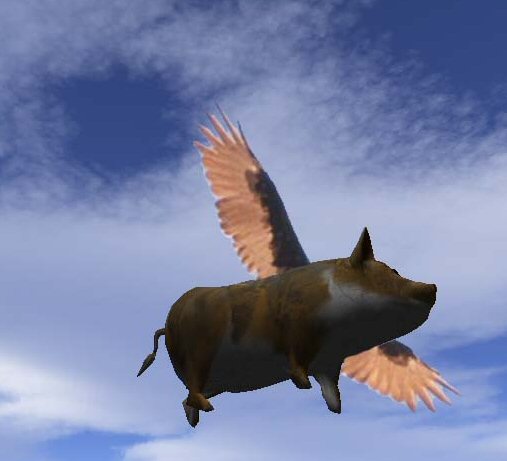
Swine flu (in recent memory, H1N1) is notorious for not only infecting pigs, but also infecting humans and chickens. Pigs, uniquely, can get avian sicknesses. Several pig farms in China and other parts of Asia tested positive for avian flu half of the time. Swine flu crosses not only the species barrier, but also the wall between mammals and birds. Careful of "when pigs fly" statements; you may find yourself doing the impossible once these crazy viruses start giving pigs wings.

Like this, only with better graphics.
 

So is swine flu really that dangerous? (Wiki says it's worse than smallpox.) 

The short answer is "not anymore." The World Health Organization ("WHO") declared the 2009 pandemic officially over. Even then, most of the people who died from it had some conditions beforehand, such as pregnancy, leukemia, and lymphoma, that compromised their immune systems. Most 'normal' people will treat swine flu exactly like they would the regular flu - by staying in bed, developing antibodies, and watching TV shows online. Most cases of swine flu are very mild. In other words, it still sucks, but was not really worth the hysteria the media put into it.

I lov-ed you, piggy! I lov-ed YOOOUUU!
 

Swine flu is more harmful to pig farmers than it is to people who do not work with pigs on a regular basis.  This may be common sense, but any animals that are packed together in one place are prone to getting sick from each other. The humans are not the only ones at risk. Some farms have lost over 65 million dollars from swine flu outbreaks; consider that karma.

Swine flu epidemics resurface every time humans think they're on the top of the world and lose their immunity to the virus. Expect it to pop up again. If we ever have a rabies epidemic, however...I TOLD YOU SO. The Chihuahuas did it!

Saturday, July 30, 2011

Microbe Week: Bacteriophage.


Call Area 51. We have reason to believe an alien has escaped the base. I repeat, an alien has escaped the base. It looks sort of like a mix between a spider, a syringe, and a land rover. We are currently not sure if it is even alive. Over.

Technically, no, viruses are not alive. They do not respire. They do not grow. They cannot self-replicate, instead injecting their DNA into a host cell and hijacking that cell's machinery. The bacteriophage above uses bacterial cells, not ours, so don't worry.


Bacteriophages (bacteria-eaters) are exactly what their name says, assuming you can understand Greek. They don't eat bacteria so much as inject their DNA into the capsule, then let the rest write itself. The bacteria soon explodes with more alien-looking phages. Since a phage's tail can only latch on to certain parts of the bacterium, certain phages can only attack certain bacteria. The most popular is the T4 phage, which eats the pesky E.coli bacterium.

Phages are important for their ability to destroy far worse bacteria just by reproducing themselves. These viruses have been quietly used for centuries to cure cholera, leprosy, dysentery, and anything else caused by a bacterium. They are the best defense we have against supergerms and E. coli infections. Never thought you'd side with a virus, did you?


So, what about E. coli, anyways? Tune in tomorrow!

Tuesday, February 22, 2011

Creature Feature: Mycoplasma.


So there's this miraculous drug out there called penicillin. It was discovered when Alexander Fleming noticed that a mold in one of his Staphylococcus plates was resistant to the bacteria therein. (Technically, people in the Middle Ages had been using moldy bread for treating wounds, but a lot of them got plague, so never mind.) It has since gone on to become the biggest antibiotic against Gram-positive bacteria ever. More on exactly what makes Gram-positive bacteria Gram-positive later.

You know what happens when bacteria meet human medication? They say "FUCK YOU" in big red letters. We push, and the bacteria have a vat of acid that they have reserved just for the occasion. That Staphylococcus mentioned above has become particularly problematic as of late; antibiotics like penicillin have led to a super-strain of Staph that is especially prevalent in hospitals. Sure, they're super-Staph, but they're still Staph. We can identify them and think up a new, crazy way to attack them. We know how to treat the symptoms if nothing else.


Enter the type of bacteria called Mycoplasma. They're small, notoriously hard to identify, and the only reason I know they exist is because a friend of mine is a RN. Being bacteria, they can spread almost anywhere. Their name comes from being mistaken for a fungus at first. They are nowhere close; their position is somewhere between a bacterium and a virus.


Mycoplasma were first discovered in cows, manifesting as a form of pneumonia that regular antibiotics could not cure. There have been other mycoplasmas found in other animals, such as one that gives chickens respiratory issues and spreads in their eggs (OUCH). The two most well-known types in humans are M.pneumoniae and M. genitalium. They have the shortest genomes next to nanobacteria and are less than half the size of an E.coli cell. Unlike most bacteria, which usually have Gram stains, mycoplasmas can only be 100% identified through complex methods like DNA testing.

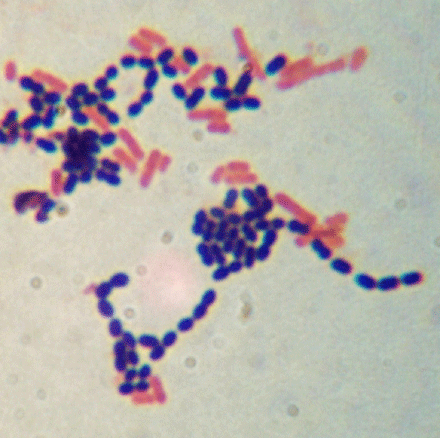
This is because some of the common antibiotics and identification methods depend on the cell wall. Gram-positive and Gram-negative bacteria get their names from a certain type of staining method. Gram-positive bacteria show up purple under this stain. Gram-negative bacteria show up bright pink. What stain works where is determined by the bacteria's cell walls. This test also determines what antibiotics will and will not work against a given organism; some, like penicillin, attack the cell walls of Gram-positive bacteria.


Wow, our bacteria sure are gay.

Mycoplasma do not have cell walls. (They have nonetheless been grouped with G+ bacteria due to genetic relations.) They are parasites in respiratory tubes and genitalia and use their host's cholesterol to make their membranes. Wow, they must be having a blast in America; plenty of cholesterol, for sure.


Pictured: Mycoplasma heaven. Y'know, if hamburgers were alive.

Since these bacteria are parasites, it is almost impossible to develop antibiotics for them in a lab. Being a parasite means that the host has to be present as well, which is a little bit hard given the choice environments of these bacteria. Zithromax works only because it does not attack the cell wall. Antiviral herbs such as hyssop might also be effective. Until we learn how to synthesize genitalia, mycoplasmas will be at large.

If we push nature, nature shoves back. Tough cookies.

Tomorrow: SPAM! And a deadly spider NATIVE TO SUBURBIA!

Monday, January 24, 2011

Creature Feature: Prions.

Yesterday's zombie entry was the second time I had mentioned the strange little things called prions. If you have a good memory, you might remember that the first time I mentioned prions was the entry on human cannibalism. Surprise, surprise, kuru is a prion-triggered disease that comes from eating human brains. Or listening to too much Ke$ha.


Apparently Ke$ha advocates people getting kuru, now. Congrats: Your plot to have a hoard of drooling zombie slaves at your command worked.

Braaaiiins? Zombie is prion victim? The symptoms of prion-caused diseases (in this case, mad cow disease) include: 

"...rapidly progressive dementia, leading to memory loss, personality changes and hallucinations. This is accompanied by physical problems such as speech impairment, jerky movements (myoclonus), balance and coordination dysfunction (ataxia), changes in gait, rigid posture, and seizures." You tell me if this sounds like zombie behavior or not.

The most distinctive hint that an unknown disease might be caused by a prion is that, yes, they all attack the brain. Mad cow disease (which has a different name when spread to humans), kuru, and scrapies (the sheep version of mad cow) are all caused by prions. There are various ways to contract prion-based diseases, included eating affected neural matter. Several of them are also hereditary and nearly always lethal.


This is not salami. It is, however, headcheese.

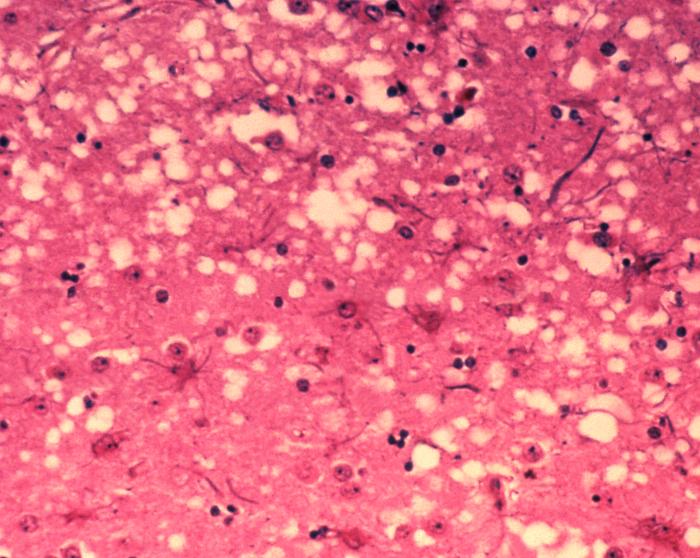
Many prion-caused diseases have at least one name using the words "spongiform encephalopathy."  This is a fancy way of saying, "it turns a brain into Swiss cheese (or Spongebob)," which is what causes all of the quoted symptoms.


But what exactly are prions? The current theory is that prions are, or at least encourage the replication of, deformed proteins in the brain. An individual prion has as much DNA as a rubber stamp (i.e. none) and a similar function: To propagate its misshapen self onto an animal's brain cells. (Fungi get off just fine.)

Essentially, they're that wrench in the gears that shuts down the whole power plant. They are the one 0  that should have been a 1 in a computer program. They're that paper jam that happens the night you have a term paper due. Prions are that sort of simple, glitchy thing that makes everything go wrong.  Oh, and despite being inanimate, they can multiply like YouTube videos.

Prions are not alive, but they are capable of self-replication. They do not have DNA/RNA like viruses. They just act like a rubber stamp on other neural proteins. This makes scientists wonder what the hell nature was thinking. (Personally, we think she has just decided to flip humanity the bird and given us an enemy that we cannot attack without screwing ourselves over.) Unlike viruses, they are clearly not alive, but no less deadly.


She's going to be sent to the slaughterhouse...then Mickey D's. Think about that.

Be afraid. Be very, very afraid. When scientists start making medicine that affects protein synthesis in the human body, I would be willing to bet 100 bucks that, for every ten lives saved with science's next miracle medicine, one person will become a crazed zombie thanks to that one protein that decided to be a douchebag in the office and order multiple photocopies of its rear end.

Tomorrow: Speaking of crack medicine, can Brazilian pit viper venom provide a cure for diabetes, or does it just make things worse?

Friday, December 31, 2010

Creature Feature: Astrovirus.

Happy New Year's, everyone! Or, well, it will be 2011 tomorrow if it isn't where you are already. In any case, have some fireworks:


Or astroviruses (family Astroviridae).

Surprisingly pretty, aren't they? A lot of viruses, deadly though they may be, look like they would make good lighting fixtures once seen individually. Astroviruses are so named because they have little stars (with either 5 or 6 points) covering the surfaces of their shells. There are a number of them between several bird and mammal species.


Astroviruses are the viruses that ruin your holidays - the most common symptom of an astrovirus is, in a word, stomach flu.There are a number of other things that can cause stomach flu; the sort spread by astroviruses is only the 4th most common, and is usually spread in childcare facilities and military living arrangements. Otherwise, they're so light a group that Wikipedia has their species names in English, not Latin.

Happy holidays, all! Keep your hands clean to prevent the spread of firework viruses!

(Does anyone know the name of this one bug with 'fireworks' shooting out of its ass? I tried to find it and failed. Short improv entry was short.)