Showing posts with label bovines. Show all posts

Wednesday, January 2, 2013

They Actually Eat That: Angus Beef.

Everybody these days is advertising Angus beef. People actually care about what they eat now; putting a breed name in front of beef implies a higher standard to the audience's unwitting minds. Does it really, though? If so, why does every fast food chain on the planet suddenly stock it?  Never fear, "They Actually Eat That" is here to put your thoughts to rest!


First of all, what is Angus beef? Angus beef is any meat that comes from Angus cattle, polled (hornless) Scottish cattle. They have been in the U.S. since 1873 at least, when a farmer named George Grant began breeding the British cattle in Kansas. They were bred for and marketed as the ideal beef cow. They rarely let people down by that standard, if you know what kind of Angus meat to get.

Here's the kicker: A cow must be at least 51% black to be considered an Angus. That's it when it comes to labeling something as "Angus." It doesn't even have to technically be an Angus, just a dark cow. Angus are known for their black color, so there's a chance that there's some Angus in a mostly-black cow, but exactly what else is in there is up for debate. Government hoodwinking strikes again!

Real Angus beef is known for its marbling. For those of us who aren't professional chefs, this means that there are strings of fat on the muscle. Although this sounds gross, it helps keep the steak a tiny bit moist when cooking.  If you get meat from something like a Belgian blue, for example, there's no fat there - it just heats up instantly. It does matter where you get your steak from; it stops mattering so much when that meat is stuffed into a sausage lining or made into a patty.


Angus cattle may be known for their meat, but does that mean all Angus meat is good? No! There is such a thing as low-quality Angus beef. All it means is that the meat comes from standard beef cows instead of cows that we don't know the lineage of. In other words, Angus is a buzzword. They're just finally telling consumers that their beef comes from this type of cow as opposed to discarded Holsteins. The Angus burgers and hot dogs floating around could well be made from the discarded bits that weren't prime steak.

Those of you wanting good Angus beef should look for two things: certification and grade.  Certified Angus is exactly what it says: beef that comes from cows that are most definitely Angus cattle. Grade applies to all beef - even Angus. The Angus used in fast food burgers is either the not-Angus beef or Angus beef barely fit for human consumption. Be a smart consumer. It scares the machine.


Sunday, November 11, 2012

Creature Feature: Texas Longhorn.

Honesty time: I tried to resist doing this one. Texas Longhorns are awesome, but at first I thought them better for Freak Week. The juices simply refused to flow for bald cypress (a moderately interesting swamp conifer), and I'd already done cochineal in the OLD entry on scale insects. Cotton might have been interesting, but c'mon...it's Texas.


Texas Longhorns are, no kidding, a cattle breed native to Texas. Thanks to mixing with feral cattle, Texas Longhorns have no specific patterning - just huge horns. The closest related breeds are in Portugal; the Longhorn breed itself was established in the 1500's. The highest ever paid for a Longhorn was 140,000 USD, and exceptionally good lines can still fetch into the 40,000's. Even the cows of this breed have amazing horns.

The most obvious feature to pick on is, of course, the longhorn's headgear. Although not as impressive as Ankole-Watutsi horns, a Texas Longhorn's signature horns can get up to 7 feet long from tip to tip. As morbid as this sounds, their skulls do look amazing in a den. That said, they're pricey.


Longhorn cattle are very tough cows. They can find food and shelter all on their own in case of emergencies. They calve easily, which is one of the reasons to add them to breeding stock.This hardiness led to them being popular until the 1900's, at which point environmental durability and lean meat were no longer selling factors. With the demand for lean or free-range meat on the rise, Texas Longhorns have seen another surge in popularity.

The Texas Longhorn, alongside the Holstein, has to be among the most recognized cattle out there. Nothing says "southwest" like a bovine head with those horns. Texas uses them as a mascot for everything, even a women's basketball team. If you haven't seen a Texas Longhorn and live in the U.S., you must be living under a rock...or just unaware of exactly what you're looking at in those old westerns.

This looks awesome. People mess with horses; they do not mess with 7 feet of horn.

Saturday, July 28, 2012

Rare White Bison In Connecticut.


July 28th marks the naming of a white bison calf born in Connecticut. His official sacred name is now "Yellow Medicine Dancing Boy," which will probably get old to either the townspeople or the buffalo after a while. It's probably one of the coolest things that has ever happened in Connecticut, so of course people are excited.

White buffalo are rare. The National Bison Association estimates that only 1 in 10 million buffalo are born white. That's more than one in a million. No wonder people are lining up to see it; genuine white buffalo are a very rare thing. There have been a few other white buffalo in America, the most notable being Miracle in 1994.

There are several ways to get a white buffalo. Albinism and leucism are both in the species. In recent years, a third form has popped up: white produced by cross-breeding with cattle. The baby born in Connecticut will be gene tested just to make sure he is a pure white buffalo. Even so, several native American tribes have paid the buffalo a visit.

Before you ask, yes, people have tried to breed white buffalo. In the instance that someone managed to breed a bunch of purebred white buffalo, it looks as though their particular white strain was dominant (with brown fathers yielding white calves through one white female). I'm not so sure about other populations. These are still pretty rare animals.

Another awesome thing: White buffalo are an excellent example of what this blog originally intended to advertise:A mythic creature brought to life. Yes, seriously.


Several Native American tribes treat a white buffalo like a magical creature. The one in the news at the moment is the Lakota. Here is just one of the tales surrounding the sacredness of the white bison:

One summer a long time ago, the seven sacred council fires of the Lakota Sioux came together and camped. The sun was strong and the people were starving for there was no game. 

Two young men went out to hunt. Along the way, the two men met a beautiful young woman dressed in white who floated as she walked. One man had bad desires for the woman and tried to touch her, but was consumed by a cloud and turned into a pile of bones. 

The woman spoke to the second young man and said, "Return to your people and tell them I am coming." This holy woman brought a wrapped bundle to the people. She unwrapped the bundle giving to the people a sacred pipe and teaching them how to use it to pray. 

"With this holy pipe, you will walk like a living prayer," she said. The holy woman told the Sioux about the value of the buffalo, the women and the children. 

"You are from Mother Earth," she told the women, "What you are doing is as great as the warriors do." 

Before she left, she told the people she would return. As she walked away, she rolled over four times, turning into a white female buffalo calf. It is said after that day the Lakota honored their pipe, and buffalo were plentiful. (from John Lame Deer's telling in 1967). 

Even today, the white buffalo strikes the Lakota as a symbol of peace, hope, and rebirth.  Let's hope they're right; if so, the world might not end in December.

Thursday, July 12, 2012

Creature Feature: Giant Eland.

Nature shows focus too much on big preds, blah blah blah. Seriously, film crews have to spend hours getting those successful hunts on film.  More often than not, the herbivore survives. Predators kill off the weak, very young, or sick. That way both species stay healthy as a whole.


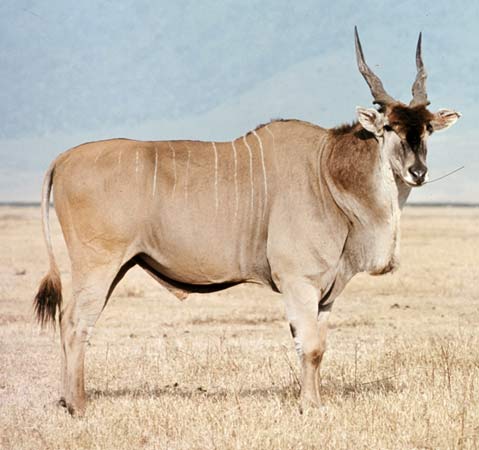
With that in mind, there are some herbivores that are pretty impressive to look at, even without a lion chasing them. The giant eland (Taurotragus derbianus) is one of them. It is native to central and western Africa. Like most antelope, it's an herbivore. What, did you think it had the potential to eat you, too?

The giant eland is impressive on a number of levels. It's fast, capable of reaching speeds of up to 43 mph. A height of almost 6 feet at the shoulder makes it the largest antelope in the world. The babies grow fast. Also, those horns look pretty darn awesome. (Luckily, they're also pretty docile.)

Badass, even when chillin'.


Both sexes of eland have twisting, V-shaped horns. The bulls lock them during courtship, as might be expected. They are also useful for knocking down branches. You will never forget those horns after seeing them once Many antelope have nice headgear, but the eland has to be at least in the top 5 when it comes to having awesome horns.

Despite being listed as "least concern," the giant eland is increasingly threatened by human hunting. This is just not for a very impressive trophy head; the meat of the eland is also packed with nutrition. The milk of an eland also contains twice the protein and three times the content of regular cow milk. They also require a lot less water than cattle. Luckily, there have been quite a few instances of domestic giant elands, so they should be around no matter how desperate Africa gets. Then again...behold the fate of the aurochs:


Shoot.

Thursday, June 21, 2012

Creature Feature: Wildebeest.

Ah, antelope. The mere word antelope conjures images of wild, open areas and elegant, deerlike animals. Home, home on the range and all that. Screw wolves, antelope should be the ones being called "majestic." Google Image a Thompson's gazelle, one of the most popular prey species for lions on nature documentaries. Look at those horns, that leap, that...


...wait a sec, what the EFF is that?!

That, dear friends, is a wildebeest (Connochaetes). You might know it a little better as the gnu. There are two species: the blue wildebeest (C. gnou)and the black wildebeest (C. gnou). Both of them are equally weird and native to Africa. They are among the least charismatic mammals on that continent. Granted, the blue wildebeest is still on the Serengeti, so the 'beest gets some screentime from that alone.

The wildebeest is probably the least enchanting of the antelope living on the African savannah. They look more like oxen than antelope, what with their wide faces, curved horns, and bulky builds. They have squarish pupils like goats, eyes that range from brown to deep red, and have faces that are slender rectangles as opposed to any other shape.  In other words, they're probably the best visible proof that antelope are, in fact, more closely related to cattle than to deer. Even cows don't have spinal ridges like that. The short 'mane' and hump call to mind the 'bad guy' of the savannah, the hyena. Yes, we're still talking about an herbivore.

This one just looks BADASS.


Wildebeest have exactly two presentations in popular culture: As food or as something utterly terrifying. Most of us probably first learned of wildebeest from The Lion King, in which - spoiler alert - a stampede of red-eyed, horned faces tramples poor Simba's father. I can see a number of reasons for them to pick wildebeest as opposed to some other ungulate, but the one that sticks out the most is that wildebeest and those hyenas both have a menacing, brutish hump that just makes them look evil. They're even colored similarly. Even though wildebeest themselves are completely benign, they can easily be sold as the most menacing antelope ever.

Interestingly, the wildebeest stampede in The Lion King may have been based off of an actual event.  Every year, massive herds of wildebeest and zebra migrate away from the Serengeti, the most filmed place on the planet. (Note how, even in the movie about this epic migration, the wildebeest are slated as prey for a cheetah- not that it isn't realistic.) Scientists think that this is due to the availability of surface water. They have also observed a sort of collective intelligence among the migrating herd - a hive mind that makes them conquer the obstacles on their path as one. (Humans seem to have the opposite mentality, acting more like idiots when in a group.) Horns, check; sinister eyes, check; evil hunch, check; hive mind, check.

Have a black wildebeest. Black makes EVERYTHING more evil!


The wildebeest is so famously monsterlike that ancient people actually made a monster out of it. Going back as far as ancient Greece, the wilderbeest of Ethiopia (itself kinda legendary) was mutated into the legendary catoblepas- a monster with the head of a boar and the body of a buffalo. It was forever doomed to look downward thanks to its heavy head. Pliny the Elder thought that the catoblepas's down-turned head was a rather fortunate adaptation, given that anything that made eye contact with it turned to stone. Another Roman historian disagreed about the beast's infamous stone gaze, but gave it toxic breath as compensation. Either way, the wildebeest, a real animal, was suddenly on par with the infamous basilisk. The main differences: catoblepas had the decency to keep its head down and could run you over if its breath and gaze did not do the job. Wildebeest have no such superpowers, but they are weird-looking enough to make one wonder.

And if they do have superpowers? There is no benevolent deity out there. Period. They already killed Mufasa unintentionally. We're next. 

Wednesday, May 30, 2012

"They Actually Eat That:" Bouffalant.


OK, no, people don't really eat Pokemon. We do, however, eat buffalo (Bison bison).


Since man first found buffalo (or bison, take your pick), man has known that the animal was good for eating. The Native Americans used every part of the bison from meat to coats to eyeballs. The eyeballs were a treat for the young'uns. We said every part and we meant it.

The first settlers on the plains also discovered that bison were good eating. Instead of trying to economize the bison and make sure some still lived, however,  the settlers proceeded to ravage the native population. There were only a few hundred left by the mid-1880's. Whether this was because they came in droves, because they didn't know a thing about the environment they had entered, or because bison meat was just that damn good is not certain. There was also a huge demand for anything bison in Europe, further spurring the animal toward extinction.

The bison were not amused.


Of all the things the European settlers did, nearly annihilating the bison was the second worst. (The first was the collection of anti-Native events, obviously.) Bison were the only creatures the plains had that kept the prairie grasses at a manageable level. If you mess with tier 1 of the food pyramid, the whole thing collapses. Way to go, free market.

There were exactly four herds of bison that managed to survive to this day. The most famous was a herd started from exactly five wild calves caught by James "Scotty" Philip in South Dakota. Another was brought by boat to Antelope Island, Utah, and is today one of the largest publicly-owned herds in North America. A third breeder in Texas bottle-fed a few bison calves and now has the third captive herd. The only truly wild bison herd is the one in Yellowstone, Wyoming. To summarize: Responsible captive breeding was just about the only thing saving North America from severe ecological damage.


So, after this little fiasco, you'd think we'd have learned our lesson and stopped hunting bison, right? Nope. Hunting is still legal, albeit tightly controlled, in Utah. Eating buffalo is still a thing. We just know what we're doing, now. The bison we eat are all (or, mostly) farmed. Hell, we've even been able to hybridize them with cows. They're called "beefalo." They were bred solely to be eaten, so don't look so shocked when you see buffalo on the menu.

Monday, May 14, 2012

Bio-Art: Mother and Child, Divided.

Happy belated Mother's Day, everyone! I hope you had a great time hanging out with your mothers. I know that sounds weird to say. As today's art piece shows, not everybody is so lucky. 

Disclaimer: Art and pic belong to Hirst.


Hello again, Damien Hirst. Fancy seeing you on this column with yet another formaldehyde piece. Mother and Child, Divided features a fully-immersed cow and calf separated by a number of barriers - including one gruesome twist.  This time, quite a lot is in the name.


Mother and Child, Divided is a fitting title in more ways than one. Not only are the cow and calf lamenting being separated postmortem, the displays themselves are bisected. The full setup contains a total of four tanks, each containing half of a cow or calf. Both mother and child are bisected. They are set up so that museum-goers can walk between the halves and see what the cows really look like inside.  How the organs do not randomly float around in the formaldehyde, I have no idea. The cows also have to be replaced from time to time.

This piece caused quite a stir when it was brought to Japan (the land of Godzilla, ninjas, and tentacle porn) for an art exhibition in 2008.  Japan had a ban on British beef out of fear of mad cow disease. It was quite a hassle not only transporting the containers, but explaining that these cows were not for eating. I don't think the Japanese would try that anyways, but am nonetheless sure there is porn of it. It's the internet.


This is one piece that, despite previous questioning of Hirst's work, is definitely art in my mind. It is a very real, but often unacknowledged fact that cows are frequently separated from their young on factory farms. The only thing that could have made this sadder would have been to have the mother and child facing each other. Clearly, some thought went behind this formaldehyde-laden work.

Or maybe Hirst just wanted to mess with cow corpses for some other reason. Anyways, happy belated Mother's Day!


Sunday, August 7, 2011

Creature Feature: Dik-Dik.


If you saw a cute little antelope like this running along the African grasslands, what would you call it? Bambi (even though antelope are not THAT close to deer)? Madoqua guentheri? A pile of "D'AWWWW" and "let me show my kids this thing?"

Haha. Science disagrees with whatever you said. That little antelope is officially called a dik-dik. No, an internet troll did not hack my account. That is its name. It sounds exactly like the dirty word for a man's phallus repeated. Oh, and yes, the Ultimate Muscle character was named after this antelope.

His dub name: Dik Dik Van Dik. His Japanese name: Gazelleman. WHAT THE FUCK, 4KIDS?


The name does not come from a scientist's dirty mind. Instead, the word "dik-dik" is onomatopoeic of the (larger!) female dik-dik's warning call. These antelope are small - 30-40 cm (12-16 in.) at the shoulder, but that warning call has ruined many a hunting party. Besides warning other dik-diks, other life on the plains takes the call as a sign to get the fuck out. The only people who really call these antelope dicks are disgruntled hunters.

This good venison?
 

Like the klipspringer, another adorable antelope, dik-diks are designed to take the heat. They have a special cooling system in their cute little snouts that recirculates blood so that the dik-dik does not overheat. By panting, the dik-dik can withstand temperatures of up to 104 degrees Fahrenheit (40 degrees Celsius). It's not just cute - it's efficient.

How do you make a cute antelope cuter and more efficient? By making it mate for life. Dik-diks are one of the few animals in which the male and female mate for life. Besides sounding wonderful for those who believe in true love, being monogamous saves lives. It's easier to avoid predators when not looking for mates...and with somebody around to watch your back.


Thursday, July 14, 2011

Creature Feature: Klipspringer.

"Human feet are inefficient!" We have said it again and again: human feet fail at being anything but mildly dextrous snowshoes. We have no claws, and although our five digits were useful for climbing trees, they are not so useful for running. As a rule of thumb, the fastest creatures are the ones who have the least of their bodies on the ground at any given time.


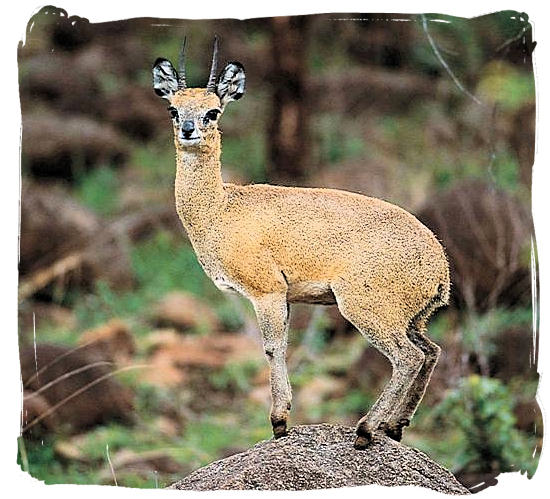
Nowhere is this more true than with the klipspringer (Oreotragus oreotragus - no relation to Oreo cookies). The klipspringer is a small antelope native to the rockier parts of southeastern Africa. It's so agile it makes other ungulates look like awkward turtles by comparison. The klipspringer looks at us and laughs its adorable little tail off as it dashes up the cliffs like so:


See that? That was Bambi ballet dancing (note: antelope like the klipspringer are not as close to deer as they look). We're not kidding - the klipspringer has evolved to walk on its toes just like a ballerina, only all the time. Ungulates normally walk on their toenails, but the klipspringer takes it one step further by walking on the tippy-tips of its toenails. The digits are so narrow that all four feet can fit on the surface of a rock the size of a Canadian dollar coin.


The klipspringer's rocky, dry habitat has given it another useful adaptation: It does not need to drink. At all. Like many desert animals, it gets all the water it needs from the succulents it eats. It is also one of the few truly monogamous mammals, staying in breeding pairs instead of large herds. Not that we would mind herds of cute, athletic antelopes dancing on their tiptoes.

Friday, April 1, 2011

Freak Week II: Ankole-Watusi Cattle.

"Cows are my frieeends" - GIR, Invader Zim.

Before they were lard-laden milk and meat creatures, cows were considered awesome animals. If one had a cow in ancient Greece, it was a status symbol. A cow is a lot bigger than you think it is. More people are killed by pissing off cows than by pissing off sharks. Again, one wonders whose bright idea it was to steal milk from an animal that could easily run one over.

One is forced to wonder that once more upon seeing how badass some cattle look.


Those giant horns belong to Ankole-Watusi cattle, a breed native to southern Africa. They can deal with almost any sort of climate and sparse resources, making them popular around the world. Plus, those horns look awesome.

Ankole-Watusi cattle were bred for gigantic horns. These not only have a practical use - honestly, a lion would probably run from horns that spread 8 feet from tip to tip - but also look beyond badass. The horns also help the cow maintain body heat in its native habitat.


In Africa, these cows were usually kept by royalty, and are still rarely slaughtered for meat. Live animals were more valuable than dead ones in ancient times. We cannot really blame them for treating cows with such magnificent adaptations as special; their horns and hardiness in the harsh African climate cement their status as the "cattle of kings."

Ankole-Watusi cattle were originally imported as zoo animals. Their zebu lineage and massive horns made them eye candy until the 1930's. Afterward, the cattle made it into private collections. Today most zoos would not dare show off a breed of a domesticated animal; apparently, they just aren't wild enough anymore! (Again, we must gun for a "zoo of freaks.")

That is one horny bull...


As one may have guessed, Ankole-Watusi cattle are primarily ornamental. They do, however, have lean meat and milk rich in butterfat. Some breeders choose to emphasize these commercial aspects; others amplify the exotic look. Take your pick as to which you would choose, but in either case, holy cow!

Tomorrow: Tiptoe through the tulips...

Thursday, February 17, 2011

Creature Feature: Saola.


In the looks department, the saola (Pseudoryx nghetinhensis) is nothing special. It's a fairly bland antelope. Sure, it has some interesting features - short horns, huge scent glands, and an odd skull that make scientists think it a primitive bovid - but not weird enough to make the average Joe go "WOW!" The people in Laos and Vietnam, however, go so far as to consider it a unicorn because of one simple feature: It is that rare.

The last time we heard about something like this was the okapi, an animal so bizarre that it may as well be mythical. There are good records of the okapi in local lore; the Egyptians thought it was strange, and they were the ones obsessed with the afterlife. The okapi was also rare enough to elude scientists until the 1900's. That's rare, but the saola has beaten its record.


 The saola is just plain rare. In 15 years of searching, science has discovered zero saolas in the wild. Its mythical status is well-warranted, seeing as it has been spotted by villagers while avoiding the eye of science for so long. It was not even officially acknowledged as an animal until 1992. Either we fail as humans, or the saola really knows how to hide.

There have been very few instances of a saola ever being in captivity. In August 2010, people in Laos found a wild saola and tried to raise it in captivity, but, like any unicorn, it promptly died. No unicorn would ever tolerate being gawked at and prodded with weird poles. They would commit suicide before that.

Not a happy unicorn. Twonicorn? 
Tomorrow: OK, enough mammals. Time for a bird.

Monday, January 24, 2011

Creature Feature: Prions.

Yesterday's zombie entry was the second time I had mentioned the strange little things called prions. If you have a good memory, you might remember that the first time I mentioned prions was the entry on human cannibalism. Surprise, surprise, kuru is a prion-triggered disease that comes from eating human brains. Or listening to too much Ke$ha.


Apparently Ke$ha advocates people getting kuru, now. Congrats: Your plot to have a hoard of drooling zombie slaves at your command worked.

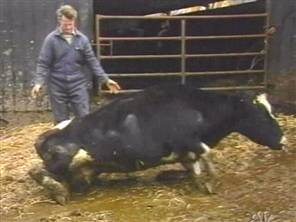
Braaaiiins? Zombie is prion victim? The symptoms of prion-caused diseases (in this case, mad cow disease) include: 

"...rapidly progressive dementia, leading to memory loss, personality changes and hallucinations. This is accompanied by physical problems such as speech impairment, jerky movements (myoclonus), balance and coordination dysfunction (ataxia), changes in gait, rigid posture, and seizures." You tell me if this sounds like zombie behavior or not.

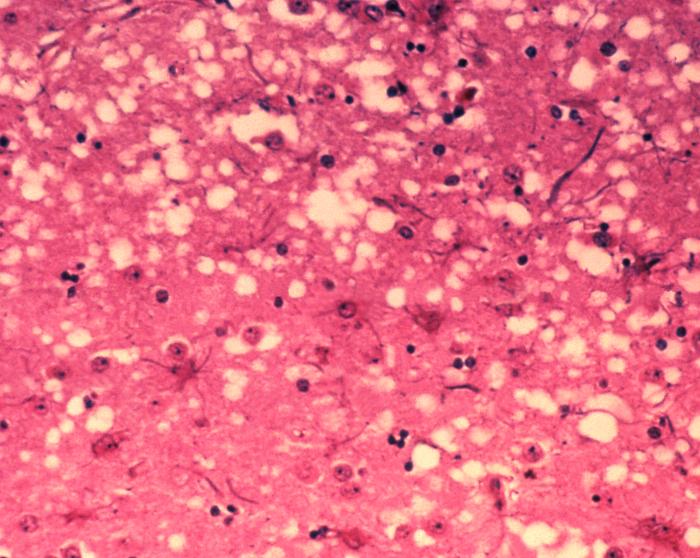
The most distinctive hint that an unknown disease might be caused by a prion is that, yes, they all attack the brain. Mad cow disease (which has a different name when spread to humans), kuru, and scrapies (the sheep version of mad cow) are all caused by prions. There are various ways to contract prion-based diseases, included eating affected neural matter. Several of them are also hereditary and nearly always lethal.


This is not salami. It is, however, headcheese.

Many prion-caused diseases have at least one name using the words "spongiform encephalopathy."  This is a fancy way of saying, "it turns a brain into Swiss cheese (or Spongebob)," which is what causes all of the quoted symptoms.


But what exactly are prions? The current theory is that prions are, or at least encourage the replication of, deformed proteins in the brain. An individual prion has as much DNA as a rubber stamp (i.e. none) and a similar function: To propagate its misshapen self onto an animal's brain cells. (Fungi get off just fine.)

Essentially, they're that wrench in the gears that shuts down the whole power plant. They are the one 0  that should have been a 1 in a computer program. They're that paper jam that happens the night you have a term paper due. Prions are that sort of simple, glitchy thing that makes everything go wrong.  Oh, and despite being inanimate, they can multiply like YouTube videos.

Prions are not alive, but they are capable of self-replication. They do not have DNA/RNA like viruses. They just act like a rubber stamp on other neural proteins. This makes scientists wonder what the hell nature was thinking. (Personally, we think she has just decided to flip humanity the bird and given us an enemy that we cannot attack without screwing ourselves over.) Unlike viruses, they are clearly not alive, but no less deadly.


She's going to be sent to the slaughterhouse...then Mickey D's. Think about that.

Be afraid. Be very, very afraid. When scientists start making medicine that affects protein synthesis in the human body, I would be willing to bet 100 bucks that, for every ten lives saved with science's next miracle medicine, one person will become a crazed zombie thanks to that one protein that decided to be a douchebag in the office and order multiple photocopies of its rear end.

Tomorrow: Speaking of crack medicine, can Brazilian pit viper venom provide a cure for diabetes, or does it just make things worse?

Friday, November 5, 2010

Creature Feature: Gaurs.

Before I start, just look at the word "gaur" for a minute. Say it out loud. It sounds like something a vicious animal would say, right? Sort of like a cross between a growl and a roar. Gaaauurrr...

GAAAUUUR!


...yeah, a gaur's a type of cow.


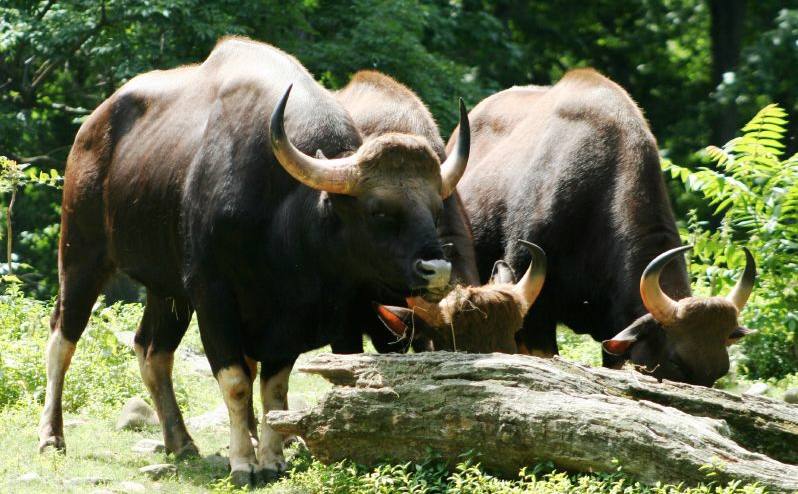
Gaur (Bos gaurus) are a relative of the domestic cow. They are found in India and South-Southeast Asia, including China, Vietnam, India and Indonesia. They are not as closely related as the aurochs are to modern cattle - it's more like the relationship between a dog and a coyote. Before you ask, yes, the two can interbreed.

Gaur are giant cattle. They are bigger than any known bovine species, living or dead. They can reach up to 10 feet long and 7 feet high; the aurochs only reached 6.6 feet at the shoulder. Males are larger than females. Only elephants, rhinoceroses, and hippos are larger than the gaur.

Unlike domestic cattle, gaur have very few natural predators. The young can be picked off by leopards and dholes (sort of like Asian wolves), but nobody messes with the adults. A healthy adult gaur was once reported killing a tiger - big cat, the king of beasts in China - that had been stupid enough to mess with it during the daytime. (During the night, it's still a bit hard - a fight between the two is actually a really close match, no matter WHAT tiger fans tell you.) No wonder the Hindus treat cows nicely; the gaur give them a very good reason to see cows as friends, not food.


Just put down the burger and nobody gets hurt...

Alas, gaur are becoming vulnerable. It's not because humans are being stupid and killing off all the gaur for sport; they're far too awesome for that. Instead, the gaur's food sources are becoming scarcer and scarcer.

By the way, the bull on the original Red Bull bottle was a gaur, not Bos taurus. This does not make that sugary crap any better for you; nobody really knows what taurine does, but it was first extracted from bull bile. This is one of those things that makes you wonder how people found out, but at the same time, you don't wanna know.


Red Bull: It's really bile!

Thursday, September 23, 2010

Creature Feature: Mini Cows.

Take a deep breath after those last two entries. You deserve something cute if you read them. I do not mean cute in my own perverse sense of cute, I mean cute that leads to a general "d'awww!" from most people.

Ready? OK, good.


Yes, that is a really small cow. Miniature cattle only get 36-46 inches in height, making them ideal for aspiring mini-dairy farmers, mini-butchers and cow lovers who cannot afford a whole lot of farm space.

They are also darn adorable. Seriously, that's a cow the size of a dog, there. To put things in perspective, this is how big a regular Holstein gets:


(As I said in my aurochs entry, cows used to be even bigger. This cow was BRED DOWN to approximately 5 ft in height.)

There is not only one breed of miniature cattle. There are several. The Dexter and certain strains of Zebu (Bos primogenius indicus) were deemed 'naturally small' since they were developed before large size became desirable in cattle. Lately, crossing different breeds such as Holsteins or Angus into miniature strains has become common and, of course, profitable.


Also adorable.

Miniature cattle are steadily rising in popularity. One of the main reasons for this rise is that, the increased awareness of factory farming, more people would like to know where their food is coming from. The easiest way to know that for sure is to raise, milk and kill it yourself. These cows only take an acre or two of land per specimen, so they are a more manageable way to know where one's food has been.

Plus, they have been bred to look like pandas:

Tuesday, August 3, 2010

Creature Feature: Aurochs.

Sorry to disappoint any of you, but there will be no particularly awesome videos this entry. No Youtuber has ever captured this animal alive on film.

That's because it's extinct.

If you do not already know what an aurochs is, you will probably be surprised to learn that it is, of all things, a cow. THE first cow.


It kicked ASS.

Aurochs first appeared in the Pleistocene era, covering much of the Eurasian continent. Like much of the Pleistocene megafauna, humans contributed to their extinction. That's right: cows used to be big enough to be considered dangerous megafauna. It makes one wonder who, exactly, had the bright idea to take their milk.


Don't. Even. THINK about it.

The aurochs was domesticated around 6000 B.C. and still widespread enough in Europe to be used in the Roman battle arena. After that, they were over-hunted to extinction - even when hunting later became restricted, it was too little, too late. The last aurochs, a female, died in the forests of Poland of natural causes in 1627.

The aurochs is the origin of all European (taurine) cattle breeds. It is well-recorded in art going all the way back to cave paintings. Possibly because of this close relationship and early domestication, the first character of the Phoenician alphabet was an image of a bull's head.


Why the hell am I talking about a dead animal, then? It's pushing up daisies. It has ceased to be. IT is an EX-bovine!


(Oh, it's just pinin' for the fjords!)

There are a number of parties trying to, in some way, shape or form, resurrect the aurochs. The German Heck brothers attempted to make a breed of cattle phenotypically similar to the aurochs of old, but many say that truly breeding back is an exercise in futility. Poland also has an institute devoted to resurrecting the aurochs, making it the only cool thing they've ever donr.


Heck cattle.

An aurochs-based "Jurassic Park" scenario is another possibility. As of this year (no, seriously, THIS YEAR), scientists have mapped a full mitochondrial sequence from a single aurochs bone.

However, this begs the question: As with Jurassic Park, do we really want to have cattle a little smaller than elephants? Sure, in this case it was our bad, but cattle are already big animals. There would be little point in recreating a nigh-mythical animal except for, well, profit. That is a cash cow.

When I say "nigh-mythical," I mean it. The aurochs, now extinct, has been a religious figure ever since humans started drawing things on cave walls. Its curved horns were seen as a representation of the lunar crescent and a bull's skull resembles the female reproductive tract. (Seriously, check that one out - it's freaky.) The constellation Taurus has always been seen as a bull's head. The Golden Calf mentioned in the Bible probably refers to the many pagan bull idols.


Humans have also been using it in Magic:the Gathering since the dawn of time.

"I am thinking of aurochs and angels, the secret of durable pigments, prophetic sonnets, the refuge of art. And this is the only immortality you and I may share, my Lolita." - This may be from a novel about pedophilia, but when a cow is put up there alongside angels and art, you know it's special.

Sunday, July 25, 2010

Creature Feature: Freak Week - Belgian Blues.


Was I the only one who just went "COW SMASH!?"


These Hulk-esque cows are not the result of gamma rays gone awry (they aren't green, silly). Belgian Blues (a variety of Bos taurus) are selectively bred to be huge, muscular cows thanks to a single defective gene.

This gene's purpose in life is to regulate muscle mass and simultaneously trim down fat. It has parallels in mice and, yes, humans. Normally, a gene making the protein myostatin would keep the muscle mass down; when it malfunctions, the result is called 'double muscling.' It makes the meat of the Belgian Blue leaner, enough so that one barely has to cook it to get all the fat off. Check out the stats alongside supermarket meat and chicken breasts - WOW!

There are, of course, reasons that such a muscle-inhibiting gene exists. Although being beefy like that cow may sound like a good idea to some of my readers, the babies of that cow are so big that the mother cows have to be repeatedly C-sectioned to get the calf out. The birth canal in a Blue cow is also narrower than usual, so even when she is bred to a 'normal' bull, she has trouble being a breeder.


Selective breeding does not have to be nearly as complex as the video makes it sound. All it means is that people are breeding animals for a specific trait. That means regulating reproduction for great awesomeness...or great freakishness. We will be seeing plenty of both this week, depending on your perspective.