Showing posts with label Freak Week II. Show all posts

Tuesday, April 12, 2011

Freak Week II: Racehorses.

Oh, scratch that bit about horses having absolutely nothing weird. One of the types of horses that everybody knows about certainly merits a place in Freak Week II.


Yes, those are racehorses. Yes, they are stranger than they look.

Horse racing itself has similar origins as car racing: day-to-day encounters with fellow charioteers naturally resulted in competition between riders, and somebody, somewhere decided to capitalize on the riders' competitive spirits. Nothing wrong with that, although we are sure many would admit that seeing horses run is far more fun than watching cars drive.

No, the horses running is not weird. The horses themselves are.

Most of the horses in racing today are part of a breed called Thoroughbreds. They are a cross between two different types of Arabian (Darley and Gondolphin), Byeley Turk, and English racing horses.  They can come in many coat colors and are bred for a competitive temperament, speed, and agility. Again, no surprises there.


All Thoroughbred horses derive from one of three sires: Herod, Matchem, or Eclipse. Eclipse, a Darley Arabian, was never defeated, and hooo boy did he get immortalized in racing history. 95% of the male horses in racing today are directly related to Eclipse. Think about that for a bit: 9.5 out of ten horses at the track share the same dad, granddad, or great granddad. Creeeeepy.


Hey, bro. Or are you my second cousin?

I'll let Wikipedia tell you exactly why this is terrifying if the idea of you and your running partner sharing the same dad did not cement it in for you:

"According to one study, 78% of alleles in the current population can be traced to 30 foundation animals, 27 of which are male. Ten foundation mares account for 72% of maternal (tail-female) lineages, and, as noted above, one stallion appears in 95% of tail male lineages.[28]" 


In other words, these horses are inbred to the degree that it makes purebred dogs look like they're not even cousins. Thoroughbreds are at risk of dying out due to lack of genetic diversity. It is not legit to register Thoroughbreds that have not been seen gettin' it on. No artificial insemination. No embryo transplants. All inbreeding for damn fast horses.

Saturday, April 2, 2011

Freak Week II: Semper Augustus and Tulipmania.

Happy April 2nd, everyone! What better way to celebrate the coming of Spring (in one part of the world) than with a flower?


Yes, those are tulips (genus Tulipa), one of the most popular ornamental flowers in the world. These are very special types of tulip called Semper Augustus that was grown back in 17th-century Holland. Do not try to look for one in a flower catalog. You may find similar-looking tulips, but Semper Augustus is an extinct strain of tulip.

What the hell happened?

Back in 1593, tulips were introduced to Europe via the Ottoman Empire. Since they were new and very hard to grow (a tulip bulb only forms once every 7-12 years), they were seen as status symbols. The Dutch became particularly fond of them.


They might STILL be crazy.

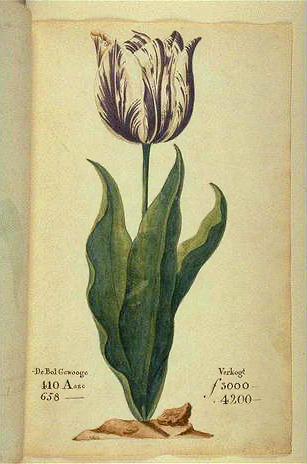
By 1637, the Dutch had gone completely nuts raising tulips. They not only had red, yellow, and white varieties, but began to breed tulips with odd "flames" and streaks on their petals. Several of these odd tulips, including the Semper Augustus and the Viceroy, were so rare and expensive that people would sell the farm to get just one bulb.


Watercolor drawing of a Viceroy. Not worth as much as the actual flower.

No, seriously. Here is what people paid for a Viceroy, which was not even the most expensive bulb in existence:

Two lasts of wheat 448ƒ
Four lasts of rye 558ƒ
Four fat oxen 480ƒ
Eight fat swine 240ƒ
Twelve fat sheep 120ƒ
Two hogsheads of wine 70ƒ
Four tuns of beer 32ƒ
Two tons of butter 192ƒ
1,000 lb. of cheese 120ƒ
A complete bed 100ƒ
A suit of clothes 80ƒ
A silver drinking cup 60ƒ
Total 2500ƒ


In modern money, that's around 1,250 USD. Semper Augustus ran for at least twice that. That's a few bills. It is also a lot more than the average Dutch worker made.  Hell, see the cows on that list? Cows are expensive animals. These were very pricey tulips.

Rare color patterns like those found on the Semper Augustus and Viceroy were caused by the tulip breaking virus. It is spread by aphids and also called "tulip mosaic virus," "Lily streak virus," or simply "TMV." This virus causes abnormal white streaks in the tulip's petals. Modern strains of tulip with streaks are just bred that way; no tulips were harmed to make the bulbs available in magazines.

Utilizing this virus to give tulips unique patterns came with a downside: The virus severely stunts the growth of the plant. Successive breeding accelerated this effect so much that the bulb did not develop into a flower, thus ending the genetic line.


People lost millions breeding impermanent tulips. There were investment pamphlets advising against tulips, frequently citing religious material. Much like homosexuals and abortions today, tulips were considered against Christian morals.  We hope they were not likening it to genitalia, but given how the Christian mind works, it would not have been out of bounds.


Suggestive, much?

Since then, "tulip mania" has been used to describe any economic bubble. The dot-com bubble, expensive ball pythons, and the subprime mortgage crisis have all been compared to the tulip craze in Holland. Although reports of exactly how many people got into tulips are likely exaggerated, some people were certainly mad about flowers.


Tomorrow: Incense and peppermints...and White Widow.

Friday, April 1, 2011

Freak Week II: Ankole-Watusi Cattle.

"Cows are my frieeends" - GIR, Invader Zim.

Before they were lard-laden milk and meat creatures, cows were considered awesome animals. If one had a cow in ancient Greece, it was a status symbol. A cow is a lot bigger than you think it is. More people are killed by pissing off cows than by pissing off sharks. Again, one wonders whose bright idea it was to steal milk from an animal that could easily run one over.

One is forced to wonder that once more upon seeing how badass some cattle look.


Those giant horns belong to Ankole-Watusi cattle, a breed native to southern Africa. They can deal with almost any sort of climate and sparse resources, making them popular around the world. Plus, those horns look awesome.

Ankole-Watusi cattle were bred for gigantic horns. These not only have a practical use - honestly, a lion would probably run from horns that spread 8 feet from tip to tip - but also look beyond badass. The horns also help the cow maintain body heat in its native habitat.


In Africa, these cows were usually kept by royalty, and are still rarely slaughtered for meat. Live animals were more valuable than dead ones in ancient times. We cannot really blame them for treating cows with such magnificent adaptations as special; their horns and hardiness in the harsh African climate cement their status as the "cattle of kings."

Ankole-Watusi cattle were originally imported as zoo animals. Their zebu lineage and massive horns made them eye candy until the 1930's. Afterward, the cattle made it into private collections. Today most zoos would not dare show off a breed of a domesticated animal; apparently, they just aren't wild enough anymore! (Again, we must gun for a "zoo of freaks.")

That is one horny bull...


As one may have guessed, Ankole-Watusi cattle are primarily ornamental. They do, however, have lean meat and milk rich in butterfat. Some breeders choose to emphasize these commercial aspects; others amplify the exotic look. Take your pick as to which you would choose, but in either case, holy cow!

Tomorrow: Tiptoe through the tulips...

Thursday, March 31, 2011

Freak Week II: Mongolian Horse.

Of all the mammals in the world, the horse gets the least amount of love on this blog. It's not that I don't like horses; like all females, I went through a horse/pony phase, got a lot of horse books, and even took riding lessons.

This blog has nothing against horses. They just aren't very weird.

Sure, they're beautiful, graceful, powerful, and whatever else have you, but horses are only really weird if you have never seen a domesticated horse before in your life. A real horse person may talk on and on about the differences between an Arabian and a Palomino, but that's still not particularly weird. Cool, but not strange unless you want to get into subtleties.


Racehorses have a lot of inbreeding going on, though.

To make horses weird, one has to go way back. The horse was probably first domesticated in Mongolia. Let's try there.


The Mongolians love their horses. The horse population in Mongolia is around three million - more than the entire human population. The national drink, airag, is made of mare's milk. Each family member has his or her own horse. Young men are traditionally given a horse upon their third birthday. Even the nomadic tribes have horses. An old Mongolian proverb says that "a Mongol without a horse is like a bird without wings." Horse lovers, start packing; Mongolia is horse country.


The Mongolian breed of horse is a right bitch to find pictures of, if only because Mongolia also has wild horses. The two are hard to tell apart; not very much has changed in Mongolia since the horse became domesticated. This similarity plus genetic diversity makes them a strong candidate for the first horse breed ever.

Mongolian horses are sturdy. Very few of them need to wear shoes. Even so, they tread cautiously. Once they get used to having a rider, they are calm horses and can run up to 35km/h. Racing horses is the second most popular sport in Mongolia; given the creature's popularity, it is very easy to see why.


The horse was the primary weapon of the Mongolian Empire. Fighters with horses had a substantial advantage over people without: horsemen were faster, could trample opposition, and could shoot arrows on horseback. It was thanks to the horse that Genghis Khan was able to take over much of the known world. As the great Khan himself said, "It is easy to conquer the world from the back of a horse."


KHAAAN!

Tomorrow: These are some VERY horny cattle.

Wednesday, March 30, 2011

Freak Week II: Scottish Folds and American Curls.


Notice something a little bit...off...about that adorable little kitten?


OH MY GOODNESS, A CATGIRL STOLE ITS EARS!


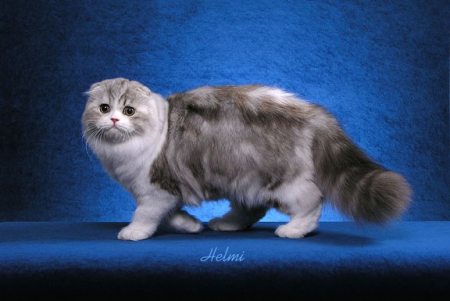
Actually, no kittens were harmed in making catgirls. The cat above is of a special 'breed' called a Scottish Fold. As the name implies, the ears on Scottish Fold kittens have the cartilage folded downward. This gives them a round-headed look that has been described as "owlish."


O rly?

The Scottish Fold breed started with one cat, Suzie, who lived on a farm near Perthshire, Scotland. When she had kittens, two of them were born with folded ears like their mother. One of the kittens was taken in by a nearby cat-fancier, and the breed developed from there. Ear-folding is dominant, so the trait was easy to pass on to many varieties of cat. Thus the breed was born.

Before you ask: Yes, all Scottish Folds are directly related to Suzie. They are not necessarily inbred (responsible breeders encourage outcrossing), but have an amazing amount of issues from the one trait of folded ears. Even well-bred kittens develop osteochondrodysplasia - or, in English, bone problems. This can include anything from malformed bones at birth to severe arthritis in later years. These issues are so common with Scottish Folds that one vet discouraged breeding them entirely; they are also not recognized by European fanciers as a breed.


Of course, a breed needs more than one trait to be considered a breed. As in canids, cats with folded ears tend to have amicable personalities. Folds are very communicative cats; they also sleep on their backs and sit in "Buddha Position." Aww, they think they're people!

A DS is not included with Scottish Fold cats. Sorry.

If folded ears are not your thing, the American Curl has the exact opposite mutation of the Scottish Fold: A Curl's ears curl upward for an expression of eternal surprise. Pet Curls can have the ears curling almost straight upward; show-quality curls demand a definite curl, but not so much that the ears touch the skull. Both longhair and shorthair Curls have very silky coats. If you like your cats a little bit odd but still with hair, the ears have it.

Not to be confused with the American Girl franchise.

Tomorrow: We swear, this was the weirdest horse we could find...

Tuesday, March 29, 2011

Freak Week II: Bully Whippets.


Pop quiz: What is wrong with this dog?
A) OMG THAT PICTURE IS SOOO FAKE!
B) It's an experiment by the EVUL COMMUNIST RUSSIANS! We're SCREWED!
C) One gene.

Sorry, this picture has been sent around the interwebs so frequently as a "real or fake?" or Russian conspiracy fodder that it merited a short quiz. Beneath all this internet BS is a normal whippet with only one gene awry. As you can see, Wendy is a perfectly content Boston family pet underneath all that muscle:


Not all whippets are as muscular as Wendy. Whippets are a sort of mini greyhound bred for one thing: speed. They can run up to 36 mph and have a winning demeanor. As dog breeds go, whippets are relatively problem-free; at most, they have some "athletic" heart diseases, but otherwise lead average dog lives.


Normal whippet.

Super-muscular whippets like Wendy are called "bully whippets." This says nothing about their personalities, just their bizarre build. The gene for extra-fast whippets is the heterozygous form of the gene that omits myostatin in dogs. Having two of the same omission allele together leads to double-muscling, creating the same beefy look found in Belgian Blue cattle (from last Freak Week). Seriously - it's the exact same mutation, just in a dog instead of a cow.

Hey, Korea...
 

Imagine crossing a bully whippet with a Chinese Crested, Xoloitzquintle, or Peruvian Inca Orchid. If the resulting image made you wet your pants in a combination of fear, WTF, and awesome, our work here is done.

Tomorrow: Hello kitty...with straaange ears.

Monday, March 28, 2011

Freak Week II: Great Danes.

First of all...

HAPPY BIRTHDAY, LADY GAGA! 


Seriously, Monster Monster, you have inspired me SO much, especially recently. Without you, my life would not even have direction. Freak Week is for you. A whole fantasy universe is for you. The one thing I will not do for you is get a Facebook. If you see this, let me know. Happy birthday!

That said, it seems like not many people have noticed the two Harlequin Great Danes appearing in several of Lady Gaga's videos. Prior to "Born This Way," almost all of Gaga's videos (with the exceptions of "Alejandro," "Just Dance," and "Beautiful, Dirty, Rich") had at least one Great Dane somewhere. Their names were Lava and Rumpus; Rumpus died in October of 2009. They are not technically Gaga's dogs and truly belong to this California breeder. Lava and Rumpus were most obvious in the videos for "Poker Face" and "Telephone" (in which Lava unfortunately gets poisoned along with the rest of the diner).

Fame: It lets one kill puppies and still be A-OK.


Lady Gaga has since changed her mascot to a unicorn. Nothing wrong with that; it's just harder to write an entry on (although the okapi and narwhal entries have some things to say about unicorns). Animals in show business are so underrated, especially when they're odd like Danes. 

Great Danes are an excellent example of exactly how versatile the canine genome is. At first glance, one would never expect that a Great Dane and a Chihuahua could be the same species; it was just luck of the draw that dogs were so versatile. There are an endless amount of mutations to play with in Canis lupus familiaris that took millennia of breeding to flesh out. One of those was, of course, for size.


Great Danes are big. The longest on record is 7.2 feet from head to tail and 3.5 feet (slightly over a meter) at the withers (shoulder height). These dimensions do not really convey how big Great Danes are. We could swap numbers all day, but there is nothing like being in the same room with a dog as big as a pony. Figures do not properly convey how big that is.

Danes are large working dogs, but have also been bred for a regal, elegant appearance and a docile temperament. They are excellent with people and other pets alike. Attacks from this breed are very rare. This has loaned them the nickname "the Apollo of all breeds"- in short, a dog so magnificent that it can be compared to the divine.


Even the divine need flaws, and the Great Dane has them in spades. They have been bred so extensively for size that, like many large dog breeds, they have a tendency towards a nasty stomach disease called gastric dilatation vulvosis (GDV). In GDV, the stomach twists upon itself; this warrants immediate surgery. The usual prescription for preventing this in Danes is to tack the stomach onto the right side of the abdominal wall. No wonder the little puppy above looks so sad.

GDV is just the tip of the iceberg. Danes also have a history of heart conditions which have no reliable prevention method. This barrage of problems leads to a shorter lifespan in Danes than other dogs - approx 6.5-7 years. The name "Heartbreak breed" is more than apt. Poor Rumpus probably got killed off by one of the many breed disorders associated with being a Dane.

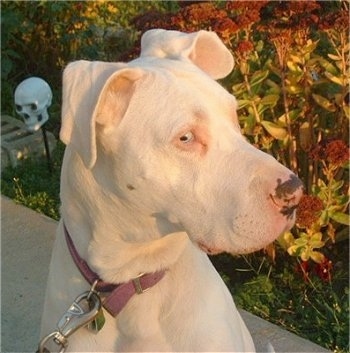
By the way, Danes have naturally floppy ears...and usually aren't this white.


Gaga's Harlequin Danes have one more problem to add to the list: Every white dog breed in existence is prone to deafness and poor eyesight. Melanin (black pigment) does a lot in mammals. Parts without black pigment, specifically the ears and eyes, are prone to burning and generally not functioning well. Mammalian ears need melanin to hear properly. If a dog is white around the ears or eyes, it may be deaf, blind, or both. It is strange to hear a deaf dog bark.


Despite all their heritable issues, Danes have left their pawprint on popular culture. Comic dog Marmaduke is a Great Dane. So is the ever-lovable Scooby-Doo. The Hound of the Baskervilles has always been a Great Dane in films. Gaga's dogs are in very good company; it's such a shame that her unicorn invokes images of My Little Pony, Lisa Frank, and CHAARRRLLIIIEEEE.

Tomorrow: Is this dog on steroids? Part of a Russian army experiment to make the world's strongest dog? The answer to both is "no."