Showing posts with label humans. Show all posts

Tuesday, December 6, 2011

A Wizard Did It: Mind Control.

If you click around enough on the internet, you will eventually find yourself in the mire called "conspiracies." If the people who make these posts are right, then we are all being slowly brainwashed by the New World Order government, starting with CIA brainwashing and ending with a slow meltdown into consumerist zombies. It's all according to what the reptilian aliens who puppet our governments want, you see.

Of all the things above there, you probably guessed by the title that exactly one of them is confirmed. The conspiracy nutjobs are onto something. You read that right, folks: There is confirmed evidence that, at least at one point, the CIA actually perfected the art of honest-to-goodness brainwashing.


Look up how we're being brainwashed and you'll find out about something called Monarch brainwashing. This is not that. In the 1960's, supposedly around the same time Monarch stuff was perfected with LSD, Dr. Jose Delgado conducted experiments using brain implants in different animals. As seen above, he stimulated the hypothalami of mammals such as cats and bulls. He found that such stimulation could turn rage on and off at a moment's notice. It was handy and uncanny, but, due to ethical concerns, the experiments were never performed on humans. At least, that's what they want us to think.

Then the government outdid itself. Controlling rage was not enough. More recently, starting in at least 2005, a new project came to light: ratbots.
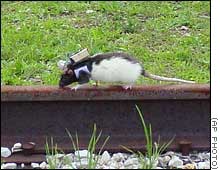


Ratbots are exactly what they sound like: Rats controlled entirely by humans via radio and computer signals. They look like they're wearing cute little backpacks. They are really more wired than that; probes have been placed in the rats' brains to stimulate certain areas. There are exactly two psychological buttons that need to be pushed to make the rat an automaton: One that processes signals from the rat's whiskers and another that taps the reward center.

Think about how simple that is. Even though the scientists making the ratbots cited practical uses such as treating neurological disorders, spinal chord injuries, and using the rats to detect mines, the far more insidious purpose definitely crossed the scientists' minds. The article from Rense.com, featuring conglomerate thoughts from various newspapers and societies,  puts it best:
""Could it be used, Big Brother-style, to control human behavior, consumer spending, or even worker productivity?" asked the Humane Society in a recent article.
 
"What if some future implant, billed as a medical miracle, was also secretly encoded to direct thought, getting a person to think like Big Brother, or to work harder for managers at corporate control, or to follow the orders of Mephistopheles?" asked The Boston Globe in a recent editorial. "What if Madison Avenue got a piece of the supposed beneficial chip to direct the consumer to buy the expensive spread or the new cereal?""
 
Of course, these rats are totally being used for non-sinister purposes. They are definitely not one of the reasons I have a cat.  Nope. 

Sunday, December 4, 2011

A Wizard Did It: Growing Body Parts.

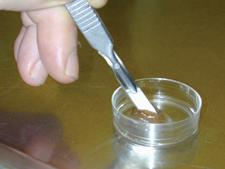
Losing body parts can be one of the most traumatic experiences in a person's life. Even with skin and organ transplants, there's a chance of rejection. Alcohol killing brain cells isn't cool, either. Also...oh, hell, you came here for the freakish science. I may as well cut the lead-in and show you what you came here to see: A mouse with an ear on its back.


This mouse is one of many comprising its appearance to give humans missing bits and pieces. It's hairless and has its immune system compromised such that it will not reject foreign tissue. Although the masters behind the mouse claims that it will live a normal mousey life, given the reduced immunity, we highly doubt that. It will, however, have popularity among evangelists as a harbinger for the end of the world.

The ear and several other body parts can be grown on biodegradable scaffolding. This is harder than it sounds; specific chemical signals are required to make cells grow. There are no stem cells required; instead, all the bits are harvested from cadavers, which may be better or worse. Once they are re-started, however, everything from ears to arteries can be effectively grown in a bioreactor. Or on a hairless mouse. 

The names to know for this form of tissue engineering are Boston's Bob Langer and Joseph Vacanti, now widely hailed as the fathers of growing tissues in the lab. (There is also a Chinese scientist questionably copying them.) Other scientists refined the processes, creating fancy things like bioreactors that simulate the body even better than a petri dish. There are even ways to make body bits grow in 3-D environments thanks to NASA. Oh, and despite harvesting corpses, the Vatican says this process is OK.


We just hope that cutting off body parts or some such does not become a sick fashion trend. Amputee fetishes are bad enough; now that parts can potentially be regrown, who knows what people will be trying out as edgy trends next?

Catgirls are always an option. No exceptions.

Saturday, December 3, 2011

A Wizard Did It: Super-strength.

OK, we're cheating a little on this one. Wizards don't usually have super strength - if anything, their STR stat is usually very low, meaning that a hit from that nasty-looking staff will only cause eight hit points' worth of damage at best. It's still a superpower, and definitely worth covering this week.


Das Uberboy - real name unknown -  was born with muscles that would make Schwarzenegger cry. He is currently an eleven-year-old child living in Germany, hopefully beating up school bullies who would otherwise steal kids' lunch money. He's been lifting 6.6-pound weights since the age of 5; we sure hope he has a sense of justice!

Das Uberboy is among the rare specimens of humanity to exhibit double muscling. The gene for myostatin is just plain gone in this kid. Genetically, there is nothing to stop his muscles from growing. Remember bully whippets and Belgian Blue cattle? Same thing, only in humans. (Hell, given that his mother and grandfather were athletes, this may well have been inherited in the exact same way.)

Just to remind you, whippets usually look like little greyhounds.


Scientists are currently interested in Das Uberboy so that they may cure diseases that affect muscle such as muscular dystrophy. Das Uberboy may also explain why some people are naturally stronger than others. Legal performance enhancers are also a possibility. There are, however, some worries about satellite cells, which may create a muscular 'burnout' and deplete muscle later in life. How many people using this will be REALLY worried about the long term, again?

A loooong time ago, Friedrich Nietzsche talked about Das Ubermensh. This child was probably not what he had in mind, but Das Uberboy is still cool. Alas, there are very few pictures of the boy, so please make due with this article.

Thursday, December 1, 2011

A Wizard Did It: Pyrokinesis.

 Many people consider making fire one of the most important discoveries of humankind. After the invention of fire, we could endure cold nights and cook food that might otherwise kill us. Fire has also been important in warfare, causing massive damage and making people flee the area lest they get singed.  It's also flashy; even though we have mastered the art, pyrotechnics remain a staple of stage shows. The first person to handle fire must have been thought of as a wizard.

Second only to our admiration of fire is our desire to control fire.  We don't just mean turning on a stove - we mean the ability to create fire just by thinking about it. Matches and camphor just aren't enough anymore. We want to answer that "need a light?" situation without carrying such items around. The bad part is, for that, you'd need magic.


Qigong master Zhou Ting-Jue may as well be the next prophet. He was born in 1934 and has been practicing martial arts since he was seven. Eventually, he was let in on some of the more spiritual secrets of Chinese culture, including qigong, which is like very intense yoga. After decades of qigong, he can heal the sick, adjust his weight at will, and, apparently, heat things so hot that he may as well be setting them on fire. All of this is done solely by controlling his own energy flow.

Mind, heating things to the boiling point is not quite pyrokinesis. It is still pretty close. That towel was steaming.  He probably could ignite a match or move a candle flame by pure force of will if he really wanted to. He would have more credibility than any YouTubers claiming to be the Human Torch.

Unleash the power of the sun!


Disclaimer: The supernatural powers of qigong are still under debate, even with spectacular individuals such as Zhou around. This does not mean that one should not give it a shot. Pyrokinesis aside, qigong is very good at reducing stress, improving mood, and keeping one in good physical shape. It does not promise giant ki blasts, but hey, results may vary.

Even so, ki mastery is NEVER like this.
 

Wednesday, November 30, 2011

A Wizard Did It/"They Actually Eat That:" Semi-Living Steak and Disembodied Cuisine.

If you are reading this, chances are you know a vegetarian. We aren't being picky, here - anyone who avoids meat of any sort is some type of vegetarian. One of the reasons they will most likely cite in their reasons for vegetarianism is that eating meat is cruel to animals...which, given how most meat is farmed, is perfectly reasonable.

"Depressing" doesn't even begin to cover it.
 

The question is, what's the alternative? It's not like there's some magical product of science that is, in a way, cruelty-free...


...oh, wait. There totally is. Sort of.

Although not mass-marketed (as far as we know), the Tissue Culture and Art Project has made meat grown in a petri dish several times. The Semi-Living Steak, for example, was a culture of pre-natal lamb meat (don't get me started with "life begins at conception"). The sample was from an animal that had not yet been born; your mileage may vary as to whether this process solves the cruelty issue or not. The meat was grown on an edible polymer. Regardless of how it was grown, meat is meat; insofar as I can tell, the scientists tried to eat it. It was made in Harvard's Tissue Engineering and Organ Fabrication Laboratory, so you know it's good. Nothing says fresh like an Ivy League college!


That steak was just the beginning. The real big, bio-engineered meat project TC&A made was Disembodied Cuisine, an art installation shown in France (2003). Semi-living frog steaks were cultured, then eaten in a "nouvelle cuisine" -style dinner. Live frogs were there to laugh at the French people watching. (The frogs were later released into a botanical garden, presumably still laughing.) The whole thing was designed to spit in France's face; of all the European countries, nobody hates engineered food quite like the French. Small surprise that most people spat it out.

These projects were not just freaky food. Even though the meat itself was cultured, several animal products were used in their formation. There are still victims, but the public does not really know about them. We dream of a victimless utopia in which there is no suffering at all, but then what? The food chain still needs to exist on some level.We hate to say this, but animals suffer plenty in nature, too. This 'meat' is intentionally ironic. Most news crews missed the joke.

Tuesday, November 29, 2011

A Wizard Did It: Levitation.

What would you give for a flying car? Or to fly like Superman? Or...hell, making anything fly would be pretty cool. Alas, unlike Arthur Weasley or anyone else from Potterland, we are unable to make cars, or much of anything else, fly. Shame on us.


Remember where we parked.


Kidding! Science has actually found ways to make things levitate. The flying cars from The Jetsons are coming soon! WE PROMISE!

There are several ways that science can make things levitate, including sound and wind, but the favorite method uses magnets. The most common way that scientists levitate things involves superconductors in a process called diamagnetism. Diamagnetism creates a little sandwich of similar magnetic fields, making the two repel. This process has been used most famously with a very confused frog, but also grasshoppers, various minerals, and mice. That's right: After mice, we will become very close to levitating humans.


As for the flying cars, we already have flying trains. There are several trains around the world dubbed "maglevs" because they levitate using super-magnets. (For those curious, the JR-Maglevappears to be the only one still running.)  Maglev creates another magnetic 'sandwich' in which a criss-cross of magnetic fields keeps the train stable and slightly above the ground. It's not quite diamagnetism, but still levitating with magnets. Not only does this keep the tracks really clean, it reduces the amount of energy necessary to run the trains. It's a win-win situation.


For those of you into parapsychology, levitation does sometimes happen to people...only they are (usually) unable to control when and how. It is often embarrassing when it happens. As an example of how unpredictable things can get, poltergeist activity can often be linked to unconscious telekinesis from teenage girls. It's that random if it ever happens.

Although some people may have the power to levitate objects and/or themselves, there is a good chance that 1. they are faking it (like almost every yogi in India) or 2. the power is extremely spontaneous and difficult to record. There has only been one recorded, controlled, and repeated test of levitation, and even that has been put under criticism. You're better off ghost hunting if you really want to see levitation or any sort of telekinesis in action.

Theme Week: A Wizard Did It!

Here at Wonderful World, we try to showcase all the strange things nature has to offer. Sometimes, however, a certain segment of that gets cropped out: Humans!

Yes, humans are part of nature, too! Homo sapiens sapiens is actually a very strange part of nature, and thus deserves one or two theme weeks. We've already done The Human Freak, which shows that, hey, nature does still affect us. It is equally interesting to see how we bend nature to our whims. One could even call it...magic.

Asa very sage website once put it, "Science is magic explained." Half of the spells in Harry Potter have real world counterparts. You probably should not try them at home, but the point is that they can be done.

Wednesday, March 9, 2011

"They Actually Eat That:" Breast Milk.

Only a couple of weeks ago, a controversial new ice cream hit the streets in London. It was called "Baby Gaga" and, besides playing off of the popular singer's name and costing WAY more than ice cream should (14 bucks a scoop?!), contained a controversial ingredient: Human breast milk.


The ice cream has since been pulled off the market due to both complaints from the singer herself and general health concerns. Geez, you people managed to piss off Lady Gaga, one of the least judgmental people in the world; surely a line has been crossed.

Actually, this is not the first time breast milk has been used in food...


...well, yeah. After all, babies drink it. How bad can it be? It's organic, all-natural, and completely consensual. Drinking cow milk is yet another weird thing about humans - the more you think about it, the weirder it is that adult humans drink the milk of another mammal. At least breast milk is from our own species. Rejoice, PETA and vegans; breast milk is milk that we can all feel good about!

Baby Gaga ice cream is one of a number of attempts to get human breast milk into food. One restaurant owner in Switzerland created a whole menu based off of products made from human breast milk (which was well-received before he revealed its secret ingredient). Costa Rica is experimenting with breast milk dairy as an alternative to weaning. Breast milk has been slipped into various things just for shock value. This is nothing new.


Not like this.

The bad news: Things with breast milk in them always, always, always get dropped on by the health inspectors. Besides the initial disgust, using fresh human breast milk could contain infections from the mother. The health inspectors would have to test it over and over for HIV, drugs, and goodness knows what else.

On the other hand, do you know exactly what your cows have been eating? It's weird that humans are the only animals that drink the milk of another mammal, and numerous vegan cookbooks and PETA will tell you that the cows don't like it, either.

Who thought this was a good idea, again?
 

Hate to break it to you tree-huggers, but humans are omnivores. We have evolved to eat animal protein. If we do not have adequate iron, we go crazy like that woman who ate a cutlery store. Vitamins are great if you feel like swallowing a medicine cabinet every morning, and tree nuts are probably okay if one is not allergic, but for most of us, it is easier, tastier, and generally more efficient to eat an animal. Do you think that you can undo evolution, PETA?

Next week: Breast milk ice cream is only the tip of the iceberg. The British have much stranger cuisine where that came from!

Sunday, March 6, 2011

BodMod Week: Amputation.

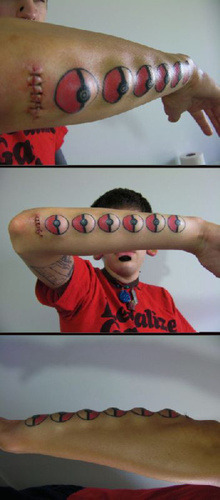
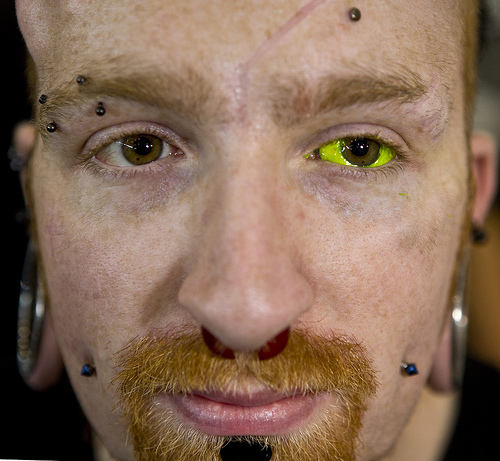
Hoo boy. Out of all the body modifications this week, today's entry is the most likely one to instantly label someone as a mental patient. Even with eyeball jewelry, tongue bifurcation, and Poke Balls that look like they could give birth to Pokemon at any minute, one body mod stands out as being really, really fucked up: Amputation.

Or maybe he lost his arm in combat and decided to turn it into a shark.
 

Yes, cutting off a limb can be considered an artistic body modification. It is also, theoretically, the simplest mod done this week. All it entails is cutting off a limb, genitalia (which I am NOT getting into) or...well, anything else. It can be done as part of a religious rite (ceremonial castration comes to mind) or as a sign of a seriously sick mind.

Before you ask what possesses people to do this, amputation is one of the few body modifications with its own set of mental disorders. As per another website on the subject, "Psychiatrists believe that limb amputation is not a sexual fetish or psychosis but a symptom of body dysmorphic disorder, a crippling, but largely unheard of and undiscussed, mental disorder related to Obssessive Compulsive Disorder. BDD sufferers obsess about minor flaws or imagined defects, usually involving the head and face. It can lead to social phobia and reclusion as sufferers avoid contact with others to hide their imagined deformities." 

In short, these people believe that they are freaks and seek to rectify the problem. The end result is something akin to a "chicken or the egg" puzzle; if one thinks one is a freak and, in fixing themselves, look like a freak to everybody else, it's eerily self-fulfilling. 


Another disorder commonly associated with amputation is Body Integrity Identity Disorder (BIID), sometimes simply called "Amputee Identity Disorder." People with BIID do not feel right as long as they have all their limbs. After reading a few reports, it sounds suspiciously like the sensations associated with the Otherkinism mentioned last entry: A general feeling of being not at home in one's body. At least these people are serious about getting their limbs hacked off - after all, they usually have to do the hacking themselves.

These mental disorders create a crisis for surgeons asked to amputate. If somebody with BDD or BIID really thinks that they are in need of an operation, there is a chance that they will perform it themselves and die in the process. It is illegal to amputate a perfectly healthy limb most of the time; this means that many of BDD and BIID people have to freeze their body parts off or otherwise remove them themselves. Even licensed surgeons refuse to cut off a working leg.


Some body modifications, like tattoos, are relatively harmless. Amputation is not one of them. Magnify every "be careful when you do this!" warning we have ever given by 100. There was a reason we ended BodMod Week with amputation.

Tomorrow: Finally, we get back to animals! Have you ever wondered what it must be like to see on the full light spectrum? :D

Saturday, March 5, 2011

BodMod Week: Tongue Splitting.

There's a group of people online who, for whatever reason, wanna be dragons. They are so desperate that they dress up as dragons and write crazy fiction about becoming dragons, then usually taking revenge on all of humanity. Some of them even claim to feel wings, claws, and tails as phantom limbs. That's either insane or hardcore depending on how you look at it.

They are not, however, hardcore enough to do this:


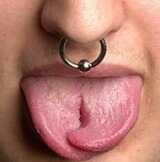
That is not a genetic mutation, nor does it allow for a human to sense the world like a snake or lizard in any regard. (If you want that, reactivate your Jacobson's Organ.) It is just a modification to make things look reptilian, and is called tongue-splitting, bifurcation, or forking (pick your favorite). Such a mod was almost unheard of in the late 90's, but is becoming more and more common.


The first recorded tongue splitting was done in 1996 by Dustin Allor, a 19-year-old body piercer. She did it herself by cutting her tongue slowly with a piece of fishing wire, then letting the wound heal. The result was two separate prongs that could move independently. Shortly after, in 1997, the Lizardman had his own tongue forked.It was really just a drop in the bucket for him.  The modification has risen in popularity since.


The methods of tongue splitting vary, but they are all very painful. There's the fishing twine mentioned above, but as the mod gained popularity, more techniques came out. Scalpels are used by most licensed tongue-splitters. Cauterizing (splitting the tongue in half with a laser or cautery unit) is another valid method. All of these are painful; reversing the process is doubly so.

Tongue-splitting is so notorious that the U.S. has outlawed it in several instances. Anything that detracts from a military image, including a forked tongue, is outlawed in the army. Illinois was the first state outlawing tongue splitting, and was soon followed by New York, Delaware, and Texas. Australia enacted a ban on this mod in 2003. The military case is understandable, but it's somebody's body. They'll fork their tongues if they want to; illegalization just means that it will have to be on the black market (or in Indiana with all the fireworks and venomous snakes).

Tomorrow: Probably the easiest mod in the book...

Friday, March 4, 2011

BodMod Week: Corset Piercings.

 Just when you thought that silicone implants beneath one's tattoos were nuts, you see something like this:


If you think you have seen something like this before but cannot quite place where, those piercings are meant to mimic the back of a corset - a garment used to give women an hourglass figure. This does not do that at all. It is just made to give the illusion of a corset. It does not have to be on the back, either - several people have done corset piercings on their chests, arms, or legs.


This effect is done by using something called captive bead rings. Captive bead rings are special piercing rings that use a bead to close them - that is, they will not snag as easily as some other type of closures. This structure makes them ideal for looping ribbons through...again, and again, and again.

Corset piercings are usually done for events like photo shoots and kinky parties. They are vulnerable to the same risks of infection as other piercings. For short periods of time, they are also sometimes inserted with a hypodermic needle. Emphasis on "short periods of time."


Again, this one just LOOKS painful.

Most people are sane enough to remove corset piercings after a week. Those who have attempted permanent piercings have not been very successful. Such a modification would take a lot of maintenance every day. It would not be worth having a corset that one could not take off.

Tomorrow: HISSS! A shame this one doesn't grant REAL snake-vision, otherwise I'd do it in a heartbeat.

Thursday, March 3, 2011

BodMod Week: 3-D Tattoos.

Has anyone else gotten really, really annoyed with the 3-D craze that has been hitting theaters and TV screens since Avatar? Avatar was not a good movie in terms of the story; it was had a visual gimmick. How To Train Your Dragon blew that gimmick out of the water and was a better movie overall. If your movie needs 3-D to be good, it is not a good movie.

Similarly, if your tattoo needs 3-D just to be a good tattoo, it is probably a bad idea. You are also probably stoned. No offense, but whatever you plan on putting in 3-D had better be one of the most badass things on this planet.


If you thought that bagelheads were bad, 3-D tattoos are taking silicon/saline implants to the next level. They use subdermal implants of silicon and saline to give tattoos a texture. This requires surgery, injections, or both; not every tattoo artist will perform them simply because they are not licensed to do so.

Bagelheads and other types of body inflation have one silver lining over implant tattoos: Bagels go away. These things are going to stick around for life. Some of them, like the spider, look pretty cool and are rational tattoo ideas (even if the 3-D is pushing it a little). Others, well...


This is a good idea...how?  

 Some people say that tattoos are a bad idea by themselves. Getting a surgical procedure to enhance them is hardcore, yes, but one has to be careful with permanent body modifications. 3-D tattoos have to be based on something seriously worth 3-Ding. Otherwise, one could end up like this fellow forever:

Gotta...Catch 'em...All? O.o;


...seriously, that just looks painful. Ballsy move, but not worth permanent mental and physical scars. Inflation would have been a better choice, man.


Tomorrow: Do you like corsets? Forget the rack-pushing; some people just love that zig-zagged ribbon enough to want it in their skin.

Wednesday, March 2, 2011

BodMod Week: Bagelheads.

We can understand some silicon-saline implants. Rack jobs, for instance, look all right. Getting the same thing done to one's nutsack is slightly less attractive, but no less logical if one is trying to outdo a tanuki in endowments. (For your own safety, do not Google Image that.) The majority of saline treatments have no such method to their madness.

Do you remember that that one guy in high school who would do anything, and we mean ANYTHING, just to be different? We swear that this way of thinking is the only justification for "bagelheads." (No, they are not called that in Japan.)


Bagelheads are exactly what they sound like: People with one or two saline solution bagels rising up out of their foreheads.This is done by a professional piercer with a saline drip that causes the desired area to swell up immensely like an intentional tumor. The lump can then be molded into any shape.


In general, this mod is called body inflation; "bagelhead" is used only to describe the strange cluster of individuals that have picked a bagel instead of some other shape. Presumably, the bagel was chosen because there are a lot of commuters in Japan and the lumps are fun to dye like real bagels. By the way, rumor has it that some people do not stop at the head and get bagels in their arms, breasts, and asses.

Why? It's a fad. Like all fads, it is silly and most of its followers are doing it just to feel cool. There are, as far as pics can tell, not that many people doing it (a search yields only 2-4 different bagelheaded individuals). Besides, how many people do you see in Tokyo with bagels on their heads? Surely that is a sign telling Godzilla to eat them first. 

Mmm, donuts!

The good news is that bagelheads are temporary. They only last for a night before one's immune system takes care of them. Side-effects include stretched skin (no, really?), headaches (again), infection, eyes swollen shut, and the same sordid feeling that one gets after reading bad hentai. Imagine if bagelheads were permanent; people would regret getting their baker's dozen if they were stuck with flesh-bagels.

Tomorrow: Tattoos and silicone injections - two things that people often wind up regretting. Especially in combination.

Tuesday, March 1, 2011

BodMod Week: Eye Tattoos (...and other jewelry).

Name one place that you do not want to get poked, kicked, slashed, or poked with a really hot French fry. Chances are, your first guess was your eye (or, if you have balls, your crotch). The eyes are usually the most vulnerable point on a creature; even dragon fanatics usually peg the eyes as the weakest spot on their supernatural uber-beasts. Hell, nature has several weapons designed to aim for the eyes, just because it sucks to get hit there.

"Cobra venom" is one of the most badass ways to get blinded.


Some people say, "fuck nature, we can take it." The things that humans will willingly put inside their eyes are, well, eye-popping. The most common trend catching eyes these days is corneal tattooing - a practice known since ancient times as a medical procedure, but more recently done just to freak people out.


Sticking ink in one's eye is not anything new. Eyeball tattoos are one of the oldest forms of tattoo art.  They go back as far as Ancient Rome. Galen of Pergamum, a Roman philosopher, used them to conceal white spots on the cornea. Various other doctors have performed their own tweaks on the procedure of medical eyeball art.


"Just hold still while I stick this ink-coated needle into your eye..."

Yes, eyeball tattooing has medical benefits. It can reduce the unsightly effects of eye diseases such as leucoma, cataracts, keratitis, various diseases of the iris and even the sight impairments caused by albinism. Besides simple cosmetic changes, the ink may help reduce glare in the eye and promote visual acuity. Hey, laser surgery was discovered by accident when a guy got glass in his eye; don't knock it 'til you've tried it.


As a body modification in healthy individuals, however, eyeball tattoos are a recent fad. The first two eyeball tattoos as most people know them were done by two Canadian prison inmates. They were not trained professionals in any sense of the word- just two inmates playing around with a hypodermic needle full of tattoo ink. Do not trust them if you would like a similar mod done. 

Tattooing eyeballs a risky procedure, especially if it is not done by a trained professional. The eye has a lot of delicate little blood vessels that can burst if the needle is poked the wrong way. It's delicate territory. Eye tattoos are dangerous enough that the state of Oklahoma has outlawed them. How long do you want to bet that will last?


(When eyeball tattoos are outlawed, only outlaws will have eyeball tattoos. Easy way to pick 'em out.)

For those of us who are not hardcore enough to stick needles into our scleras, eye surgeons in the Netherlands have developed a way to insert platinum hearts and half-moons into patients' eyes. The procedure ranges anywhere from 500-1,000 euros. They claim that it is safe (in part because platinum is an inert metal as well as shiny), and, thus far, no side-effects have been found. British scientists disagree; they believe that, sooner or later, the eye is going to react to the foreign piece of metal. We're with them on this one. Murphy's Law: Anything that can go wrong, will go wrong.

This looks more than a little dangerous.


Tomorrow: Tentacles and bay-gulls? It can only be from Japan.


Monday, February 28, 2011

BodMod Week: Blacklight Tattoos.


We lied. This week is not completely unrelated to "Born This Way." Rick Genest (AKA Zombie Boy) up there is an example of extreme body modification; he is covered in skeletal and muscular tattoos from head to toe. He plans to do more where that came from, by the way.

Say, wouldn't it be cool if someone did a full-skeleton tattoo like that, only with glow in the dark ink? Y'know, so that they could go shopping without getting weird looks, but look like they were underneath an X-ray in the dark?


Well, at least one person did.

How did they do that?

This massive skeletal tattoo was done in blacklight ink. It does not technically glow in the dark. There is no safe "glow in the dark" ink and likely only one blacklight ink that has been certified safe by the FDA. Then again, the FDA lets Mickey D's through; how much you trust their judgment is entirely relative.

Smaller blacklight tatts have been done as well, looking just as impressive as their bigger counterparts. This sort of ink is great for doing hidden images like stars or simple accents on extant designs. The general idea is to have something that looks either invisible or okay under regular lighting, but REALLY stand out under UV light.


For the love of Pandora, why?

Things that glow in the dark, or at least under blacklight, are cool! Not everybody lives in the mesopelagic zone, AKA "that part of the ocean where everything glows in the dark." It's a pretty impressive effect on land. (Go click on the "bioluminescence" tag below to see more on that.)

Simple answer aside, mammals tend not to be very colorful animals. We, as mammals, have been cursed with a horrible, horrible pigment range. Pick your favorite domesticated mammal; chances are, every domesticated mammal out there can potentially have the exact same paint job. (The author cannot look at dogs the same way after clicking around in cow breed pages.) The mammal color range is sepia-tone, largely because mammals that see in full RGB color are few and far between.

This is a normal parakeet. Swear.


This is not true with the rest of nature. Some pigments on flowers and feathers can only be properly seen beneath a UV lamp. Birds see colors into the ultraviolet range, and insects have a different type of vision from humans entirely, allowing them to identify each other and potential food on completely different light wavelengths. Humans are missing out; with our limited vision, we can only see half of nature's acid trip. 

Think this is weird? Just wait. People do far weirder things with ink.


Tomorrow: Think tatts are cool? Imagine getting one in your eye.

BodMod Week.

Oh, how funny it is that the start of what should have been February's Theme Week is on the same day as Lady Gaga's "Born This Way" video. Alas, this particular theme deals with people who were, for whatever reason, not happy with being born the way they were, and go to extreme measures to change their physical appearances.

Why? Because there are some things that the human body just cannot do without excessive surgery, inks, or implants. We, as mammals, are severely inhibited in what pigments our bodies can produce; humans, despite all of our diversity, cannot grow claws, true fur, or any neat stripes. We have the thumbs and brain power to at least simulate some of the weirdest, most majestic things found in nature on our own bodies. It just takes guts and willpower to make them manifest!


This week covers seven of the weirdest things that normal people can do to their bodies. These are not sacred rites in which a boy scars himself in order to become a man; they are modifications done by people independently and of their own free will. If it's a rite of passage handed down from father to son, that's one thing; if someone just wants to look like Satan, that's another.


Let the completely intentional freak show commence! (Before you ask, no, I am not doing genital piercings.) 

Monday, January 24, 2011

Creature Feature: Prions.

Yesterday's zombie entry was the second time I had mentioned the strange little things called prions. If you have a good memory, you might remember that the first time I mentioned prions was the entry on human cannibalism. Surprise, surprise, kuru is a prion-triggered disease that comes from eating human brains. Or listening to too much Ke$ha.


Apparently Ke$ha advocates people getting kuru, now. Congrats: Your plot to have a hoard of drooling zombie slaves at your command worked.

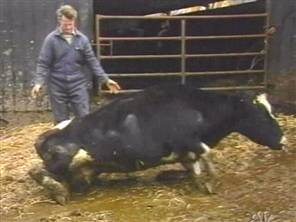
Braaaiiins? Zombie is prion victim? The symptoms of prion-caused diseases (in this case, mad cow disease) include: 

"...rapidly progressive dementia, leading to memory loss, personality changes and hallucinations. This is accompanied by physical problems such as speech impairment, jerky movements (myoclonus), balance and coordination dysfunction (ataxia), changes in gait, rigid posture, and seizures." You tell me if this sounds like zombie behavior or not.

The most distinctive hint that an unknown disease might be caused by a prion is that, yes, they all attack the brain. Mad cow disease (which has a different name when spread to humans), kuru, and scrapies (the sheep version of mad cow) are all caused by prions. There are various ways to contract prion-based diseases, included eating affected neural matter. Several of them are also hereditary and nearly always lethal.


This is not salami. It is, however, headcheese.

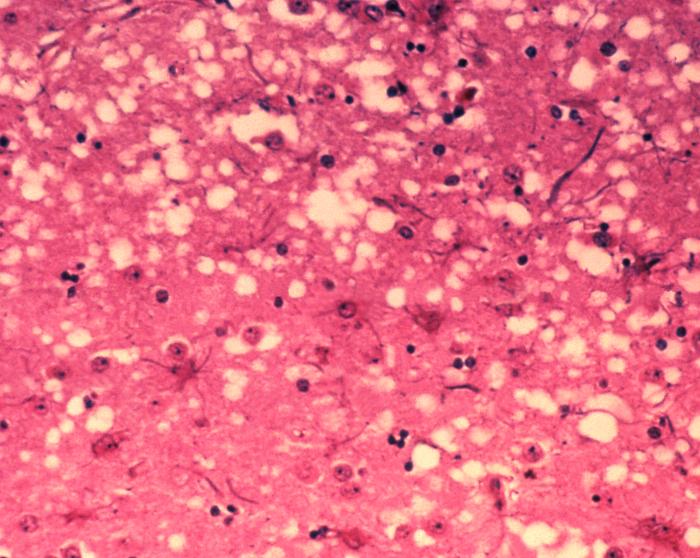
Many prion-caused diseases have at least one name using the words "spongiform encephalopathy."  This is a fancy way of saying, "it turns a brain into Swiss cheese (or Spongebob)," which is what causes all of the quoted symptoms.


But what exactly are prions? The current theory is that prions are, or at least encourage the replication of, deformed proteins in the brain. An individual prion has as much DNA as a rubber stamp (i.e. none) and a similar function: To propagate its misshapen self onto an animal's brain cells. (Fungi get off just fine.)

Essentially, they're that wrench in the gears that shuts down the whole power plant. They are the one 0  that should have been a 1 in a computer program. They're that paper jam that happens the night you have a term paper due. Prions are that sort of simple, glitchy thing that makes everything go wrong.  Oh, and despite being inanimate, they can multiply like YouTube videos.

Prions are not alive, but they are capable of self-replication. They do not have DNA/RNA like viruses. They just act like a rubber stamp on other neural proteins. This makes scientists wonder what the hell nature was thinking. (Personally, we think she has just decided to flip humanity the bird and given us an enemy that we cannot attack without screwing ourselves over.) Unlike viruses, they are clearly not alive, but no less deadly.


She's going to be sent to the slaughterhouse...then Mickey D's. Think about that.

Be afraid. Be very, very afraid. When scientists start making medicine that affects protein synthesis in the human body, I would be willing to bet 100 bucks that, for every ten lives saved with science's next miracle medicine, one person will become a crazed zombie thanks to that one protein that decided to be a douchebag in the office and order multiple photocopies of its rear end.

Tomorrow: Speaking of crack medicine, can Brazilian pit viper venom provide a cure for diabetes, or does it just make things worse?