Showing posts with label bioluminescence. Show all posts

Monday, June 17, 2013

Bio-Art: Glowing Monkeys.

I've been looking into a book called Frankenstein's Cat. It details the advances made in mixing organic lifeforms with technology, covering everything from GloFish to Roachbots. In other words, it gels very nicely with this little column. It is so named because, hey, we've made a cat that glows green in the name of curing lethal diseases.

It's weird -maybe even cute - when cats and danios get turned green, but what if science did a GFP splice that really hit home?

Source: PopSci.


Well, Japan did. In May 2009, Erika Sasaki of the Central Institute for Experimental Aninals in Japan injected marmoset embryos with GFP. That's right: we've made a monkey glow green.Or, rather, we've made twin monkeys glow green, and it's 100% heritable. As with most of these experiments involving GFP, the scientists hope to track the genetics of Parkinson's, Huntington's, and many other hereditary diseases.

Marmosets, for the record, are probably the ideal lab monkey. (Rhesus monkeys are the other big monkey you need to know.) They reproduce at a young age, and are juuust distant enough from humans to avoid any really sticky ethical issues. Experiments have been done to make monkeys glow in the past, but this is the first time that the trait has been heritable. The last monkeys did not pass it on to their offspring, or else suffered genetic lottery fail.

Kei and Kou are the first F2 glowing marmosets. They were made by effectively cloning a male glowing marmoset's sperm into the egg of a normal female marmoset. Although not as well-expressed as one might think, the little monkeys do indeed glow in the dark beneath their fur. If nothing else, their underpaws glow green, showing the transgenics at work. Since then, they have gone on to sire many a glowing monkey, creating the first glowing primate founding stock.

Here's the kicker: even monkeys aren't close enough to humans to track some diseases. Soon, we will need to splice human embryos if we want to cure diseases that can only affect people in a certain way. Ethical concerns aside, it should be easy to find some crazy mom who would want a bright green baby, so long as "will not look like The Grinch" was part of the contract. This isn't art yet, but look for gene spliced kids in the future. It'll happen.

Monday, July 2, 2012

Bio-Art: K9 and Ruppy.

Remember Eduardo Kac's GFP Bunny project? The one in which Alba, the glowing green bunny, was supposed to be integrated into normal bunny life?  He intended to take that project to the next level by creating a GFP dog (GFP K-9). It fell through, but here's a nice Photoshopped prototype:

Pic by Kac. Disclaimer: Actual dog may vary.


Luckily for Eduardo Kac, scientists in South Korea have been hard at work making glowing puppies real. They have made glowing dogs with an on-off switch. They also made Ruppy, a beagle that glows red, in 2009. I would make a joke about eating dog, but dog research is actually legitimate in some cases. In Ruppy's...you make the call.


Ruppy was spliced with a RFP (red fluorescent protein), making her the first transgenic dog ever.  In plain English, that means she glows red beneath ultraviolet light. The pigment is not nearly as widespread as someone like Kac would like it to be; only the spots that would normally be white on a beagle's coat wind up glowing red. Still better than nothing. Remember, we got no proof that Alba actually glowed except her slightly green coloration.

She is also a cloned dog, which opens a few more cans of worms. When you get to cloning dogs as well as mice, rabbits, and rats, you now have conclusive proof that many species of mammals can be cloned safely. This naturally opens the door to questions about human cloning. Dogs are pretty darn close to people in society ("low-class people" or "high-class animals," I've heard). You would have to be living under a rock to not get how controversial cloning humans is. Dog cloning is getting there.


Let's be perfectly honest: What reason would science have to make a glowing dog other than "hey, look, we made a glowing dog!"?  You can make the "genetic disease research" argument all you like. There are very few reasons to make dogs glow. Sure, if they had a natural glowing gene that only dogs had, that'd be a good reason to breed glowing dogs; as-is, we can probably stick with rabbits and rats when it comes to treating Parkinson's.The clip in a link cited several diseases that dogs and humans have in common, but part of me just thinks they're pulling an Eduardo Kac and making their genetic research look cool in the process.

The most plausible reason to experiment on dogs is to look at things that change with age, specifically fertility. The same scientist who made Ruppy is working on a project with oestrus triggers. We can only assume that a hose will be involved. Whether these tests will be repeated on humans or not remains to be seen.

Friday, April 27, 2012

Let's Go Spelunking: Dismalites.

As you all probably know, I'm a huge fan of things that glow in the dark. Bioluminescent animals are of particular interest to me. Go figure that caves have some creatures that glow in the dark. Bioluminescence occurs wherever there's darkness - you just need to know where to look for it.

If fireflies and mushrooms are not your cup of tea and you still want to see something glow in the dark on land, look no further than the caves in Dismals Canyon, Alabama. The caves there are chock full of glowing worms called dismalites (Orfelia fultoni). They are related to the Arachnocampa of New Zealand. They make the inside of a cave look covered in cyan stars. 


Beware, looks are deceiving! That light show looks like a starry sky for many invertebrates flying into the cave, too. The glowing spots are just a trap to lure in tasty moths, larger flies, and other creepy crawlies, including mosquitoes. The glowly spots conceal an intricate web of mucous strings that works almost like a spiderweb, snatching prey in mid-air. Although we may be big enough to avoid getting caught in the web, other insects are not so bright and get stuck in the sticky strands. The larvae then feed on the helpless bugs to their hearts' content. If other bugs are not available, they resort to eating their own pupae.

These enchanting, yet vicious, little glow-worms are members of the family Diptera, which also contains the ever-popular fruit flies and garbage-eating houseflies. The adult form of these glowing larvae is a type of fungus gnat. They stay a long time in their larval form, however - if Arachnocampa are any indication, anywhere from 6 months to a year, which is like eons to a fly. Beelzebub would be so proud to see humans ogling his not-as-repulsive familiars.

As one may have suspected, there are a lot of larvae up there. This is an immense gathering of flies that just so happens to look attractive to us humans. They need very specific conditions to gather in such numbers. Along with keeping cave water clean for human use, let's preserve cave ecosystems to keep the second starry sky alive.

Monday, October 3, 2011

Bio-Art: (Gene)sis.

Science and religion have been at odds since the ancient Greeks. Yes, really; there was a time in ancient Greece when church and state were not separated, and people got in trouble for saying that the sun and moon were not gods. Fathers of democracy, everyone!

Regardless of who started it, harsh debates between religion and science sprout up every time a new discovery that could cure Alzheimer's hits the presses. Now that we know how sex works, there are questions about exactly when life begins, hindering valuable stem cell research. Let's not get into chimeras and cloning, even though we probably should. The general thesis behind all those things is the same: Creation is God's domain, and even attempting to create new life artificially is an act of hubris. Apparently said hubris does not include Chihuahuas.

From ekac.org.


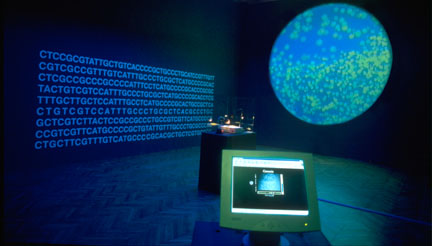
Then there's (Gene)sis - Eduardo Kac's personal message to God encoded in 4-letter DNA. He took a bit of the Bible, and transferred it into Morse code. "And God said, Let us make man in our image, after our likeness: and let them have dominion over the fish of the sea, and over the fowl of the air, and over the cattle, and over all the earth, and over every creeping thing that creepeth upon the earth."- now in GFP DNA for all to see. It's neat that someone translated the beginning of the Bible into a custom gene - a molecule that makes up all life as we know it. In the Beginning was the Word indeed.

We can understand people getting up in arms about human cloning, but this? This is chewing God up, putting him under ultraviolet light, and spitting him out. Alba was all right. How are people not offended by this? Yes, glowing things are always cool, but it's like Eduardo Kac has made himself a lightning rod for divine wrath. This is hubris if I ever saw it manifested into the coolest form possible (aside from creating Satan in a test tube- now THAT would be cool).


After being exposed to UV light so often, the DNA began to mutate. What used to be coherent words (in Morse) became swapped strings of gibberish as the bacteria multiplied. Supposedly there is a site where one can alter the composition of (Gene)sis for oneself, making the process go even faster. I am not sure if this is still up; the URL in my book seems to be wrong and/or dead. 

More importantly, what do you, the readers, think of this work? Is it blasphemy (like Chihuahuas should be)? Does mankind really have a God-given right to tweak nature as it so desires? Eduardo Kac loves to incite discussion, so discuss, discuss, discuss! 

Monday, September 12, 2011

Bio-Art: Alba.

Transgenic life is inevitable. Our food is spliced several times over with genes that promote growth and prevent pests. Even organic tomatoes are considerably modified from their wild counterparts. It was only a matter of time before our pets got into the splicing craze.

Image from Kac's site. Hope he doesn't mind the free advertising!


Meet Alba. She was made by French scientists under commission from Eduardo Kac, whose specialty is using science to make beautiful things. Under normal light, she is a perfectly healthy-looking lab rabbit. There is no way to tell that Kac ever intended for her to be anything besides a pet.

Then the blacklight comes on and she starts to glow bright green.

How you can tell this image is fake: The pupil isn't glowing.


Alba contains the GFP protein from crystal jellyfish (Aequorea victoria) in her veins. The protein is usually used to track certain traits, such as disorders, in organisms (namely fruit flies). Who are we kidding? Science just loves making things glow crazy colors.

Alba was created purely for aesthetic pleasure. We are unsure of HOW much she glows - most of the photos have been altered to exaggerate how bright Alba is - but somewhere, beneath all that white, fluffy fur, she will glow as green as The Hulk in the proper lighting. It helps that Alba lacks pigment, but even so, she will not glow as brightly as the image shows.

Making the bunny glow was just one part of a bigger "GFP Bunny" project. Her designer, Eduardo Kac, wished to make a creature outside of nature, then integrate it into his household as a pet. This unfortunately happened with GloFish before Alba ever made it into Kac's home.


No sooner was Alba revealed when controversy came hard and fast. In the mid 2000's, Kac tried to take his bunny home, but the French lab insisted that she stay at the facility. This led to a back-and-forth conflict between the labs, Kac, and the news media covering the cute little glowing bunny.

Ultimately, Eduardo Kac's project never came to its conclusion (especially with the sketchiness of Alba's whereabouts today). Kac probably still has his "Free Alba" flag flying outside his house, waiting for the rest of us to accept that a glowing animal can be just as fine a pet as any other. Hey, we accept Chihuahuas fairly readily.

Monday, August 15, 2011

Bio-Art: Avatar.

That's right: After doing Bio-Art features twice in a row, both times on Monday, I decided to make this a thing. Mondays will now be Monster/Bio-Art Mondays, with every Monday featuring a new piece of modern pseudoscience or scientific art. This Monday will be Avatar. K? K.


If you do not know the story of Avatar, you have been living underneath a rock for the last few years. No offense, but very few facets of popular culture have been untouched by Avatar. I also say this because the story is like Dances with Wolves mixed with Ferngully and given LSD. You've probably seen the story before.

Long story short, Jake Sully, an ex-marine, joins a team of scientists on Pandora, a planet with all-new life forms. Sully and some other members of the team are assigned to the Avatar Project in which they mind-sync with genetically-engineered bodies of the planet's key sentient race, the Na'vi. He eventually gets to know the Na'vi so well that, after an epic battle with his old boss, he becomes a Na'vi.

These two get mated for life in a FAR stronger relationship than anything humans can do. Sorry.


Okay, where to start with one of the biggest pieces of pseudo-scientific art since Jurassic Park? How about the hyper-ecology that everybody seems to love?

Hollywood loves to make what I call 'hyper-ecologies.' There is no definition for this in Webster, but in short, it's an ecology that eats earth species for breakfast - literally. The killing in these settings is usually kicked into hyper-drive, meaning that even that world's ladybug is waiting for the right opportunity to murder you. "Everything that crawls, flies or squats in the mud wants to kill you and eat your eyes for jujubes." - the mark of a hyper-ecology.

The actual ecology of Pandora, however, is not on crack like it was in Fragment. Along with fierce carnivores like Toruk, the Banshees, and Thanator (BADASS name), we are exposed to a large amount of herbivores. These herbivores look like they could defend themselves - they aren't pansies, but they have evolved to have hooves, tough skin, or creative ways of concealing themselves, just like real herbivores. There are also small predators, like the doglike pack-hunters that attack in the night (which would promptly OWN any domestic dog and remind me of Inca Orchids).  It's meant to be alien, but is really only on par with Australia in ferocity and general strangeness.

Awww, baby viperwolves! I WANNA TAKE ONE HOME!!! <333


Speaking of, despite being isolated like Pandora, Australia did have a lot of convergent evolution with the rest of the world. Pandora takes this to an extreme. Many of the designs were based off of sea life, such as the "Christmas Tree Plant." A lot of the life on Pandora is like earth life with extra limbs, bioluminescent spots (which serve little purpose- this place has day and night) and flashy colors. The Banshees and Toruk are kind of exceptions, but they're probably what would happen if fish eventually took to the air. Or so the textbook says.


The jaws on these guys really speak to their evolutionary lineage.

The Na'vi really push the bar; nearly everything on Pandora has 6 limbs except for them (although we do see the Prolemuris with two limbs fusing). Na'vi are furry Mary Sue/Gary Stu wet dreams, able to control everything in their environment via energy networks. They are overanthropomorphized and played way too straight as the poor native tribe that needs salvation from the white man. It's also mildly annoying that every fictional hominid in every fictional ecosystem I've seen sports a primate-ish ancestor, making reptoids (theoretically descended from troodons) at least more creative than most.

This thing honestly SCARES ME.
 

My overall thoughts on Avatar coincide with those of Red Letter Media: "Well, I didn't hate it." It does not do story or characters well. What it does do well is create a plausible, if derivative, ecosystem. Instead of there being nothing but giant superpredators, there are plants, animals, and several more or less docile species. It feels like a lot of that world's potential is wasted in a movie - even with hours' worth of extra footage, Cameron cannot do his world justice on film.

When RLM said that Avatar felt like "Pandora: the Ride," I was inclined to agree. There were books and an extensive Wiki on the universe. It sounds like it would be a fun world to play around in, either in fanfiction or as a MMO. Most computers come with built-in webcams, now. Use some of that fancy face-mapping technology to make incredibly realistic Na'vi avatars and go. Luckily, James Cameron is already planning on making such a game - don't kill yourselves yet, OK?