Showing posts with label insects. Show all posts

Thursday, January 2, 2014

Happy New Year:Glowing Cockroaches For All!

 So let's start a new yearly tradition: Find our favorite new species discovered this past year. There were a lot of cool things, including a tyrannosaurid and a smallish extinct felid from Tibet. My pick, however, goes to...

Via Pintrest.


...a cockroach. An adorable, glow-in-the-dark cockroach, but still a cockroach. It has been dubbed  Luchihormetica luckae, with no good common name. We'll just call him "Lucky" for the rest of this entry; nobody wants to write that name out ten plus times, and face it, this is one of the more likeable cockroaches out there. Just don't get any ideas about stealing his Lucky Charms. He really doesn't like that.

Here's why this little cockroach of glowy awesomeness was picked over a T-Rex relative: I have never seen anything like Lucky! It's apparently mimicking another toxic, glow in the dark insect called a click beetle. This beetle is toxic; that paint job is warning colors. This is the only known instance of a glow being used as mimicry. Yeah, these guys will survive the apocalypse just fine.

Bioluminescent bugs are rare. The most commonly-known ones are glow worms and fireflies. Along with glowing on its body, the "eyes" on its glowy outline are pools of bioluminescent bacteria. Don't "ew" that - if you didn't have E.coli in your gut, let's just say digestion would be a lot harder. It's exciting to have another glowing bug to add to the short list!

Lucky was found in the rainforests of Ecuador near an active volcano. That's a pretty bizarre environment if you think about it. There cannot be too many rainforests like that around, meaning that this cockroach might only be able to live in that one area. Save the rainforest - it has neon roaches! It sounds weird to use a cockroach as a reason to protect the rainforest, but darnit, this is a gorgeous one!

Happy New Year! May many new species be discovered in 2014!

Saturday, July 13, 2013

Newsflash: U.S. Military's Latest Weapon: Cyber-Bugs!

Remember when this blog covered the Robo-roach? It turns out that the military thought that was a good idea, too. They have now made sophisticated beetle cyborgs, capable of watching you in your sleep, or naked in front of your PC.


...Y'know, as if purely mechanical drones weren't enough. More on the how and why below:

"Facing problems in its efforts to train insects or build robots that can mimic their flying abilities, the U.S. military now wants to develop "insect cyborgs" that can go where its soldiers cannot.
The Pentagon is seeking applications from researchers to help them develop technology that can be implanted into living insects to control their movement and transmit video or other sensory data back to their handlers.

In an announcement posted on government Web sites last week, the Defense Advanced Research Projects Agency, or DARPA, says it is seeking "innovative proposals to develop technology to create insect cyborgs," by implanting tiny devices into insect bodies while the animals are in their pupal stage.

As an insect metamorphoses from a larva to an adult, the solicitation notice says, its "body goes through a renewal process that can heal wounds and reposition internal organs around foreign objects, including tiny (mechanical) structures that might be present."

The goal is to create technology that can achieve "the delivery of an insect within five meters of a specific target located at hundred meters away, using electronic remote control, and/or global positioning system." Once at the target, "the insect must remain stationary either indefinitely or until otherwise instructed ... (and) must also be able to transmit data from (Department of Defense) relevant sensors ... includ(ing) gas sensors, microphones, video, etc."

The move follows challenges the agency says it has encountered in its efforts to train insects to detect explosives or other chemical compounds, and to mimic their flight and movement patterns using small robots.

Several years ago, DARPA launched a $3 million project to train honeybees to find landmines. According to a report by the American Forces Press Service, scientists used sugar-soaked sponges treated with explosives to get the bees to identify the smell as a possible food source." -Source with more. Now you'll be carrying a flyswatter wherever you go...just in case.


Friday, March 8, 2013

Creature Feature: Leaproach.

Sure, they'll never get an awesome story glamourizing how awesome they are at surviving, but you still have to admire that cockroaches are so good at surviving that they've been around, and will be around, longer than we have or ever will.

Oh, and they have evolved to leap. Wait, what?


Yes, in 2011, a leaping cockroach (Saltoblattella montistabularis) - "leaproach," if you will- was discovered in Africa. If it's any comfort, it feeds on grasshopper droppings. Come off it- anyone who has done research beyond the school books knows that plenty of animals literally eat crap. It is not even an inch long, so should you be in South Africa and come across one, there's a good chance you will not even notice its existence.

This creature is not a grasshopper. It is, however, an astounding example of convergent evolution - looks like a grasshopper, hops like a grasshopper, but isn't a grasshopper. Instead, it is a cockroach with grasshopper traits and the astounding superpowers of cockroaches. It can jump up to 50 times its body length, and living entirely on excrement is also quite the feat.


Believe it or not, leaping cockroaches used to be a common thing. Until this discovery, they had not been seen since the Jurassic Period. Part of me also wonders if some of them might have survived long enough to make it into the Bible and appear as one of the plagues in Exodus - even though locusts are totally another creature. This is still a horror-roach that deserves some terrifying mention.

But wait, is it? This cockroach is hardly a pest. It feeds off of the crap of pests, but is not a pest in itself. It's tiny. I daresay it's almost cute. And hey, roaches aren't all that bad; they're just better survivalists than we are. Maybe we should embrace the cute roach and treat it as a peace offering - riiight before the insects conquer us for real. Yeah, still waiting on that.


Saturday, February 23, 2013

Newsflash: Manipulation of Monarch Butterflies.

It's almost March. That means Spring will be coming soon. This also means that several other animals, such as monarch butterflies, will soon be flourishing in our lawns. 


For those of you who know nothing about monarch butterflies aside from what they look like, you are missing out. Monarchs migrate from the cooler parts of North America down to Mexico as soon as winter hits. They give birth there, then die. The new monarchs that result then fly their way back up north when things get warmer. They are the only insects that migrate 2,500 miles a year. One of the classic butterflies happens to be one of the most impressive in several regards.

One mechanism has been found to play a tole in this intense migration: monarch butterflies have an uncanny genetic instinct to migrate to the exact same spot every year. The monarchs mate, then die, leaving their offspring to navigate the exact same path. That's 2,500 miles, all wrapped into genes like the world's finest GPS. Beat that, Google Maps.

Now, scientists have found what makes these butterflies tick. Here's the deal:

"Until now, researchers didn’t know what triggered the trek north. They suspected environmental factors such as temperature or changing day length could cue the monarchs. To find out, Reppert’s team studied southward-migrating monarchs captured in the eastern United States. The scientists housed one group of migrants in an incubator for 24 days and turned down the temperature to 4° Celsius during dark “night” periods and 11° C during light “day” periods — the average temperatures in the wintertime butterfly roosts. The team exposed a second group of butterflies to the same temperatures while also simulating the subtle increase in daylight that monarchs see over the winter while in Mexico.

Then the researchers took the two groups outside and tethered them one by one inside a flight simulator — a white plastic barrel that gauges flight bearings. In both experimental groups, the lab-wintered butterflies flew north. In fact, Reppert says, “the data were identical.”
Also, southern-migrating monarchs that had been captured in Texas and kept in the lab under fall conditions — with no pulse of nightly cold temperature — continued to head south when hooked up to the flight simulator.

“It’s astounding,” says ecologist Karen Oberhauser of the University of Minnesota, who supplied captured butterflies to Reppert’s team. She’s convinced that just 24 days of cold temperature is enough to switch butterflies’ flight direction from south to north. But she’s also curious about the effects of day length alone.

Reppert says the direction trigger might be modified by changes in day length, but “clearly coldness is the main factor.” Next, his team hopes to figure out exactly how the monarchs sense temperature."


Source + more here. 

This is neat stuff.A lot of people don't really think about seasonal cycles in wild animals. We're kinda used to animals, including humans, mating all the time. In reality, animal mating cycles are fine-tuned such that mommy only gives birth when there is an abundance of food available. Humans and domestic animals usually don't have to worry about that.

More importantly, however, this revelation on the impact of temperature may mean that the monarch is in trouble. If global climate change messes with their migration patterns, the species could die out. Enjoy the magnificent butterflies while we have them; if these findings are any indication, we might not have them around much longer.

Tuesday, February 19, 2013

Creature Feature: Spiny Leaf Insect.

There is a rather bizarre game that I like to play in the shower at my local health club. For whatever reason, there are a strange number of small flies in the women's locker room - usually one or two to a stall. (I haven't said anything; they've been there for as long as I can remember, and I'd presume the various renovations they've done would have fixed something.) My goal, as soon as I hit the shower, is to go fly-hunting. I show no mercy; rather, the night is not complete without swatting one fly on the marble. After all, I'm only selecting out the flies who aren't fast or clever enough to camouflage themselves, right?


That said, some insects, like this spiny leaf insect (Extatosoma tiaratum), have stunning camouflage. It is so good at camouflage that it is also called "Macleay's Spectre." This insect is native to Australia and possibly New Guinea. It is related to walking sticks despite looking a fair amount like a mantis, and is not a true leaf insect at all.

One word can sum up the spiny leaf insect: Impressive. It's large, for a bug, able to stretch across a grown man's fingers. Both sexes will occasionally curl their long abdomens like scorpion tails when threatened, creating a sort of mantid-scorpion look. Again, that camouflage is a real treat; it even has thorns. 


There are a number of interesting things about spiny leaf insect reproduction. For example, the males can fly, and only the females have that godly camouflage. The females, after getting knocked up, flick their eggs out of their bodies and onto the forest floor. These eggs hatch better in cooler temperatures, - under 25 degrees Celsius. Also, the girls are parthenogenic- that is, they can produce other female progeny without a male.

Know what's awesome? These unique insects make excellent pets. They can be found in schools and laboratories as test animals, and are very good for the first-time insect fancier. They are vegetarians, and can feed on any number of plants. Find a care sheet on them if you're interested; I'm sure they're around. It would be hard to find a better pet or display insect, if that's up your unique alley. Look closely at that tree branch- it might be a bug.

Saturday, January 26, 2013

Newsflash: Dung Beetles use the Milky Way.

...wow, that title sounds dirty. If you're too young to have a mind that goes to the gutter, don't worry about what I just said. Just know that almost everything in nature has an amazing sense of navigation compared to the silly humans who use Google Maps.  Like the sailors of old, they often use the stars as a sort of natural map. It turns out that this holds true for dung beetles as well.

Many animals, including birds and humans, use stars for navigation. This is  not the case for some creatures, like pigeons, who use the Earth's magnetic pull. Given that a little insect probably doesn't have great eyesight like birds and humans, it is mind-boggling to see one use the galaxy as a road map.


If Discovery News is correct, dung beetles don't just use the starry sky, but the Milky Way for navigating as they roll their dung balls. Even on a moonless night, a dung beetle will roll its ball of feces in a perfectly straight line. It was a mystery how they could do this without moonlight.

The experiment to test this went along these lines:

 "To test their navigation, researchers watched the beetles in a planetarium under a starry sky, a sky showing only the Milky Way, and an overcast sky. The beetles had no problem maintaining their straight lines under the first two skies, but couldn’t do it when the Milky Way was indistinguishable.

Most stars are probably too dim for the insects’ eyes, the researchers said in the study published online in Current Biology."

Hm. So along with making pyramids, the ancient Egyptians figured out that dung beetles rolled their balls of feces according to the heavens. Maybe they were onto something about scarabs being sacred. I wouldn't sacrifice an animal to that, though.

Sunday, January 20, 2013

Creature Feature: Picture-Wing Flies.

Flies are really taken for granted. Sure, they land on our food, but it's only because we leave it out for them. Without flies, the world would be covered in dog poop. In more than one sense, they're garbage men for the entire planet - it's a dirty job, but someone's gotta do it.

But did you know that flies can also be gorgeous? As in, comparable to birds-of-paradise?


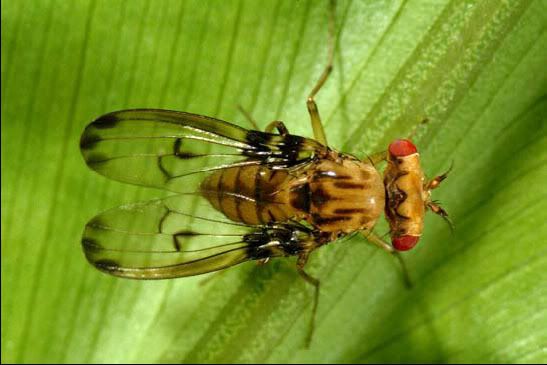
That is one of several (111) species of picture-wing fly found only on Hawaii. They are closely related to the common fruit flies around the world, and are so named for the patterns that the males have in their lacy wings. Several of these fly species are endangered or threatened, which are in turn important to equally-endangered plant species on the island. Yes, these flies are nectar-drinkers and pollinators- just like hummingbird, butterflies, and fuzzy-wuzzy bumblebees. They're sounding cuter already.

Compared to the 1000-something species of fruit flies in existence, 111 species is not a lot, nor should it be a surprise. It only takes two fruit flies for there to suddenly be millions on an island. If the Center for Biological Diversity is correct, those 111 picture-wing species came to Hawaii only 5 million years ago from one egg-bearing female- even more stunning than if a male had been present. They reproduce faster than rodents.

Fruit flies also have simply amazing genetic potential. That's why they're so horribly popular in genetic studies: they breed like crazy and have a million mutations to play with.  Lek courtship is unusual in insects, and is far more common in birds, which have more potential for elaborate courting rites...or so we thought.


When the rapid breeding rate and genetic potential of the fruit fly is brought to an island, the flies flourish. What were once ravenous pests suddenly become nectar-drinking, dancing insects with beautiful wings. Even humans do not change that radically in such a short amount of time. These must be Beelzebub's personal entertainers, if I must make a reference to Lord of the Flies. Flies may annoy us on the mainland, but they aren't all bad.

Tuesday, January 8, 2013

Creature Feature: Giraffe Weevil.

Insects are automatically nightmare fuel when it comes to creature design. With the possible exception of butterflies, there is no insect on the planet that cannot be made into an object of terror. Even harmless, annoying things can be magnified into monsters. Weevils, which are already terrifying if seen up close, reach the peak of their horror monster potential in this fellow:


This bug-meets-Apatosaurus creature is called a giraffe weevil (Trachelophorus giraffa) . It is native only to Madagascar, second only to Australia for the title of "World's Weirdest Island." They are herbivorous like all weevils, partial to seeds and fruit. New Zealand also has a "giraffe weevil," so just to be clear, this one is from the island with happy lemurs.

The giraffe weevil cannot help but stand out. That long neck on the males is 2-3 times the length of the females. It is almost an inch log - not the record for weevils, but still quite big for one. It has a striking, red and black palette. No, it is not poisonous as far as my sources know. Seeing a giraffe weevil in the wild must be amazing. The bright  color and long neck both make it unforgettable.


This long neck is for one very important purpose: Mating. Specifically, male giraffe weevils fight each other with their long necks. The females have much shorter necks, and referee the neck-fights between the two males. The winner gets laid. Fair enough.

This is not to say that the ladies of the species are not at all interesting. Unusually for insects, the female lays exactly one egg after mating. She then encases it in a tube cut from a leaf. The leaf is then cut such that two edges mesh together-  effectively, primitive Velcro. The leaf nest then drops to the forest floor, where the weevil will hatch, grow, and repeat the process.  Giraffe weevils: males look freaky, females invented Velcro before people.

Saturday, December 15, 2012

Newsflash: Gold-Mining Termites.

If you walk down a street or turn on the radio, there is a good chance you will hear/see at least one  advertisement offering "cash for gold." The idea is basically selling your jewelry and antiques to get money.

The thing is, gold is actually useful. Aside from being decorative and having a loooong history as a status symbol, gold is used in computers. It's a better conductor than copper. Functional and fashionable? How wouldn't that lead to money?

Looking for a way to get some easy gold? Well, it turns out that ants and termites are natural treasure hunters. Here's the scoop from National Geographic:

"New experiments in West Australia reveal that termites "mine" and stockpile the precious metal while they're collecting subterranean material for their nests.

For the study, entomologist Aaron Stewart, with Australia's Commonwealth Scientific and Industrial Research Organisation, and colleagues took samples from several termite nests and compared the nest material to nearby soil samples from varying depths.

By using a mass spectrometer—an instrument that measures molecules' chemical makeup—they discovered that the termite nests were richer in gold than termite nests farther away from the metal, Stewart said in an email. (Also see "Battling Termites? Just Add Sugar.")

"That social insect colonies can selectively accumulate metals from their environment has been known for some time," Robert Matthews, a professor emeritus of entomology at the University of Georgia, noted by email.

"Some have even suggested that ant and termite nests could be analyzed productively when searching for potential mining sites for precious metals" such as gold, he said.

Those are Stewart's thoughts exactly. Gold deposits are usually hidden a few meters below the surface, making them tough for people to locate. But insects could essentially act as indicators of this buried treasure, said Stewart, whose study appeared recently in the journal Geochemistry: Exploration, Environment, Analysis.

"Drilling is expensive. If termites can help narrow down the area that needs to be drilled, then exploration companies could save a lot of money."

~National Geographic. Source and more here.

The question is why the termites are hoarding gold. Zinc, as the article later details,  helps keep insect armor tough. Gold would seem to be far less useful to them, but who knows? Maybe the termites really regulate their mounds via supercomputers, or perhaps they just like shiny things despite being almost blind. So much like us!

By the way, don't sell your gold objects. Ever since the U.S. ditched the gold standard, the dollar has been backed up by faith. Faith in the government...riiiiight.

Sunday, November 18, 2012

Creature Feature: Giant Weta Bug.

You know what people like Greenpeace say about protecting the rainforest? That there might be a million different species there that we've never seen before, and some of them might cure cancer or whatever deadly disease have you? They're right. 100% right. New species are discovered every day, and while it's not likely that one will magically have a cure for AIDS or whatnot, there is always that one weird species that will break records.


This bug is a Little Barrier Island Giant Weta (Deinacrida heteracantha). She is infamous for potentially displacing the African Goliath Beetle for the title of "world's largest insect."  All wetas are native to New Zealand, and this girl is no exception. Giants wetas in general are highly endangered. They fill the niche of rodents where native; you decide which is scarier.

First off, what is a weta, anyways?  There are roughly 70 different kinds of weta, all of which are native to the islands of New Zealand.The name is Maori for, umm, this particular type of bug.  They used to be much more plentiful, with fossil records extending into Eurasia. Now, the island weta are under threat by rats and other introduced mammals brought by European settlers.

The giant weta in particular is the largest, or at least heaviest, insect in the world. It weighs 71g, tops. For those of you who either hate metric (why?) or need a better idea of how heavy that is...that's three mice. For something that doesn't even have a spinal cord and lives on land, that's pretty big. Yes, this is yet another example of insular gigantism.


This particular female giant weta broke records in 2011. She's the chart-topper at 71g. Granted, she was carrying eggs, but giant wetas in general are still pretty big bugs. Most adult Goliath beetles top out at around If any bug steals limelight from Africa's Goliath beetle, it'd be a giant weta. If nothing else, it's the largest weta. Goliath beetles still average 80g as larvae.

 The good news? This bug is a vegetarian. Or, at the very least, the heavy female found in 2011 had a particular fondness for carrots. Giant wetas are seriously docile; even when food is not present, they will allow themselves to be handled. There are a lot more "perfectly safe" creatures in New Zealand than in Australia, and this giant, cricket-like creature is among them. Funny how that works, isn't it?

Oh, and then there's Weta Workshop....but more on one of their works tomorrow. ;)

P.S.- In honor of Thanksgiving, "They Actually Eat That" will take place on Thursday of this week instead of Wednesday.

Wednesday, November 14, 2012

"They Actually Eat That:" Roaches.

An interesting special was on the news yesterday: China, the most populated nation on the planet, is eating more and more meat by the day. They see it as "revenge" after living in poverty for so long, even though (like American factory farm meat) the meat there is potentially toxic unless you happen to be an elite. This new interest in meat means that China is headed towards more pollution problems, as if they did not have enough already.

Huh. That's funny. In America, we're working on fixing that problem by eating insects. The "impoverished" parts of the world make better use of the bugs around them than we do of the pig, and we make damn good use of the pig. What we and other countries do with cockroaches is especially cool.


First off, yes, Thailand is on this list. Given that China manages to turn anything into cuisine, there is a good chance that you can find them at night markets there, too. (For those curious, I've eaten a few insects; they taste, for the most part, like chicken.)  They are also popular in certain types of African cuisine (including Botsawanan) and Caribbean cuisine. If 50 Ways to Cook a Cockroach actually has any cockroach recipes in it, good on them.

For the most part, cockroaches are still an "eww" food in America, despite being excellent sources of protein. The Titan roller coaster in Texas, however, offers edible  Madagascar Hissing Cockroaches to kids if they want to skip to the front of the line. With entomophagy enjoying a popularity boom, cockroach recipes have also hit the internet and a few restaurants. Careful, though; there are also some recipes for cockroach killer out there. If it can kill an animal notorious for surviving anything, it can kill you.


Now, please note that I am not encouraging you to try eating cockroaches at home. You don't know where they've been; unless you intend to cook them, I can't recommend eating them. Just know that, in the event that you are the only survivor of a nuclear apocalypse, the roaches will still be around while the cows, pigs, and chickens will all perish. Just sayin'.

Saturday, November 10, 2012

Creature Feature: Mexican Jumping Beans.

In Texas, every souvenir shop has something made out of a weird, dead animal. Hotlix are everywhere. Quite a few places had longhorn cow skulls. Leather exists there- very good leather. One of the most bizarre, however, just so happens to be quite common: the Mexican jumping beans. 


The beans actually 'jump' thanks to the larva of a moth called Cydia deshaisiana, or the "Mexican jumping bean moth." As per the name, they are native to Mexico and the southwestern United States. There are actually a number of shrubs, and a number of moths, that can make "jumping beans," but for now we will focus on the kind sold in random tourist junk shops.

The larval moth spends its entire life in the seed capsule (not bean) of a Sebastiana plant. An adult  C. deshiasana lays an egg on the seed, and the larva burrows in shortly after. If the seed is cracked, the little creature uses silk to repair it. The bean, if nothing else, is a source of food and shelter all at once. Not a bad home if you happen to be a caterpillar.

The "jumping" in jumping beans happens when the larva has eaten all of the inside of the bean. Then, for no explicable reason, they begin pulling silk around the inside of the bean, causing it to roll and fidget if not jump. They jump as an attempt to regulate their body temperatures - it's hot down south!


 Of course, the jumping bean larva cannot stay inside the bean forever. It pupates inside bean, meaning that the frail adult moth will have a hard time getting out. To escape, the larva forms a "trap door" in the bean- a small, round hole that it can push its way out of. This small hole is sometimes marketed as well, even though it defies the point of a jumping bean.

The adult moth is a small, gray, unimpressive creature. It's one of those bugs that reaches maturity only to mate; it doesn't even have jaws. In the span of a few days, it must mate, find an immature Sebastiana seed, and lay eggs. Thus the cycle of touristy crap begins again...but look on the bright side: other, related moths do this to seeds we actually eat.

Tuesday, November 6, 2012

Creature Feature: Dung Beetles.

Animals do all sorts of weird things involving stuff that humans wouldn't touch. THis has largely to do with that animal's personal world - for example, urine is an excellent indicator of scent (and most of the animal world does see by scent) and rabbits eat their own droppings so as to eat the extra nutrients. It all makes sense in the animal's own view of the world.


That said, dung beetles must be one of the most baffling species in the world to humans. All dung beetles are scarabid beetles, and they can be found on every continent except Antarctica.  Trying to name off every single species would be an exercise in futility. They eat and lay eggs in feces. Gross, right?

What's gross to us is really quite monumental in the beetle's own little world. Dung beetles are amazing. The dung balls that the beetles make are either a) massive food stores or b) nests made of quite a convenient material. The balls of feces they accumulate can be up to ten times their weight, so rolling one is like a single human pushing 6 buses full of people! Also, it's kind of funny that the males are usually the ones doing the rolling- make jokes about THAT at will.

It's a small world, after all.


This use of dung is quite a valuable service. Rolling the dung means rolling foul-smelling excrement away from whatever made it, refertilizing the soil and keeping pests away at the same time. Dung beetles save the U.S. cattle industry somewhere around 38 million dollars every year. Seriously, it's a good thing that somebody is handling the dung; we humans do not want to deal with it ourselves.

Finally, what would an entry on dung beetles be without at least mentioning ancient Egypt? The Egyptians, for all their pyramids, agricultural advances, and nifty inventions believed that the sun was rolled across the sky like a dung beetle rolling excrement. It was also believed that all dung beetles were male and that they reproduced by masturbating into a dung ball. We can understand falcons, ibises, crocodiles, and jackals being impressive. The dung beetles are actually pretty cool, too, but giving them the sun might be pushing it.


Sunday, November 4, 2012

Blasphemy Week: Pustulated Carrion Beetle.

What could possibly be worse than the Irukandji? It's really hard to beat an invisible, tentacled blob of poison when it comes to blasphemy. I really hope none of you are eating anything while reading this. This is...icky.

Source.


The Pustulated Carrion Beetle (Nicrophorus pustulatus) is almost exactly what it sounds like: a beetle that mates and lays eggs on carrion, i.e. a corpse. The pustulated carrion beetle, however, ups the ante from mating on corpses to regular brood parasitism. It is native to North America, including much of the U.S. and Canada.

"Brood parasitism" does not involve any internal squick. No, this is parasitism done outside of the body, which actually opens itself up to more horror. Basically, "brood parasitism" is when an animal is forced to raise another animal's young - knowingly or not. Probably the most well-known example of this is the cuckoo bird, who has brood parasitism so down-pat that cuckoos will attack birds that refuse to raise their young. N. pustulatus is the pimp of brood parasitism, letting its young be reared by a number of insect species...oh, and snakes

Source.


Now, I realize not many people are sympathetic to snakes. A lot of you probably think that snakes are terrible parents, leaving their young as soon as they're out of the eggs. This is not necessarily true; quite a few snakes, most notably Burmese pythons, are very protective of their clutches and may even raise the temperature around their eggs with muscular contractions. King cobras build nests. (In species where the snakes give live birth, well, there's considerable parental investment already.) Point is, as creatures who do tend to young, we should be terrified.

N. pustulatus is the first known insect brood parasite of a vertebrate, in this case the Black Rat Snake (Elaphe obsoleta) and a few other species (including the Gray Rat Snake, which is becoming endangered). The beetle lays her eggs directly proportionately to the amount of eggs in momma rat snake's nest (so no, it never wipes out a nest). Unaware that her babies are literally being devoured from the inside-out, the rat snake guards her nest while the beetle tends her larvae alongside. Look on the bright side: the beetles don't have a mafia.

If the idea of finding beetle larvae in snake eggs is not unholy enough to warrant a spot in this week, the implications of it sure are. Imagine a brood parasite of, say, humans along the lines of what these beetles do to snakes. (Before you say anything about that being impossible, there are wasps that lay eggs inside caterpillars; human skin would be no issue, and this is all hypothetical anyways.) You're welcome.

Saturday, October 20, 2012

Creature Feature: Bookworms/Common Furniture Beetle.


A lot of people reading this have probably heard the phrase "bookworm." For those of you who haven't, one, you're probably living under a rock, and two, it means someone who really likes books - a bibliophile. They are most often depicted as nerdy little worms of some sort, often comically reading a random book. So are bookworms a real, actual species of insect?

Answer: Yes and no. There are a number of insects and invertebrates that could be called 'bookworms.' Silverfish and cockroaches are quite fond of hiding in between pages of old books and taking a bite. There are bugs called "booklice" which are not really lice at all, instead being flying insects that have been around since the Permian. Even rodents occasionally chew on books. Some of them are interested in the glue; others tunnel through the pages like wood; rodents will gnaw on anything to keep their teeth filed down. Really, especially in the modern age, a book is a very safe hiding place with some food lying around. There's no reason for bugs not to invade such a place.

Source.


All sorts of things can eat books, but the term 'bookworm' usually refers to the larvae of one of two beetle species: the common furniture beetle (Anobium punctatum) and the death watch beetle (Xestobium rufovillosum).  Even then, these two are usually more interested in the wood around the books than the book itself. Books are made from trees just like wood, and so happen to be on the menu. They are like junk food to these baby beetles.

On that note, take bookworms seriously, especially if the larvae in question belong to the common furniture beetle. Beetles called "bookworms" will fly in through any little crevice and lay their eggs near books. These are, however, wood-boring beetles; any wood that isn't made from "heartwood" (the inner wood of the tree) is prone to infestation, as is any untreated wood. 

Source.


The most obvious signs of bookworms are, of course, little larvae and tunnels in your books. Look for 'dust' on your bookshelves if you think your wood might be infested. To prevent them to begin with, keep your books in a clean, dry place. If you think you have a whole library's worth of little grubs, there are a few chemicals, including tobacco, that you can use to fumigate the area. Do your homework before trying to get rid of other bookworms.

Although some of the cartoony bookworm characters are quite benign and adorable, this is definitely not the case in real life. Real bookworms can wreck an entire library without checking out anything. Nature sees paper as "very thin, dead trees." Why shouldn't stuff take advantage of it?

Thursday, September 27, 2012

Creature Feature: Mourning Cloak.

It definitely feels like fall here in Chicago. Things are getting colder. Leaves are falling. Halloween stuff is available in stores everywhere. I can't hate fall because I really hate winter, but it is when things start to get depressing.


Then I see one of these, and still can't help but wow. That's a Mourning Cloak (Nymphalis antiopa), a large butterfly native to North America and northern Europe. There have been some reports of them in Britain, but they are few and far between.They can be found far outside of their range during migration.

A flutter-by look does not do this butterfly justice. Not only are Mourning Cloaks big with distinct markings, but they're part of a group of butterflies called "brushfoot butterflies." If you look at a Mourning Cloak in detail, it looks like they have only four feet. The last two are there, but so vestigial that they have been reduced to brushes. Don't worry, nobody plucked them off.

From Thebutterflysite.com


If you don't think the butterfly is impressive, the caterpillar certainly is. It is also called the "spiny elm caterpillar." Like many caterpillars, the spiny elm puts all Hot Topic customers to shame with its spikes and outlandish orange spots. They often feed in groups, defoliating whole leaves before moving on to the next. Although, hey, nobody likes having their trees nibbled, these caterpillars are rarely problematic enough to warrant pest control. Just remember that they become awesome butterflies.

Winter does not do a thing to Mourning Cloaks. Like less-masculine bears, they enter diapause (i.e. hibernate, effectively) until spring warms things up. They are literally among the few insects to survive winter in the Midwest. Instead of flower sap, they feed on tree sap after awakening. Clever butterfly is clever and has found a niche all its own. Good going, Mourning Cloak; now keep impressing me until winter hits!

Friday, September 21, 2012

Creature Feature: Assassin Bug.

Some of you have probably noticed little ads on YouTube or Blip for a cartoon whose tagline is "nature is dirty."Yes, nature is dirty on every single level. It's all about screwing, killing, mind control, and getting high - you know, things that one would expect from the mafia. That said, nature even comes equipped with its own band of assassins...

Photo by Debbie Roos.


...who just so happen to be insects.

There are a lot of leafhopper-ish bugs under the big happy family of assassin bugs. They get their name from being ambush predators, mostly of other insects, but also vertebrates. They all belong to the family Reduviidae, which is related to water bugs. I really hate doing single entries on whole families of things, but this really is an interesting bunch. There are about 7000 species in total. This is not doing the whole family justice.

All assassin bugs have venom. For those of you out there who aren't toxicologists, most types of venom contain digestive enzymes. Assassin bugs inject a mix of these enzymes and an anaesthetic into  the skin of their target. In the case of insects, the internal tissues are also liquefied. The resulting juice is then sucked up through the assassin bug's strawlike rostrum like some horrible smoothie.


Since there are so many kinds of assassin bugs, it's hard to make any sort of generalization about them. You can probably find an assassin bug near you, but whether it will be after your blood or not depends on exactly where you are. Some kill unwanted pests, like roaches, moths, Japanese beetles, and mosquitoes; others drink mammalian blood just like mosquitoes. There is a chance that bloodsuckers in South America might harbor a particularly nasty disease simply called "Chagas' disease"- gross stuff comes with the hematophage territory. 

Chagas' disease is carried by assassin bugs in the tropical Americas. Actually, if you want to be technical, Chagas' disease is caused by a parasite on the assassin bug called Trypanosoma cruzi  - a parasite of a parasite, if you will. It is deposited in the bug's feces, which easily gets into human skin with but a scratch. The most obvious sign of the disease is localized swelling around where the bug's feces were deposited, but if left untreated, the protists strike the muscles and heart. The bloodsucking assassin is just a vector in this protist's life; I'd say "don't shoot the messenger," but that's really the best way to stop the bug from spreading feces. Like I said, nature is dirty. 

Saturday, September 15, 2012

Creature Feature: Bed Bugs.

"Good night. Sleep tight. Don't let the bed bugs bite!"

Hahaha. As I've been finding out recently, easier said than done. We have bedbugs or something else. I want to say that it's some sort of mite, but for now, let's look at bed bugs. (I will make another entry on mites if need be.) There is more to them than meets the eye.


The term "bed bug" usually refers to Cimex lectularius, the common bed bug that feeds on human blood. It can, however, refer to any member of the genus Cimex or even the whole family Cimicidae. Bed bugs are found everywhere and have been feeding on humans for millennia. Don't feel too bad about finding them in your house - you're just a few generations behind.

The bed bug has to be one of the most durable little insects ever. They do not really care how hot or cold things are; too cold and they just hibernate. Bed bugs do not care whether your house is clean or dirty. All they want is your blood and a place to hide and reproduce in. That's really all they need: Food, shelter, and sex.

Oh wow. Yes, let's talk about bedbug reproduction for a moment. It's...special.

Pic by Rickard Ignell.


All bed bugs mate through something called "traumatic insemination." While taking that literally might just translate as "rape" to most people, it is a very special kind of rape in scientific circles. Some animals do not have openings for a penis to go into, so the male inserts himself wherever he pleases into the female's flesh (and thus blood). That is how bedbugs get knocked up: by having the male pierce the female's exoskeleton with his hard-on. Face it: Even the kinkiest people wouldn't find that kind of penetration sexy.

So, how do you know if you have bed bugs in your house? Well, seeing one or getting repeated blisters for no good reason are fairly sound signs. Dead bed bugs apparently smell like raspberries, so if you aren't a fan of raspberries and randomly smell them, that's a pretty good hint, too. Get an exterminator; they might even bring a bed bug-sniffing dog along. Bed bug attacks have been on rise rise, so have the number handy. Just remember that the females get a really raw deal.

Tuesday, August 14, 2012

Creature Feature: Argentine Ants.

No matter how advanced humans get or how much we spawn, insects will always outdo us. They spawn faster, evolve faster, and several species are remarkably social. Hell, now, they've even caught up in the invasive species department. We thought we had that market cornered.

First, a reminder: Ants are already secretly terrifying, and not just when they happen to be on your food. They are the only animals aside from humans (and maybe chimps) that wage war. They also have livestock in the form of aphids and agriculture in the form of fungi. These little insects are so much like us that it's uncanny. They're almost idealized as hard workers that are so driven to work that they are all but born into a caste. This is eusocial? Creepy.


The Argentine ant takes the creepiness up another few levels. It is a dark ant native to Brazil, Ecuador, and, of course, Argentina. Now, they can be found on every continent except Antarctica (y'know, the only continent with "ant" in its name). They probably spread via human transport, but "alien conspiracy" would not surprise us, either. They're ants, so they'll eat whatever's around.

If you thought Japanese beetles were bad, they have nothing on the invasive power of Argentine ants.  These ants have spread to every area willing to accommodate them. All it takes is ten workers and a single queen to churn out a whole colony. Since these are ants we're talking about, they are also perfectly capable of displacing current ant species, making the Argentine officially the One Ant to Rule Them All. People worry about culture becoming homogenized; these ants are already most of the way there.


You know what's even creepier? Every single Argentine ant colony outside of Argentina is genetically related. Scientists have taken ants from Europe and mixed them with Asian and North American colonies with no ill results. Go ahead, try this with humans (even triplets who had to separate for some reason). The result will not be this clean.

Also, if you happen to have a problem with these ants...too bad. Pesticides make the queen lay more eggs. There also tend to be many queens. Congratulations, Argentine ants: you have officially taken over the world. Way to beat Pinkie and the Brain to the punch.

Tuesday, June 19, 2012

Creature Feature: Giant Water Bug.

It's been a while since we did something creepy. No, I do not mean "rip you face off" terrifying, but genuinely, skin-crawlingly creepy. It's been a while since I did something like that. Brace yourself:


Giant water bugs are exactly what they say on the label: giant bugs that live in water. They can be found in the slow-moving streams of almost every place except Africa, Europe, and India. They are big and strong enough to take down everything from insects to crustaceans to fish, frogs, and reptiles. This entry is unfortunately going to focus on the entire family Belostomadidae simply because there's more to say about them.

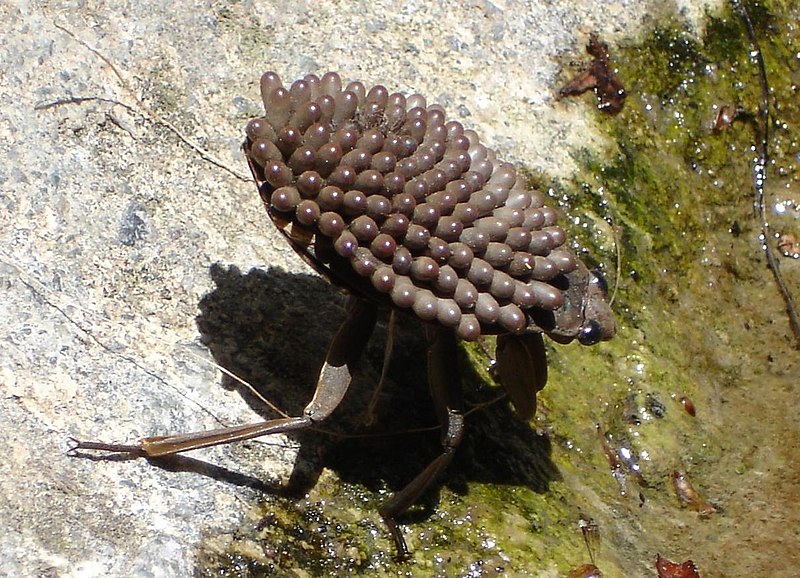
As with most things with "giant" in their names, one must ask "how giant is giant?" It depends on the species. Specimens range from 1.5 inches to 4 inches solid. The picture up there gives one a very good idea of how big that is without using a measurement converter. For a water bug, that's pretty big.


Water bugs have some impressive hunting tactics. They have evolved to hunt entirely underwater. They look exactly like a dead leaf from above. While lying in wait for prey, they breathe through a natural snorkel. When something tasty comes around, they quickly spring with their powerful front legs and inject enzymes into their quarry with piercing mouthparts. Sometimes they mistake human toes for salamanders, leading to the nickname "toe-biter."

Remember how I said these water bugs could take down vertebrates? They do that with the most painful bite in the insect world. In other words, they're everywhere and they sting like little bastards. Do not pick up a dead one unless you want to be hurt - they can play possum. The bite has no harmful side-effects, it just hurts.

Happy belated Father's Day!


Many giant water bug species have a parental care system rivaled in weirdness only by that of seahorses. For starters, the females do all the courting; the opposite is usually the case. After copulation, the female lays her many eggs on the father's back. The male cannot mate while he's got eggs on his back; that would be awkward on so many levels. It's like everything Discovery Channel told you has been turned upside-down.

Giant water bugs are also eaten. They are particularly popular in Thailand, where they are served as a snack food. People draw them in with blacklights during breeding season, catch them, then, well, heat them. For more on that, use the handy-dandy search function to find a very old "They Actually Eat That" entry.  Bon appetit!