Showing posts with label beetles. Show all posts

Tuesday, January 8, 2013

Creature Feature: Giraffe Weevil.

Insects are automatically nightmare fuel when it comes to creature design. With the possible exception of butterflies, there is no insect on the planet that cannot be made into an object of terror. Even harmless, annoying things can be magnified into monsters. Weevils, which are already terrifying if seen up close, reach the peak of their horror monster potential in this fellow:


This bug-meets-Apatosaurus creature is called a giraffe weevil (Trachelophorus giraffa) . It is native only to Madagascar, second only to Australia for the title of "World's Weirdest Island." They are herbivorous like all weevils, partial to seeds and fruit. New Zealand also has a "giraffe weevil," so just to be clear, this one is from the island with happy lemurs.

The giraffe weevil cannot help but stand out. That long neck on the males is 2-3 times the length of the females. It is almost an inch log - not the record for weevils, but still quite big for one. It has a striking, red and black palette. No, it is not poisonous as far as my sources know. Seeing a giraffe weevil in the wild must be amazing. The bright  color and long neck both make it unforgettable.


This long neck is for one very important purpose: Mating. Specifically, male giraffe weevils fight each other with their long necks. The females have much shorter necks, and referee the neck-fights between the two males. The winner gets laid. Fair enough.

This is not to say that the ladies of the species are not at all interesting. Unusually for insects, the female lays exactly one egg after mating. She then encases it in a tube cut from a leaf. The leaf is then cut such that two edges mesh together-  effectively, primitive Velcro. The leaf nest then drops to the forest floor, where the weevil will hatch, grow, and repeat the process.  Giraffe weevils: males look freaky, females invented Velcro before people.

Sunday, November 4, 2012

Blasphemy Week: Pustulated Carrion Beetle.

What could possibly be worse than the Irukandji? It's really hard to beat an invisible, tentacled blob of poison when it comes to blasphemy. I really hope none of you are eating anything while reading this. This is...icky.

Source.


The Pustulated Carrion Beetle (Nicrophorus pustulatus) is almost exactly what it sounds like: a beetle that mates and lays eggs on carrion, i.e. a corpse. The pustulated carrion beetle, however, ups the ante from mating on corpses to regular brood parasitism. It is native to North America, including much of the U.S. and Canada.

"Brood parasitism" does not involve any internal squick. No, this is parasitism done outside of the body, which actually opens itself up to more horror. Basically, "brood parasitism" is when an animal is forced to raise another animal's young - knowingly or not. Probably the most well-known example of this is the cuckoo bird, who has brood parasitism so down-pat that cuckoos will attack birds that refuse to raise their young. N. pustulatus is the pimp of brood parasitism, letting its young be reared by a number of insect species...oh, and snakes

Source.


Now, I realize not many people are sympathetic to snakes. A lot of you probably think that snakes are terrible parents, leaving their young as soon as they're out of the eggs. This is not necessarily true; quite a few snakes, most notably Burmese pythons, are very protective of their clutches and may even raise the temperature around their eggs with muscular contractions. King cobras build nests. (In species where the snakes give live birth, well, there's considerable parental investment already.) Point is, as creatures who do tend to young, we should be terrified.

N. pustulatus is the first known insect brood parasite of a vertebrate, in this case the Black Rat Snake (Elaphe obsoleta) and a few other species (including the Gray Rat Snake, which is becoming endangered). The beetle lays her eggs directly proportionately to the amount of eggs in momma rat snake's nest (so no, it never wipes out a nest). Unaware that her babies are literally being devoured from the inside-out, the rat snake guards her nest while the beetle tends her larvae alongside. Look on the bright side: the beetles don't have a mafia.

If the idea of finding beetle larvae in snake eggs is not unholy enough to warrant a spot in this week, the implications of it sure are. Imagine a brood parasite of, say, humans along the lines of what these beetles do to snakes. (Before you say anything about that being impossible, there are wasps that lay eggs inside caterpillars; human skin would be no issue, and this is all hypothetical anyways.) You're welcome.

Saturday, October 20, 2012

Creature Feature: Bookworms/Common Furniture Beetle.


A lot of people reading this have probably heard the phrase "bookworm." For those of you who haven't, one, you're probably living under a rock, and two, it means someone who really likes books - a bibliophile. They are most often depicted as nerdy little worms of some sort, often comically reading a random book. So are bookworms a real, actual species of insect?

Answer: Yes and no. There are a number of insects and invertebrates that could be called 'bookworms.' Silverfish and cockroaches are quite fond of hiding in between pages of old books and taking a bite. There are bugs called "booklice" which are not really lice at all, instead being flying insects that have been around since the Permian. Even rodents occasionally chew on books. Some of them are interested in the glue; others tunnel through the pages like wood; rodents will gnaw on anything to keep their teeth filed down. Really, especially in the modern age, a book is a very safe hiding place with some food lying around. There's no reason for bugs not to invade such a place.

Source.


All sorts of things can eat books, but the term 'bookworm' usually refers to the larvae of one of two beetle species: the common furniture beetle (Anobium punctatum) and the death watch beetle (Xestobium rufovillosum).  Even then, these two are usually more interested in the wood around the books than the book itself. Books are made from trees just like wood, and so happen to be on the menu. They are like junk food to these baby beetles.

On that note, take bookworms seriously, especially if the larvae in question belong to the common furniture beetle. Beetles called "bookworms" will fly in through any little crevice and lay their eggs near books. These are, however, wood-boring beetles; any wood that isn't made from "heartwood" (the inner wood of the tree) is prone to infestation, as is any untreated wood. 

Source.


The most obvious signs of bookworms are, of course, little larvae and tunnels in your books. Look for 'dust' on your bookshelves if you think your wood might be infested. To prevent them to begin with, keep your books in a clean, dry place. If you think you have a whole library's worth of little grubs, there are a few chemicals, including tobacco, that you can use to fumigate the area. Do your homework before trying to get rid of other bookworms.

Although some of the cartoony bookworm characters are quite benign and adorable, this is definitely not the case in real life. Real bookworms can wreck an entire library without checking out anything. Nature sees paper as "very thin, dead trees." Why shouldn't stuff take advantage of it?

Friday, June 1, 2012

Who's That Pokemon- Unova Edition: Karrablast/ Escavalier

There are two Pokemon in Gen V that break all the rules of Pokemon evolution that we thought we knew:  Shelmet and Karrablast. While there have always been Pokemon that evolve via trading, these two only evolve when traded for each other. Then one must trade back to add the new Pokemon to one's Pokedex.


The result: Shelmet becomes a shell-less, super-fast ninja slug called Accelgor (wrap your brain around that), while Karrablast walks right into the slug's old home and resembles an insectoid knight called Escavalier (shown above). This is, believe it or not, based on a real thing:

Awesome photo by J. Konuma. Slender specimen.


Several types of ground beetle are specially-adapted to eat snails. The group to look at, Carabidae, has several members that can fit right into a snail's shell and eat the slug while it's still inside. They are flightless and found in many parts of the world, including Japan, Europe, and the Americas. Aside from eating snails, they will also eat other insects or fruit that happens to be lying around.


The carabid beetles come in two flavors: long and small-headed and large and heavy-headed. These are both effective when it comes to eating snails for completely different reasons. On one hand, you're slender enough to break into the snail, but have trouble cracking their armor; on the other, large-headed beetles can crush the snail in their jaws, but can't fit their heads into the shell as can their slender counterparts. There's an evolutionary tradeoff that relates entirely to eating snails and the physics therein. This has promoted differentiation among ground beetles. They're like the Darwin's Finches of the insect world.

We're almost glad Pokeymanz didn't make this one too realistic. Yes, Karrablast gets a diet plan and steals Shelmet's shell, but at least the pink squishy inside Shelmet lives. The slug gets to live a happy life as a ninja when traded over as opposed to being devoured. Be free, ninja slug. Be free.

Sunday, February 12, 2012

Creature Feature: Dim?!

Here in America, we will copyright and patent everything. Look at SOPA/PIPA; assuming they were legit acts and not brutal acts of the police state and NWO, even potentially having copyrighted material on a site would be enough to shut it down. There is even an insane person who attempted to patent the stick. Look it up; our culture is copyright crazy.

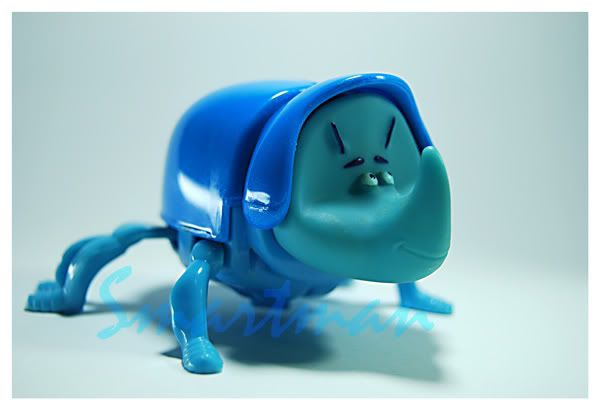
There was one instance, however, in which nature copied a copyrighted character. Mind, nature used a different color palette, but the point remains that the rhinoceros beetle Dim now has a real-life counterpart.


A Peruvian rhinoceros beetle, Megaceras briansaltini, sports a horn almost exactly like Dim from A Bug's Life. The resemblance is uncanny. No, the bug did not come first; it was discovered years after A Bug's Life was made. If Disney could sue nature for copyright laws, they probably would. The discovery of life copying art like this has been dubbed the "Dim effect" in the blue rhinoceros beetle's honor.

Horn aside, this bug looks like some sort of alien. That face should be on some sort of dragon-insect cross. It's Dim gone horribly, horribly wrong. He came to the dark side for the cookies and you know it!
Clearly the face of an evil mastermind.


Here's the kicker: We honestly do not know if this insect is an actual species or not. For all we know, that copyright-infringing horn was a fluke mutation. Cases like this are why it's really important to save biodiversity hotspots like rainforests, guys. The more species a place has, the better off it is ecologically. Plus, neat stuff like this happens. It's always cool when nature has the potential to drive copyrighters up the wall.

Wednesday, January 5, 2011

Creature Feature: Photuris.

OK, I lied a little. There is one genus of insect that comes fairly close to the goings-on at "Roppongi." The problem is that humans fail really, really hard at interspecies sex.

"Find hole, insert hard-on." How hard can it be, right?

Answer: A LOT harder than that. Every species has certain behaviors - scents, pheromones, feather displays, and other mating rites - that keep them from successfully breeding with another species. Humans see things very differently from most of the species that they would like to mess around with (with many mammals having better smell and/or hearing), and thus miss critical hormonal cues. There are ways to make animals more than happy to do their thing, but in this case, rape is just easier for most humans.

Yeeeaaaaah...nature has a whole genus of bugs that do not just flip mating rites the bird, but abuse them. This is not done by some horrible new species of killer, flesh-eating wasp. The culprit is a firefly that is widespread over the continental U.S. and Canada.

Yes, a firefly.


Wait a minute. Everybody in the U.S. and some parts of Canada has seen these guys. Some elementary school kids had a huge drive to make Photuris pennsylvanica up there the state bug of Pennsylvania. Their larvae are called glowworms because they glow in the dark. They make summer nights awesome. Are these really the insects who have crossed the interspecies sex barrier?

Well, yes and no. Fireflies in the genus Photuris are not interested in getting it on with different fireflies. The females of Photuris still copy the light patterns of Photinus females to attract Photinus males. (That enough Greek for you? Good.)

Then they eat said males.


Photuris fireflies are not called "femme fatale" fireflies for nothing. The female Photuris isn't even interested in getting it on - all she wants is lucibufagin, a bad-tasting chemical that she can only get from eating a Photinus firefly. 

I guess this means you aren't calling me?


Male Photuris fireflies have a different problem: How does he find a mate when she's attracting men of another genus? Lucky guess. It's literally a shot in the dark when a male Photuris is looking for a voracious, poisonous woman. Some males have also taken to copying another species's lights, just to get her to come hither a little bit faster.

Insects are actually really, really good at stealing secrets. There are insects upon insects, as well as a few arachnids (remember Portia?) that live by cracking another bug's code for something. There are flies that trick ants into giving them food, parasites that make bees vomit a little bit of food, and a million other tricksters that would make great computer hackers. If Google was managed by insects, the internet would be dead within a week.

As for what a scientist has to say on this miraculous code-cracking?

"We humans are slow learners, but we're starting to catch on."  

Sunday, December 5, 2010

Creature Feature: Tortoise Beetles.

There are usually one of two reactions to beetles: If it is a ladybug, people tend to go "awww" and put it on umbrellas, purses, you name it; if it is not a ladybug, the usual reaction is to kill it with fire. That's a shame; there are a fair amount of beautiful, interesting beetles that deserve the same love that ladybugs get.


This is EXACTLY what it looks like: A bug with sh*t on its back.

"Wait a minute, Kuro. This little worm is among the more lovable beetles?"

Yes, yes it is. That is the larva of a tortoise beetle, a blanket term for beetles of the family Cassidae (or Hispinae). There has been a lot of debate on the exact taxonomy of these beetles, but they are definitely related to leaf beetles. They eat plants all their lives, so if you wish to find one (which you very well might when all is said and done), look for leaves that have been chewed. They are especially fond of bindweed. Various species of this family have been found from North America to Vietnam. 

Tortoise beetle larvae have a very interesting (i.e. unpleasant) way of protecting themselves: Instead of discarding their waste, they wear it and all that sticks to it as armor. Not many predators are willing to eat that, no matter how common corprophagy is in non-human animals.

But wait. It gets better.


This little insect undergoes a dramatic metamorphosis from a crap-wearing bug to one of the single most beautiful beetles in the world. (Technically, there are several dozen species of tortoise beetle, but all ladybugs look alike to most people, too.) The adult form has a transparent shell that makes it look like a glass button:


Or a piece of gold:

Golden Tortoise Beetle...,. by *duggiehoo on deviantART

Or even a ladybug:


As one might expect, these beetles are often used in jewelry (even with most of their iridescence lost). Do want; not that I want to see these beetles dead, but with elytra like that, wow.

Thursday, October 28, 2010

Creature Feature: Bombardier Beetle.


Before you say anything, yes, that beetle just shot boiling liquid and vapor out of its ass. That was a bombardier beetle, which means it is from any of several tribes of ground beetle. Although the beetle in the video was probably African from what I have read, bombardier beetles are found worldwide. In German, they have been given the awesome-sounding name of
Bombardierkäfer. That should be a Rammstein song.


FEUER FREI! Bang bang! 

This beetle has one of the most stunning defense mechanisms in the animal kingdom. Without getting into too many chemical details, it has one chamber in its rear for hydrogen peroxide and another for hydroquinone. When threatened, it releases both chemicals at once. The result is a messy, smelly, smoky explosion not unlike the sort found in chemistry classes.


Valid shirt is valid.

The heat created from the chemical reaction can reach up to 100 degrees Celsius - the temperature at which water boils. About a fifth of this nasty solution is vaporized, scaring off many potential predators. Some of the bombardiers in Africa can even tuck their abdomens beneath their legs to make their aim more accurate. This was the bug that Animal Planet cited for for making their dragons' firebreath plausible, but given the series of fast pulses necessary to keep this insect from burning its rear end, making anything breathe a solid stream of fire still isn't a good idea. Just give it a gatling gun instead.


Much more plausible than a regular dragon. Really.

Also, they are carnivorous. This means that, should one grow to immense size, we are not safe from its jaws or acid-squirting rear. It would make an excellent kaiju or Pokemon, but nooooo...


 Oh, c'mon. You made a MOVE called "Boiling Water," Nintendo.

Monday, September 13, 2010

Who's That Pokemon? - #214 Heracross.


Heracross is one of the baddest bugs in the Pokemon world. It has massive ATK, the most powerful Bug-type attack in the game at its (STAB'd!) disposal and an ability that makes its ATK even more impressive. Its unique Bug/Fighting combination leaves it with few weaknesses. I have heard Heracross touted as one of the best Pokemon in the game since its introduction.

To make things even cooler, Heracross is based off of an actual beetle:


The rhinoceros beetle dubbed kabutomushi ("helmet bug") (Trypoxylus dichotomus or Allomyrina dichotoma, depending on who you ask) in Japan is the real-life basis for Heracross. They are found throughout Japan, China, Taiwan and Korea.

Like Heracross, the males of the species have spectacular horns with a cross-like growth on the end. They have been featured in every series that features monsters kicking each other's asses.


Including Mushiking, a game devoted entirely to fighting beetles. (Sorry, I couldn't find the rhino card.)

Also, like Heracross, these bugs are born to fight. In Japan, pitting one male unicorn beetle against another is as popular as fighting roosters and bettas, if not more so. This sport is enjoyed by children and adults alike, leading Japanese scientists to seek stronger, faster-growing beetles. People both lose and win a lot of money pitting one male beetle against another, but they are not difficult to procure at all; people either catch their own beetles or buy them at department stores for approximately 5-10 USD.


Boxed and ready for battle!

Want a real Heracross? Nintendo lies; it's not THAT hard to get one.

Tuesday, August 10, 2010

Creature Feature: Trilobite Beetles.


If you have ever gone through a good class on the history of the Earth, you have seen a trilobite. Trilobites are those little (or sometimes not so little) invertebrates. They are currently extinct, but their presence is so ubiquitous in the fossil record that it is possible to tell what era a fossil bed is from based on the trilobites alone.


They're also found in Pokemon, which says something about their popularity.

Researchers can claim that trilobites are extinct all they like. The trilobite beetles (genus Duliticola) will flip them the bird however a beetle can.


Trilobite beetles are native to the wetter rain forests of India and Asia. As such, they are naturally endangered. Like bagworms (...for those of you who know WHAT those are), only the males get a winged adult form.

The females look like fossils. ON ACID.


Several other beetles, such as the netwing larva above and baby fireflies, also resemble trilobites on acid. Just sayin'.

The females look like fossils. ON ACID.


Strangely, there is NOTHING on these creatures. They are endangered, rare, and trippy as all get-out, but Wiki only has a paragraph on trilobite beetles. Given the widespread nature of trilobites in the past, why has no more effort gone into studying these guys? Are all the important scientists still wasting their time trying to get pandas to mate?

Give up already. The bear's doomed.

Thursday, June 10, 2010

Creature Feature: Japanese Beetle.


Many of you probably know about the Japanese beetle (Popillia japonica) thanks to the little nibbles on your trees, shrubberies, and flowers. You might have seen these guys in your weeds, wreckin' your yard. Yes, they are related to the rose chafer beetles that I want in a lucite clock (both are in the family Scarabaeidae), but these are far, far more annoying.

Japanese beetles are, however, very very pretty. Like the rose chafer, they have some metallic green parts. Their wing covers are bronze-orange, and the whole bug would make a nice jewelery piece. At the tips of their antennae are little three-fingered 'hands' that reach out to give the beetle a better sense of its surroundings. (Am I the only one who finds that image both creepy and adorable?) Also, yes, those are tufts of hair you see on the beetle's underside.


I could praise these little green and orange bugs all day. That would not stop me from luring them into a little plastic bag and drowning them. As beautiful as they may be, they are, like lionfish, a destructive invasive species. Though well-regulated in their native habitat (Japan), in America, they have become even more infectious than DDR. They predate upon 200-odd plant species, including quite a few that humans would like to keep around.


Come pick my roses! No, wait, NOT LIKE THAT!

Japanese beetles probably came into the U.S. in a shipment of iris bulbs before 1912. They were first spotted in a New Jersey nursery in 1916, and have spread their way across the U.S. (and even into Canada) ever since. The beetles' success has caused an increase in some bird populations, which causes the birds to be considered pests themselves. (Why no one has labeled humans as pests, I'll never know. Sorry, jaded again.)


Just a reminder of what these guys can do.

So, despite their beauty, feel free to drown them, smack them into walls, seal them into plastic blocks, fry them (hey, you never know, might be good), use them in chicken feed, or tear off their wing coverts and make a necklace out of them. Get a big enough one, preserve it, and brag that you have a lucky Egyptian scarab. You'll be doing the United States a great service.