Showing posts with label artiodactyls. Show all posts

Sunday, July 7, 2013

A Week of Hogwash: Warthogs.

How on Earth could this blog possibly do a week of pigs without covering the warthog (Phacochoerus africanus)? Outside of the wild boar, warthogs are among the most famous of wild swine. I'm amazed this pig wasn't covered already, seeing as I'm a fan of Disney's Lion King. Consider this entry an insight into Pumbaa's secret life.

Talking meerkat not included.


The team behind the Lion King was not as collectively stupid as some generic "jungle animal" film producers and actually picked a wild pig that lived in Africa. Warthogs are the only pigs adapted to savannah life, being able to graze and eat darn well anything they come across (including insects - the movie got that right, too). They are so named for the "warts" on the sides of their very odd-looking faces, which are at the very least a lot stranger than the wild boar's. No prizes for beauty contests, but impressive nonetheless. There are a few species of warthog spread across the savannah of Africa, making the whole species not threatened.

Wild pigs always have very impressive heads, and warthogs are no exception. The namesake "warts" are globs of fat used for surviving tough weather and added protection when fighting fellow male warthogs. The tusks of a warthog, which curve in crescents over the snout, are sometimes used to make tourist trinkets instead of elephant ivory. The lower pair of tusks is constantly rubbing against the upper pair, whetting them like little daggers all the time. Woe to any predator in the mood for pork chops.


The warthog is more than just a not-so-pretty face. They are also quite adaptable, despite having no protection from extreme heat or cold. A warthog is able to go up for a week without water. Those fatty warts are good if food ever becomes scarce. Speaking of food, a warthog can "kneel" on its front legs to get the lowest little bits of grub. They are pigs that can go without excessive food and water - neat.

As opposed to the downright vicious wild boar, warthogs would rather run than fight. They usually flee into a burrow - either their own or someone else's - and effectively block the entrance with their visages. Four tusks are a pretty good threat. Cowardly? Maybe. Effective? Well, considering that wombats do the same thing with their butts, a head armed with pointy tusks is a step up. Good on you, Pumbaa.


Saturday, July 6, 2013

Newsflash: U.S.A. Going Hog Wild.

Oh, hey, speaking of feral superhogs, wild pigs just hit a new record. They have been problematic in the Unites States for a long time, being fertile, intelligent, adaptable omnivores (sound familiar?). Bacon lovers rejoice: soon, you will be able to hunt your own. 


"Digging up fields and lawns, killing livestock and spreading disease, wild pigs have gone from a regional nuisance to one rapidly spreading across the nation.

The animals have razor-sharp tusks, a bottomless appetite and no natural predators, and experts say the invasion of the feral pigs has become a major problem that is moving north.

“This truly is becoming a national crisis,’’ John Mayer, the manager of environmental science at the Savannah River (S.C.) National Laboratory, told TODAY on Friday.

The U.S. Department of Agriculture estimates that wild hogs, which can weigh more than 200 pounds, are responsible for more than $1.5 billion in agriculture damage and destruction every year. TODAY’s Kerry Sanders took a ride in a helicopter to see them firsthand, watching dozens on the run across the 2,000-acre South Fork Ranch in Okeechobee, Fla.

“It’s like having a rat in your house,’’ Southfork Land and Cattle Company’s Bill Wallace told Sanders. “They’re just not a good thing.”

In 1987, there were an estimated two million wild pigs in about 20 states, primarily in the South and concentrated in Texas and Florida. Now there are an estimated six to eight million wild pigs roaming 47 states.

“This increase that we’ve seen in wild pigs is unquestionably dramatic,’’ Mayer said. “We don’t have another species here in the U.S. that has increased at this same rate.”

Experts say the explosion in the wild pig population is partially due to hunters transporting them across state lines, plus some escaping from hunting preserves. The animals also produce two litters a year, rapidly swelling their numbers." - TODAY News.

Thursday, July 4, 2013

They Actually Eat That/A Week of Hogwash: Head Cheese.

Originally, this entry was going to be dedicated to Hormel. Not only are they probably awful factory farmers, depriving piggies of their natural well-being, but they will put everything and anything ham-related into a can. That includes canned bacon and taquitos. Look it up if you're curious; I'm just going to sigh, say "oh, Hormel," and move on to something even more disgusting than canned bacon. 


This is commonly known in the U.S. as "head cheese." It is also called "souse" or "brawn" if one simply must make it sound more classy to offset exactly what sort of meat is in question. As one can probably guess, it is made from the head of the pig, sheep, or calf. It has been around since the Middle Ages as a European peasant food. Gee, I wonder why?

Let's think about that for a moment.  There are plenty of meaty parts on an animal's body. The head is not one of them unless the animal in question happens to be a whale or dolphin. Feel your own head for a minute and imagine someone thinking, "hey, there might be meat, there." You'd probably think they were the stupidest, sickest people on earth, right? So, how does that relatively thin skin even remotely qualify as food?

Hey, remember aspic? How about gelatin? Head cheese is usually in a meat gel like that. The meat around the skull naturally gels that way to some degree. Head cheese can look like perfectly OK loaves of mystery meat (see also: meat glue), or it can look like modern food/art gone horribly wrong. Some people think it looks really beautiful; while I can see why they think that, I do not necessarily agree.

OK, this one from the Houston Press does look nice.


Who would do such a thing? Everybody. China does it, every country in Europe does it, and America does it by default. It's a good way to use up parts of a pig that nobody would otherwise eat, even if it happens to be from the 2nd ring of Hell. If a culture eats pigs, it has head cheese in some form. Now enjoy your 4th of July barbeque if you happen to be in the United States. :)

Wednesday, January 2, 2013

They Actually Eat That: Angus Beef.

Everybody these days is advertising Angus beef. People actually care about what they eat now; putting a breed name in front of beef implies a higher standard to the audience's unwitting minds. Does it really, though? If so, why does every fast food chain on the planet suddenly stock it?  Never fear, "They Actually Eat That" is here to put your thoughts to rest!


First of all, what is Angus beef? Angus beef is any meat that comes from Angus cattle, polled (hornless) Scottish cattle. They have been in the U.S. since 1873 at least, when a farmer named George Grant began breeding the British cattle in Kansas. They were bred for and marketed as the ideal beef cow. They rarely let people down by that standard, if you know what kind of Angus meat to get.

Here's the kicker: A cow must be at least 51% black to be considered an Angus. That's it when it comes to labeling something as "Angus." It doesn't even have to technically be an Angus, just a dark cow. Angus are known for their black color, so there's a chance that there's some Angus in a mostly-black cow, but exactly what else is in there is up for debate. Government hoodwinking strikes again!

Real Angus beef is known for its marbling. For those of us who aren't professional chefs, this means that there are strings of fat on the muscle. Although this sounds gross, it helps keep the steak a tiny bit moist when cooking.  If you get meat from something like a Belgian blue, for example, there's no fat there - it just heats up instantly. It does matter where you get your steak from; it stops mattering so much when that meat is stuffed into a sausage lining or made into a patty.


Angus cattle may be known for their meat, but does that mean all Angus meat is good? No! There is such a thing as low-quality Angus beef. All it means is that the meat comes from standard beef cows instead of cows that we don't know the lineage of. In other words, Angus is a buzzword. They're just finally telling consumers that their beef comes from this type of cow as opposed to discarded Holsteins. The Angus burgers and hot dogs floating around could well be made from the discarded bits that weren't prime steak.

Those of you wanting good Angus beef should look for two things: certification and grade.  Certified Angus is exactly what it says: beef that comes from cows that are most definitely Angus cattle. Grade applies to all beef - even Angus. The Angus used in fast food burgers is either the not-Angus beef or Angus beef barely fit for human consumption. Be a smart consumer. It scares the machine.


Sunday, November 11, 2012

Creature Feature: Texas Longhorn.

Honesty time: I tried to resist doing this one. Texas Longhorns are awesome, but at first I thought them better for Freak Week. The juices simply refused to flow for bald cypress (a moderately interesting swamp conifer), and I'd already done cochineal in the OLD entry on scale insects. Cotton might have been interesting, but c'mon...it's Texas.


Texas Longhorns are, no kidding, a cattle breed native to Texas. Thanks to mixing with feral cattle, Texas Longhorns have no specific patterning - just huge horns. The closest related breeds are in Portugal; the Longhorn breed itself was established in the 1500's. The highest ever paid for a Longhorn was 140,000 USD, and exceptionally good lines can still fetch into the 40,000's. Even the cows of this breed have amazing horns.

The most obvious feature to pick on is, of course, the longhorn's headgear. Although not as impressive as Ankole-Watutsi horns, a Texas Longhorn's signature horns can get up to 7 feet long from tip to tip. As morbid as this sounds, their skulls do look amazing in a den. That said, they're pricey.


Longhorn cattle are very tough cows. They can find food and shelter all on their own in case of emergencies. They calve easily, which is one of the reasons to add them to breeding stock.This hardiness led to them being popular until the 1900's, at which point environmental durability and lean meat were no longer selling factors. With the demand for lean or free-range meat on the rise, Texas Longhorns have seen another surge in popularity.

The Texas Longhorn, alongside the Holstein, has to be among the most recognized cattle out there. Nothing says "southwest" like a bovine head with those horns. Texas uses them as a mascot for everything, even a women's basketball team. If you haven't seen a Texas Longhorn and live in the U.S., you must be living under a rock...or just unaware of exactly what you're looking at in those old westerns.

This looks awesome. People mess with horses; they do not mess with 7 feet of horn.

Saturday, July 28, 2012

Rare White Bison In Connecticut.


July 28th marks the naming of a white bison calf born in Connecticut. His official sacred name is now "Yellow Medicine Dancing Boy," which will probably get old to either the townspeople or the buffalo after a while. It's probably one of the coolest things that has ever happened in Connecticut, so of course people are excited.

White buffalo are rare. The National Bison Association estimates that only 1 in 10 million buffalo are born white. That's more than one in a million. No wonder people are lining up to see it; genuine white buffalo are a very rare thing. There have been a few other white buffalo in America, the most notable being Miracle in 1994.

There are several ways to get a white buffalo. Albinism and leucism are both in the species. In recent years, a third form has popped up: white produced by cross-breeding with cattle. The baby born in Connecticut will be gene tested just to make sure he is a pure white buffalo. Even so, several native American tribes have paid the buffalo a visit.

Before you ask, yes, people have tried to breed white buffalo. In the instance that someone managed to breed a bunch of purebred white buffalo, it looks as though their particular white strain was dominant (with brown fathers yielding white calves through one white female). I'm not so sure about other populations. These are still pretty rare animals.

Another awesome thing: White buffalo are an excellent example of what this blog originally intended to advertise:A mythic creature brought to life. Yes, seriously.


Several Native American tribes treat a white buffalo like a magical creature. The one in the news at the moment is the Lakota. Here is just one of the tales surrounding the sacredness of the white bison:

One summer a long time ago, the seven sacred council fires of the Lakota Sioux came together and camped. The sun was strong and the people were starving for there was no game. 

Two young men went out to hunt. Along the way, the two men met a beautiful young woman dressed in white who floated as she walked. One man had bad desires for the woman and tried to touch her, but was consumed by a cloud and turned into a pile of bones. 

The woman spoke to the second young man and said, "Return to your people and tell them I am coming." This holy woman brought a wrapped bundle to the people. She unwrapped the bundle giving to the people a sacred pipe and teaching them how to use it to pray. 

"With this holy pipe, you will walk like a living prayer," she said. The holy woman told the Sioux about the value of the buffalo, the women and the children. 

"You are from Mother Earth," she told the women, "What you are doing is as great as the warriors do." 

Before she left, she told the people she would return. As she walked away, she rolled over four times, turning into a white female buffalo calf. It is said after that day the Lakota honored their pipe, and buffalo were plentiful. (from John Lame Deer's telling in 1967). 

Even today, the white buffalo strikes the Lakota as a symbol of peace, hope, and rebirth.  Let's hope they're right; if so, the world might not end in December.

Wednesday, May 30, 2012

"They Actually Eat That:" Bouffalant.


OK, no, people don't really eat Pokemon. We do, however, eat buffalo (Bison bison).


Since man first found buffalo (or bison, take your pick), man has known that the animal was good for eating. The Native Americans used every part of the bison from meat to coats to eyeballs. The eyeballs were a treat for the young'uns. We said every part and we meant it.

The first settlers on the plains also discovered that bison were good eating. Instead of trying to economize the bison and make sure some still lived, however,  the settlers proceeded to ravage the native population. There were only a few hundred left by the mid-1880's. Whether this was because they came in droves, because they didn't know a thing about the environment they had entered, or because bison meat was just that damn good is not certain. There was also a huge demand for anything bison in Europe, further spurring the animal toward extinction.

The bison were not amused.


Of all the things the European settlers did, nearly annihilating the bison was the second worst. (The first was the collection of anti-Native events, obviously.) Bison were the only creatures the plains had that kept the prairie grasses at a manageable level. If you mess with tier 1 of the food pyramid, the whole thing collapses. Way to go, free market.

There were exactly four herds of bison that managed to survive to this day. The most famous was a herd started from exactly five wild calves caught by James "Scotty" Philip in South Dakota. Another was brought by boat to Antelope Island, Utah, and is today one of the largest publicly-owned herds in North America. A third breeder in Texas bottle-fed a few bison calves and now has the third captive herd. The only truly wild bison herd is the one in Yellowstone, Wyoming. To summarize: Responsible captive breeding was just about the only thing saving North America from severe ecological damage.


So, after this little fiasco, you'd think we'd have learned our lesson and stopped hunting bison, right? Nope. Hunting is still legal, albeit tightly controlled, in Utah. Eating buffalo is still a thing. We just know what we're doing, now. The bison we eat are all (or, mostly) farmed. Hell, we've even been able to hybridize them with cows. They're called "beefalo." They were bred solely to be eaten, so don't look so shocked when you see buffalo on the menu.

Saturday, January 7, 2012

Creature Feature: Synthetoceras.

Here at the Wonderful World, we do occasionally try to stick to the old title and make a mythical creature real. There was a whole week devoted to the possible sources of mythical creatures, including how, and if, they ever existed or potentially could exist. Bear in mind that these entries were not necessarily complete, meaning that I could have totally missed something obvious. In this case, it was our bad twice over. Ladies and gents, we present to you...the quadricorn:


Actually, Synthetoceras looks more like a kirin from Twelve Kingdoms, but the joke was too silly to resist.


Synthetoceras ('fused horn') was a genus of artiodactyls that lived in the Miocene Epoch - 13.6-5.33 m.y.a., or "after the dinosaurs" for those of you keeping track at home. Fossils of this genus have been found from Wyoming to the lowermost tip of Illinois. Synthetoceras ran parallel to modern cervids in terms of size (ranging from roe deer to elk) and presumably niche, but was not directly related beyond having cloven hooves. It may have been more closely related to camels than to deer.

We know what you're here for, however. How about that crazy horn?


(c) Murray Alcosser.

The type species of the genus, S. tricornatus, had three horns in total. It was about 7 feet (2m) long, making that strange horn quite imposing. The two near its eyes looked fairly normal, being short and curved like cow horns. The last horn, located on its nose, was bifurcated at the tip (making it not quite a quadricorn). Since only males had these horns, it is assumed that it was used for territorial battles or courtship.

Beyond that, we do not know very much about Synthetoceras. We think it lived in herds and overall behaved much like modern deer. The only real difference would have been the headgear, which even the most crazy conspiracy theorist could not mistake for the head of Satan. Satan with a slingshot horn...come on.

Saturday, December 24, 2011

Creature Feature: Reindeer!

'Twas the night before Christmas...and Kuro was making a blog entry. Yeah, this blogger doesn't even take a day off for Christmas. That's what made today's entry to hard to pick. But hey, I figure some of us will be seeing these guys on our roofs tonight:


...wha? Wait a minute, that looks nothing like the reindeer we've grown up with. Sure, it has antlers, but it's nowhere near the flighty, slender deer we're all used to seeing. What's going on?

You were born that way, Rudolph.


The marketing people have corrupted us again: real reindeer, or caribou (Rangifer tarandus), do not look like they could fly at all. The "reindeer" we know and love have plenty of traits taken from regular deer and antelope. Just about the only thing holiday marketers get right is that reindeer are native to northern Europe, Russia, and northern North America. There are several subspecies of reindeer, and it is almost impossible to pick exactly one to focus on. They all have some very interesting adaptations to the tundra environment, so please forgive me if I switch subspecies every now and again.

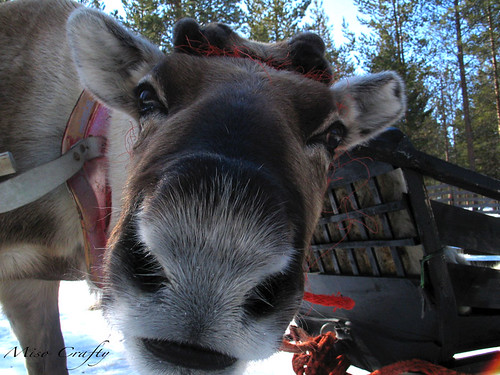
Reindeer are perfectly adapted for the icy cold and scarce resources of the tundra. Their nostrils have more surface area than the noses of most mammals, so any frigid air is heated by the creature's body before it reaches the lungs. Their hooves becomes spongy in the summer and tighten up in the winter, allowing for a great grip at both extreme temperatures. They will eat virtually any plants they come across, including lichen in winter and acid trip mushrooms. Of course, their fur also changes seasonally...but that certainly is not unique to reindeer.

That nose helps keeps reindeer from inhaling cold air. No, it isn't red.


Unlike most deer, both sexes of reindeer grow antlers. This is why the sexes of Santa's reindeer can be so hard to pin down; if you've ever wondered why a reindeer named "Vixen" (a female name) had antlers, wonder no more - it's totally possible! The exact type of antlers often vary by subspecies, but the rule of thumb is that the farther north you go, the spindlier the antlers get.

There are a few other differences between northern and southern reindeer.  Northern reindeer tend to have whiter coats and smaller size overall. One type from Svalbard Island does not get over 200 pounds - that's small for something usually considered a giant ungulate! Domesticated reindeer are shorter and heavier than wild reindeer on the whole, which makes one wonder how Santa's tame deer can fly. Oh, riiight...holiday magic.

Strangest of all, reindeer are thought to be the only mammals capable of seeing ultraviolet light.  Although an arctic landscape may look super plain to us, things on said landscape stand out in ultraviolet light. Urine, for example, is easily visible in UV. Combine this with the relatively low light for a good chunk of the year, and BAM! Suddenly you get a mammal that can see trippy colors.Nobody knows how the reindeer are not blinded by the ultraviolet light, but we're always looking for clever gene splicing potential. Here's to looking at the sun without being blinded!