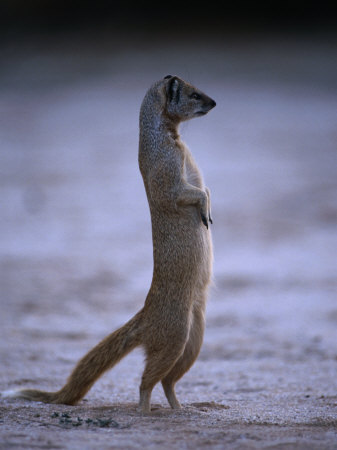
So I'm in Hawaii, right now. There is flora and fauna that I've never seen anywhere else everywhere. Oh, and I've also caught a few glimpses of a species that one does not expect to see in Hawaii: the mongoose.
How did I not do the mongoose before? Mongooses are weird little carnivores that are related to civets and hyenas- yeah, picture that family reunion for a sec. Like hyenas, they are more closely related to cats than dogs. Even the names "mongoose" and "ichneumon" are weird. Although the Indian grey mongoose is the most well-known, there are some 33-odd species of mongooses, including the meerkat- which I did cover a very long time ago. Mongoose species are native to Africa and southern Eurasia, including India.
Like the honey badger, the mongoose is a badass. Its greatest achievement is taking down cobras. Mongooses are so well-known for this that Rudyard Kipling, the author of the Jungle Book (and the white man's burden) wrote "Rikki -Tikki-Tavi," an adorable little story about a mongoose saving a family of humans from a family of cobras. Seeing as mongooses are cute, fuzzy little things and cobras are cobras, it's obvious whom the audience will root for.
There's a bit of conflicting evidence about whether mongooses are technically immune to cobra venom or not. Almost everybody will cite that the mongoose has a thicker hide than most fuzzy animals. Most people will also cite a chemical immunity to at least part of a cobra's venom. Regardless, there's not much a snake can do against a mongoose. It's really not a fair match.
This snake-killing reputation has gone so far that researchers will consciously ignore everything else in order to sic a mongoose on snakes. There were efforts to curb the Okinawan habu, another venomous snake, by introducing the mongoose. Instead, it turned out that the two species were not even active at the same time, so the mongooses helped themselves to the native bird life. This incident was so famous that it remains a roadshow staple, and even got woven into Pokemon's Zangoose and Seviper. Y'know, even though it was an epic failure.
Speaking of epic fail, introducing a mongoose to an island for any reason is a bad idea 99% of the time. Even if your excuse is rodent or snake control, mongooses are versatile little buggers. They don't really look to kill snakes as much as honey badgers do; if there's easier prey, they'll take it. Although they can kill venomous snakes pretty easily, the same really goes for almost anything smaller than the mongoose. The Hawaiian o'-o', among other birds, fell prey to the mongoose because they had no defenses against any predators. They had originally been brought over to kill rats and other vermin, but screw that- those birds had nothing to protect them. It's like choosing from a pre-packaged steak or getting out there and shooting the cow yourself. Maybe people trying to control pests should think of things that way!
Thing is, Hawaii also has Stitch. Mongooses are pretty awesome, but Stitch is immune to everything but water. Game, set, match, mongoose.
[Unfortunately, I could not find an image of Stitch VS a mongoose. You'll have to use your imagination. ]
 |
| Source. |
How did I not do the mongoose before? Mongooses are weird little carnivores that are related to civets and hyenas- yeah, picture that family reunion for a sec. Like hyenas, they are more closely related to cats than dogs. Even the names "mongoose" and "ichneumon" are weird. Although the Indian grey mongoose is the most well-known, there are some 33-odd species of mongooses, including the meerkat- which I did cover a very long time ago. Mongoose species are native to Africa and southern Eurasia, including India.
Like the honey badger, the mongoose is a badass. Its greatest achievement is taking down cobras. Mongooses are so well-known for this that Rudyard Kipling, the author of the Jungle Book (and the white man's burden) wrote "Rikki -Tikki-Tavi," an adorable little story about a mongoose saving a family of humans from a family of cobras. Seeing as mongooses are cute, fuzzy little things and cobras are cobras, it's obvious whom the audience will root for.
 |
| Nom nom nom nom nom....bring the kiddies. |
There's a bit of conflicting evidence about whether mongooses are technically immune to cobra venom or not. Almost everybody will cite that the mongoose has a thicker hide than most fuzzy animals. Most people will also cite a chemical immunity to at least part of a cobra's venom. Regardless, there's not much a snake can do against a mongoose. It's really not a fair match.
This snake-killing reputation has gone so far that researchers will consciously ignore everything else in order to sic a mongoose on snakes. There were efforts to curb the Okinawan habu, another venomous snake, by introducing the mongoose. Instead, it turned out that the two species were not even active at the same time, so the mongooses helped themselves to the native bird life. This incident was so famous that it remains a roadshow staple, and even got woven into Pokemon's Zangoose and Seviper. Y'know, even though it was an epic failure.
 |
| Image cropped from a Bulbapedia scan. N.B.- Zangoose has Immunity, and an overall better stat spread than Seviper. Once again, this is not a fair match. |
Speaking of epic fail, introducing a mongoose to an island for any reason is a bad idea 99% of the time. Even if your excuse is rodent or snake control, mongooses are versatile little buggers. They don't really look to kill snakes as much as honey badgers do; if there's easier prey, they'll take it. Although they can kill venomous snakes pretty easily, the same really goes for almost anything smaller than the mongoose. The Hawaiian o'-o', among other birds, fell prey to the mongoose because they had no defenses against any predators. They had originally been brought over to kill rats and other vermin, but screw that- those birds had nothing to protect them. It's like choosing from a pre-packaged steak or getting out there and shooting the cow yourself. Maybe people trying to control pests should think of things that way!
Thing is, Hawaii also has Stitch. Mongooses are pretty awesome, but Stitch is immune to everything but water. Game, set, match, mongoose.
[Unfortunately, I could not find an image of Stitch VS a mongoose. You'll have to use your imagination. ]