Showing posts with label cnidaria. Show all posts

Sunday, November 25, 2012

Creature Feature: Frogspawn.

Corals are pretty strange as far as animals go. Supposedly they're alive and slightly poisonous, but a lot of people treat them like rocks anyways. They make jewelry out of coral, making it effectively the most macabre jewelry ingredient after bones and claws. There are, however, soft-bodied corals...and then there are corals like this:


This coral, Euphylla divisa, goes by the charming common name of "frogspawn." It's native to the Indo-Pacific and can be readily found in the aquarium trade. It's also called the Wall, Octopus, or Honey coral. They're pretty much living acid trips in terms of color possibilities. Y'know, as if crazy tentacles weren't enough to suggest drug use.

Just as a little refresher: Corals are usually made of thousands of teeny-tiny polyps. Said polyps live on the calcified remains of their ancestors. A single "head" of coral is also made up of genetically-identical individuals. It's as if that one church in the Czech Republic was made entirely out of the bones of one, cloned individual. That said, Corsola, you scary.

I live on the bodies of my dead brethren! :D


Frogspawn is still a stony coral, but it has exceptionally-large polyps. These polyps are bubbly, green things that resemble frog or fish eggs, hence the name. The main identifying trait, however, is that the polyp is bifurcated. This distinguishes it from a few other species, most notably grape coral (which has only one, unified tentacle as opposed to split).

There is some concern about over-collection from the wild. Frogspawn is a very common coral in the trade, so there's not much need to get a wild-snagged specimen. They take two years to propagate in the wild. Just make sure that 1) you know how to handle a reef tank and 2) you ask where the corals came from. No need to harm reef systems to look at a living work of art anymore.


Saturday, November 3, 2012

Blasphemy Week: Irukandji.

There is no better way to disprove "Jesus loves you" than to look at Australia. Kangaroos? They're smart enough to drown dogs. Speaking of dogs, dingoes- you know, the canids that eat babies - originated from the pet dogs brought over by Aborigines. See that koala? That'll kill you, too. Australia is the monster ballad of "HUMANS SHOULDN'T BE HERE," as if an island of venomous snakes was not bad enough. Oh, Australia has those, too, by the way.

So how do you choose one unholy terror in an island chock-full of demonic wildlife? You go a little bit outside the island and into the ocean. Then you die, because you didn't count on this thing giving you a tap on the shoulder:

Source.


That little jellyfish is called an Irukandji. It is found only in the waters of Northern Australia - y'know, as if the rest of the island wasn't trying to kill you already. There are several species in at least two different genera, meaning that those waters are a breeding ground for a number of unknown, lethal jellies. It eats fish, but incidentally, anything that touches it dies.

Yes, it really is that small- only 2.5 centimeters at the bell. Since this is a jellyfish we're talking about, it's also that invisible; you don't even see the thing coming. Its tentacles are finer than human hair and can get up to a meter long. Good luck detecting it. And, yes, it is also that venomous.

Source.


The Irukandji is officially the most venomous animal on the planet. Five minutes in, most humans (y'know, the ones without mongoose blood coursing through their veins) start feeling achy in the back, muscles, and generally all over, as well as sweating, anxiety, and other ill signs. If left untreated, it becomes a pain so excruciating that survivors tell doctors to kill them.  Even morphine fails to dull the pain this little jelly dishes out.

So we have a tiny little creature that is not only invisible, but also manages to encapsulate sadism so thoroughly that people beg for a merciful death. This creature was actually horrifying enough to make it into Franken Fran. Still think that there's a loving God? The jellyfish disagrees.

Wednesday, November 16, 2011

"They Actually Eat That:" Jellyfish.

Or, if you prefer,"I Actually Ate That: Jellyfish Salad."


Those brown stringy bits on top of diced cucumbers are none other than 100% genuine jellyfish. They came from an authentic Chinese restaurant near Chicago's Chinatown. They tasted all right - in short, like the dressing on the salad - and are easily the wiggliest thing I will ever try. Unless, of course, I manage to get my mitts on ikizurkuri...no, wait. Even then, these disembodied strips of cnidarian would out-wiggle a death-twitching fish.

The creepy thing is, even with all that wiggling, there was a good chance that the jellyfish I had was dried before it reached my plate. After looking around at recipes, it turns out that dried jellyfish is commonly found in Korean and Chinese marketplaces. The jellyfish are rehydrated before being cut into strips. So...wait a minute. I was eating zombie jellyfish

Besides jellyfish, common ingredients in a jellyfish salad include cucumber, dried prawns, and sesame. It is very easy to prepare and always served cold. One recipe usually serves 2-4 people depending on how much one intends to eat. That's a lot of re-soaked cnidarian.

Additional testimony confirms my thoughts about what it is actually like to eat jellyfish: Slimy, scrunchy, and just barely an animal. Jellyfish has a texture all its own. If some just so happens to find its way into your fish sticks, you'll know. Believe me, there is nothing like eating jellyfish. They are becoming more and more common, so expect this trend to catch on...

Peanut butter and jellyfish from Deep End Dining.


So, should you try jellyfish, if you get the chance? Sure. It's worth trying, and definitely fun to watch wiggle in your chopsticks. If you can find a place that has jellyfish, by all means dig in and try some cnidarian.

Thursday, September 29, 2011

Creature Feature: Upside-down Jellyfish.

Cnidarians, as creatures, are underrated. Sure, they don't have claws, teeth, or even spinal cords, but that does not make them any less fascinating than large predatory mammals. The only two biologically-immortal animals in existence are cnidarians. All those pretty fluorescent proteins used in labs come from jellyfish and anemones. A box jellyfish will kill you more quickly than a tiger. Hell, cnidarians even have a sort of agriculture.


Cassiopea jellyfish are also aptly called upside-down jellyfish. They are found in swamps and mudflats of hot, humid areas like Florida, Hawaii, and Southeast Asia. Instead of stinging like normal jellies, they secrete their venom into a mucous cloud above them; said fluid is extremely itchy to swim through. They are not born upside-down, but do eventually spend their lives as living, tentacled pancakes secreting itchy fluid into the water.

Upside-down jellyfish often have algae growing on their tentacles. Specifically, zooxanthellae, a type of protist algae (as opposed to stuff like cyanobacteria), take up residence in the jellies' tentacles, making them look more like flora than fauna. The algae get a more or less safe place while the jellyfish get food. They even get free water circulation from the Cassiopea's pulsating bell. It all works out.


Of course, some things take advantage of these jellies' unusual anatomy. Sea urchin crabs steal them and put them on their backs as goofy-looking, living protection. Loggerhead sea turtles and ocean sunfish love these jellies (they're probably whole foods!). Admittedly, when you look like a salad bar, you are asking to be food no matter how toxic you are.

Cnidarians: Is there anything they can't do? Yes, we're pretty sure they can do tentacle rape, too.

Thursday, February 10, 2011

Creature Feature: Box Jellyfish/Sea Wasp.

It stuns me that there has never been a horror flick about jellyfish. Their body structures are alien to humans, they have vicious stinging tentacles, and they either look somewhere between creepy and elegant or are darn near invisible in the ocean. As icing on the cake, many of them glow in the dark. Sounds like monster movie material to me.

Haha. If only nature cranked out a gargantuan, man-eating jellyfish for us to play with! The deadliest jellyfish in the world is nigh-invisible, and some of its relatives are tiny.


Chironex fleckeri, also called the sea wasp, is cited as the most lethal jellyfish in existence. Its tentacles contain enough venom to kill 60 adult humans; like everything else in Australia, it is out to kill you, and does a damn good job of it. A few others in the genus have nasty venom as well.


Box jellyfish in general are sophisticated cnidarians. As their name indicates, their bells are distinctly cuboid as opposed to being round and frilly like the bells on most jellies. They have a nervous system more complex than that of many jellyfish, and, despite lacking a central nervous system, eyes. These eyes pick up not only dark and light, but also color; box jellyfish were found to have a particular aversion to the color red, so red safety nets are common on Australian beaches. They may also 'sleep' at night, but nobody is sure about that.

When box jellyfish, namely the sea wasp and another, smaller cousin called the Irukandji, hit the beaches, humans are usually warned via large, friendly signs. Rightfully so; these jellies are very hard to see, and with cnidocyte-covered tentacles up to three meters long, few people dare swim. Those that do step into the water risk their lives.


Also a good warning against tentacle rape. Just sayin'.

A sting from a box jelly's tentacle can kill a person in up to three minutes. Of all things, the best immediate remedy is acetic acid - the same stuff that makes vinegar smell. This will not cure the deadly sting, but can keep a person alive until an antivenin is administered. Y'know, if they can get it in before those 3 minutes. Even then, whatever the jellyfish touched will never be the same again.


Tomorrow: It's an iguana! It's a chameleon! It's...WTF is it?

Saturday, February 5, 2011

Creature Feature: Lion's Mane Jellyfish.

Ladies and gentlemen, we have some disturbing news: The world is being overrun by jellyfish. Not just any jellyfish, either; slowly but surely, the largest jellyfish in the world is taking over the seas.


This jellyfish has been appropriately dubbed the "Lion's Mane Jellyfish" (Cyanea capillata) due to its large size and extra-long tentacles. The largest jellyfish bell has been recorded at 7.6 feet (2.3m) in diameter, and the same jellyfish's train of tentacles was 120 feet (36.5m) long. It is considered the longest known animal in the world.

Y'know, the world that it will soon take over. 


Lion's mane jellyfish have become more and more abundant as of late. Science blames a number of factors for the rise. Global warming and overfishing are among the likely reasons; with warmer waters and less competition for food, the Lion's mane jellyfish are taking over the sea, and therefore the world.

Before you say that this is something that only happens in the tropics, you are way off. These jellyfish have a cousin in Australia, but they themselves are cold water jellies. The largest recorded Lion's mane up there was found near Massachusetts. Nowhere exotic. Other blooms have been found near Spain, England, and the Mediterranean coast. They have been seen around Japan (surprise, surprise) and Hawaii as well. They are targeting places that superpredators do not get to; good thing their stings are not deadly.

That said, an encounter with one of these jelly's stinging tentacles still sucks.  Symptoms include temporary pain and localized redness. They can sting after they are dead, too, so this is one dead thing to not poke with a stick.

On the plus side...


...if we can somehow make peace with these cnidarians, we can have squishies, too.

Tomorrow: As if regular starfish were not weird enough. 

Saturday, October 30, 2010

Creature Feature: Brain Coral.

Nature loves repeating her designs. Take a look at some of the barren trees in the fall, then at some fan coral, and then at the veins in your hand. They all have a similar branched look. When you have a good design, you reuse it over and over again.

Sometimes, when nature reuses designs, it is creepy. It was creepy/awesome with celosia and it is creepy/awesome with coral:


The bane of zombies everywhere.

Brain coral (family Faviidae) is an animal, yes. Corals are cnidarians, just like anemones, jellyfish, Man-o'-Wars, and hydras. Corals in particular are classified as anthozoans -  literally, "flower-animals." They are closely related to sea anemones, and, like them, spend their entire lives in polyp form.


Brain corals in particular are nocturnal feeders. They extend their tentacles at night and feed on anything small passing by. One genus of brain coral, Favia, is semi-aggressive; it will sting other corals with its long tentacles during the night. If that does not sound like a Japanese porno comic to you, you clearly do not know how the Japanese do their porn.


This is your brain on drugs.

A whole head (yes, it is actually called that) of brain coral is formed out of thousands of clones of one individual. When brain corals die, their bodies become the corrugated, calcified structure that gives the coral its name. A single head can get up to two meters high and live for over 900 years. Mind, this is a colony of clones building on top of the dead bodies of their brethren.


Of course, when humans make houses out of bones, it's considered creepy. Hmph. Whippersnappers.

Monday, October 11, 2010

Creature Feature: Portuguese Man-O'-War.

Off the top of your head, how lethal is the ocean? Not only can you not drink from it, but a ton of nasty things are waiting to make a meal of you...or at least hurt you if you get too curious.

Then there's this thing. Or, rather, this colony of many things.


The Portuguese Man o' War (Physalia physalis) is not a jellyfish. It is, instead, a colony of small hydra-like polyps. Each of these creatures has a different role to play: some become tentacles, which can get up to 66 ft long; others become the digestive system; one big huge polyp makes the sail. Imagine if your brain, spleen, stomach and liver were all different, highly-specialized individuals. That is how the Man o' War lives.


The sail - that thing that looks like an inflatable pool toy up there - keeps the Man o' War floating. Unlike jellyfish, Man o' Wars have no way of propelling themselves through the water. The sail can be deflated and inflated at will, allowing some Man o' Wars to remain hidden beneath the surface. Screw those fake shark fins; the presence of even one Man o' War can close entire beaches.


You will be assimilated...fabulously.

Where there is one Man o' War, there are usually others. Since they are forced to go wherever the wind blows them, there tend to be giant swarms of deadly water balloons with potentially over 1,000 individuals. Sightings of said swarms used to be limited to warm waters, but, in recent years, they have been spotted as far north as Ireland.

The Man o' War, while not actively out to kill you, lets its (their?) meter-long tentacles dangle continuously beneath its sail. These are usually used to poison small shrimp and fish, but are dangerous to humans was well. The sting is usually just painful as hell with some welts to make your mistake visible to the world. If one is allergic or venom travels to the lymph nodes, however, the stings can be lethal. Deaths are rare, but the presence of even one bubble floating above the water's surface can still be cause for alarm.


Oh, and they can still sting after death.

The news isn't all bad. The Man o' War carries with it some smaller marine fish that are found almost nowhere else. Species such as the clownfish seek Man o' War tentacles as protection; they themselves are immune to cnidarian venom (as Finding Nemo so nicely demonstrates). The smaller fish might lure in larger fish for the Man o' War to eat, so they're all cool with having Nemo in their tentacles.


"I wanna eat him." "NO!"

Many things also use the Man o' War for food, weaponry, or both. Loggerhead turtles eat the Man o' War for breakfast; Glaucus sea slugs not only eat the things, but use the cnidocytes as their own weaponry. The blanket octopus steals Man o' War tentacles instead of using ink; aren't you happy that Cthulhu exists NOW?


Even the Japanese agree that Lovecraft was right.

Why are people still terrified? Because not everybody's a loggerhead sea turtle, Glaucus slug, blanket octopus or another creature that finds Man o' Wars (Men o' War?) tasty...

Tuesday, September 7, 2010

Creature Feature: Hydras.

The hydra is probably Greece's most notorious drakon. She (yes, she; nearly every Greek monster was female) fit the niche of 'impossible-to-kill dragon' very well. Her blood and footsteps were highly toxic. She could regenerate every head except the one immortal head in the center (which is why hydras based off of Greek lore always have an odd number of heads; I have heard anywhere from 3-9 as a starting point). That's right, zombie logic completely fails against this thing. Even Herakles/Hercules struggled with this one.


Greek dragons are JUST SNAKES, people. Also, for some reason, these heads look male.

She is also probably the most botched of any Greek monster; as the name would indicate, a hydra is a waterborne creature. The Greek hydra never breathed fire. Ever.


Is it really THAT much of a bitch to CGI acid instead? Seeing shit corrode can be just as awesome...

She did, however, loan her name to a tiny little cnidarian like so many other badass mythological monsters:


Real hydras are tiny, water-dwelling creatures in the genus Hydra. Hydras can be found in unpolluted, freshwater bodies of water in most temperate and tropical regions.

They are visible to the naked eye and resemble small, not-as-colorful anemones. They spend their entire lives in the sessile polyp stage -that is, they always look like little anemones and spend most of their lives in one spot. Basal disc, tube, tentacles. Simple as that. (Well, OK, do you REALLY want me to get into cellular differentiation specifics, here?)

Like the mythological hydra, these creatures have insane regenerative capabilities. They are just like planaria in that, if cut with a surgical knife or other sharp instrument, the two halves will form two fully functional individual hydras. In less-severe cases, the tissue regenerates whatever is needed. Apt name was apt.


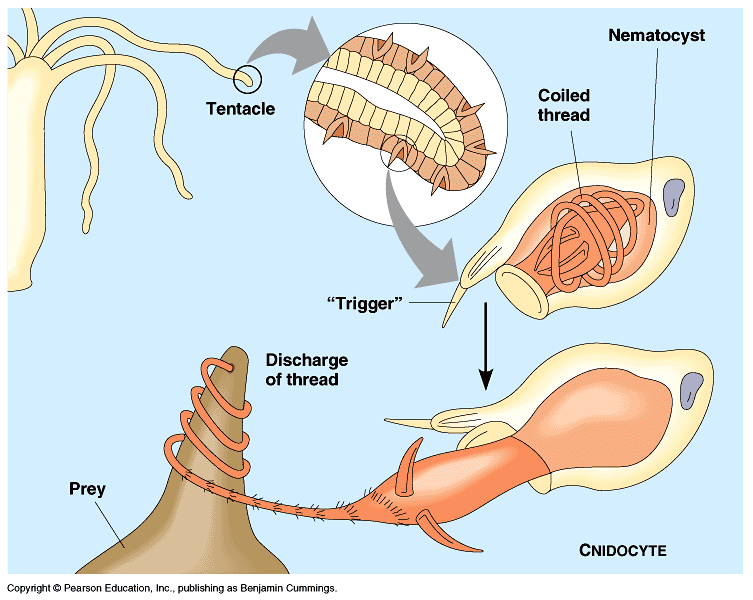
Hydras are also poisonous, albeit not to the degree of their mythological counterpart. Most cnidarians, including corals and jellyfish, have cnidocytes - hooked, venomous cells that paralyze whatever they are about to eat- in their tentacles. Hydras are harmless to humans; jellyfish are another story.

Some types of algae take advantage of the hydra's predatory nature and have formed symbiotic relationships; the hydra gets rid of stuff that would nibble them and the algae provide some supplementary energy.


Not sure if this is algae...but it is pretty.

Hydras never seem to age. Like the immortal jellyfish (another cnidarian), they are considered biologically immortal. All cells continually divide, making them hard to poison as well. If the situation with immortal jellyfish is any indicator, hydras may become capable of world domination.


This is how hydras reproduce. Perfect monster fodder.

They also have some interesting reproductive habits, but compared to ThursSaturday's animal, reproducing asexually and using sex as a last resort is hardly weird.

Monday, May 24, 2010

Creature Feature: Immortal Jellyfish.


For an immortal creature, it's quite demure-looking. Can I have an immortal Christmas ornament?

The title does not lie: There really is such a thing as an immortal jellyfish. Turritopsis nutricula does not know the meaning of 'die.' At any stage in its lifetime, it can revert back to its polyp form - the rough equivalent of a mature human becoming a baby again. This effectively makes it immortal.

How does it do this? Well, some creatures, such as salamanders, can regenerate parts via a process called "transdifferentiation." In laymen's terms, one type of non-stem cell becomes another. Usually, this process is irreversible and only occurs in one or two parts of the creature's body.

This jellyfish can reshuffle its whole life cycle. Some little critters without complex brains just flipped science the bird.

Despite the chance for immortality, many of these jellyfish do not live long, eternal lives. They are still susceptible to diseases and predation. They are, however, prolific enough to be overcrowding the oceans. No wonder there are so many Tentacool in Pokemon.

Now, I know these guys are not cephalopods, but this STILL merits an "IA CTHULHU!" or two. One of those jellyfish, mutated by radiation, waits in the R'lyeh dreaming. It's not dead, just sleeping.

Your days are numbered, chordates...

Friday, May 21, 2010

Creature Feature: Zebrafish...That GLOW?!


Just when you thought this blog was limited to natural stuff, along come these little fishies. If you know anything about GloFish, you know that they are genetically-engineered zebra danios, and are probably wondering why the hell these little Frankenfish are on a blog about the strange world around you.

Well, they certainly push the boundaries of one's imagination, do they not? Imagine putting these genes into other fish such as bettas, koi, goldfish, or angelfish. Better yet, even though the pigmentation rules are slightly different, wouldn't a glow-in-the-dark snake be sweet? The possibilities of this technology are limitless! (For those curious, science has already given us glowing mammals, but they are not available as pets.)
Pinky smash! Pinky fuel sweet rave parties with glowing body!


The neat part about GloFish is that, like yesterday's albino retic, they were spliced and bred primarily for aesthetics. Although the science was originally used to track pollutants, GloFish are now bred in large numbers and sold as pets. You will see a lot of stuff about glow-splicing being used for science, but how much do you want to bet that these people really just want to make things glow in the dark? Don't be shy; we can all relate!

For those of you thinking something along the lines of, "Oh, those silly Americans! When will they learn that freaks like these will harm the planet?" bear in mind that many, if not all, genetic experiments like GloFish are done in Asia. Americans are just one of the few nations selling them.

Also, look at how bright these things are! There is no way they could survive in the wild. If white tigers and albino animals have it hard, creatures that glow in the dark would have it doubly so. Invasive species worries aside, how could something naturally bioluminescent survive?

There are actually a few examples. Many creatures of the deepsea abyss possess some form of bioluminescence; the most widely-known is, of course, the anglerfish. The proteins used in GloFish and many other such creations use GFP (green fluorescence protein), which comes from the crystal jellyfish (Aequoria victoria and co.), or similar proteins from other sea-bound cnidarians.

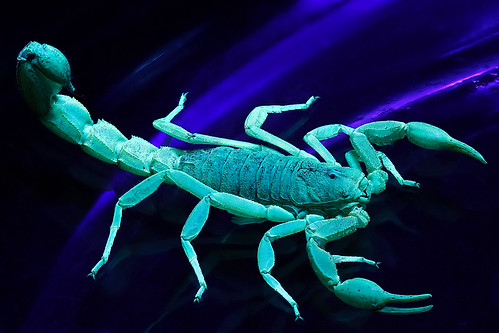
Fireflies are a good land-based example; their enzyme, luciferase (not related to Satan; know your Latin!) has been used to make a tobacco plant glow in the dark. Nearly all species of adult scorpion also glow under blacklight, making that purple bulb lighting up your psychedelic mushroom poster a valuable scorpion detector. Nobody really knows why they glow; thus far, the best explanation is some sort of natural sunblock left over from when scorpions were diurnal.

Or maybe Mother Nature was TRIPPIN' when designing scorpions. Who knows?

Eight legs, crablike pincers, a deadly sting...just for good measure, let's make it glow in the dark.

Drug trippers, take heed: Your visions of purple giraffes, neon snakes, and glowing koi will soon become reality...or would if GloFish were not copyrighted. Damn the big corporations for crushing my dreams!