Showing posts with label invasive. Show all posts

Tuesday, October 23, 2012

Creature Feature: Brown Tree Snake.

Ever wonder where some laws come from? There are whole webpages devoted to cataloging unique laws that make no sense in other countries.

There are also some crazy laws that don't make it past the House and Senate. Thank goodness HR669 was one of them. HR669 would, in short, have made it illegal to keep any "exotic" animal - even things as small and cute as parakeets and chinchillas. When you think about where the law came from, it makes a modicum of sense...but that doesn't mean it needs to apply to the rest of the world.

This law originated from Guam. In case that means nothing to you, Guam has a snake problem. A big, brown snake problem that has killed off 90% of Guam's native fauna. While someone from Guam has perfect reason to be afraid of snakes in particular, their brown tree snake situation is insane. Let me show you.

From NatGeo. Actually kinda cute.


This is a brown tree snake (Boiga irregularis). It's a slender colubrid (i.e. not a boa, python, elapid, or true viper) that can get around ten feet long in extreme cases. It actually looks really cool for something with such a mundane name, and has very mild venom. The brown tree snake is endemic to northern Australia, Papua New Guinea, and that general area.  It has also been naturalized on Guam...and this introduction is consequently proof that there is no God.

The snakes were not consciously brought to Guam. They hitchhiked in some wood on a military boat sometime after WWII (some places say 1948). From there, one gravid female hit the jackpot: her babies now had a supply of food that rarely happens in nature. How bad was it for the ecology on Guam? Let me express it in numbers.

There used to be 18 species of birds on Guam. Fifteen of those 18 species are extinct. All lizards save the (also invasive) house gecko have also been devoured. This was an island with almost no natural predators, let alone any defenses against venomous, Australian snakes. 

All species of endemic mammals on Guam are now functionally extinct if they are not outright gone. There were only three mammals endemic to Guam, and they were all bats. To a snake's mind, a bat is a cross between a bird and a mouse. Those three bats were definitely on the menu.


Oh, and forget Burmese pythons being man-eating monsters. Brown tree snakes have absolutely no fear of humans. The snakes cause power outages, of all things. Although there is absolutely no way that a brown tree snake could fit its mouth around a human infant, some have tried. This was not an accidental feeding error of any kind; these snakes fully, 100% intended to eat human children. There have been at least 11 cases of this between 1983 and 1993. That's more than the recorded amount of man-eating python incidents. Nothing is safe from brown tree snakes.

Before you suggest anything about stopping these snakes, it's too little, too late. Repeated introductions of mongoose onto snake-invaded islands have actually proven to hurt bird species more than snakes (I'll get into why when I cover habu- I've already done them as food). Guam is slowly becoming an island of the snakes. Since it's a transportation hub, however, it could easily spread to other islands like Okinawa...and apparently also Texas. Even with dogs sniffing the snakes out, it sounds like Guam itself is pretty screwed.

That's the thing about Guam's situation: It's the exception rather than the rule. Not every introduced species will flourish like this. The worst invasions are accidental introductions like this. Illegalizing the pet trade will not stop the problem. At least we know what we're shipping. You wanna stop Guam from happening again? Ban humans.

Saturday, August 18, 2012

Fun Video at the Shedd + Delay Notice.


This was awesome when I saw it. My favorite group of snake people took a trip to one of my favorite places in Chicago! Seriously, majorly cool that the Shedd got pimped. I love that place -not as much as the Field Museum, but still. Brian, you get to go such cool place. No matter how much work snake breeding is, things like behind-the-scenes trips to the Shedd must make it worthwhile.

You're probably wondering why a snake person wanted to go see a place more known for fish and dolphins than for reptiles. To be perfectly fair, snakes and fish tend to be lumped together in the "exotic" moshpit. They're both "tank pets" of sorts. Some, like the anaconda, spend a lot of time in the water. Even if herps aren't necessarily water-bound, it makes sense to find some at an aquarium.

By the way, the "invasive species" issue they touched upon really is awful. The Great Lakes have, so far, been invaded by a multitude of species, including Asian carp and zebra mussels. The invasion just so happens to be going down in the world's largest reservoir of fresh water. Have fun thinking about what that might mean for the supply of drinkable water.

Also, a different piece of news: I will be on a little bit of a vacation with my brother's side of the family from Sunday to Wednesday. During this time, entries may happen later than usual or not at all. At least one will probably happen during the trip.

Thursday, April 19, 2012

Creature Feature: Tiger Mosquito.

Y'know what's really ironic? Humans are so good at killing other species that there have been movies and anime series devoted to how humanity's recklessness will wreck the planet. We eat literally everything that is edible.We should be able to kill any species we want.

Yet we suck hard at killing invasive species. There are a number of reasons for this. Sometimes, we introduce extremely fertile species by accident through the pet trade. The main carrier for invasive freshwater species is, get this, ballast water - excess water that ships take in to adjust their weight, then dump as soon as they hit port. Invasive species can get in anywhere and establish themselves thanks to the globalization of humanity...and we can't do a thing to stop them.

So when we introduce a non-native mosquito? Shoooot, we already have problems killing the bastards.


The Asian tiger mosquito (Aedes albopictus) is actually pretty cool-looking for a death bug. It's native to the tropical areas of Southeast Asia. If you don't already know what a female mosquito eats, I feel sorry for you...and envy your location in a mosquito-free area. They're pretty much vampires.

The strangest thing is how these mosquitoes got here: via an international trade in used tires. Stagnant water had gathered in the tires at tire dumps, allowing mosquitoes to lay their eggs in a completely undisturbed environment. The larvae then got shipped to 28 countries around the world, including the United States, Australia, and the Middle East. Unlike most tropical species that only stick to hot, humid regions, these mosquitoes are able to handle cooler, dryer environments as well. We're frightened, and we haven't even gotten to the bad news yet.

The really bad news? Name a disease and these guys probably carry it. West Nile, yellow fever, and even heartworm in dogs and cats are all carried by the Asian tiger mosquito. The only good news is that, obviously, it can't carry things that don't use a mosquito as a vector (so no AIDS or cancer). Let us remind you that we suck at getting rid of these things, not for not trying.


It's ironic. We're so good at wiping out species that human-driven extinction is touted as being way faster than any other extinction event in Earth's history, and yet we fail at eradicating specific species, even if we put our minds to it. It's like the tiger mosquito, Asian carp, Burmese python, and bunnies are all laughing at us. If there is a God, it sure as hell has a weird sense of humor.

Sunday, April 8, 2012

Creature Feature: Australian Rabbits.

Hoppy Easter, everyone! Hope you all had lots of good times with your family, fun egg hunts, and, of course, candy!

Of course, bunnies aren't always fun. Wait, what?

Like The Birds, only with fluffy bunnies.
 

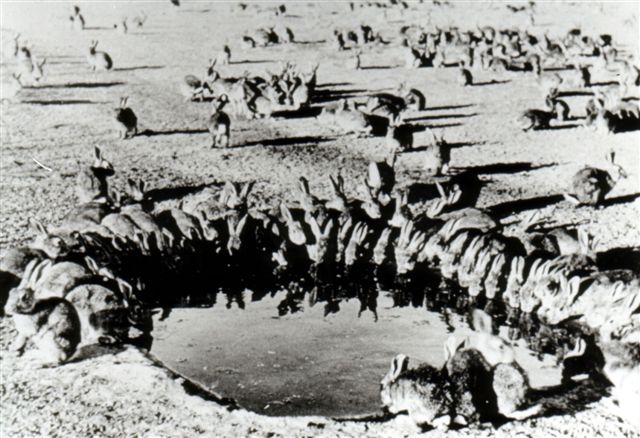
Australia has serious issues with invasive wildlife. Much of its ecosystem evolved in isolation from the rest of the world. So, when something prolific like a rabbit gets brought over by Europeans as a game animal on an island with plenty of resources, guess what happens?

Backing up a little, rabbits were brought to Australia by Europeans in the 1770's. In that day and age, colonists didn't particularly care that Australia had unique wildlife or indigenous people. They wanted to make everything in Australia as European as possible. That meant introducing rabbits as game animals.

Unfortunately, it is almost impossible to eradicate a population of rabbits. Some of the original 24 brought for hunting escaped and began running around Australia.  With no real natural predators and plenty of grass, the rabbits did what they do best: Eat, spread, and, most importantly, get it on. 

Disclaimer: Found on Photobucket. May or may not be in Australia.


Let's put it this way: In an ecological system not used to dealing with mid-sized mammals that reproduce, well, like rabbits, bunnies wreak havoc. They attack plants - the base of the food web in many cases - leading many local species to go hungry. Predators often aren't equipped to handle bunnies, either. Those feet and teeth can seriously hurt. Yes, we're still talking about rabbits.

With no predators and plenty of food, the rabbits spread from Victoria to New South Wales and into the rest of Western Australia. People tried to build fences in the 1990's to keep the bunnies out, but they had already crossed the line. What started as 24 rabbits in the 1700's had ballooned to 10 billion in the 1920's.

Silly humans, rabbits can't read!
 

The rabbits have been causing havoc in Australia ever since. They reduce native plant species by nibbling sprouts as soon as they bloom. They invaded the burrows of native species. There just aren't enough hunters to keep them at a stable level. Hell, bunnies are bacteria with spinal cords in terms of how versatile they are.

There have, of course, been attempts to stop the killer rabbits. The most successful of these has been a virus that specifically targets rabbits, causing them to develop mucus-filled lesions (myxomatosis). They die of hemorrhages and seizures within ten days. This virus, as with most things that target bacteria, eventually lost its effectiveness. Now the bunnies are on the rise again, ready to terrorize Australia with their cute, fluffy...yeah, it's hard to make rabbits sound intimidating. They're a big deal, OK?


So, when you open your chocolate rabbits (I know you have some left over), please think of Australia. Then go nuts biting that sugary rabbit's head off.

Saturday, February 25, 2012

Creature Feature: Burmese Python - Part 1.

Anybody watching this blog for more than a few weeks knows that I am a snake fanatic. So, of course, I have my own opinions about the latest update to the Lacey Act. As per the revision to the Act, one of the most popular snakes ever, the Burmese python (P. molurus bivittatus), is prohibited from crossing state lines. I personally think it sucks, but also see where the ban is coming from.

But this is not about me. This is about facts. It's about time I spilled the beans about one of my favorite snakes ever in as unbiased a manner as I possibly can.


Burmese pythons are the most notorious and popular giant pythons in existence. They are native to South-Southeast Asia. They can get up to 20 feet long, making them the largest subspecies of Indian python, and have more girth to them than retics. Burmese pythons are usually the go-to "big snake" due to their size and gentle temperament. When someone mentions the word "python," Burmese are the ones that usually come to mind.

If you have ever seen a giant snake on TV or in a photograph, there is a very high chance it was a Burmese python. (Interestingly, Harry Potter's Nagini is an exception; the last time I saw her, she was a retic.)  Burms are the giant snake of choice for many model shoots, TV shows, and art projects. They're big, but are mostly docile.  Unless you happen to smell like a rabbit or otherwise be very stupid, there is a slim chance that a Burmese python will bite you. The people who keep Burmese pythons usually love them to death. (Don't take that literally.)

Burmese pythons are usually the first big snake everyone gets. They may get up to 20 feet, but most stop at around 10-12, which is a bit more manageable. Retics have a (now mostly undeserved) reputation for being aggressive; anacondas are aggro and have hard husbandry requirements. Burmese pythons are easy to keep and, usually, as docile as kittens. Feed and breed them right and you might even be able to make a small profit off of them. If ball pythons are the general ideal pet snake, then Burmese pythons are the ideal big snake.

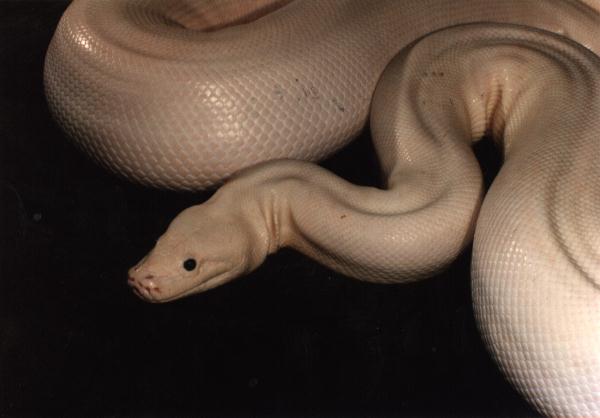
The leucistic Burmese - so rare it was once called mythical. Then it got proven to be the super form of a hypo. Yes, I know that's probably all Greek to you. It IS Greek.


Therein lies the problem: Many Burmese python owners are irresponsible in one way or another. If all of them kept their Burmese pythons in nice, custom-designed cages, or even secure sweater boxes, that would be great. This is one of those cases where irresponsibility can cost you dearly. Here are the top three reasons why Burmese pythons - snakes that deserve at least as much respect as any large dog or wildcat - tend to wind up with bad owners.

1. People simply don't do their homework. Burmese python babies are adorable, somewhat cheap, and overall a tempting impulse buy. That mouse-eating baby will grow up into a 10-12 foot serpent that can easily swallow a chicken whole. People who do not know crap about Burmese pythons usually wind up either giving their pets to a zoo/rescue or just plain releasing them. Bad situation.

Well, the author thinks they're cute...


2. There is also the simple case of biting off more than one can chew. Some people may know how big Burmese pythons get, but might not be able to take care of them in the long run. Big snakes make big messes, need big cages, and eat big food. How many people do you suppose can afford that for 20-25 years? I have asked people who either have Burms or know about their husbandry; they are costly to keep (especially if you go all-out) and require two people to handle safely. In other words, you will probably have to find a snake-tolerant roommate/lover if you intend to handle big snakes.

3. Sellers of Burmese pythons know full well that they are selling monster snakes, and fail to ask whether the customer knows how big Burms get in hopes of making a sale. Some people can start off just fine with Burmese pythons; others, not so much. A responsible snake owner should at least ask about husbandry requirements unless they have had that same species before. "How big does it get?" should be the next question.

Put it this way: If you do not know your stuff before getting a Burmese python, there is a very good chance your house will be on the news. Escaped snakes get ratings. Burmese pythons have been known to eat neighborhood pets. In one recent instance, a Burm killed the owner's daughter because the owner had a blanket as a cover on the cage. Burmese pythons can be awesome snakes, but you really have to know what you're doing. Ill-aimed bites from these snakes can lead to stitches.

Recently, Burmese pythons have been spotted in the Florida Everglades. This was largely due to a hurricane causing mass-escapes of Burmese pythons from personal collections. (Read: Not ALL of theme were released deliberately.) There, Burms have been not only eating wildlife in an already-fragile ecosystem, but have also been completing with alligators as the apex predator. Florida has all the reason in the world to ban the Burmese python. Here's a quick rundown as to why:

1. Burmese pythons compete for prey with native American alligators. Since alligators are among the most popular residents of Florida, not to mention part of the fragile Everglades ecosystem, any threat to their well-being is taken seriously.

The classic "exploding snake" pic, illustrating the point quite nicely.


2. Burmese pythons have an extra edge over alligators: They can very easily outbreed them. A Burmese python clutch can contain over 80 eggs. In nature, the ones who breed the most usually survive, so there is a very high chance that we will be seeing a lot of pythons. Sorry, the 'gator will probably lose.

3. See the ways that Burmese pythons can get out or otherwise be troublesome up above. No offense to all of you responsible keepers, but some not-so-hardcore snake lovers just want a big python because it's cool.

4. The reptile breeders kiiiinda brought this one upon themselves by having one of the largest reptile conventions in Florida. To be fair, Southern states tend to have extremely loose pet laws, so both parties are to blame.

But wait, the Lacey Act covers rest of the country, too. Isn't that a little harsh? Yes and no. My Environmental Sustainability teacher had a good explanation as to why the Burm got the Lacey Axe.

A caraBurm!


First of all, yes, Burmese Pythons could probably only survive in Florida. It just so happens that Florida has the perfect environment for them - hot and humid, just like Southeast Asia. I have heard some horror stories about Burms possibly making their way north due to either hibernation capabilities or global warming, but those are both more or less speculation. I have heard studies going either way. For now, treat it as mostly Florida's problem.

Even after the Lacey Axe, it would still theoretically be possible to smuggle a Burmese python from another state  into Florida. I have heard something about all Burmese pythons in Florida needing to be registered, otherwise the owner will be in big trouble. I would imagine that, if any Burms escaped in Florida, things would also get pretty hairy for that person. Avoid Florida like the plague, Burm fans.

Python owners believe that the update to the Lacey Act will be the end of the reptile trade as we know it. That is not true. You will still be allowed to keep your snakes. You will definitely still be allowed to trade within your state. Even if you do try to trade in other states, this act is all but impossible to enforce with snakes (as opposed to large mammals, which require huge trucks for transport).  The only thing it is really stopping you from doing business is sending Burmese pythons through the mail. Will it cripple the trade? Sure. Stop it? Certainly not. Still a waste of taxpayer dollars? Most likely.

Reptile keepers have the deck stacked against them when it comes to legislation. A lot of people fear snakes.  Every time a giant snake owner screws up, it makes the responsible owners look even worse. That is what leads to legislation like this. Education is key.

As for my personal thoughts on the Lacey Axe? Yes, the ban sucks, but there are worse bills out there. Worry more about the government tracking your every waking move and probably some sleeping moves, too. It will be a lot easier for them to catch you with giant snakes if they have cameras everywhere. The giant snake laws are just a distraction. Nowhere in the Constitution does it mention giant snakes. Worry about things like free speech first.

(Mmm...still so much I wanted to add.) 

Friday, February 10, 2012

Creature Feature: Asian Carp.

Hoo boy. This entry's a doozie; it combines one of my civic engagement projects with this blog. You guys are getting a sneak preview of a presentation that will occur on Feb 16th in my Environmental Sustainability course. Consider this studying, for I will be using terms that I have learned in the course!

By sheer luck of the draw, my group project for this course wound up being one of my favorite topics: invasive species.  Yes, many of us are mad about the Burmese Python being effectively banned. However, another invasive species has made itself even more worthy of government attention.


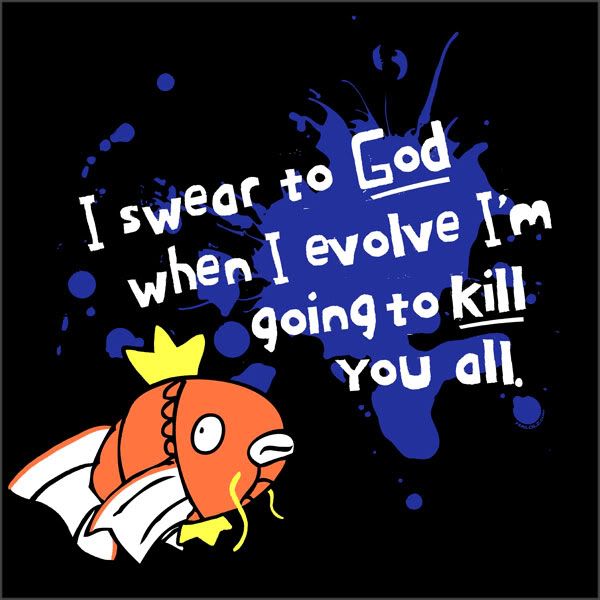
Yes, that is a carp. No, it will not evolve into Gyarados at Level 20. The seven species of "Asian carp" (there are a LOT of carp species, don't make me list them all) are proving to be quite the troublemakers all across the U.S. The main three are the bighead carp (Hypophthalmichthys nobilis), silver carp (Hypophthalmichthys molitrix), and black carp (Mylopharyngodon piceus).  The grass carp (Ctenopharyngodon idella) has also been found, but it is uncertain if they are reproducing. Also, their Splash attack is far from useless.

The Asian carp first came as a means of cleaning catfish farms down south. Unfortunately, when the Mississippi flooded over, the carp spread to other waterways...and ran (swam?) rampant throughout the U.S. This time, the pet trade is not solely to blame, but it certainly does not help that some Asian cultures consider releasing carp a way of bringing good fortune.

But these are carp. Carp. One of the most basic fish in the world. What harm can carp do?

From Sandusky Register.


Actually, carp can be quite damaging. They eat plankton - stuff at the bottom of the food chain. Anyone who knows about the food web or food chains knows that the small things at the bottom are the ones we have to worry about. Plankton are photosynthetic, which means that a lot of things eat them. They cannot endure the strain of native species and these new carp.

On a purely human level, these carp are dangerous. Every time a boat passes by, they jump out of the water en masse. They can weigh up to 110 pounds. No, they have not killed anybody yet, but it's only a matter of time. Murderkarp will become a reality.

No need to wait, actually.


The Asian carp are now trying to get into Chicago and the Great Lakes ecosystem. Holy carp! What are we to do?

There are already a few projects underway to stop the carp. One of them involves an electric barrier. A few more recent ideas by the "Carp Czar" (yes, that is an official title; it currently belongs to one John Goss) suggest poisoning and genetic engineering. My personal favorite, however, is the idea of eating the carp. A lot of the fish in the sea are harvested unsustainably, and how many people really question what kind of fish is in fish sticks? (It's usually pollock, by the way.) Carp goes for about 4 bucks a pound, and if you advertise that the fish sticks are environmentally-friendly and/or locally-farmed, that is sure to attract buyers. Plus, hey, shooting carp is an extreme sport:


Probably the first and last time you will ever hear carp to rock music.

Friday, August 19, 2011

Creature Feature: Zebra Mussels.

All too often, this blog will feature something awesome and cool that is going extinct. The rarest, most beautiful things in nature tend to be the things that humans wipe out.

This post will be different. You are invited to kill today's creature in any way you like.


Ladies and gentlemen, meet the zebra mussel (Dreissena polymorpha). Zebra mussels are small bivalves no larger than two inches in length, native to the Caspian and Black Seas in Eurasia. Although unremarkable to look at, here in Chicago, they are quite common...and shouldn't be. Go back to Russia!

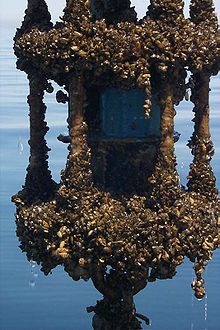
Much like the Japanese beetles, zebra mussels are a problematic invasive species. They arrive on boat hulls and spawn quickly, easily encrusting pipes and anything else their microscopic larvae happen to land on. They have not only taken over the Great Lakes, but have also been sighted in Britain, France, Ireland, Italy, Spain, the Netherlands, the Czech Republic, and Sweden. Soon they will take over the world and there will not be much that we can do about it.
In Soviet Russia, mussel eats you.


Zebras mussels hurt ecosystems primarily by replacing existing mussel species. They spawn easily and quickly with fresh additions to the gene pool from passing ships. This strips native species of resources and leaves too much food for predators of said native species to handle. They're like new neighbors who play loud music at night, no matter how many people yell at them.

Putting the fishes aside for now, the zebra mussels get into human equipment. They encrust boats, docks, power plants, and anything else that touches their lake. Water purification plants are hit particularly hard, with the estimated damages in Britain being over 500,000 pounds. You don't need a currency converter to know that's a lot of damage.

No, they don't EAT metal, just make it unusable.


Crush them. Eat them. Set them on fire. We don't hate them, but they really shouldn't be in these ecosystems! The good news is that they are slowly being overridden by the quagga mussel...

...wait, that isn't good news!