Showing posts with label russia. Show all posts

Tuesday, March 19, 2013

Creature Feature: Florida Sandhill Crane.

We sometimes envy people who grew up in the country. Yes, the poor education and sparse ukiie of technology would tend to suck, but there is usually a lot of nature out there. Florida is extremely blessed to have these guys:


Florida is home to a population of sandhill cranes (Grus canadensis). They range from the United States to Siberia, of all places. They are opportunistic eaters, and will pick on corn as well as small creatures. Some are migratory; others are not.

Sandhill cranes are usually a sight to behold, even if the adult plumage seems rather drab at first. A red patch of skin on the head makes the bird stand out. They are also amazing gliders, and enjoy riding thermals - updrafts of hot air - just as well as eagles and hawks do. The migratory sandhills gather in Bosque del Apache Wildlife Reserve in New Mexico; come in winter to see 10,000 or more cranes in one place!

Interestingly, sandhill cranes are intimately connected with the dinosaurs of old. They are almost living fossils, possessing the longest fossil record of any known bird species. The record goes back 2.5 million years. They also go into the karate "crane" pose, which looks an awful lot like an irate Velociraptor. And you thought Universal Studios was the only place they existed.

Although sandhill cranes in general are not endangered, there are a few subspecies that make the list and have conservation programs accordingly. As non-migratory birds, they are threatened by hunting and habitat loss. Killing a sandhill in Florida rakes up a hefty fine. Breeding programs exist, and should provide a bright future for this amazing bird.

Sunday, October 21, 2012

Creature Feature: Spotted Seal.

This blog has a lack of pinnipeds for no apparent reason.  Plus, I felt bad about delaying yesterday's entry, soooo....

Source.


...have a spotted seal. :)

The spotted seal (Phoca largha) is the quintessential 'seal.' It eats fish as an adult and smaller crustacean sas a pup. It is native to the north Pacific Ocean, including Japan, Russia, China, and Alaska.Althogh very similar to the harbor seal in appearance, the main distinguishing factor of the spotted seal is its irregular spots.

The spotted seal is one of those "puppy dog cute" animals. Excepting the carnivore teeth, this seal has no sharp parts. Sure, it weighs anywhere from 180-240 pounds and gets over two meters long, but that doesn't stop it from being adorable. It's even got a pointed face like a dog. What's not to like?

Source.


When they aren't swimming, spotted seals spend almost all their time on ice floes. They are usually solitary, but gather in huge crowds during mating season. They are among the few animals to temporarily exhibit a nuclear family (mom, dad, and baby) while rearing a pup. Otherwise, they are off on their own, diving up to 1,000 feet (300 meters) for their fishy prey.

Normally, the spotted seal is not endangered. It's so common that its There is an exception in China, where the seals from South Korea gather to breed. Not only are they China's only pinniped, but spotted seal meat and, umm, genitalia supposedly have medicinal properties. What? Were you expecting the Chinese not to eat seals?

Yes, that is a seal in a race car. OH JAPAN- copyright the folks at Digimon.


Of course,  since these seals are native to Japan, they have been Japanified. Japan takes anything remotely cute (or not) and turns it into colorful toys for all. The spotted seal, or gomafu azarashi,  is no exception; there are plushie spotted seals that one can hang from one's cell phone, a pet mamegoma video game, and other doses of KAWAII that overload most circuits. Most of us probably know Gomamon, the Digimon character, a lot better than anything else spotted seal-related from Japan. If it's weird and wonderful enough to wind up as part of the main cast in Digimon, it's weird enough to be on this blog, right?

Friday, January 20, 2012

Creature Feature: Ribbon Seal.

This blog does not get many pinnipeds. It's not that we don't like them, it's more like they simply are not the author's specialty. When something pinniped-related does get our attention, it usually requires a bit of research on our part.

Hi ma!


One woman in Seattle recently saw this seal resting on her dock. She snapped a photo of the strange-looking seal and sent it to her local wildlife commission. The district supervisor of the USDA in Washington, Matthew Cleland, correctly identified the animal as a ribbon seal - a seal found waaayyy farther north on a more regular basis.

Ribbon seals (Histriophoca fasciata) are usually seen in the Arctic regions of Alaska and Russia. Like most seals, they eat fish. They spend almost all of their time in open water, making them hard for naturalists to track. They only stop on ice for a few months to mate and give birth, so seeing one as far south as Washington is mind-blowing. Starbucks isn't that great.


These seals do not start life with their striking black and white patterning. Younger ribbon seals look a lot like harp seals, a species commonly hunted for their fur. This led to many seal pups being killed as if they were harp seals - that is, until people thought it fishy that a harp seal would be swimming solo. The hunting of ribbon seals was banned in Russia in 1969. Only adult seals are confused for mammalian penguins.

This appearance in Washington is not the first time ribbon seals have decided to take vacations. One male wandered all the way down to California. The seal was found at Morrow Bay, a small town north of Los Angeles. Although it was taken to a local aquarium, it died a month later. Sightings as far south as the continental U.S. are not unheard of, but still very rare.

Ribbon seals are currently in the purgatory called "Vulnerable." Something can only be considered endangered once we know how many individuals are out there.We know that the Alaskan population numbers around 250,000 individuals, but, even with hunting restricted, global climate change may present another threat. Even if these seals aren't quite endangered,they my fall there very, very soon.

Wednesday, December 21, 2011

"They Actually Eat That:" Reindeer.

This is one "They Actually Eat That" that should not be. Nobody should be surprised that people can and do eat reindeer. They're just a different sort of artiodactyl herbivore, and we eat plenty of those. Absolutely nobody should be shocked that some people living up north have found ways to eat reindeer.


Reindeer have been hunted by humans for a long time.  We are talking since the Neolithic (i.e. New Stone Age) at least. Scandanavian, North American, and Russian hunters have been the main predators of reindeer since humans moved up into the cold climates from Africa (why, I still don't know). There are certain sites in Norway being designated as national monuments for their ancient reindeer traps. Hell, people in Quebec even used to drink reindeer blood with liquor!


Then a can of reindeer meat makes it into a London store, and all hell breaks loose with animal rights activists. This farmed reindeer pate is marketed as a Christmas delicacy and a "Farm-raised relative of Rudolph." British PETA argues that reindeer get very, very stressed on farms, and thus should not be made into pate. Reindeer herders are usually nomadic, true, but one would think that ages of handling reindeer would have taught us a thing or two.

So let me ask these activists something: Do you object to regular venison on the same counts? Sure, meat is still meat, but something tells me that the positive connotation of reindeer has gotten to you. Reindeer have been bred by certain tribes for so long that they have words for "a male castrated reindeer" and other such concepts that could only come from a lot of exoperience handling these animals. We would not have words like "heifer" or "steer" if we had not domesticated cattle. Do we distinguish between neutered male deer and deer with full endowments? No. If your objection is anywhere, it should be with regular, normal venison. (And, out of curiosity, I broke my pescatarianism to try some genuine hunted venison. Good stuff.) Reindeer pulling sleighs is not just for Santa.


The people selling the reindeer steaks in London have the right idea: Reindeer is indeed a native dish of people in northern climates. Are we really so narrow-minded that we will prevent them from eating their traditional food while the British somehow manage to enjoy jellied eels? Different strokes for different folks. Santa probably makes reindeer sausage every time one of his magical flying deer dies because, umm, there's not much else to eat up there. Herbivores like reindeer are usually good eatin's.

If I didn't tell you this was reindeer, you probably wouldn't know.
 

Mind, actually eating reindeer is one thing. Alaskan shamans have, for a while now, noticed reindeer getting high off of Amanita mushrooms - a 'shroom toxic to humans. The shamans, however, figured out that reindeer are subject to the same rules as drug testing in humans - i.e. whatever was in those shrooms was probably in their urine as well. Sometimes, reindeer get the same idea and drink human urine for the exact same reason. This trip is where the idea of flying reindeer came from. Thank poisonous mushrooms for Santa's sleigh-deer!

Quick, catch him for drug dealing!


P.S. There will be more reindeer on Christmas. They're actually fascinating animals.

Friday, August 19, 2011

Creature Feature: Zebra Mussels.

All too often, this blog will feature something awesome and cool that is going extinct. The rarest, most beautiful things in nature tend to be the things that humans wipe out.

This post will be different. You are invited to kill today's creature in any way you like.


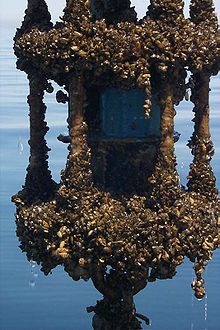
Ladies and gentlemen, meet the zebra mussel (Dreissena polymorpha). Zebra mussels are small bivalves no larger than two inches in length, native to the Caspian and Black Seas in Eurasia. Although unremarkable to look at, here in Chicago, they are quite common...and shouldn't be. Go back to Russia!

Much like the Japanese beetles, zebra mussels are a problematic invasive species. They arrive on boat hulls and spawn quickly, easily encrusting pipes and anything else their microscopic larvae happen to land on. They have not only taken over the Great Lakes, but have also been sighted in Britain, France, Ireland, Italy, Spain, the Netherlands, the Czech Republic, and Sweden. Soon they will take over the world and there will not be much that we can do about it.
In Soviet Russia, mussel eats you.


Zebras mussels hurt ecosystems primarily by replacing existing mussel species. They spawn easily and quickly with fresh additions to the gene pool from passing ships. This strips native species of resources and leaves too much food for predators of said native species to handle. They're like new neighbors who play loud music at night, no matter how many people yell at them.

Putting the fishes aside for now, the zebra mussels get into human equipment. They encrust boats, docks, power plants, and anything else that touches their lake. Water purification plants are hit particularly hard, with the estimated damages in Britain being over 500,000 pounds. You don't need a currency converter to know that's a lot of damage.

No, they don't EAT metal, just make it unusable.


Crush them. Eat them. Set them on fire. We don't hate them, but they really shouldn't be in these ecosystems! The good news is that they are slowly being overridden by the quagga mussel...

...wait, that isn't good news!

Sunday, October 17, 2010

Creature Feature: White Snailfish and the Egret Orchid.

So there was this post on CNN.com that a friend linked me to. He added "I don't know what you're going to do with this." I will grant that it does have a lot of the qualities I was talking about in my star-nosed mole entry - light coloration (if you don't use melanin, you lose it), small eyes, and an overall "weird" look.

After clicking around, I found that they were among the deepest-living fish in the world. Trust me, science, there is always something deeper. You will NEVER see how truly weird this world can get. EVER!

World's deepest living fish


VideoLife Uzerinden Izle

He was probably more referring to my monster-designing capabilities than this blog, but regardless, nature has beaten me to the punch this time:


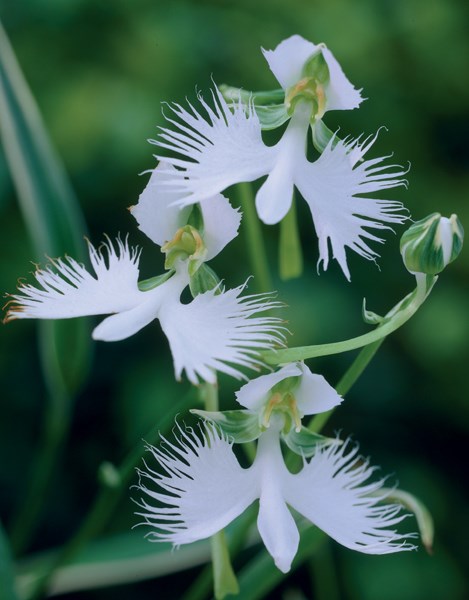
An abyssal fish...on land?! Actually, most people think that these look more like birds than fish. That's why it is commonly called the white egret orchid instead of Habenaria radiata (which does not have much to do with ANYTHING at first glance). They can be found in Japan, China, Korea and Russia, so there is really no good reason why they have not been made into Pokemon yet. They are also fairly easy to acquire from flower companies.

Now imagine if they could glow in the dark. Oooh.

(...Yeah, even though it's short, you can tell I wanted to do the egret flowers for a while.)