Showing posts with label arctic. Show all posts

Wednesday, May 29, 2013

Creature Feature: Greenland Shark.

Want an animal that could still be around 10,000 years after humanity? Sharks. Sharks are badasses that ate dinosaurs.  If we haven't dehydrated the planet, sharks will live, and they will always be associated with Jaws music in the back of our minds.


Enter the Greenland shark (Somniosus microcephalus). True to the name, it is native to the area around Greenland and Iceland. They are the largest species of dogfish and northernmost species of shark. Unlike most sharks that the general populace is aware of, these guys are probably primarily scavengers, picking on whatever carrion they can get. They also have live babies, just like boas and several other species of shark.

First of all, these sharks are huge. Jaws huge. They can grow up to 23 feet from head to tail and live around 200 years. Luckily for us, they swim only 1.6 miles per hour; a human can easily outdo that. If they did not have such derpy little mouths, we might be inclined to take them more seriously. Huge? Yes. Threatening? Hardly.


From: Fishindex.blogspot.com.

These sharks will eat any meat that fits in their goofy-looking mouths. Along with things that one might assume like seals and fish, Greenland sharks can eat reindeer and polar bears. Read that again: Reindeer and polar bears are on this thing's menu. Dear Hallmark: start marketing this thing on Christmas cards, because it's eating your mascots.

Did we mention that its flesh was poisonous? No? It is. The Greenland shark has an extremely high trimethyline oxide content in its skin. Sled dogs who eat the flesh won't die, but are unable to stand from the poison. In humans, the meat causes symptoms akin to high drunkenness. It tastes so much like piss that the folklore around the shark usually involves urine.

Wait a minute...what? Did I just say they actually ate that?

Saturday, April 27, 2013

Newsflash: Polar Bears Not As Threatened As We Thought?

Since global warming was made a thing by Al Gore, the polar bear has been its spokesperson. We were, well, not thrilled to see the polar bear put on the endangered species list, but kind of glad it got there so as to raise awareness of global climate change.

But are they really that threatened?


It sounds like a silly question. After all, the polar bear is an environmentalism mascot, just like pandas, tigers, and whales. They're one of those animals every zoo either has or tries to get because the species is going out of fashion in the natural world.

Then this tidbit came up on NPR. Recently, a writer went to the Arctic to write about polar bears. While there, he found an honest scientist who kindly showed him some polar bear droppings.The droppings revealed that the polar bear, which according to the interwebs has a diet consisting largely of seals, was also fond of goose meat and reindeer- Christmas dinner, if you will. (If we had more citations, we would give them.)

And yet, we cannot find this blurb on the internet. It made it to National Public Radio, but the surprisingly diverse diet of the polar bear has not yet crept onto the interwebs. Consider it crawling around, now. Treat it as a rumor if you like; it will get confirmed/debunked eventually.
The absence of this information on the internet baffles us, even when it shouldn't. Considering how many places say that the polar bear mainly eats seals, surely this would revolutionize something.

There are a few reasons why this hasn't gotten out, assuming its truth to begin with.  Facilities who have polar bears want to make them as big a draw as possible, which means making the bears sound rarer and more fragile than they actually are. Hell, zoos have a special "polar bear diet" that I'm pretty sure does not consist entirely of seal meat (Google it). There's something shady going on.

Don't get us wrong. The polar bear is still under legitimate threat from global warming. It's just not quite as bad as we thought.

Tuesday, May 29, 2012

Who's That Pokemon - Unova Edition: Cubchoo/Beartic.

Usually, I try to avoid doing the "usual suspects" on this blog. By "usual suspects," I mean animals that every tree-hugging organization and its grandma are pimping. This is limited almost entirely to large, carnivorous mammals (with the occasional giant herbivore), so it's pretty easy to think outside of the box. People already know most of those animals, so, wonderful though they may be, I tend to avoid them.


That said, it's really about time that this blog covered the inspiration for Cubchoo and Beartic: the polar bear.


Polar bears (Ursus maritimus) are giant, white bears that typically feed on seals, whale carcasses, and sometimes human garbage. Despite being born on land, they spend most of their time at sea, swimming and/or waiting for seals to poke their heads above water. They live only in the Arctic Circle, not the Antarctic, so any images you see of penguins and polar bears chillin' in the same place is completely fake. I'm looking at you, Coke.

American culture in particular has this weird dual stance when it comes to bears. On one hand, the bear - any bear - could rip your arm off with its claws, teeth, or both. On the other, awwwww, lookit those cute widdle ears and that fluffy-wuffy fur! And that little bobby tail! Never mind the hundreds of pounds of teeth, claws, and muscle. We find bears unbearably cute. By default, that makes them among the most marketable of the "usual suspects." (Pokemon actually addressed this side of bear-hugging in one anime episode featuring Teddiursa, but it's a minor point.)


Polar bears are the largest land carnivores period. They're twice as large as a Siberian tiger. Males are bigger than females, with the largest specimen weighing 1,002 kg - a little over 2,000 pounds in U.S. measurements. The paws can spread a foot from toe to toe in large adults. Did we mention that this bear has the most thoroughly carnivorous teeth of any bear? Watch this magnificent animal from a distance.

The polar bear is also warmer than your average bear.  Not only does it have a thick layer of fat like many animals that live in cold regions, but the bear has more fur than normal - even on the paws! The skin beneath the bear's translucent fur is actually black. No, I don't know what brave soul decided to shave a polar bear and find out what color the skin was for themselves, but they're probably missing a limb.


The polar bear is now officially on the "vulnerable" list, but may be too little, too late depending upon whom you ask. Oil drilling in Alaska, along with several other harmful environmental practices, is still perfectly legal. As one conservation group put it, "the bear's in the E.R., and they're just leaving it to die." Other people insist that the bear is in no danger at all. The polar bear's case is not something simple like "don't shoot the wolves" or "Chinese medicine kills tigers." There are a number of factors that will likely soon place the polar bear in the same situation as the scimitar-horned oryx: Only alive in captivity with an off-chance of being reintroduced to the wild. In the case of the polar bear, however, there will be no wild left for it to return to. Enjoy real-live Cubchoo like Knut while you can.


Friday, January 20, 2012

Creature Feature: Ribbon Seal.

This blog does not get many pinnipeds. It's not that we don't like them, it's more like they simply are not the author's specialty. When something pinniped-related does get our attention, it usually requires a bit of research on our part.

Hi ma!


One woman in Seattle recently saw this seal resting on her dock. She snapped a photo of the strange-looking seal and sent it to her local wildlife commission. The district supervisor of the USDA in Washington, Matthew Cleland, correctly identified the animal as a ribbon seal - a seal found waaayyy farther north on a more regular basis.

Ribbon seals (Histriophoca fasciata) are usually seen in the Arctic regions of Alaska and Russia. Like most seals, they eat fish. They spend almost all of their time in open water, making them hard for naturalists to track. They only stop on ice for a few months to mate and give birth, so seeing one as far south as Washington is mind-blowing. Starbucks isn't that great.


These seals do not start life with their striking black and white patterning. Younger ribbon seals look a lot like harp seals, a species commonly hunted for their fur. This led to many seal pups being killed as if they were harp seals - that is, until people thought it fishy that a harp seal would be swimming solo. The hunting of ribbon seals was banned in Russia in 1969. Only adult seals are confused for mammalian penguins.

This appearance in Washington is not the first time ribbon seals have decided to take vacations. One male wandered all the way down to California. The seal was found at Morrow Bay, a small town north of Los Angeles. Although it was taken to a local aquarium, it died a month later. Sightings as far south as the continental U.S. are not unheard of, but still very rare.

Ribbon seals are currently in the purgatory called "Vulnerable." Something can only be considered endangered once we know how many individuals are out there.We know that the Alaskan population numbers around 250,000 individuals, but, even with hunting restricted, global climate change may present another threat. Even if these seals aren't quite endangered,they my fall there very, very soon.

Sunday, January 9, 2011

Creature Feature: Narwhal.

Pretend that you're a person in medieval times. You're just headin' down to port, getting ready to buy some fish. On the way to your favorite fisherman, a strange item catches your eye:


Isn't that a horn from one of those magical white horses that the England put on its coat of arms? Heeeyyyy, wait a second! Unicorns don't exist...or do they?

If they do, they look FREAKY.


Nah, they don't. That twisted horn - actually a giant, ivory tooth akin to an elephant's tusk - belongs to an ocean-dwelling mammal called a narwhal (Monodon monoceros - lit. "one tooth, one horn"). As the name might indicate, they are related to other whales (particularly the beluga whale) and live in the Arctic waters year-round. They eat various things farther down on the marine food chain, sometimes diving down over 1,500 meters to get their lunch. Like the polar bear, they are somewhat threatened by global warming. (They are not officially recognized as endangered, however.)

Oh, and hunting.


The male narwhal's tusk (yes, usually only one) was quite valuable way back in the day. A unicorn's horn was said to have magical properties, curing poison among them; a single narwhal tusk could be sold for a very high price. Not realizing that a real horn should not have been made out of ivory, many people bought narwhal teeth, including Queen Elizabeth I. Nowadays, people know better, but the twist of a narwhal's tooth has stuck in many a unicorn image.


En garde!

Nobody really knows why male narwhals have these huge (2-3 meter long) tusks.  The most common assumption is that they evolved, like a lion's mane, to show a male's fitness, They also have some role in regulating social order. Yeeaaah, guys, don't get any ideas; these narwhals will outdo you in every way. Their ways to attract ladies get preserved in museums, even though the whale had to die in the process. There are also some lucky males that are endowed with two tusks; feel free to let your mind wander.

Narwhal hunting is still legal in moderation. The Inuit people have been hunting these ceteans for centuries for food. They eat every part of the narwhal, just like Plains natives consumed every part of the buffalo. Narwhal meat (for whatever reason) is the Inuit people's main source of vitamin C. Yes, apparently whales with unicorn tusks have a similar nutritional value to oranges.


A good source of vitamin C?


They also have a song.You're welcome.

Saturday, December 25, 2010

Creature Feature: Arctic Fox.

Merry Christmas, everyone! Ho ho ho and all that! Celebrate the season with Coca-Cola, even though it's available all year round and the company thinks that all cold-friendly animals live on the North Pole!


(They live, literally, on  opposite sides  of the world...but it's STILL SO CUTE!)

Ever notice how much hubbub there is around the polar bear? Sure, it is tragic to lose an apex predator to global warming, and global warming is more likely than not (only) our problem, but what about those other cool animals that live up North? They have all had to adapt to a cold, unforgiving environment. If you thought that humans having to deal with malaria in Africa sucked, try living in a place where the sun doesn't shine for a month.


Also, look at the marketing potential for this pretty critter! BEAUTIFUL!

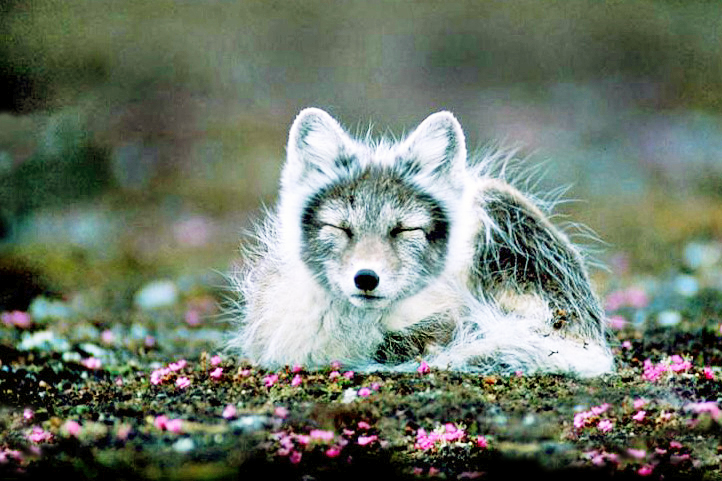
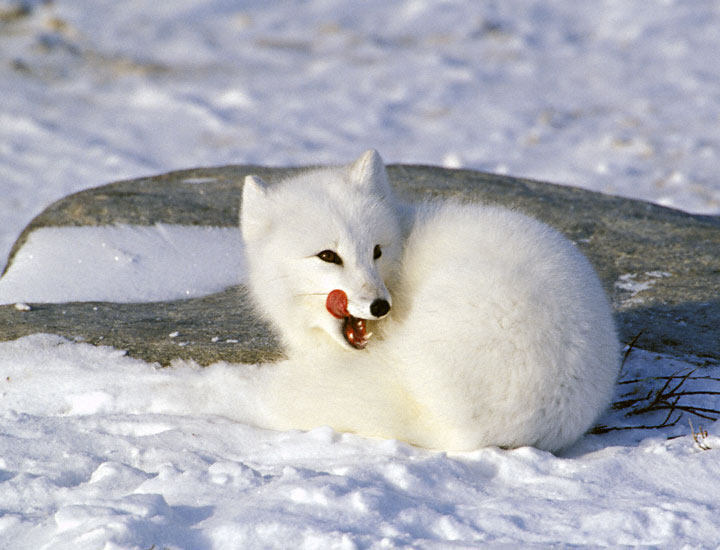
Amidst snow leopards, polar bears, and wolves, the Arctic Fox (Alopex lagopus) is often forgotten as a cold-weather predator. Given the rising population of foxes (which are almost all Reds - don't be fooled just because they're from Japan!), they should be getting more attention.

I know what you're thinking: "It's a fox and it's white. So what?"


It's not even white all the time.

"So what?" That's like saying "polar bears are just white bears." Arctic foxes have a number of other differences from normal foxes, such as body proportions (they're chubby) and large feet similar to those of snowshoe hares that keep them from sinking into the snow. They have extremely acute hearing that allows them to hear prey beneath the snow. These are foxes so well-adapted to the Arctic climate that they are the only land mammals native to Iceland.

Foxes are predators. Arctic Foxes will eat almost any mammals they can find, including snowshoe hares, as well as carrion and polar bear feces, but are especially fond of lemmings. They can eat dozens of lemmings every day. Disney did not need to kill off all the lemmings that they did; the foxes do a pretty good job. No fancy filmwork required.


NOM.

Like the polar bear, the Arctic Fox is slowly disappearing. Besides global warming affecting its habitat, the larger Red Fox has taken over some of its territory (thanks largely to the decreased wolf population). They are also all but gone from areas in which humans have settled. One subpopulation was nearly eradicated by a dog tick. Blah, blah, blah, humans suck and wiped out a perfectly good recessive trait. At least the endangered-ness is restricted to only a few select populations.

Thursday, June 24, 2010

Creature Feature: Lemmings.


A while back, there was a 7-Eleven radio commercial that went something like this: One lemming approaches another lemming with a cup of 7-Eleven's delicious coffee. They get into a conversation about how much better and cheaper 7-Eleven's coffee is VS gourmet coffee like Starbucks's and Caribou's. Lemming #1 asks why Lemming #2 is still buying the overpriced drinks. The answer?

"We're lemmings."

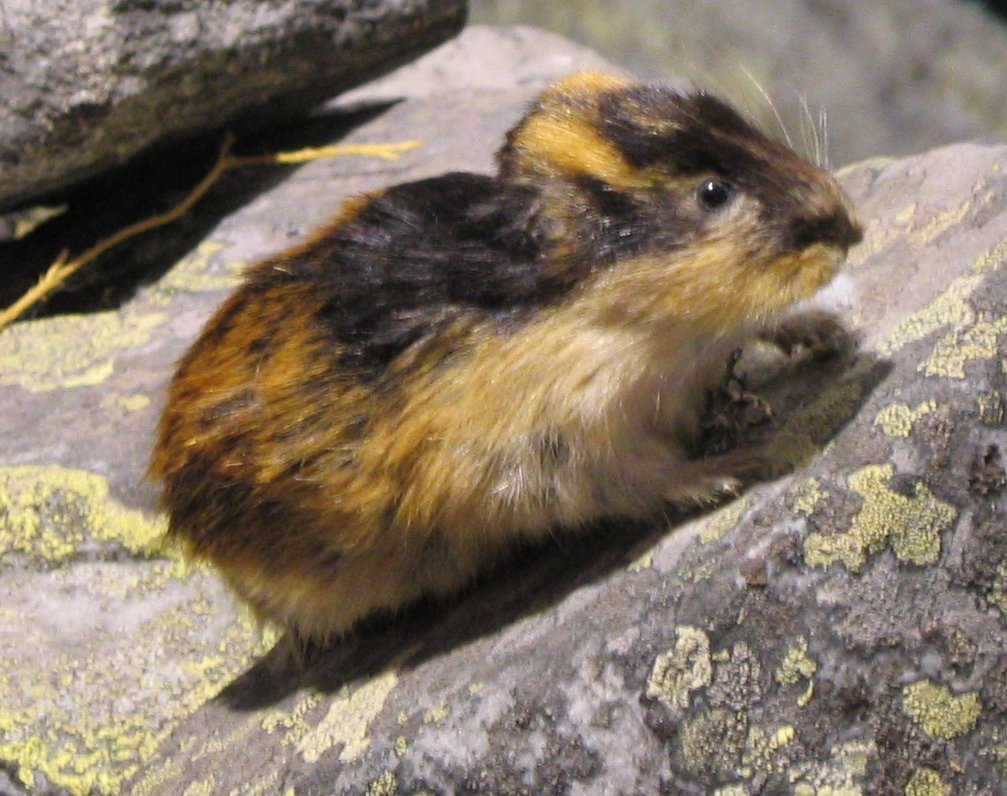
Luckily, I was aware of exactly what a lemming was and why it mattered in this situation. Lemmings (which comprise the whole tribe Lemmini) are rodents native to the northern tundra. They, along with ostriches, chameleons, and porcupines, have one of the most misrepresented and false reputations in the wild animal world.


3...2...1...D'AWW!

To call someone a 'lemming' implies that they are extreme conformists, and go with the flow so readily that they would literally jump off a cliff just to fit in. Here's the Urban Dictionary definition:

"A member of a crowd with no originality or voice of his own. One who speaks or repeats only what he has been told. A tool. A cretin.
"Ya think he'll do it?"
"He's a lemming, he'll do anything he's told."

This is largely thanks to White Wilderness, a documentary released in 1958 by Disney. Since the migration of little rodents living in the Arctic tundra apparently was not interesting enough, Disney filmed them 'jumping' (that is, being thrown) off of a cliff. Repeatedly. They do not commit suicide; a few stray lemmings may get knocked off en route, but this is definitely not intentional.

Disney also faked the whole 'mass migration' by filming only a handful of lemmings moving about in Alberta, Canada - an environment with no native lemmings, by the way.

There are a number of things wrong with the lemming myth outside of Disney's movie:

1. Why would a real creature commit suicide, let alone en masse? Sure, a few mythical creatures have shown suicidal tendencies (the Greek sphinx and supposedly the Persian simurgh among them), but in real life, the kamikaze gene feels out of place. Would we still have lemmings if they were all so suicidal?

2. Sheep would be more independent than lemmings according to the modern media. Sheep are herd animals. Rodents are not. Although lemmings do occasionally migrate, it would involve a LOT more than the dozen or so lemmings that Disney used.

3. Lemmings can swim. It's not exactly suicide if they're jumping off a cliff into the ocean. That would be more properly called an Olympic dive. Notice that all the lemmings in the film, despite being thrown off of a cliff by Disney filmmakers, are fairly cool with being thrown into the sea.


If this clip does not make lemmings sound like rodents BORN to be in a Linkin Park video, I don't know what does.

Stick with the classic sheep, an animal that does indeed move in herds and has a fairly compliant nature to begin with, as a way of insulting someone for following the crowd. Now, if you'll excuse me, I have some gourmet coffee to buy.